
Sober Support Without Rehab: How to Quit Drinking on Your Own Terms in 2026
Oct 16, 2026
What if the secret to quitting drinking isn't disappearing to an isolated facility, but learning how to thrive right inside your actual routine? If you dread stepping away from work and family for 30 days, feel alienated by sterile hospital environments, or are exhausted from quietly bargaining with wine every evening, you aren't alone. Finding empowering sober support without rehab is not only possible; it's how so many people take their power back. Sustainable change happens in real time, between morning commutes and dinner tables, not inside an artificial bubble.
You don't need an institutional badge or rigid dogma to break the cycle of starting over. In this guide, you'll discover proven, non-clinical ways to ditch alcohol permanently while keeping your everyday life completely intact. From practical daily coping strategies to finding a vibrant, judgment-free community of people who truly get it, here is how you build a life you don't want to numb on your own terms.
Key Takeaways
- Discover how structured sober support without rehab lets you ditch alcohol permanently while keeping your career, family life, and daily routines intact.
- Unpack the four core pillars of long-term non-clinical sobriety, focusing on personalized accountability, practical toolkits, and proactive mindset shifts.
- Compare inpatient clinical facilities with private lifestyle coaching so you can choose the recovery path that actually matches your lifestyle.
- Follow a step-by-step roadmap to reset your home environment, build dependable daily rituals, and handle sudden cravings with confidence.
- See how lived-experience mentorship and an uplifting peer community can dissolve the isolation of quitting drinking without clinical labels.
What Is Sober Support Without Rehab and Who Is It For?
Non-clinical sober support is structured, real-world guidance built directly into your normal day-to-day rhythm. Instead of pulling you out of your environment and dropping you into a clinical bubble, this approach focuses on behavior redesign, nervous system regulation, and emotional resilience right where you live. While severe physical dependence requires medical oversight, millions of people find that sustainable sobriety thrives through habit modification, personalized mentorship, and relatable community.
Most search results treat residential treatment centers as the only valid recovery path. Yet, the diagnostic spectrum for Alcohol Use Disorder ranges from mild to severe, meaning a one-size-fits-all clinical intervention leaves millions without relevant care. Choosing reliable sober support without rehab allows professionals, parents, and ambitious individuals to build an alcohol-free lifestyle without taking on an unwanted clinical label or putting life on pause.
The Reality of Gray Area Drinking in 2026
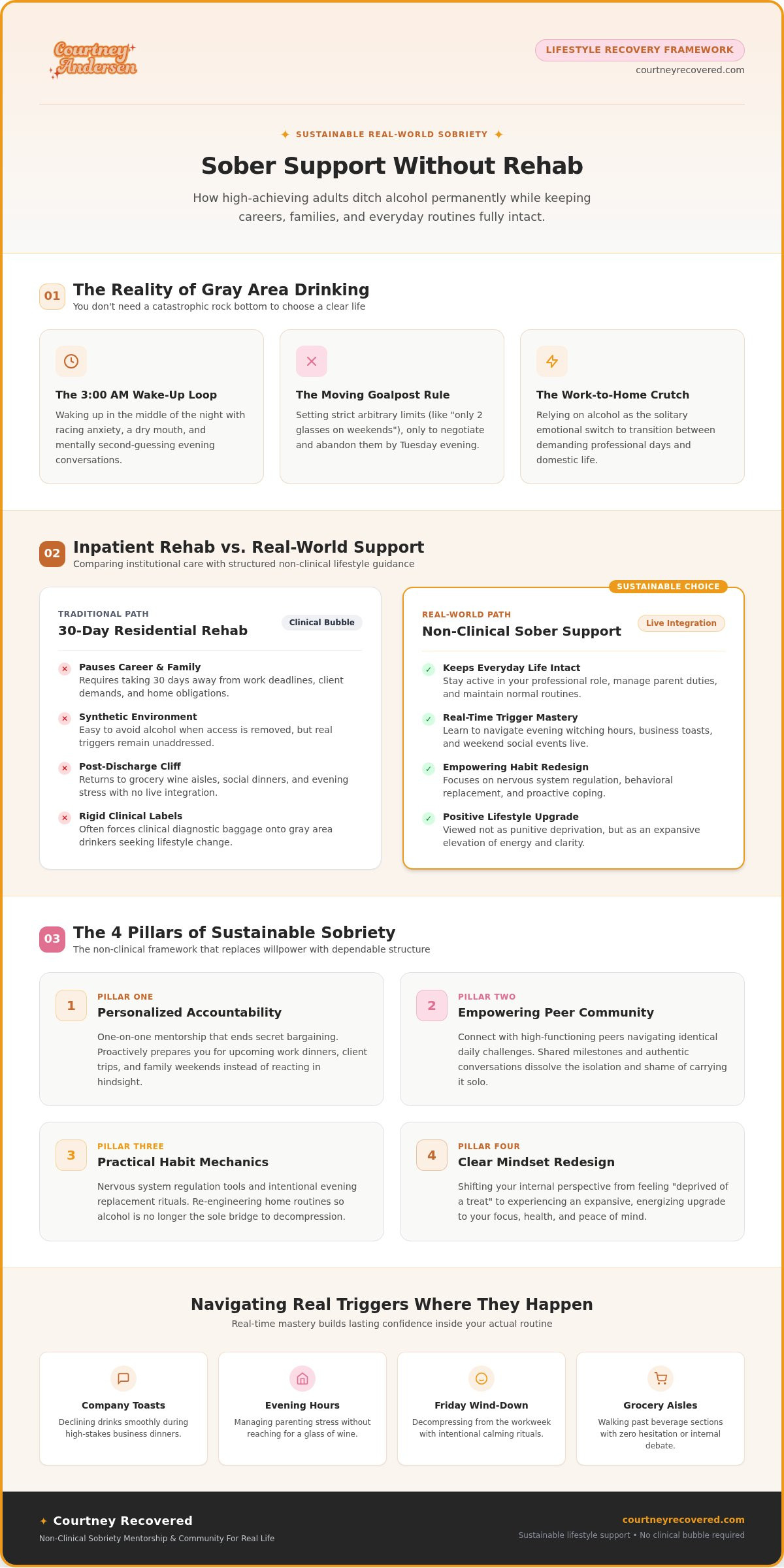
You don't need a catastrophic rock bottom to decide alcohol is no longer serving you. Many high-achieving adults operate in the middle space known as gray area drinking. You hold down a demanding job, pay your bills, and manage family commitments, but you spend exhausting amounts of mental energy negotiating your consumption.
Consider whether these patterns sound familiar:
- Setting strict limits, like "only two glasses on weekends," then abandoning them by Tuesday.
- Waking up at 3:00 AM with racing anxiety and a dry mouth, second-guessing your conversations.
- Using alcohol as your primary transition from stressful workdays to personal evenings.
You don't have to wait for your life to implode to earn help. Deciding you want clearer mornings, deeper sleep, and steady confidence is reason enough to seek support.
Why Pausing Life for 30 Days Is Not Feasible for Everyone
Checking into a 30-day residential facility simply isn't an option when you manage client deadlines, corporate teams, or young kids. Aside from significant privacy concerns, stepping away creates a synthetic environment. Inside a facility, avoiding drinks is straightforward because access is completely removed. Once you return to the grocery store wine aisle, kitchen stress, and social dinners, the old triggers are still there.
By leveraging real-world sober support without rehab, you confront your genuine triggers in real time. You learn to decline a toast at a company dinner, navigate evening witching hours with kids, and wind down on Friday nights without a drink in hand. Instead of feeling like a punitive consequence, this style of recovery becomes an active, empowering lifestyle upgrade that fits seamlessly into your actual life.
The 4 Pillars of Sustainable Non-Clinical Sobriety Support
Relying on sheer willpower alone is a fast track to burnout. Real transformation requires an intentional framework that supports you when motivation dips. When you choose sober support without rehab, your success rests on four interconnected pillars: individual accountability, empowering community, practical habit mechanics, and a clear mindset redesign. Research-backed tools from public health initiatives like Rethinking Drinking consistently show that behavioral modification and structured lifestyle adjustments create lasting results.
Instead of viewing sobriety as a permanent deprivation, these pillars reframe your journey as an expansive, positive upgrade to your energy, health, and peace of mind.
Personalized Accountability and Mentorship
Trying to stop drinking in secret keeps you trapped in the bargaining loop. Having a dedicated mentor gives you a direct line to someone who knows the terrain intimately. One-on-one accountability ensures you aren't passively reflecting on yesterday's choices; you are proactively preparing for tomorrow's work dinners and weekend getaways. Tailored feedback turns your unique lifestyle triggers into clear, manageable action steps.
Empowering Community Over Isolated Suffering
Isolation breeds self-doubt. Stepping into an active sober community online dissolves the heavy shame of carrying this challenge solo. Connecting with high-functioning peers who share your drive proves you don't have to sacrifice your social life to be alcohol-free. Celebrating wins with people on the exact same wavelength transforms sobriety from a private struggle into a vibrant, shared lifestyle.
Practical Habit Mechanics and Trigger Management
Willpower is a finite battery that empties by late afternoon. Long-term success demands repeatable rituals that replace the automatic reach for a glass. This means swapping the 5 PM transition drink with functional alcohol-free alternatives, soothing physical stress with breathwork or nervous-system regulation, and protecting your evening downtime.
Focusing on building a sobriety toolkit filled with reliable morning grounding routines and rapid-response craving tactics gives you calm control during chaotic moments. If you want structured support and proven roadmaps built for real life, explore the non-clinical coaching programs at Courtney Recovered.
Inpatient Rehab vs. Real-World Sobriety Support: Key Differences
Choosing how to step away from alcohol comes down to the environment you need to build momentum. Residential rehab removes you from your surroundings entirely, while traditional outpatient clinics require multiple scheduled visits to a medical facility each week. Private lifestyle coaching and community memberships integrate directly into your existing schedule. For high-functioning individuals who want total discretion, choosing sober support without rehab avoids clinical charts, workplace absences, and unwanted public labels.
Research published by the Public Health Institute shows that secular, cognitive-focused peer groups provide effective alternatives to AA and clinical regimens, producing comparable long-term success. Understanding how these paths differ lets you match your recovery to your daily reality.
Environment: Simulated Bubbles vs. Real-Life Triggers
Inpatient centers provide a controlled sanctuary, but that sanctuary vanishes the second you walk out the front doors. Navigating an argument with your spouse, ordering a beverage at a client dinner, or walking past your neighborhood liquor store requires muscles you cannot train in seclusion. Practicing sobriety inside your normal environment lets you unpack everyday stresses in real time, building resilience that lasts because it was forged in your actual living room.
Philosophy: Disease Labeling vs. Empowered Personal Growth
Institutional recovery often relies on deficit-based language, asking you to admit perpetual powerlessness over a lifelong condition. Non-clinical support flips that narrative entirely. Instead of treating sobriety as a grim penalty box, modern coaching frames an alcohol-free lifestyle as an elite personal upgrade. You aren't giving up your social life; you are reclaiming your baseline energy, sharp focus, deeper sleep, and emotional peace.
Crucial Safety Boundary: When Medical Detox Is Non-Negotiable
While lifestyle coaching transforms daily habits, medical detox remains essential for individuals experiencing severe physical dependency. Alcohol withdrawal can produce dangerous complications, including extreme tremors, dangerous blood pressure spikes, hallucinations, or seizures. If your body requires alcohol to prevent physical shaking or morning illness, you must complete medically supervised detoxification under a physician's care first.
Once you are physically safe and medically cleared, non-clinical sober support steps in to handle what comes next: reshaping your habits, regulating your nervous system, and rebuilding your social world.
How to Build Your At-Home Sobriety System in 5 Actionable Steps
Getting alcohol out of your life without checking into a facility requires more than crossing your fingers on Sunday night. You need an intentional ecosystem that works right where you live. By setting up real-world sober support without rehab, you protect your energy and take the guesswork out of daily decisions.
Here is your five-step roadmap to establish a reliable foundation at home starting today.
Step 1 & 2: Clear Your Environment and Secure Direct Accountability
Clean out your living space right away. Toss leftover bottles, ditch decorative wine racks, and store specialty cocktail glassware out of sight. Leaving alcohol within arm's reach forces you to burn precious mental energy saying no all evening. Once your home is cleared, write down a raw personal manifesto outlining why you are leaving alcohol behind and keep it on your phone for quick reference.
Next, bring someone into the loop. Secrecy keeps the bargaining loop alive. Partner with a dedicated coach or a trusted sober ally who expects a direct check-in every morning and evening. Texting someone "day complete" shifts your commitment from a private thought into public reality.
Step 3 & 4: Equip Your Daily Toolkit and Join a Peer Circle
Fill the 5 PM transition vacuum before it hits. Stock your fridge with premium tonic waters, adaptogen drinks, and sparkling botanicals so you have a tangible sensory reward after work. Feed your mind with empowering quit-lit like the Sober Vibes Book to replace old beliefs about alcohol with modern clarity. You can also explore practical roadmaps for life after getting sober to understand how your relationships and social habits will evolve for the better.
From there, plug into an active peer group. Having a circle of like-minded individuals means you always have a place to vent about tough days, celebrate milestones, and exchange non-alcoholic favorites without awkward explanations.
Step 5: Script Social Situations and Protect Your Boundaries
Walking into social functions unprepared creates panic. Memorize simple, breezy scripts before heading out: "I'm doing a wellness reset this month" or "I'm prioritizing my sleep right now." People rarely pry past a confident decline. For events during your first month, drive your own car so you can leave whenever your social battery drops. Reclaim your weekends by booking morning trail runs, early yoga classes, or brunch spots focused on great food, not endless bottomless cocktails.
Ready to build a personalized strategy that works around your career and family? Work with Courtney Recovered to get the tools, guidance, and daily support you need to make sobriety stick.
Courtney Andersen: Non-Clinical Coaching and Community for Real Life
You don't need a medical chart or an uncomfortable institutional setting to reclaim your clarity. Courtney Recovered offers an empowering, judgment-free space built specifically for ambitious women who want to break free from alcohol on their own terms. Led by certified sober coach and author Courtney Andersen, this platform strips away clinical pathology and replaces shame with lived-experience mentorship, high-energy accountability, and practical lifestyle redesign.
Sustainable recovery shouldn't force you to press pause on your career or family life. By accessing structured sober support without rehab, you gain the exact strategies, sisterhood, and continuous guidance necessary to step out of the exhaustion loop and step fully into your potential.
Personalized Transformation Through 1:1 Sobriety Coaching
Navigating gray-area drinking requires nuanced support that accounts for your packed schedule. Through private 1 on 1 sobriety coaching, you receive tailored, high-touch partnership designed around your professional and personal life. We dissect your individual stress patterns, dismantle the sneaky trap of high-functioning drinking, and build confidence that holds up in any social setting.
The Sobriety Circle: Your Dedicated Online Sisterhood
Walking away from alcohol feels daunting when everyone in your social sphere still drinks. The Sobriety Circle provides a vibrant online membership community where isolation disappears. Surrounded by ambitious, relatable peers who celebrate every milestone, you can speak candidly about your challenges without fear of judgment. Weekly touchpoints and shared victories make an alcohol-free lifestyle exciting, modern, and genuinely fulfilling.
Structured Programs: Stop Starting Over and The After
If you're exhausted from repeatedly waking up with regret and promising yourself "never again," structured frameworks provide the missing stability:
- Stop Starting Over: A focused program engineered to dismantle the bargaining cycle and establish your first solid foundation of alcohol-free habits.
- The After: Advanced support for women moving beyond early milestones, showing you how to build long-term purpose, navigate deep identity shifts, and protect your boundaries.
- Sober Vibes Book & Sober Toolkit: Practical, go-to recovery literature and daily tactical exercises that keep your mindset sharp whenever cravings strike.
You have negotiated with alcohol alone long enough. With customized guidance, proven resources, and empowering sober support without rehab, you can ditch the drink and design a vibrant life you love waking up to.
Step Into Your Alcohol-Free Life Today
You don't need to put your career on pause or spend weeks away from your family to create a life free from alcohol. By establishing real-world sober support without rehab, you learn to conquer daily triggers, reset your evening rituals, and rebuild lasting confidence right where you live. Sobriety isn't a somber sentence; it's an empowering personal evolution that gives you your mornings, energy, and peace of mind back.
Led by certified sober coach and author Courtney Andersen, Courtney Recovered gives you the structure you need to succeed. Through proven frameworks like Stop Starting Over and The After, along with a vibrant online sisterhood of hundreds of women thriving alcohol-free, you'll never have to navigate this path alone again.
Ready to ditch alcohol without pausing your life? Explore 1:1 Sobriety Coaching with Courtney today! Your brightest, most energized days are waiting.
Frequently Asked Questions
Can I safely quit drinking without going to rehab?
Yes, you can safely stop drinking without rehab if you don't have severe physical alcohol dependence. Millions quit successfully using lifestyle coaching, structured habit redesign, and community support. Choosing sober support without rehab gives you real-world accountability while your career and family life keep moving forward. However, if your body relies on alcohol to prevent physical shakes or morning sickness, you must consult a medical doctor first for safe clinical detox.
How does a sobriety coach differ from a licensed addiction therapist?
A sobriety coach focuses on actionable, forward-looking lifestyle redesign rather than diagnosing pathology or treating past clinical trauma. While licensed therapists specialize in mental health conditions and deep psychological processing, a sober coach offers lived-experience mentorship, day-to-day habit strategy, and high-touch accountability. Coaches help you navigate real-time social dynamics, evening cravings, and boundary setting, acting as an empowering partner right inside your daily routine.
What should I do if I experience severe physical alcohol withdrawal symptoms?
Seek emergency medical attention immediately if you experience severe physical withdrawal symptoms like uncontrollable tremors, profuse sweating, hallucinations, confusion, or rapid heart rates. Physical alcohol withdrawal can be dangerous and life-threatening. Non-clinical coaching programs never provide medical detox services or replace emergency physician care. Your physical health comes first; once a medical provider safely detoxifies and clears your body, you can jump straight into behavioral coaching and community support.
Is sober support without rehab effective for high-functioning drinkers?
Yes, sober support without rehab is often the most effective route for high-functioning individuals. High-achieving professionals and parents rarely resonate with clinical hospital wards or punitive labels, but they desperately need relief from the daily mental bargaining loop. Non-clinical frameworks target the psychological routines and social triggers unique to high-functioning drinking, giving you practical strategies to ditch alcohol permanently without stepping away from your responsibilities.
How do I handle parties and social events without drinking in early sobriety?
Always arrive with a solid game plan and an exit strategy. Hold a non-alcoholic drink as soon as you arrive so people don't offer you a cocktail. Practice a quick, casual script like "I'm focusing on my health and sleep tonight" if anyone asks. Drive yourself to the gathering so you can head home as soon as your social battery runs low. Sobriety feels awkward for the first twenty minutes, then gets much easier.
What tools do I need at home to stay sober long term?
Build an intentional environment stocked with alcohol-free drink alternatives, restorative evening rituals, and educational literature like the Sober Vibes Book. Practical recovery resources, such as the Sober Toolkit, give you step-by-step exercises to navigate sudden urges and reframe your mindset. Combine these tangible tools with a morning grounding routine, consistent journaling, and a direct line to an accountability partner to create a dependable, trigger-proof home setup.
How does an online sober community like the Sobriety Circle keep me accountable?
The Sobriety Circle provides a consistent sisterhood where you can check in daily, share raw challenges, and celebrate wins with women who understand the journey. Regular group touchpoints and shared discussions normalize an alcohol-free lifestyle, removing the heavy isolation of quitting alone. An active circle that expects your presence keeps you grounded, motivated, and fully engaged in your transformation every week.
I want you to feel sober NOT boring!
Kickstart your sobriety with my free 2-day video workshop series to master your sober mindset and have FUN in your sobriety journey!


