
1 on 1 Sobriety Coaching: Your Personalized Roadmap to a Vibrant, Alcohol-Free Life
Jul 12, 2026
What if the reason you keep "starting over" every Monday morning isn't a lack of willpower, but a lack of a personalized roadmap designed for your actual life? Most people think quitting drinking is about what you lose, but 1-on-1 sobriety coaching is actually about everything you're about to gain. It's time to stop white-knuckling your way through happy hours and start building a reality you don't feel the need to escape from. You've likely spent years in the "high-functioning trap," where your professional success masks a growing problem while you secretly feel like an outcast at every wedding or work dinner. It's exhausting to live that double life, and you deserve better than the constant cycle of shame and "day ones."
In this article, you'll discover how a tailored approach helps you ditch the misery and find true confidence without a drink in your hand. I'll show you how to move past the clinical, sterile versions of recovery and embrace a lifestyle that's vibrantly optimistic. We'll walk through the clear, actionable toolkit you need to stay sober for the long haul while creating a life that feels connected, bold, and completely authentic.
Key Takeaways
- Learn why shifting from a clinical "treatment" mindset to personalized lifestyle design makes sobriety feel like a massive gain rather than a restrictive loss.
- Discover why 1-on-1 sobriety coaching is the ideal solution for high-functioning women who need mentorship and accountability without the disruption of residential rehab.
- Compare the time and financial commitments of coaching versus traditional programs to find a sustainable path that actually fits your professional life.
- Identify the two critical phases of the first 90 days, including auditing your environmental triggers and building a custom "Sober Toolkit."
- See how structured programs like "Stop Starting Over" provide the specific roadmap you need to finally break the cycle and stay sober for good.
What is 1-on-1 Sobriety Coaching (and Why is it Different?)
Let's be honest. Most of us have a very specific, very boring image of what recovery looks like. We think of sterile rooms, fluorescent lighting, and a lot of talk about what we've done wrong. But that's the clinical model, and while it serves a purpose, it doesn't necessarily teach you how to thrive in your actual, busy life. 1-on-1 sobriety coaching is the modern, vibrant alternative. It’s not about sitting in a basement; it’s about designing a lifestyle that makes alcohol look like the least interesting thing in the room.
The biggest shift here is moving from "treatment" to "lifestyle design." Instead of focusing on a diagnosis, we focus on your goals. We look at your social calendar, your career demands, and your personal triggers to create a roadmap that is 100% yours. This isn't a one-size-fits-all program where you're just another face in a crowd. It's future-oriented support that prioritizes your evolution over your past mistakes.
A Mentor, Not a Doctor
I am not here to provide medical advice or clinical therapy. Think of me as your relatable mentor or the "cool older sister" who has already navigated the exact path you're on. Recovery coaching works because it’s rooted in shared experience. This peer-led approach creates immediate trust and safety. I don't look at you through a medical lens; I look at you as someone who is ready to reclaim her power. We focus on the "how" of daily living, like how to handle a high-pressure work event or how to enjoy a vacation without a drink in your hand.
The Power of Radical Accountability
In large group settings, it’s far too easy to hide in the back or stay quiet. You can go through the motions without ever making real changes. With 1-on-1 sobriety coaching, that "hiding" disappears. This is radical, supportive accountability. It means you have a partner who is actually invested in your success. Whether it’s through our scheduled sessions or real-time support during a "trigger" moment, you aren't doing this alone. This personalized attention is exactly what makes the "Stop Starting Over" goal possible. You get the specific tools you need to handle your life, not someone else's, ensuring you build a foundation that actually lasts.
Who Benefits Most from Personalized Sobriety Support?
You don't have to lose everything to decide you've had enough. For a long time, the recovery industry focused almost exclusively on people who had already hit a traditional "rock bottom." But what about the women who are still killing it at work, raising kids, and keeping the house together while secretly drowning in a bottle of Chardonnay every night? If you feel like an outcast in traditional recovery circles because your life looks "fine" on paper, you're exactly who benefits most from 1-on-1 sobriety coaching.
Personalized support is for the woman who is tired of the "Day 1" cycle. You know the one. You wake up on Monday full of resolve, only to find yourself at the liquor store by Thursday afternoon because "it was a long day." This coaching isn't about fixing a broken person; it's about helping a powerful person reclaim her energy and focus. It's for those who want a permanent mindset shift rather than a temporary break from the booze.
Escaping the High-Functioning Trap
Professional success is often the biggest barrier to getting help. When you're hitting your KPIs and getting promotions, it's easy to lean into the "I'm not that bad" myth. You tell yourself that real alcoholics don't have 401ks or organized pantries. This trap keeps women stuck in a loop of misery for years because they don't see themselves represented in clinical treatment models. Gray Area Drinking is the space between social drinking and rock bottom. It's a spectrum where you're still functioning, but you've lost your joy. If you're ready to stop pretending you're okay, looking into personalized mentorship can be the first step toward a life you actually love.
When Group Programs Aren’t Enough
Many women try anonymous groups and walk away feeling more alone than before. While community is great, these groups often lack the specific lifestyle advice a professional woman needs. You need to know how to navigate a high-stakes networking event without a glass of scotch in your hand. You need a plan for the "mommy wine culture" at school functions. This is where peer recovery coaches bridge the gap. Unlike a general group setting, 1-on-1 sobriety coaching integrates directly into your busy life. We don't ask you to put your world on hold; we give you the tools to show up in that world with more confidence and clarity than ever before.
Sobriety Coaching vs. Rehab: Finding Your Right Path
Choosing between residential rehab and 1-on-1 sobriety coaching isn't about which one is "better" in a vacuum. It's about which one fits the life you're actually living right now. Traditional rehab often requires you to hit "pause" on your entire existence. You leave your job, your kids, and your home for 30 days or more to live in a sterile facility. For many professional women, that kind of disruption feels impossible. It also creates a massive "re-entry" problem. When you leave a controlled bubble to come back to your old life, all your old triggers are still waiting for you exactly where you left them.
The philosophy behind these two paths is also fundamentally different. In the medical model, you're often treated as a patient who needs to be "fixed" or managed. In the empowerment model of coaching, you're a client who is ready to level up. Coaching views sobriety as the foundation for a successful recovery, focusing on building a life that feels too good to mess up with a hangover. We move away from the high-cost clinical fees and randomized testing of the medical world and move toward a personalized investment in your future self.
The "Not Bad Enough" Dilemma
Waiting for a traditional "rock bottom" to qualify for rehab is a dangerous game. You don't have to wait until you lose your house, your career, or your marriage to decide that alcohol is taking more than it's giving. 1-on-1 sobriety coaching is the proactive choice for high-performers. It's the "early exit" from the elevator before it hits the basement. If you're still functioning but you're miserable, you don't need a hospital bed; you need a strategy. Coaching allows you to address the problem before it becomes a catastrophe, keeping your reputation and your sanity intact.
Real-World Integration
The biggest perk of coaching is that you learn to stay sober while you're actually living your life. Rehab is a bubble. It's easy to stay sober when there's no booze around and no stress from your boss. The real test happens at the bachelorette party, the holiday dinner, or the high-stakes work trip. Coaching gives you real-time strategies to navigate these moments as they happen. You keep your career moving. You stay present for your family. You build a sustainable foundation because it was built in your real environment, not in a clinical facility. It's about creating a toolkit that works in your living room, not just a therapist's office.
What to Expect: The First 90 Days of 1-on-1 Support
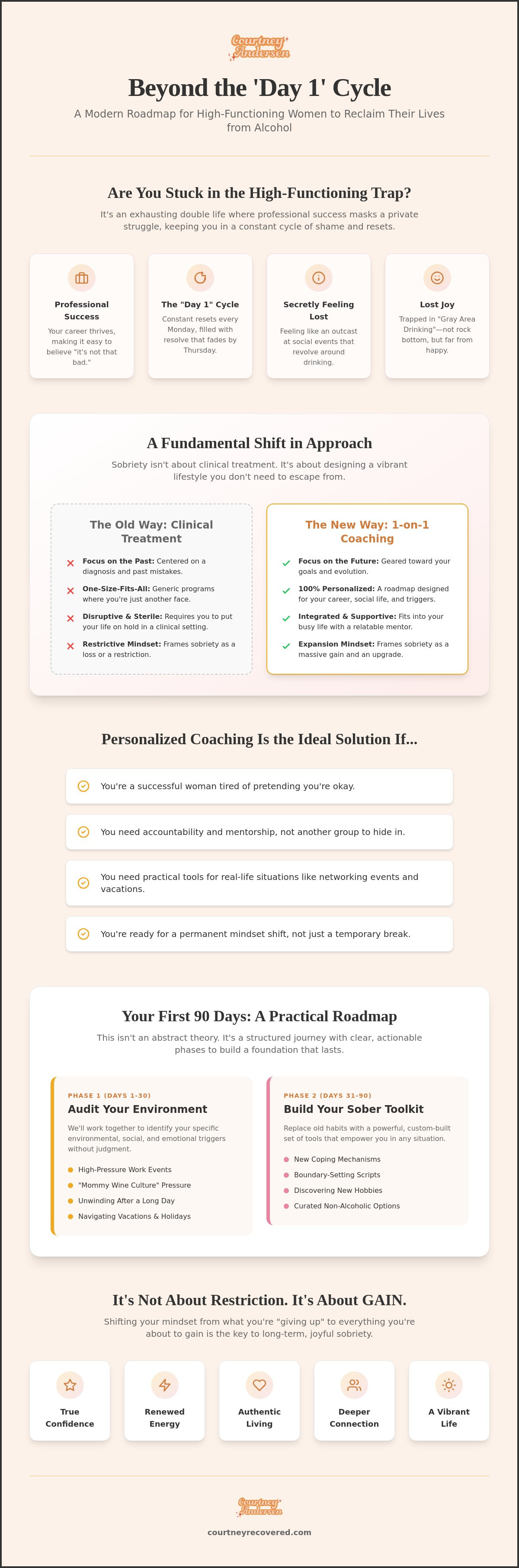
The first three months are where the magic happens. It’s the timeframe required to move past the physical cravings and start the deep, rewarding work of mental rewiring. When you commit to 1-on-1 sobriety coaching, we don't just hope for the best. We follow a structured, high-momentum roadmap that takes you from the exhaustion of "day one" to the vibrance of a life you actually enjoy. This isn't about sitting around and waiting for time to pass; it’s about active, intentional lifestyle design.
Our journey together moves through four distinct phases:
- Phase 1: The Deep Dive. We perform a full audit of your triggers, your kitchen, and your social circle to remove the friction points that keep you stuck.
- Phase 2: Building the Toolkit. You'll start implementing daily sobriety tools to handle stress, boredom, and social pressure without reaching for a bottle.
- Phase 3: Social Navigation. We rewrite your identity in your community, giving you the confidence to show up at weddings, work dinners, and parties as the woman who doesn't drink.
- Phase 4: The After. This is the transition from "not drinking" to "thriving," where we focus on long-term maintenance and finding joy in your new reality.
Rewiring Your Daily Routine
Most women struggle the most during the "witching hour," that 5 PM window where the transition from work to home feels like it requires a glass of wine. A coach helps you bridge this gap by replacing old habits with new, celebratory rituals. The first 30 days are largely about breaking the physical cycle. By using resources like the Sober Toolkit, you'll have a tangible plan to manage cravings and emotional spikes in real-time. We don't just tell you what not to do. We give you a specific, actionable plan for what to do instead.
Navigating the Identity Crisis
The scariest question most women face is, "Who am I without alcohol?" If your social life has revolved around drinking for a decade, the thought of being sober can feel like losing a part of yourself. This is where 1-on-1 sobriety coaching is most powerful. I help you discover your vibrant self outside of the bottle. You'll learn that you aren't "losing" your social life; you're gaining a more connected and authentic version of it. We move you through the Stop Starting Over phase and into a place of permanent freedom, where sobriety isn't a chore; it’s your superpower. If you're ready to stop the cycle, you can start your 90-day transformation today.
Start Your Journey with Courtney Recovered
You have spent enough time stuck in the loop of "starting over" every Monday morning. You've felt the weight of the high-functioning trap and the isolation of feeling like you don't fit into traditional recovery boxes. Now, it is time to choose a different path. My approach to 1-on-1 sobriety coaching is built on the belief that sobriety isn't a life sentence of boredom. It is a promotion. It is an invitation to a more vibrant, connected, and high-energy version of yourself that you haven't met yet.
We don't just wing it. My philosophy is rooted in providing the exact structure you’ve been missing through the Stop Starting Over program. This isn't about clinical checklists or sterile advice. It’s about mentorship from someone who has been exactly where you are. We focus on active lifestyle design, ensuring that your sobriety feels like a massive gain rather than a restrictive loss. To support this journey, we integrate tangible resources like the Sober Vibes Book and the Sober Toolkit, giving you a physical and mental framework to rely on when life gets loud.
Your Personalized Recovery Roadmap
The first step is a simple discovery call. This isn't a high-pressure sales pitch. It’s a conversation to see if we vibe and if you’re ready for this level of radical accountability. A typical 1-on-1 sobriety coaching session is conversational, high-momentum, and intentionally non-clinical. We don't dwell on the past; we audit your present and build your future. It’s a space where you can be completely honest about your struggles without fear of judgment. Investing in coaching is an investment in your own vibrancy. You are deciding that your future self deserves a life that doesn't require a drink to be enjoyable.
Beyond the First 90 Days: The After
Sobriety doesn't end at the 90-day mark. That is just where the real fun begins. As you move into The After, my role shifts from helping you survive the early days to helping you thrive in your new reality. You’ll have the opportunity to transition into the Sobriety Circle, a community of like-minded women who are also navigating this alcohol-free life. Having a mentor who understands the long-term journey is crucial for maintaining your momentum and preventing that "just one drink" itch from returning years down the line. You don't have to do this alone, and you don't have to settle for a mediocre life.
Stop starting over and start living today.
Claim Your Seat at the Table of Your Own Life
You've seen how 1-on-1 sobriety coaching flips the script on traditional recovery. It isn't about being a "patient" or sitting in sterile rooms; it's about designing a lifestyle that makes alcohol look like the least interesting thing in the room. We've covered why high-performing women need a specific roadmap to escape the "gray area" trap and why the first 90 days are critical for rewiring your daily rituals. This is your chance to move from the exhaustion of white-knuckling to the freedom of true, unshakeable confidence.
As the author of "Sober Vibes" and a mentor who has guided a community of over 1,000 women, I know that your success depends on a plan that fits your actual life. My approach has been featured in major recovery publications because it prioritizes your vibrancy over clinical labels. You've spent enough time hiding behind professional success while struggling in private. It's time to bring your internal reality in line with the amazing life you've built on the outside.
Ready to break the cycle? Book your 1:1 Sobriety Coaching Discovery Call now.
You don't have to stay stuck in the "starting over" loop. A brighter, bolder, and more connected reality is just one decision away. Let's build it together.
Common Questions About Personalized Sobriety Support
How much does 1-on-1 sobriety coaching typically cost?
Investing in your sobriety is an investment in your future vibrancy. While costs vary across the industry based on a mentor's experience and the level of support provided, most women find that a coaching package is a fraction of the long-term costs associated with a drinking habit. You are paying for a personalized roadmap and radical accountability that helps you skip the years of trial and error often found in free group settings.
Do I need to be "sober" before I start 1:1 coaching?
You do not need to be sober before your first session. In fact, many women seek out 1 on 1 sobriety coaching specifically because they haven't been able to stop on their own. We start exactly where you are right now. Whether you're currently in the middle of a "Day 1" cycle or you are just sober-curious, we work together to build the foundation for your alcohol-free life from the ground up.
What is the difference between a therapist and a sobriety coach?
A therapist is a licensed clinical professional who focuses on diagnosing and treating mental health conditions or past trauma. A sobriety coach is a peer-led mentor who focuses on action, daily living, and future-oriented goals. While a therapist helps you understand the "why" behind your past, a coach provides the "how" for your sober future. It is about practical lifestyle design rather than clinical treatment.
Can I still go to AA while working with a sobriety coach?
Absolutely, you can still attend AA or any other community meetings while working with a coach. Many women find that personalized support provides the specific strategy that general groups often lack. Coaching doesn't replace community; it enhances it by giving you a private space to discuss specific triggers and goals that you might not feel comfortable sharing in a large, anonymous room.
How long do I need to work with a coach to see results?
Most women begin to feel a shift in their mindset within the first 30 days, but the most sustainable results usually happen over a 90-day period. This timeframe allows you to move past physical cravings and start the deep work of rewiring your social identity. By the end of three months, you'll have a clear, actionable toolkit and the confidence to navigate high-stakes social events without a drink.
Is sobriety coaching confidential?
Your privacy is a top priority. Every conversation we have is a safe, confidential space where you can be completely honest about your struggles and your wins. Unlike a public meeting where you might run into colleagues or neighbors, 1-on-1 sobriety coaching offers a discreet way to get support. You can share your internal monologue without fear of judgment, knowing that your journey is entirely your own.
Does insurance cover sobriety coaching services?
Generally, sobriety coaching is an out-of-pocket investment because it is a non-clinical service. While some regions have recently introduced legislation to mandate insurance coverage for recovery coaches, it is not yet a universal standard. Most clients view coaching as a personal development expense, similar to a fitness trainer or a business consultant, focusing on the high-energy life they are building for themselves.
What happens if I relapse while working with a coach?
If you have a slip, we don't treat it as a failure; we treat it as data. We use that moment to audit what happened and adjust your plan to prevent it from happening again. The goal is to move past the "Stop Starting Over" phase and into permanent freedom. We look at what specifically triggered the moment and refine your toolkit so you can stay on track with confidence.
I want you to feel sober NOT boring!
Kickstart your sobriety with my free 2-day video workshop series to master your sober mindset and have FUN in your sobriety journey!


