
Life After Sobriety: Build a Life You Don't Need to Escape
Aug 08, 2026
What if the "boring" life you are terrified of is actually the only way to finally feel alive? You are probably sitting there wondering if life after getting sober means you will forever be the outcast at the bachelorette party or the person with nothing to talk about at dinner. It is completely normal to feel like you are losing your identity along with that glass of wine. Maybe you are even stuck in that "gray area" boredom where the days feel long, and the social spark feels totally extinguished.
I get it because I have been there too. But here is the secret: sobriety is not a life sentence of restriction; it is the ultimate life hack for reclaiming your vibrance. In this guide, you will discover how to move beyond just "not drinking" and start designing an alcohol-free lifestyle that feels like a massive upgrade. We are going to dive into how to navigate parties with confidence, handle relationship friction, and find a deep sense of purpose that makes "liquid courage" look like a cheap imitation of the real thing.
Key Takeaways
- Learn why sobriety is a massive lifestyle upgrade rather than a list of restrictions. We are moving past just "not drinking" into total emotional freedom.
- Navigate the identity crisis of your first year by rediscovering the passions and hobbies that alcohol used to numb.
- Stop relying on willpower and start using a structured Sober Toolkit. Morning and night routines are the anchors that keep you steady.
- Master the art of being social without the liquid courage. You will learn how to handle parties and partners who still drink while thriving in your life after getting sober.
- Discover how community and expert support turn "The After" phase into a vibrant reality you never want to escape.
Beyond the Quit: What Life After Getting Sober Actually Looks Like
Most clinical websites talk about Sobriety like it is a long, sterile hospital stay. It is often framed as somber, restrictive, and frankly, a little depressing. But that is not what we are doing here. In 2026, the "Sober Curious" movement has officially evolved into high-performance sobriety. It is about emotional freedom and the kind of mental clarity that makes you feel like you finally have the cheat codes to your own life. Life after getting sober is not about what you are giving up; it is about the massive upgrade you are finally allowing yourself to have.
For a long time, you might have been "white-knuckling" it. That is that tense, teeth-gritting feeling where you are just trying to survive the hour without a drink. Transitioning into a life you actually enjoy means moving past that survival mode. It is weird at first. I will be the first to tell you that the transition feels clunky and raw. But the "After" is where the real magic happens. It is where you stop surviving your days and start actually living them with a level of intensity you forgot was possible.
The Difference Between Quitting and Building a Sober Life
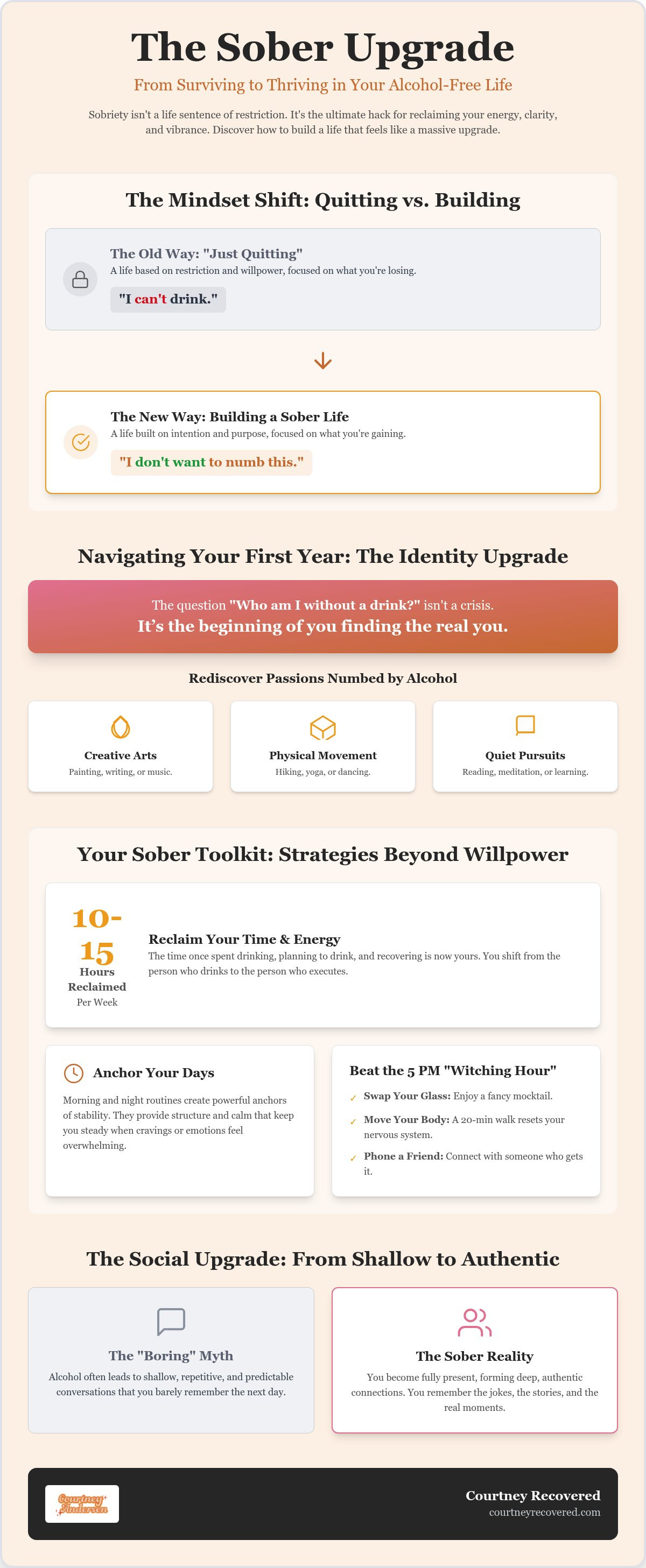
Quitting is just the first step. It is like clearing the rubble before you build a brand new house. If you only focus on stopping the habit without healing the root cause of why you drank, you are just left with a giant, uncomfortable void. Building a sober life is about filling that space with things that actually matter to you. You move from the restrictive "I can't drink" to the empowering "I don't want to drink" because your reality is finally too good to numb. The After is a proactive, intentional lifestyle choice where you design your days around what makes you feel electric instead of what helps you escape.
Common Misconceptions About the 'Boring' Sober Life
Let's kill the myth right now that you will be the "boring" person in the corner. Reality check: alcohol actually makes conversations shallow, repetitive, and predictable. When you are sober, you actually remember the jokes and the stories. You have deep, authentic connections that do not vanish when the sun comes up. You are not losing your "cool girl" status; you are reclaiming your vibrance. You become the person who is actually present, high-energy, and ready for anything. Life after getting sober means you are the one with the most energy in the room, not the one looking for the nearest exit.
Navigating the Identity Crisis of Your First Year
"Who am I without a glass of wine?" It's the question every single one of us asks. Honestly, it's a total rite of passage. For years, alcohol was likely your personality, your stress relief, and your social lubricant. Suddenly, that's gone. You're left standing there, looking in the mirror, wondering who the hell this new person is. This identity crisis is actually a sign of massive progress. It means you're finally making room for the real you to show up. It's uncomfortable, sure, but it's where the growth happens.
Understanding the First Year of Sobriety: What to Expect on Your Journey to 365 Days helps normalize the emotional rollercoaster. The first few months are often about survival, but as you move toward that one-year mark, you start rediscovering hobbies that alcohol previously numbed. Maybe you used to love painting, hiking, or just reading a book without the words blurring. These passions are still there. They're just waiting for you to wake up and pay attention to them again. Your life after getting sober is a blank canvas, and you finally have the energy to paint it.
Breaking the 'Gray Area' Cycle
Many of us were "high-functioning" drinkers. You held down the job, the family, and the social life, but you were constantly managing a heavy secret. This is Gray Area Drinking: when your habit becomes a Burden. Putting down that secret is the biggest relief you'll ever feel. You're no longer performing; you're just being. Research into long-term sobriety strategies shows that shifting your mindset from "hiding" to "thriving" is key to making this change permanent and joyful.
Reclaiming Your Time and Energy
Have you ever actually calculated the time you spent drinking or recovering? Most people find an extra 10 to 15 hours a week in their life after getting sober. That's a massive amount of "found" time. You shift from "the girl who drinks" to "the girl who executes." But we have to talk about the 5 PM "Witching Hour." That's when the cravings usually hit the hardest. Instead of reaching for a bottle, try these practical swaps:
- Trade your wine glass for a fancy mocktail in a beautiful coupe.
- Move your body. A 20-minute walk can reset your nervous system.
- Call a friend who knows your goals and can hype you up.
If you feel like you need a personalized roadmap to navigate these identity shifts, my 1:1 Sobriety Coaching is designed to help you build that new life with total confidence and zero apologies.
Your Sober Toolkit: Strategies for Long-Term Maintenance
Willpower is a finite resource. If you are relying on it to stay dry, you are going to be exhausted by Tuesday afternoon. Life after getting sober is not about being "stronger" than a bottle; it is about being smarter than your triggers. You need a system that works when you are tired, stressed, or just plain bored. This is why we focus on a structured Sober Toolkit. It is about building a set of non-negotiables that protect your peace without making you feel like your life is one giant chore.
Think of your toolkit as the scaffolding for your new life. Without it, the whole structure can feel a bit shaky when things get real. You are not just trying to "not drink." You are actively designing a reality where alcohol has no place because it simply does not fit anymore. This shift in perspective is what moves you from a fragile streak to a solid, vibrant lifestyle that you actually want to keep.
Daily Tools for the Modern Sober Woman
Morning and night routines are your anchors. They bookend your day so that the middle part does not feel like a chaotic freefall. The Sober Vibes Book is a game-changer here because it keeps your "why" front and center when the world starts getting loud. Reading "Quit-Lit" is not just for the early days; it is a way to constantly refresh your perspective and stay grounded in your growth. When you feel a midday craving or social anxiety creeping in, having these tools ready means you don't have to think; you just execute. Proactive daily maintenance beats emergency recovery every single time.
The Role of Accountability and Mentorship
Trying to do this alone is like trying to learn a new language without a teacher. It is technically possible, but it is the hardest and slowest way to get results. While traditional programs have their place, many women find that a 1-on-1 sobriety coaching approach feels more like a personalized roadmap. A coach acts as a mentor who has already walked the path and can help you dodge the potholes before you hit them. It is about having someone in your corner who sees your potential even when you are having a "meh" day.
Community is the secret weapon against the "sober and lonely" trap. Finding your people within a space like the Sobriety Circle means you never have to explain why you are not drinking. You just get to be yourself. Whether it is a dedicated accountability partner or a group of women who totally "get it," having that external support system ensures that life after getting sober never feels like a solo mission. It is about trading the isolation of a habit for the connection of a movement.
Rebuilding Your Social World and Relationships
The biggest lie about life after getting sober is that your social calendar is about to shrivel up and die. It feels like you are choosing between your health and your friends, but that is just the fear talking. You don't have to become a hermit or a "narc" who judges everyone at the table. In fact, being the only one who actually remembers the night is a total power move. You are still you, just with a much better memory and zero morning-after anxiety. Thriving in your life after getting sober means reclaiming your social power, not hiding from it.
Navigating relationships with people who still drink can be tricky, especially if that person is your partner. The "Husband dynamic" is real. If your marriage used to revolve around split bottles of wine, you have to find new ways to connect that don't involve a corkscrew. It is about rebuilding trust and intimacy on a foundation that isn't liquid. Setting boundaries with friends who "miss the old you" is also non-negotiable. If they only liked the version of you that was numbed out, they weren't really your people to begin with.
Sober and Social: The New Nightlife
You need a game plan for when someone asks, "Why aren't you drinking?" You don't owe anyone a medical history. A simple, "I'm on a health kick," or "I've realized I'm much more fun without it," usually shuts it down. If you are at a wedding or a bachelorette party, keep a mocktail in your hand so people stop offering. Re-learning how to dance and flirt without liquid courage feels awkward for about ten minutes. After that, you realize you are actually funnier and more present than you ever were before. Always have an "Exit Strategy." When the conversation starts getting repetitive, and the room gets "sloppy," it is time to go. You have nothing to prove by staying until 2 AM.
Healing Connections at Home
Motherhood is another minefield. The "Mommy Wine Culture" is everywhere, telling you that you need a drink to survive your kids. Breaking that cycle is the greatest gift you can give your family. You move from the "Pink Cloud" phase, where everything feels amazing, into the "Reality Check" phase where you have to actually deal with the friction in your marriage. This is where the real work happens. You are learning to communicate without the buffer of alcohol, and while it's hard, the intimacy you build is actually authentic.
If you are tired of feeling like the "sober and lonely" one in your friend group, come find your new tribe in the Sobriety Circle where we celebrate every win together.
Designing Your Vibrant 'After' with Expert Support
You have already done the hardest part. You put down the glass and decided that "good enough" was no longer enough for you. Now, it is time to stop focusing on what you left behind and start being obsessed with what you are building. Life after getting sober should not feel like a consolation prize. It is the main event. We are moving past the exhausting cycle of "Stop Starting Over" and stepping into a phase I call "The After." This is where you stop surviving your sobriety and start using it as a launchpad for a life that feels like a massive, high-definition upgrade.
The goal here is simple: we want to design a reality so vibrant and fulfilling that alcohol eventually feels like a total downgrade. When your life is full of authentic connection, deep sleep, and genuine joy, the idea of a hangover becomes laughable. But you don't have to figure out this blueprint on your own. Choosing the right level of support is about recognizing where you are on the journey. Whether you need the daily inspiration of the Sober Vibes Book, the high-energy pulse of a community, or the deep dive of 1:1 mentorship, there is a roadmap waiting for you.
The Sobriety Circle: Your Online Sober Community
Community is the secret weapon that kills the "sober and lonely" trap before it even starts. Most people fail because they try to stay dry in a vacuum. The Sobriety Circle is not a somber support group where we sit around talking about how much we miss drinking. It is a high-energy, membership-based space designed for the modern woman who wants to thrive. You get a consistent "vibe" of optimism and practical tools that keep your momentum high. Inside the circle, you find women who are navigating the same professional and social hurdles as you, proving every day that a sober life is the ultimate power move.
1:1 Coaching: The Personalized Roadmap
Sometimes, a group setting isn't enough to break a stubborn relapse cycle. If you feel like you are constantly hitting a wall, it might be time for a personalized approach. 1:1 mentorship is the fastest way to bridge the gap between where you are and the vibrant "After" you deserve. We work together to identify your specific triggers and build a customized Sober Toolkit that actually fits your lifestyle. This is about more than just "not drinking"; it is about high-performance living. If you are ready to stop guessing and start executing, book your 1:1 Sobriety Coaching discovery call today, and let's start building a life after getting sober that you never want to escape.
Claim Your Vibrant New Reality
You have already taken the most important step by deciding that you deserve more than a life spent numbing out. We have explored how to navigate the identity shifts of your first year, build a rock-solid toolkit, and master the art of being social without the liquid courage. Your life after getting sober is not a restricted version of your old self. It is a high-definition, high-performance upgrade that allows you to finally show up as the woman you were always meant to be.
As a professional sober coach for high-achievers and the author of the Sober Vibes Book, I am here to tell you that this journey is meant to be celebrated. My non-clinical, high-energy approach is designed to help you move past the survival phase and into a reality you never want to escape. You don't have to navigate this transition in isolation. It is time to trade the "sober and lonely" fear for a community that truly gets it.
Ready to design your vibrant sober life? Join the Sobriety Circle today! Your most electric days are still ahead of you. Let's go get them.
Your Questions About The After, Answered
Is life actually better after getting sober?
Yes, life after getting sober is a total upgrade that replaces the foggy survival of drinking with high-definition clarity and genuine energy. You aren't just losing a habit; you are gaining back your time, your health, and your self-respect. While the early days are a transition, the long-term result is a life that you no longer feel the need to escape from every weekend.
How long does it take to feel 'normal' after quitting drinking?
Most people start feeling a physical shift within the first 30 days, but mental normalcy usually hits around the 90-day mark. This is when the initial brain fog lifts and your sleep cycles begin to stabilize. A full identity shift often takes about a year as you navigate every holiday and season for the first time without a drink.
What do I do if my partner still drinks and I'm sober?
Open communication and firm boundaries are the keys to navigating a relationship where one person still drinks. You don't have to be the alcohol police, but you do need to protect your own peace by letting them know what you need. This might mean keeping the wine out of the house for a while or finding new evening rituals that don't revolve around the bar.
Will I ever be able to have fun at a party again without alcohol?
You will actually have more fun because you will be fully present and won't spend the next morning cringing at your texts. Once you get past the initial ten minutes of social anxiety, you realize you are still funny and charismatic without a glass in your hand. Plus, you get the added bonus of driving home safely and waking up feeling electric.
What is the 'Pink Cloud' phase in sobriety?
The Pink Cloud is that early burst of euphoria where you feel like you have finally conquered the world and everything is sunshine. It is a great phase, but it's important to use that high-energy period to build your Sober Toolkit. When the cloud inevitably fades and real life gets heavy again, those routines will be what keep you steady.
How do I handle my first sober bachelorette party or wedding?
Go in with a plan that includes a fancy mocktail in your hand and a pre-arranged exit strategy. If the party starts getting sloppy and the conversation starts looping, that is your cue to head home and get some amazing sleep. Focusing on the person you are celebrating rather than the bar menu makes the whole experience much more meaningful.
Do I need to go to AA to stay sober long term?
No, AA is just one path, and it is definitely not the only way to build a vibrant life after getting sober. Many high-achieving women find that personalized coaching or modern communities like the Sobriety Circle fit their lifestyle much better. The best path is the one that makes you feel empowered and connected rather than restricted or shamed.
What is the best way to maintain sobriety when I'm feeling lonely?
Connection is the ultimate antidote to the sober and lonely trap that causes so many relapses. Reach out to your accountability partners, dive into a new hobby, or engage with your sober community online. When you surround yourself with people who truly get it, you realize that being sober is the most connected you have ever been.
I want you to feel sober NOT boring!
Kickstart your sobriety with my free 2-day video workshop series to master your sober mindset and have FUN in your sobriety journey!


