
Gray Area Drinking: When Your Habit Becomes a Burden
Jul 12, 2026
What if you didn't have to lose everything just to gain a life you actually love? You've got the career, the family, and the "perfect" life on paper, but you're still waking up at 3 AM with a racing heart and a heavy dose of hangxiety. You spend more mental energy negotiating your next glass of wine than you do on your actual goals. It's that exhausting, silent struggle of gray area drinking where you feel like a total fraud because everything looks fine to the outside world, yet your spirit feels completely weighed down.
I know exactly how it feels to be stuck in that "silent middle" where you aren't quite a disaster, but you definitely aren't thriving. You don't need a rock bottom to choose a better path. In this article, you'll discover why this middle ground is often the hardest place to be and how to navigate your way toward a vibrant, alcohol-free life. We're going to dive into the mental load of managing your habit and how to finally wake up feeling refreshed, proud, and ready to take on the world without needing a glass of wine to make it through the day.
Key Takeaways
- Stop waiting for a disaster to happen and learn how to identify the "silent middle" of gray area drinking where your habit no longer serves your goals.
- Recognize the mental drain of exhausting moderation rules and discover why being "high-functioning" is just a temporary stage before burnout.
- Get a clear, step-by-step roadmap for a 30 to 90-day reset that clears the mental fog and restores your natural energy.
- Learn how to trade the isolation of a secret struggle for a vibrant social life that doesn't revolve around a glass of wine.
- Discover how personalized support through 1:1 Sobriety Coaching can help you design a life you truly love waking up to every single day.
What Exactly is Gray Area Drinking?
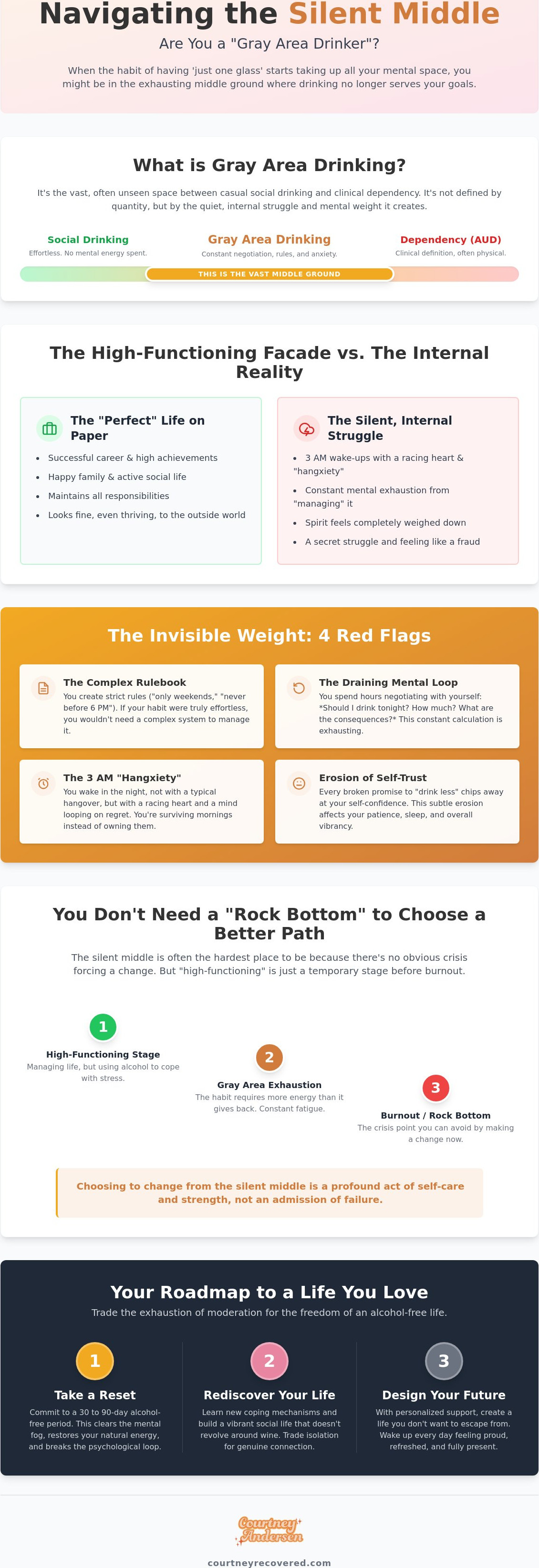
You know that space where you aren't exactly falling apart, but you definitely aren't "fine"? That's gray area drinking. It is the vast, often exhausting middle ground between the casual social drinker who can take or leave a glass of Pinot and the clinical definition of Alcohol Use Disorder (AUD). Most people think you need to hit a "rock bottom" to justify quitting. They think if you haven't lost your job, your house, or your family, then you don't have a problem. But this isn't about how much you drink or how often; it's about how you feel. It's that nagging sense of misalignment, where your habits no longer match the person you want to be.
This isn't a medical diagnosis you'll find in a doctor's office. It's a self-identified realization. You can be a CEO, a marathon runner, or the PTA president and still be a gray area drinker. The hallmark of this space is what I call "The Silent Burden." It's the sheer amount of mental energy you spend thinking about alcohol. Will there be wine at the party? Should I have two glasses or three? If I drink tonight, I'll have to skip my workout tomorrow. That constant internal negotiation is heavy. It's a mental weight that keeps you from being fully present in your own life.
The "Fuzzy Boundaries" of Moderation
Official guidelines often feel totally irrelevant when you're in the thick of it. As of 2026, the U.S. Dietary Guidelines have shifted to a "less is better" approach, removing specific daily limits. This ambiguity makes the gray area even foggier. There's a massive difference between wanting a drink because you enjoy the taste and needing one to "shut off" your brain after a long day. Gray area drinking usually doesn't involve a physical dependency where you'll experience dangerous withdrawals. Instead, it's a psychological loop. It's that transition drink that helps you shift from "boss mode" to "home mode," creating a fuzzy boundary where alcohol becomes your primary coping mechanism.
Why High-Performers Fall into the Gray Area
If you're a high achiever, alcohol often feels like the ultimate reward. You work hard, you parent hard, and you feel you've "earned" that bottle of wine at the end of the day. We live in a world that glamorizes "mummy wine culture" and professional happy hours, making it feel like drinking is a prerequisite for success. The irony is wild. You're using a central nervous system depressant to "relax" from a high-energy, high-stress life. Instead of actually recharging, you're just numbing the fatigue. This doesn't fix the stress; it just delays the bill, which usually comes due at 3 AM when the hangxiety kicks in.
The Silent Signs: Is Your "Social" Habit Actually a Burden?
You probably have a list of invisible rules. You only drink on weekends. You never touch the hard stuff before 6 PM. You only buy the "expensive" wine so it feels like a sophisticated hobby rather than a nagging habit. These rules are meant to keep you safe, but they're actually the biggest red flag. If your drinking was truly social and effortless, you wouldn't need a complex legal system to manage it. The rules exist because, deep down, you know the habit is starting to drive the bus. This is the hallmark of gray area drinking. It isn't about being a "mess"; it's about the exhaustion of trying to stay "fine."
The heaviest part of this burden is the mental loop. You spend your afternoon deciding if today "counts" as a drinking day. You spend your evening counting how many sips are left in the bottle or calculating if you can have one more and still be functional for that 8 AM meeting. Then comes the hangxiety. That 3 AM wake-up call where your heart is racing, your mouth is dry, and your brain is on a loop of regret. You aren't hungover in the traditional, "can't get out of bed" sense, but you are spiritually depleted. You're surviving your mornings instead of owning them.
Have you ever finished a glass in the kitchen before walking back to the living room? Or maybe you "top off" your drink when no one is looking so the total count stays low in their eyes. This secret drinking isn't about the volume of the liquid. It's about the shame of the secret. When you start hiding the evidence, you aren't just lying to others. You're breaking the most important bond you have: the one with yourself.
The Physical and Emotional Toll
You might wake up feeling "okay," but you've lost your edge. Your skin looks a little duller, your sleep is fragmented, and your patience with your kids or partner is paper-thin. This is a subtle erosion. You don't notice it day to day, but over time you realize you've traded your vibrancy for a duller version of yourself. Every time you break your own "moderation rules," you lose a little more self-trust. That internal whisper that says "I'm not sure I can stop at one" becomes a deafening roar that keeps you stuck in the gray.
The Social Camouflage
Often, we hide behind the "fun one" persona. You're the life of the party, the one who brings the best bottle, and the person everyone wants an invite from. This social camouflage makes it incredibly hard to see the truth. In fact, many major publications like Forbes have explored What Is Gray Area Drinking? to highlight how the external image of success often masks deep internal discomfort. Your friends might tell you that you're fine because your struggle makes them uncomfortable with their own habits. But they aren't the ones waking up at 3 AM. If you're ready to stop the internal negotiation and finally reclaim your mental space, you don't have to wait for things to get worse to start getting better.
Gray Area vs. Rock Bottom: Why You Don’t Need a Crisis to Quit
Society loves a good comeback story. We're conditioned to believe that you have to crash the car, lose the job, or end the marriage before you're "allowed" to say enough. But waiting for a catastrophe is like waiting for your house to burn down before you decide to fix the faulty wiring. You don't need a crisis to deserve a better life. In the world of gray-area drinking, your "rock bottom" is simply the moment you decide to stop digging. It's an internal shift, not an external disaster. You can choose to raise your own bottom today simply because you're tired of feeling heavy.
Traditional recovery models often focus on being "broken" or "powerless." If that clinical, 12-step atmosphere doesn't resonate with you, that's okay. My approach is intentionally non-clinical and celebratory. We aren't looking for a medical diagnosis; we're looking for a life that feels electric. You don't have to be at death's door to want to feel more alive. This is about empowerment, not admission of a moral failing. It's about recognizing that a habit that once felt like a social lubricant has become a mental anchor.
The High-Functioning Trap
If you're still hitting your KPIs and the kids are fed, it's easy to tell yourself you're fine. But "high-functioning" isn't a permanent status; it's a high-stress stage on a downward slope. You're holding it all together with sheer willpower, and that's exhausting. Functioning should be the bare minimum for your life, not the ultimate goal. When you wait for a "sign" that things have gone too far, you're just trading your best years for a duller version of reality. You don't need to wait for the wheels to fall off to decide you want a smoother ride.
Choosing Gaining Over Giving Up
Let's reframe this entire conversation. Sobriety isn't a punishment for being "bad" at drinking. It's a massive promotion for your entire existence. This is the core of the "Sober Vibes" philosophy. You aren't "giving up" wine; you're gaining clarity, deeper sleep, and a social life that actually feels connected and authentic. When you step out of gray area drinking, you aren't entering a life of restriction. You're entering a life of total freedom. You don't need to be broken to want to be better. You just need to be brave enough to admit you're ready for more.
How to Break the Cycle of Gray Area Drinking
Breaking free from gray area drinking isn't about white-knuckling your way through a dry month. It's about trading a habit that makes you small for a lifestyle that makes you feel giant. First, you have to admit the burden. You don't need to adopt a label or call yourself "diseased" if that doesn't fit your reality. Just be honest: the drinking has become a job you no longer want to do. Once you own that, commit to a reset. Whether it's 30, 60, or 90 days, you need a significant break to let your brain chemistry recalibrate, and the mental fog finally lift.
Building a practical strategy is your next move. This isn't just about willpower; it's about preparation. You need to have physical things to reach for when the habit starts whispering in your ear. Finally, stop trying to do this in secret. Privacy is where the "just one glass" lie thrives and grows. When you bring your struggle into the light with a community that actually gets it, the habit loses its power over you almost immediately.
Practical Tools for the First 30 Days
That 5 PM "Witching Hour" is usually the hardest part of the day. It's the ritual of the pour that you're actually addicted to, not just the liquid. Replace it with a new, high-vibe habit. Maybe it's a fancy mocktail in your favorite glass or a quick walk to reset your energy. This is where the Sober Toolkit becomes your best friend. Instead of scrolling through your phone, dive into the Sober Vibes Book. Reading about the vibrant reality of sobriety helps shift your mindset from "I can't have wine" to "I finally get to have my life back."
Navigating the "Stop Starting Over" Phase
We've all been there. It's Day 4 or Day 14, you feel fantastic, and your brain starts lying to you. "See? You're fine. You clearly don't have a problem. You can handle one glass tonight." This is the Stop Starting Over phase, and it's where most high-performers trip up. You have to identify if your trigger is genuine stress, simple boredom, or just an old neurological loop. Accountability is your secret weapon here. You wouldn't try to master a new business skill or hit a massive fitness goal without a plan or a mentor. Why treat your sobriety any differently? If you're tired of the "Day 1" cycle, you can work with me 1:1 to build a personalized roadmap that actually sticks.
Designing a Life You Don’t Want to Escape
Most recovery programs focus entirely on the "problem." They want you to sit in a sterile room and talk about what you've lost. But we're doing things differently. Escaping the trap of gray area drinking is only the first half of the equation. The second half is building a life that is so vibrant and fulfilling that you actually don't want to numb yourself to it. This is about "The After." It's about waking up with genuine energy, reclaiming your evenings, and feeling a level of confidence that doesn't come from a bottle. You aren't just quitting a habit; you're launching a new version of yourself.
If you're a high-performer, you already know that generic advice doesn't cut it. You need a strategy that fits your actual life, not a one-size-fits-all clinical plan. This is where 1:1 Sobriety Coaching comes in. It's the personalized fast track to freedom. Instead of trying to fit into a box, we look at your career, your parenting style, and your social circles. We don't just talk about "not drinking." We talk about thriving. We talk about how to navigate a high-stakes board meeting or a chaotic family holiday with your power fully intact.
The Power of Personalized Mentorship
A coach understands your world because they've lived it. I'm not here to judge your choices; I'm here to help you upgrade them. We move past the white-knuckle phase and start designing a reality where you are the most present, capable version of yourself. This isn't about being "fixed" because you were never broken. It's about mentorship. It's about having someone in your corner who can see the path ahead when you're still clearing the brush. We tailor your sobriety to your specific goals so it feels like a gain, not a loss.
Your Invitation to the Sobriety Circle
One of the biggest fears people have when leaving gray area drinking behind is the fear of being "sober and lonely." You worry that your social life will die or that you'll be the "boring" one at dinner. I'm here to tell you it's actually the opposite. In the Sobriety Circle, you find a tribe of women who are just as ambitious and fun as you are. They're doing life without the hangovers, and they're doing it with style. You don't have to do this in secret anymore. Join the Sobriety Circle and find your tribe today!
You've done enough "Day 1s." You've spent enough 3 AMs promising yourself that tomorrow will be different. Let's make this the last time you ever have to start over. You deserve a life that feels as good on the inside as it looks on the outside. The roadmap is ready. The community is waiting. The only thing left is for you to decide that you're worth the investment. Let's get started on building a life you truly love.
Your Vibrant Life is Waiting
You've spent enough time negotiating with yourself at 3 AM. By now, you know that gray area drinking isn't about being "broken"; it's about being ready for more. You've learned that you don't need a crisis to justify a change and that your "high-functioning" status is actually just an exhausting stage you're ready to outgrow. Sobriety isn't a loss. It is the ultimate lifestyle upgrade that gives you your mornings, your energy, and your true self back.
As the author of the Sober Vibes Book and founder of the Sobriety Circle community, I specialize in a non-clinical, lifestyle-first approach designed for women who want to thrive, not just survive. You've done the hard work of identifying the burden. Now, it's time to take the fast track to freedom and stop the cycle of starting over. Ready to ditch the burden? Book your 1:1 Sobriety Coaching session here.
You're so much closer to that refreshed, proud version of yourself than you think. Let's make this the moment everything changes. You've got this, and I've got you.
Common Questions About Gray Area Drinking
Am I an alcoholic if I only drink gray area amounts?
You don't need to adopt a heavy label like "alcoholic" to decide that your relationship with alcohol isn't working. Labels are often less important than the actual impact drinking has on your daily life and mental space. If you feel a persistent misalignment between your habits and your goals, that is reason enough to make a change. Gray-area drinking is about the internal burden you carry, not about a clinical diagnosis or a specific number of drinks.
What is the difference between a high-functioning alcoholic and a gray area drinker?
The main difference lies in the level of physical dependency and the severity of consequences, though the lines are often blurry. High-functioning usually describes someone who maintains their external life while struggling with a significant addiction. Gray area drinkers are often in the "silent middle" where they aren't physically dependent but are mentally exhausted by the constant negotiation of moderation. Both groups spend way too much energy managing a habit that has become a job.
How can I stop drinking on my own without AA?
You can absolutely find freedom through non-clinical paths like personalized mentorship, lifestyle coaching, and community support. Start by building your own Sober Toolkit with practical rituals that replace your evening pour and dive into "Quit Lit" to shift your mindset. Many high-performers find that a structured program like Stop Starting Over provides the clarity and strategy they need without the somber atmosphere of traditional 12-step meetings.
Will I ever be able to drink moderately again?
Moderation is often more exhausting than simply not drinking because it requires constant mental monitoring and rule-setting. While some people can return to occasional drinking, most gray area drinkers find that the mental freedom of "zero" is far more rewarding than the stress of "just one." Once you experience the high-energy vibrancy of a sober lifestyle, you likely won't want to go back to the mental loop of managing a habit.
How do I tell my friends and family I’m quitting if I don’t have a "problem"?
Frame your decision as a positive lifestyle upgrade rather than a response to a crisis. You can simply say you're doing a health reset to improve your sleep, energy, and focus. Most people will respect your desire to feel your best, and you don't owe anyone a "dark secret" to justify choosing a more vibrant life. Lead with your excitement about how good you feel, and the people who love you will follow your lead.
What happens to my body after 90 days without alcohol?
After 90 days, your brain chemistry has significantly recalibrated, leading to deeper sleep, stabilized moods, and the disappearance of 3 AM hangxiety. You'll likely notice clearer skin, reduced inflammation, and a significant boost in your natural energy levels. This is the point where the "mental fog" truly lifts, allowing you to experience a level of productivity and presence that was previously blocked by the dulling effects of alcohol.
Is gray area drinking a real medical term?
No, it is a descriptive lifestyle term rather than a formal medical diagnosis. It emerged because the official public health guidance, like the 2026 U.S. Dietary Guidelines that emphasize "less is better," often leaves a gap for people who don't fit the clinical criteria for Alcohol Use Disorder. It describes the space where your drinking isn't a "disaster," but it is definitely a "detriment" to your overall well-being and happiness.
Can a sobriety coach help me if I haven’t hit rock bottom?
Yes, helping you avoid a rock bottom is exactly what a sobriety coach is for. Coaching is the "fast track" to freedom for women who are tired of the silent struggle and want a personalized roadmap out of the gray area. You don't need to wait for your life to fall apart to deserve expert support. A coach acts as a mentor, helping you design a high-vibe life you actually love waking up to.
I want you to feel sober NOT boring!
Kickstart your sobriety with my free 2-day video workshop series to master your sober mindset and have FUN in your sobriety journey!


