
Recovery Resources: 2026 Alcohol-Free Guide
Oct 15, 2026
What if staying alcohol-free didn't require checking into a sterile clinic or memorizing century-old dogmas in a church basement? Most people assume that finding recovery resources for sobriety requires extreme crisis intervention, but real, sustainable freedom happens right in the messy rhythm of your normal day. You don't need cold medical jargon to build a vibrant life you genuinely love waking up to.
If you're exhausted from battling 6 p.m. cravings, restarting the dreaded Day One loop, and fearing that giving up alcohol means kissing your social identity goodbye, you're not alone. It's completely valid to feel isolated when drinking still feels like everyone else's default setting for fun. This guide shows how practical, non-clinical tools, uplifting community networks, and simple daily practices can turn staying sober into an empowering lifestyle upgrade. Ahead, we'll map out the exact modern toolkits and peer connections you need to ditch the hangovers and thrive on your own terms.
Key Takeaways
- Willpower alone is an exhausting dead end; discover why practical recovery resources for sobriety focus on building supportive routines instead of white-knuckling cravings.
- Learn how to assemble a multi-layered daily toolkit that protects your peace, crushes evening triggers, and completely reframes how you view alcohol.
- Understand the critical differences between clinical interventions and lifestyle-first coaching so you can choose the right level of support for your personal safety and goals.
- Get actionable steps to audit your social calendar, clear physical triggers, and tap into an empowering sisterhood that makes living alcohol-free genuinely fun.
What Are Recovery Resources for Sobriety and Why Do You Need Them?
Think of recovery resources for sobriety as your personal scaffolding. They aren't just emergency hotlines or sterile hospital directories designed for worst-case scenarios. Real, modern recovery resources are the multifaceted daily habits, community connections, and mental frameworks that protect your peace and physical energy. They turn what feels like a restrictive sacrifice into a massive lifestyle upgrade.
Willpower alone burns out fast. Relying solely on grit to turn down drinks means you are completely drained by dinner. White-knuckling leaves you feeling isolated and deprived while everyone around you toasts to the weekend. Sustainable sobriety doesn't come from sheer discipline. It requires structured external support, practical routines, and peer guidance that replace liquid courage with genuine self-trust.
The Shift from Crisis Intervention to Daily Lifestyle Design
Traditional recovery messaging often treats quitting drinking as a punitive measure reserved only for catastrophic crisis points. While clinical care is vital during acute emergencies, it rarely teaches you how to enjoy a summer concert, navigate a high-stakes dinner, or unwind after a grueling Tuesday without a glass of wine. Educational foundations like Understanding Alcoholism reveal how deeply alcohol impacts brain chemistry and behavior across a wide spectrum. Modern tools focus on proactive habit restructuring, taking the shame out of the process and normalizing an alcohol-free lifestyle in everyday social and professional spaces.
Identifying When You Need External Recovery Support
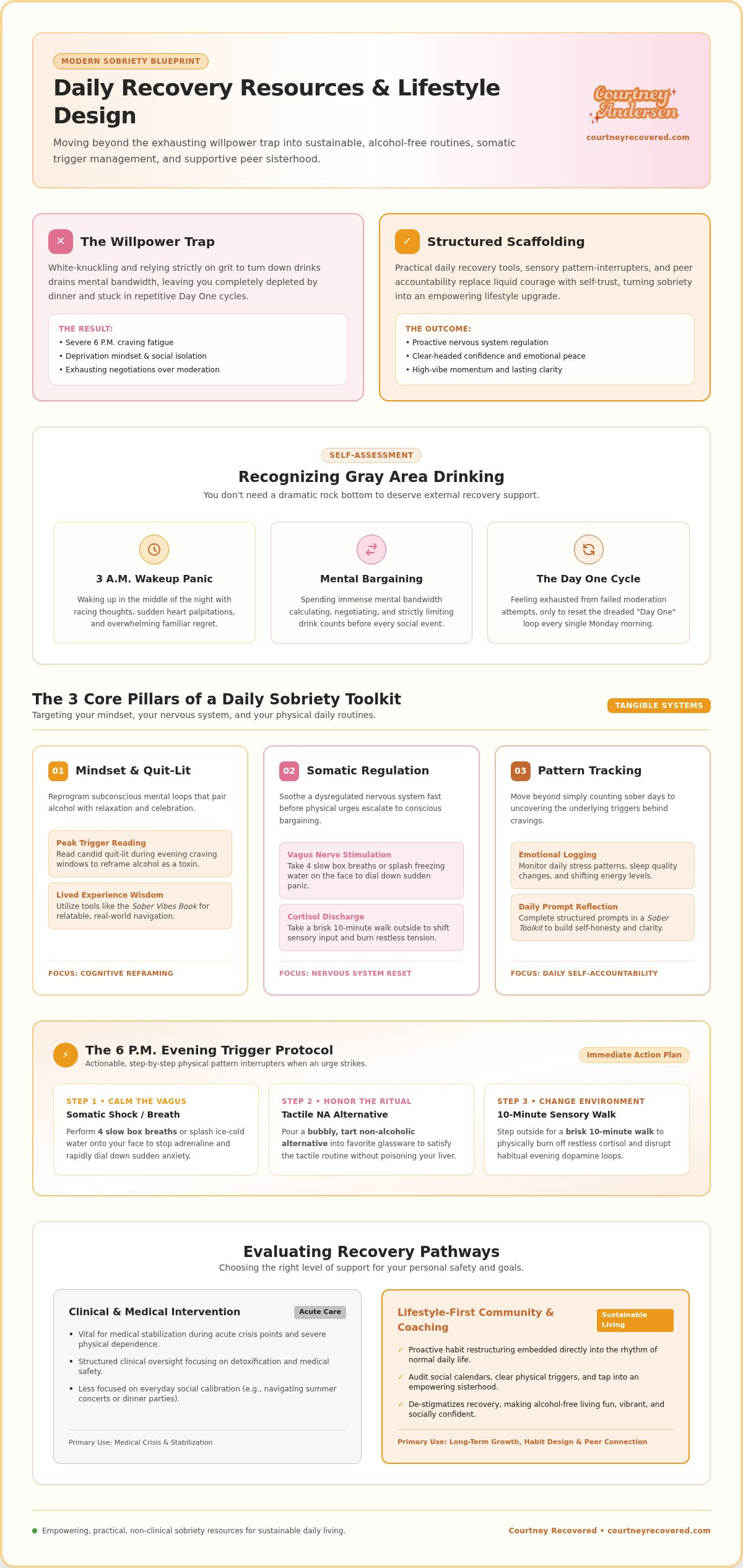
You don't need a dramatic rock bottom to deserve a better life. Most people find themselves trapped in a gray area of drinking, spending immense mental bandwidth negotiating their consumption. You might recognize the signs:
- Constantly bargaining with yourself about how many drinks you will allow tonight.
- Waking up at 3 a.m. with heart palpitations, racing thoughts, and familiar regret.
- Feeling utterly exhausted from trying to moderate, only to repeat the Day One cycle every Monday.
If managing your drinking feels like a heavy second job, external accountability is the missing link. Leaning into dedicated recovery resources for sobriety pulls you out of that lonely cycle, replacing quiet panic with high-vibe momentum and lasting clarity.
The Core Pillars of an Effective Daily Sobriety Toolkit
Staying alcohol-free becomes effortless when you stop relying on gut-wrenching discipline and start leaning on tangible routines. A truly protective routine touches three areas: your mind, your nervous system, and your physical environment. By building a personalized framework, you transform sobriety from an agonizing waiting game into an intentional, high-energy upgrade.
Quit-Lit and Educational Mindset Resources
Your brain has spent years pairing alcohol with relaxation, celebration, and stress relief. To break those mental loops, you have to reprogram how you view booze. Reading candid, modern quit-lit during your peak trigger hours completely reframes alcohol from a cherished reward into an unnecessary toxin. Grabbing the practical Sober Vibes Book gives you relatable, lived-experience wisdom to swap mental cravings for clear-headed confidence right when you need it most.
Somatic Practices and Trigger Management Tools
When an urge hits, it registers as physical tension long before your conscious mind starts bargaining. Soothing your dysregulated nervous system fast prevents a temporary craving from turning into a full-blown relapse. Try these physical pattern-interrupters:
- Take four slow box breaths or splash freezing water on your face to stimulate the vagus nerve and dial down sudden panic.
- Pour a bubbly, tart non-alcoholic alternative into your favorite glassware to honor the tactile ritual of unwinding without poisoning your liver.
- Head outside for a brisk ten-minute walk to physically burn off restless cortisol and change your sensory input.
If you need step-by-step guidance on setting up these daily rituals, explore our deep dive into building a sobriety toolkit to ground your evenings.
Digital Accountability and Progress Tracking Systems
Milestones matter, but tracking your underlying emotions matters even more. While watching sober days tally up on your phone offers a quick hit of pride, monitoring your daily stress, sleep quality, and energy levels reveals the exact emotional patterns that tempt you to drink. Working through structured prompts in a dedicated resource like the Sober Toolkit creates space for daily reflection, keeping you honest and proactive before cravings catch you off guard.
For individuals facing severe physical dependence, clinical interventions remain critical, and directories like Find Treatment Near You connect individuals directly to licensed medical facilities. But for anyone managing gray area habits, these practical daily practices turn recovery resources for sobriety into an exciting personal transformation. If you're ready for guided support that meets you right where you are, discover how Courtney Recovered empowers your alcohol-free journey every single day.
Evaluating Recovery Pathways: Clinical Treatment vs. Community and Coaching
There isn't just one rigid road to an alcohol-free life. Choosing the right recovery resources for sobriety means understanding where you fall on the support spectrum. Matching your current situation with the right level of care keeps you safe, supported, and set up for long-term momentum.
When Clinical Intervention and Medical Detox Are Necessary
Safety comes first, always. Medical detox is strictly necessary if you experience severe physiological dependence. Warning signs like uncontrollable tremors, persistent vomiting, confusion, hallucinations, or seizures are dangerous medical emergencies requiring immediate clinical supervision. Non-clinical mentors and coaches are not healthcare providers; they do not diagnose conditions or manage physical withdrawal. If your body physically depends on alcohol to function safely, consult a licensed physician or hospital treatment facility before exploring lifestyle adjustments.
The Power of Peer Support and Online Sober Circles
Once you've established physical safety, isolation becomes your greatest risk factor. For decades, community support was limited to rigid, location-bound meetings in church basements that often felt intimidating and heavy on dogma. Modern secular platforms have completely modernized this dynamic. Connecting with an uplifting sober community online gives you instant access to women who share your values and daily challenges. Swapping stories about navigating networking happy hours, family boundaries, and alcohol-free dating transforms recovery from a somber chore into an exciting, connected lifestyle.
Accelerating Growth with 1:1 Personalized Sobriety Coaching
While peer circles offer incredible camaraderie, private mentorship accelerates your personal transformation. General advice rarely accounts for your specific career pressures, evening habits, or personal blind spots. Investing in tailored 1 on 1 sobriety coaching bridges the gap between wanting to quit and actually executing the change in your daily routine. A dedicated coach serves as a trusted guide, offering forward-focused accountability and practical strategies to help you ditch the restart loop for good.
How to Build Your Personalized Sobriety Action Plan
Sobriety doesn't happen by accident. You design it. Having access to modern recovery resources for sobriety is fantastic, but without an intentional roadmap, all those quit-lit books and sparkling waters won't stop a craving. A personalized action plan gives your days predictable structure, removing the exhausting mental gymnastics of deciding whether you'll drink tonight.
Building your plan takes five focused moves:
- Audit your environment: Clear out hidden friction points, alcohol stashes, and high-risk social invitations.
- Build a safety roster: Save a list of sober peers or coaches you can text the moment an urge hits.
- Anchor your days: Create grounding morning habits and intentional evening rituals.
- Script your boundaries: Memorize simple exit strategies and drink declinations before walking into events.
- Commit to a framework: Follow a structured reset blueprint rather than trying to figure it all out alone.
Auditing Your Environment and Setting Bulletproof Boundaries
Start by clearing out the temptation. Pour out the half-empty wine bottles, give away leftover spirits, and tuck the barware out of sight. When alcohol is sitting on your kitchen counter after a brutal workday, you're forcing your tired brain to fight an uphill battle. Outside your home, decide your social boundaries before you walk through the door. You don't owe anyone a dissertation about your personal choices. A crisp "I'm skipping alcohol tonight" or "I don't drink" shuts down nosy questions immediately. Watch out for HALT triggers (Hungry, Angry, Lonely, Tired); physical depletion masquerades as a booze craving almost every single time.
Structuring Daily Routines to Eliminate the Relapse Window
The trickiest hurdle arrives between 5:00 PM and 7:00 PM. That evening transition zone is where your mind goes on autopilot and tries to hand you a drink to signal that work is finished. Disrupt that pattern immediately. Swap the couch for a brisk outdoor walk, jump into an online check-in, or pour a tart tonic over crushed ice. Pair that with consistent sleep habits to help your disrupted dopamine levels regulate naturally. Layering these habits alongside reliable recovery resources for sobriety protects your peace during high-stress hours.
If you're tired of white-knuckling the workweek only to restart on Sunday night, lean on structured guidance. Programs like Stop Starting Over give you the exact steps to dismantle recurring triggers for good. Ready to turn this plan into your everyday reality? Team up with Courtney Recovered to lock in your personalized alcohol-free roadmap today.
Finding Long-Term Success and Sisterhood with Courtney Andersen
Staying alcohol-free isn't about sitting in a quiet room feeling deprived while everyone else enjoys life. Courtney Recovered exists to prove that choosing an alcohol-free lifestyle is the most empowering, vibrant move you will ever make. You don't need sterile medical jargon or somber lectures to build a deeply fulfilling reality. When you pair modern recovery resources for sobriety with authentic community, staying sober stops being an exhausting daily struggle and becomes your greatest superpower.
Inside the Sobriety Circle: Connection Without the Stigma
Nothing breaks the habit of drinking faster than finding women who get it without an ounce of judgment. Inside the Sobriety Circle online membership, connection replaces shame. You gain a front-row seat to an inclusive space where members celebrate everyday wins, untangle tough cravings together, and attend live group workshops and guest speaker events. Sharing candid truths with a supportive sisterhood turns a scary lifestyle change into an exciting shared adventure and keeps your daily momentum high.
Designing Your Thriving Future in 'The After'
Ditching the bottle is only the first phase. Once the physical fog lifts, you face a brand new question: what do you actually want your life to look like? Moving into long-term alignment means moving past mere alcohol avoidance to actively building bold career goals, genuine relationships, and rock-solid self-worth. Advanced programs like The After help you navigate the complex emotional landscape that unfolds once the physical cravings fade. You can discover more about stepping boldly into your personal evolution by exploring life after getting sober.
You don't have to navigate this journey in silence or wait for another painful Monday morning to make a change. By tapping into modern recovery resources for sobriety and claiming your spot in an uplifting community, you unlock the clear-headed confidence you've been chasing all along. Your vibrant alcohol-free reality is waiting right now.
Step Into Your Vibrant, Hangover-Free Life
Ditching alcohol doesn't mean shrinking your social world or sitting on the sidelines. Real, lasting freedom happens when you stop white-knuckling through Friday nights and start building intentional daily routines that actually protect your peace. By surrounding yourself with modern, non-clinical recovery resources for sobriety, you trade morning regrets, anxious 3 a.m. wakeups, and endless Day Ones for clear-headed confidence and genuine joy.
You don't have to navigate this journey by yourself. From the relatable real-world wisdom inside the Sober Vibes Book to structured breakthroughs in programs like Stop Starting Over and The After, practical support meets you at every phase. Whether you need the high-touch guidance of 1:1 Sobriety Coaching or the daily magic of authentic sisterhood, your next chapter is ready when you are. Join the Sobriety Circle and discover the vibrant community waiting for you. You deserve a life you don't need to escape from, and your best days are just getting started.
Frequently Asked Questions
What are the most effective recovery resources for sobriety if I want to avoid 12-step programs?
The most effective non-twelve-step recovery resources for sobriety center on lifestyle mentorship, secular online communities, and habit restructuring. Private 1:1 sobriety coaching and inclusive spaces like the Sobriety Circle prioritize personal empowerment over powerlessness and dogmatic steps. Modern literature, guided somatic breathwork, and goal-focused reset programs help you dismantle emotional drinking triggers while keeping your personal autonomy front and center.
Can recovery resources help someone who is a gray area or high-functioning drinker?
Yes, absolutely. You don't have to hit a dramatic rock bottom or receive a formal clinical diagnosis to benefit from recovery support. High-functioning and gray area drinkers often carry an exhausting mental load from constant bargaining, social anxiety, and poor sleep. Targeted recovery resources for sobriety give you practical tools to break subconscious drinking loops, establish firm social boundaries, and reclaim vibrant energy without setting foot inside a clinical facility.
How do I know whether I need medical detox or non-clinical sobriety coaching?
You need medical detox if you experience severe physical withdrawal symptoms such as uncontrollable shakes, hallucinations, nausea, rapid heart rate, or seizures. Those are critical medical emergencies that require licensed healthcare supervision. Non-clinical sobriety coaching is designed for individuals who are physically safe but struggle with the mental bargaining, evening routines, emotional triggers, and social pressures of staying alcohol-free long term.
What should be included in an early sobriety toolkit for daily craving management?
A balanced daily toolkit addresses your nervous system, mindset, and habits simultaneously. Include physical pattern-interrupters like sour non-alcoholic tonics, ice water, and box-breathing exercises to soothe sudden cravings fast. Pair those somatic tools with structured mindset prompts from the Sober Toolkit, inspiring quit-lit on your nightstand, and the direct phone numbers of supportive sober peers you can message whenever 5:00 PM cravings spike.
Is an online sober community as effective as attending in-person support meetings?
For many people, online sober communities are far more effective and sustainable than traditional in-person meetings. Digital circles offer on-demand connection right from your phone, removing geographic restrictions, awkward room dynamics, and scheduling headaches. Inside a global membership like the Sobriety Circle, you can attend live workshops, ask questions in real time, and lean on an uplifting sisterhood anytime a craving threatens to derail your day.
What happens if I experience a relapse while actively using recovery resources?
A slip isn't a total failure; it's useful data showing where your toolkit needs reinforcement. Instead of spiraling into shame or giving up, look closely at what happened right before you drank. Were you physically exhausted, emotionally triggered, or underprepared for a social situation? Structured blueprints like Stop Starting Over help you unpack the exact triggers behind the slip so you can rebuild momentum immediately.
How can books and quit-lit help change my subconscious desire to drink?
Quit-lit works by systematically dismantling the glamorous cultural myths you have absorbed about alcohol. When you read honest, lived-experience books like the Sober Vibes Book, you begin to see alcohol as an addictive toxin rather than a luxurious reward or stress reliever. That mental reconditioning rewires your subconscious desires, making alcohol look unappealing instead of something you are painfully missing out on.
I want you to feel sober NOT boring!
Kickstart your sobriety with my free 2-day video workshop series to master your sober mindset and have FUN in your sobriety journey!


