
Stay Sober Long Term: Build a Life You Don't Need to Escape
Oct 08, 2026
What if you keep starting over not because you lack willpower, but because you lack a life you actually enjoy? Most of us have been there, trapped in that exhausting loop of Day 1 fatigue and the nagging fear that life without a glass of wine will be, well, boring. You want to know how to stay sober long term without feeling like a social outcast or a dry drunk who is technically sober but totally miserable. It's time to stop white-knuckling your way through the weekend and start creating a reality you love.
I know how heavy that mental obsession feels, especially when you're managing a high-stress career and a social life that feels like one big happy hour. This article is your roadmap to total freedom. We are diving into the mindset shifts, daily tools, and community secrets that turn quitting into a vibrant, permanent lifestyle gain. From deep emotional sobriety to building a supportive tribe of like-minded women, you'll discover how to build a life so good you never feel the need to escape it again.
Key Takeaways
- Learn why shifting your internal narrative from "I can't drink" to "I don't drink" is the ultimate secret to staying sober long-term.
- Discover how to transition from the temporary high of the "Pink Cloud" into deep emotional sobriety, where you can navigate stress and loneliness with total confidence.
- Master the daily habits and routines that make recovery a non-negotiable, vibrant lifestyle with a practical Sober Toolkit.
- Find out why isolation is the biggest threat to your success and how a high-energy community like the Sobriety Circle provides the connection you need to thrive.
- Unlock the mindset shifts required to build a life that feels like an upgrade rather than a sacrifice, ensuring you never feel the need to escape your reality again.
Beyond the Pink Cloud: What Long-Term Sobriety Really Means in 2026
2026 has officially flipped the script on recovery. We've moved past the "Sober Curious" phase and into a world where "Sober Permanent" is the ultimate status symbol. Real talk: figuring out how to stay sober long term isn't just about counting days or avoiding the wine aisle. It's about reaching a state of total emotional freedom. It's about moving from a life of restriction to a life of expansion.
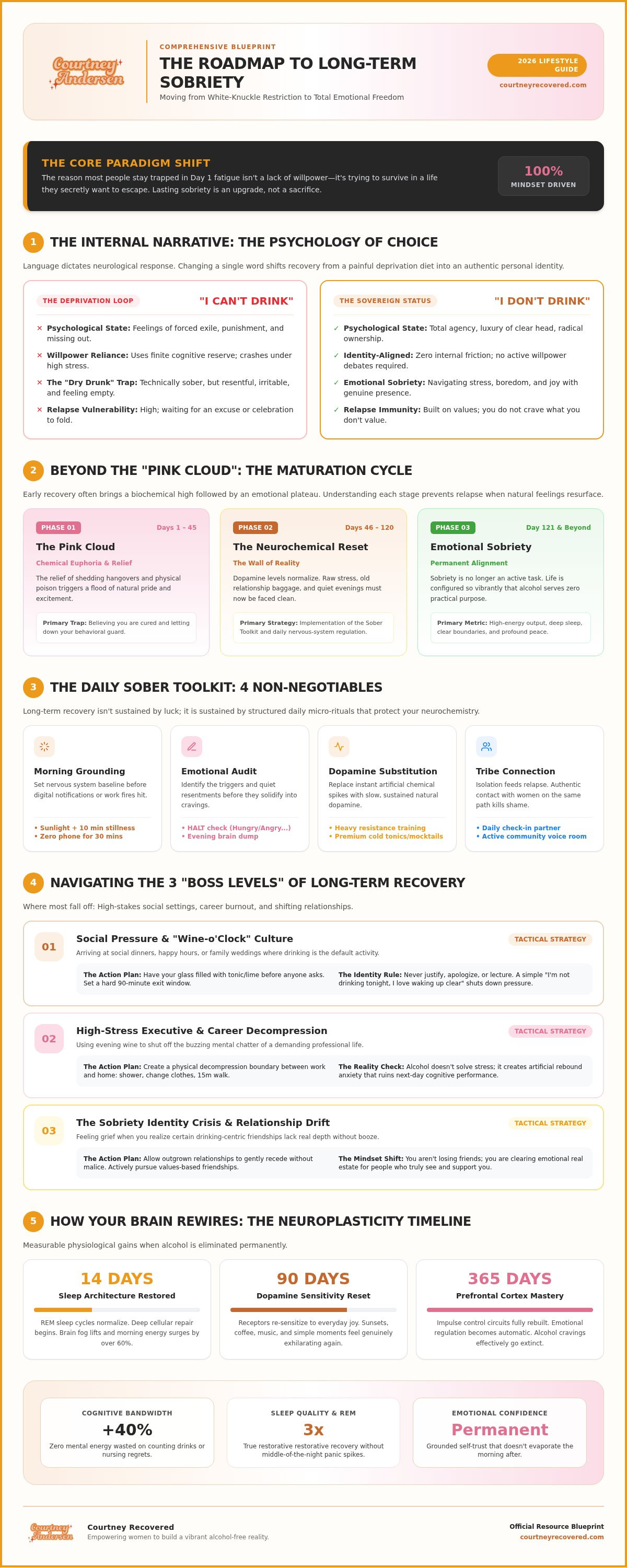
At first, you might hit the "Pink Cloud." This is that floaty, euphoric feeling where everything seems amazing because you've finally stopped the poison. But the cloud always fades. It's a natural chemical reset, and when it disappears, you're left with your life exactly as it was, just without the numbing agent. This is where the magic happens. You stop just surviving and start the real work of building a life you don't need to escape.
The Difference Between 'Not Drinking' and Being Sober
There's a massive gap between white-knuckling your way through a wedding and actually being sober. Willpower is a finite resource; eventually, it runs dry. If you're just "not drinking," you're likely to fall into the "Dry Drunk" trap. You're technically sober, but you're still angry, stuck, or miserable because the underlying "why" hasn't changed. Long-term sobriety means aligning your actions with your highest self.
Why the 'Stop-Start' Cycle Happens (And How to Break It)
Most people get stuck in the "Day 1" loop because they focus on what they're losing rather than what they're gaining. This cycle is especially common in Gray Area Drinking: when your habit becomes a Burden, the pain isn't loud enough to force change, but the quiet desperation is soul-crushing. To break it, you have to move from a "quitting" mindset to a "becoming" mindset.
Learning how to stay sober long term involves understanding cognitive-behavioral relapse prevention models to identify the emotional triggers that send you back to the start. When you stop trying to "quit" a bad habit and start "becoming" the woman who doesn't need it, the cycle finally breaks for good. You're not losing a drink; you're gaining your life back.
The Identity Shift: Moving from 'I Can't Drink' to 'I Don't Drink'
Your internal narrative is the single most important predictor of your success. If you spend your energy telling yourself you "can't" have a drink, you're living in a state of constant deprivation. That’s exhausting. Long-term success happens when you flip the script and realize you simply "don't" drink. This isn't just a linguistic tweak; it’s a total reclamation of your power. In 2026, sobriety has become a badge of luxury, clarity, and high-performance living. It’s the ultimate choice for the woman who refuses to play her life on hard mode anymore.
Reclaiming the word "sober" means seeing it as a status symbol rather than a sacrifice. When you show up to a high-stakes meeting or a Friday night dinner with total presence, you're operating from a place of strength that booze could never provide. Of course, this shift often triggers a "Sobriety Identity Crisis" when your friends are still stuck in the wine-o-clock culture. That is where tough-love realism comes in. You have to acknowledge your past without letting it dictate your future. You aren't "recovering" from a fun habit; you're evolving into a version of yourself that no longer requires a chemical buffer to handle reality.
Ditching the 'Alcoholic' Label (If It Doesn't Serve You)
For many high-functioning or gray area drinkers, the word "alcoholic" feels like a heavy, clinical cage that doesn't quite fit. If that label keeps you stuck in shame, drop it. You can choose an identity that actually inspires you. Instead of focusing on what you were, focus on who you are: a woman who values her energy, her sleep, and her mental real estate. By following NIAAA guidance on long-term recovery support, you can build a lifestyle that prioritizes your well-being without adopting a label that feels like a life sentence.
Rewiring Your Brain for a Vibrant Alcohol-Free Life
Your brain is a masterpiece of neuroplasticity. When you stop flooding your system with artificial dopamine spikes from alcohol, your brain eventually learns to enjoy the "real" stuff again: a killer sunset, a deep conversation, or the rush of a morning workout. This is the ultimate sobriety mindset shift. You stop seeing alcohol as the thing that adds flavor to life and start seeing it as the thief that takes your vibrancy away. Sobriety is the ultimate life hack for professional and personal success because it gives you back the one thing you can't buy: time. If you're tired of generic advice and want a personalized roadmap to make this shift stick, 1:1 Sobriety Coaching can help you navigate your specific triggers and goals.
Your Long-Term Sobriety Toolkit: Daily Habits for Permanent Change
Thinking about how to stay sober long term can feel like staring at a mountain peak from the base. It’s daunting if you only look at the "forever" part. The secret is in the daily maintenance. You need a Sober Toolkit. This isn’t a clinical exercise; it’s your personal gear for navigating a world that’s obsessed with happy hours. To keep your momentum, you have to treat your sobriety like the high-value asset it is. That means showing up for yourself even when the initial excitement has worn off.
Practical Daily Maintenance: The Non-Negotiables
Your morning and night routines bookend a successful day. In the morning, you set the vibe. At night, you process the stress. For the modern professional, the H.A.L.T. method (Hungry, Angry, Lonely, Tired) is your first line of defense. Before you entertain a craving, ask yourself if you’ve actually eaten or if you’re just drained from back-to-back meetings. Harvard Health highlights healthy habits to avoid relapse, and for us, that means consistent self-check-ins. Using a daily guide like the Sober Vibes Book keeps your perspective fresh so you don't drift into autopilot mode. Daily accountability check-ins matter just as much in year three as they did on day three; they keep the "why" alive.
Building Your 'Sober Social' Scripts
The "Boss Levels" of sobriety usually happen at social events. You need scripts. When someone asks why you aren't drinking, you don't need a medical history ready. "I'm retired from drinking" or "I’m on a massive health kick" works perfectly. If you’re facing the "Bachelorette Party" test, don’t go in empty-handed. Pack a literal toolkit in your purse: your favorite AF (alcohol-free) beverage, a charged phone to text your accountability partner, and a clear exit plan. Knowing how to stay sober long term means being the most prepared person in the room. Continuous education through "Quit-Lit" ensures you never forget that alcohol was the thing holding you back. For a full list of what to keep on hand, dive into The Best Sobriety Tools and Resources to Kickstart Your Alcohol-Free Life in 2026.
Navigating the 'Boss Levels': Relationships, Loneliness, and Emotional Sobriety
Once you’ve cleared the first few months of sobriety, you hit what I call the "Boss Levels." This is where the physical cravings have faded, but the real work of emotional sobriety begins. Emotional sobriety is your ability to feel your feelings, even the messy ones like rage, grief, or boredom, without reaching for a bottle to numb them out. Learning how to stay sober long term means mastering the art of emotional regulation. It’s about building a nervous system that can handle a high-stakes board meeting or a toddler’s tantrum without needing a chemical buffer.
The "Sober and Lonely" phase is a common hurdle during this transition. You might feel like you’ve lost your social identity, but this period is actually a bridge. You are clearing out the noise of drinking culture so you can finally hear your own life again. This is a time for deep self-trust and radical honesty. If you want to see what’s waiting for you on the other side of this bridge, dive into our guide on Life After Sobriety: Build a Life You Don't Need to Escape.
Healing Relationships (And Knowing When to Walk Away)
Sobriety is a truth serum for your relationships. You’ll quickly discover which "drinking buddies" were only there for the booze and which friends are truly in your corner. Setting boundaries with people who aren’t supportive isn't mean; it’s self-preservation. In your marriage, the shift can be intense. Navigating intimacy and connection without liquid courage feels vulnerable at first, but the depth you’ll find when you’re fully present is a total game-changer. And for the parents out there, sober parenting is the greatest gift you can give your kids. You aren't just physically in the room; you’re emotionally available for the bedtime stories, the nightmares, and the quiet moments that used to blur together.
The After: Maintaining Momentum After the First Year
Reaching your first sober anniversary is a massive win, but it’s also where the "complacency trap" hides. You might start to feel "cured" and think you can handle just one glass at a wedding. This is exactly why The After program is essential. It’s designed to help you navigate the complex emotional landscape that shows up in year two and beyond. You move from the survival mode of early recovery into a phase of true thriving. This is the time to set big, audacious sober goals, like launching that business or training for a marathon. If you’re ready to stop just surviving and start living a life that feels like a permanent upgrade, join us in the Sobriety Circle for the high-energy community and support you need to make it stick.
The Power of Community: Why You Can’t Do This Alone
Isolation is the absolute enemy of progress. You can read every book on the shelf and listen to every podcast available, but if you're trying to do this in a vacuum, you're playing on expert mode for no reason. Figuring out how to stay sober long term becomes infinitely easier when you have a tribe that actually gets it. In 2026, we've moved past the somber, basement-meeting vibe of the past. We're building communities that are as vibrant and high-energy as the lives we're creating. This isn't about sitting in a circle and talking about how hard life is; it’s about celebrating how good life has become.
A clinical support group might give you the "what" of recovery, but a vibrant community gives you the "vibe." You need people who speak your language, understand your professional drive, and know exactly what it’s like to navigate a dry wedding without feeling like a charity case. When you find your people, sobriety stops feeling like a secret you're keeping and starts feeling like a club you're proud to belong to. It’s the difference between surviving and truly belonging.
The Sobriety Circle: Your Online Support System
The Sobriety Circle is your digital home for ongoing accountability and real-deal friendship. This membership-based community is where the magic happens between the big milestones. It’s about breaking that exhausting relapse cycle through our Stop Starting Over approach. With peer support that mirrors your lifestyle and ambitions, you don't just stay sober; you thrive. Learn more about finding your tribe in Sober Community Online: Finding Your Vibe and Your People in 2026.
1:1 Sobriety Coaching: The Fast Track to Freedom
While group energy is incredible, sometimes you need a personalized roadmap that hits your specific pain points. That is where 1:1 coaching comes in. Think of it as the "tough love" mentorship you need to break through plateaus and design a life that fits your unique goals. My coaching isn't just about abstinence; it’s about lifestyle design. We look at your career, your boundaries, and your big dreams to ensure your alcohol-free life is a permanent upgrade. If you're ready to take a deep dive into your potential, check out 1-on-1 Sobriety Coaching: Your Personalized Roadmap to a Vibrant, Alcohol-Free Life. You don't have to figure out how to stay sober long term by trial and error. You can follow a proven path with someone who has already walked it.
Your Vibrant, Alcohol-Free Future Starts Now
You've learned that the secret to staying sober long term isn't restriction; it's expansion. By shifting your identity from "I can't" to "I don't," you reclaim your power and your mental real estate. We've covered the essential daily tools and the emotional grit needed to navigate the "Boss Levels" of life with total clarity. Sobriety is the ultimate upgrade, and you're finally ready to live a life that doesn't require a chemical escape hatch to survive the weekend.
You don't have to do this alone. As the author of the Sober Vibes Book and founder of the community voted the #1 Sober Community for Professional Women, I’m here to lead the way. Whether you need expert 1:1 coaching with Courtney Andersen or the high-energy connection of our tribe, the roadmap is ready for you. Ready to stop starting over? Join the Sobriety Circle and find your vibrant alcohol-free life today.
You've got this, and the best version of your life is just one brave choice away. It's time to stop surviving and start thriving.
Frequently Asked Questions
How do I stay sober long term without AA?
You find a modern, community-based approach that focuses on lifestyle design rather than just abstinence. Programs like the Sobriety Circle offer peer support and high-energy connection without the clinical feel of traditional 12-step meetings. By focusing on personal growth and identity shifts, you can build a sustainable lifestyle. It's about finding what resonates with you, whether that is 1:1 coaching or structured digital programs that celebrate your evolution and personal power.
What is the hardest month of sobriety to get through?
Many people find months three through six the most challenging. This is often when the euphoria of the "Pink Cloud" fades and reality sets in. You've cleared the initial physical hurdle, but the deeper emotional work begins. This is when you might feel "cured" and tempted to test the waters. Staying connected to a mentor or a supportive tribe is crucial during this period to maintain your momentum and focus.
How do I deal with sober loneliness in my first year?
Loneliness is often a sign that your old social life was built on a shaky foundation of booze. To move through it, actively seek out people who share your new values. Joining a vibrant online community provides immediate connection with women who understand the transition. Instead of mourning the loss of drinking buddies, focus on building deep, authentic relationships that don't require a chemical buffer to feel connected.
Can I ever drink moderately again after being sober for a year?
For most who have struggled with a stop-start cycle, the idea of moderate drinking is a trap that leads back to old habits. One year of sobriety is a massive achievement, but it doesn't change how your brain reacts to alcohol. Instead of trying to moderate, focus on the freedom you've gained. Most find that the mental energy required to moderate is far more exhausting than simply choosing a vibrant, alcohol-free life.
How do I handle social events like weddings or bachelorette parties while sober?
Preparation is your best friend for high-pressure events. Always have a non-alcoholic drink in your hand so people don't ask what you're drinking. Arrive with a clear exit plan and a sober script ready for when people get pushy. If the event feels too risky for your current stage, it's okay to say no. Protecting your peace is more important than attending a party where you'll feel miserable or tempted to slip.
What are the best daily tools for maintaining long-term sobriety?
A comprehensive Sober Toolkit is essential for daily maintenance. This includes a mix of morning routines, evening reflections, and practical resources like the Sober Vibes Book. Consistent check-ins with an accountability partner or a coach keep your "why" fresh and your goals in sight. Using these tools daily helps you build a life you don't need to escape, turning sobriety from a chore into a lifestyle gain you actually enjoy.
Why do I keep relapsing even when I really want to stay sober?
Relapse often happens because you're relying on willpower alone instead of shifting your underlying identity. If you still see alcohol as a reward or a necessity for stress, your brain will eventually find a way back to it. Breaking the cycle requires a structured approach like the Stop Starting Over program. You need to address emotional triggers and build a supportive environment that makes how to stay sober long term feel natural rather than forced.
What is emotional sobriety and why does it matter?
Emotional sobriety is the ability to navigate life's highs and lows without needing a drink to regulate your mood. It means building the resilience to sit with discomfort, boredom, or joy while staying fully present. This is the ultimate goal of recovery because it provides true freedom. Programs like The After focus specifically on this stage, helping you master how to stay sober long term by cultivating deep self-trust and emotional intelligence.
I want you to feel sober NOT boring!
Kickstart your sobriety with my free 2-day video workshop series to master your sober mindset and have FUN in your sobriety journey!


