
Sobriety Journal Prompts: 50+ Questions to Fuel Your Vibrant Alcohol-Free Life
Oct 19, 2026
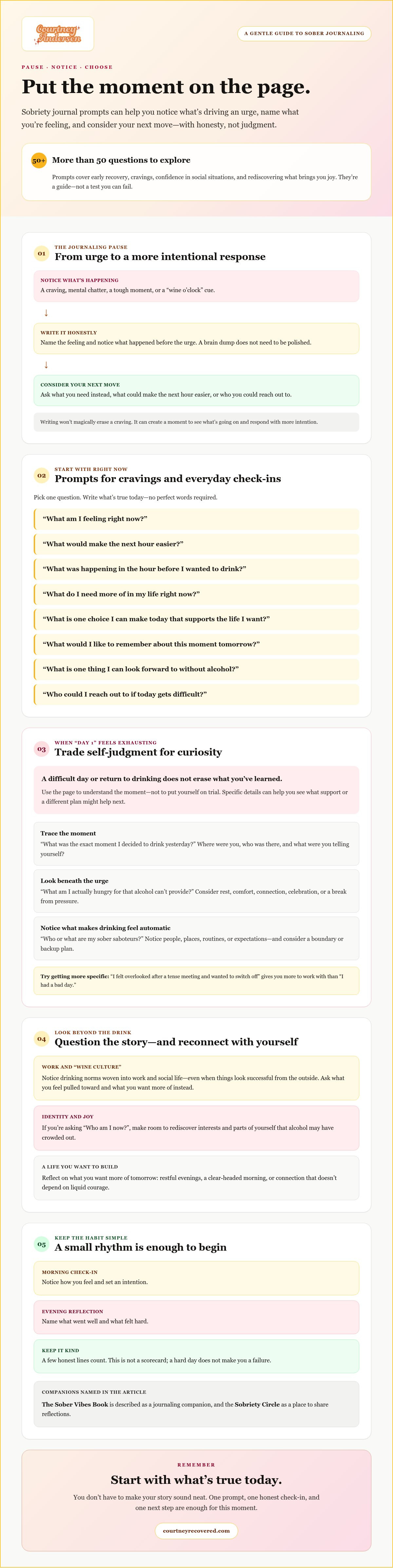
What if your journal could do more than replay what went wrong? The right sobriety journal prompts can help you spot what’s driving a craving, name what you’re feeling, and choose your next move with a clearer head. If you’re wondering, “What should I write about to help me stay sober today?” start with what’s happening right now. No perfect words required.
Maybe a return to drinking has you calling yourself a failure. Maybe “wine o’clock” culture makes sobriety sound like one long list of things you’re missing. Without alcohol, you might also be asking, “Who am I now?” Those feelings are real, but they don’t define your whole story. Your journal can help you meet yourself with honesty, not judgment.
Inside, you’ll find more than 50 questions to help you navigate early recovery, work through cravings, feel more confident in social situations, and rediscover what brings you joy. Think of them as a guide, not a test you can fail. Pick one prompt, write what’s true today, and let that be your next step toward an alcohol-free life.
Key Takeaways
- Use sobriety journal prompts to uncover what’s behind the urge to drink and respond with more intention.
- Explore the feelings beneath the “Day 1” cycle without turning a setback into a verdict on yourself.
- Question the drinking norms woven into work and “wine culture,” even when life looks successful from the outside.
- Reconnect with interests and parts of yourself that alcohol may have crowded out.
- Build a simple journaling rhythm, with the Sober Vibes Book as a companion and the Sobriety Circle as a place to share reflections.
Why Journaling is Your Secret Weapon for a Vibrant Sober Life
Your mind can get loud when you’re changing your relationship with alcohol. Maybe you’re replaying last night, bargaining with yourself about a drink, or wondering why you feel pulled toward wine when your life looks fine on paper. Put it all on the page. A brain dump doesn’t need to be polished. It can help you get the mental chatter out of your head, see what’s going on, and make room to consider your next move.
Writing can give you a moment between feeling an urge and acting on it. Name what’s happening, notice what came before it, and consider what you need instead. That pause won’t magically erase a craving, but it may help you respond more intentionally. The overview of Writing therapy offers context on expressive writing and putting difficult experiences into words.
The “GPS” Analogy: Navigate Life Without the Fog
Sober journaling is a practical way to track what you feel, spot roadblocks, and choose your next turn with intention. Think of each entry as a quick check-in with your emotional map. What happened before the urge? Were you lonely, overwhelmed, celebrating, or surrounded by “wine o’clock” cues? Seeing patterns on paper can help you prepare for a tricky moment. Start with one of these sobriety journal prompts: “What am I feeling right now?” or “What would make the next hour easier?”
This shifts you from trying to fix a problem to thinking about the life you want to build. Instead of recording only what went wrong, reflect on what you want more of tomorrow: restful evenings, a clear-headed morning, or connection that doesn’t depend on liquid courage. Honest reflection can also give a 1 on 1 sobriety coaching journey a clearer starting point. You don’t have to make your story sound neat. Start with what’s true.
- “What was happening in the hour before I wanted to drink?”
- “What do I need more of in my life right now?”
- “What is one choice I can make today that supports the life I want?”
- “What would I like to remember about this moment tomorrow?”
- “What is one thing I can look forward to without alcohol?”
- “Who could I reach out to if today gets difficult?”
Non-Clinical Benefits: More Than Just “Recovery”
A journal can help you reclaim time and attention that once went into the wine-o’clock loop. Use a morning entry to notice how you feel and set an intention; use an evening one to name what went well and what felt hard. As alcohol-free routines take shape, you may notice changes in sleep, skin, or focus, though everyone’s experience is different. The point isn’t to chase a perfect glow. It’s about building a routine and social life that feel like yours, without needing a drink to get started.
Keep it simple: a few honest lines count. These reflections aren’t a scorecard, and a hard day doesn’t make you a failure. They’re a way to notice your needs, recognize small wins, and keep shaping a life you don’t need to escape from.
Prompts for the Early Days: Breaking the "Day 1" Cycle
Starting over can feel exhausting. But a difficult day or a return to drinking doesn’t erase what you’ve learned. It can help you see where you need more support or a different plan. If you’re tired of starting over with sobriety, use your journal to get curious instead of piling on shame. What was happening just before you drank? What emotion were you hoping to numb: loneliness, stress, anger, boredom, or something else?
Be specific. “I had a bad day” may be true, but “I felt overlooked after a tense meeting and wanted to switch off” gives you more to work with. The University of Rochester Medical Center explains how journaling can help people manage stress and emotions. Writing down your experience won’t solve everything, but it can help you recognize what’s going on and decide what support or action might help next.
Stopping the Relapse Loop
Try these sobriety journal prompts without editing yourself. The goal is to understand the moment, not put yourself on trial.
- “What was the exact moment I decided to drink yesterday?” Trace the choice back: where were you, who was there, and what were you telling yourself?
- “What am I actually hungry for that alcohol can’t provide?” Maybe it’s rest, comfort, connection, celebration, or a break from pressure.
- “Who or what are my sober saboteurs?” Notice the people, places, routines, or expectations that make drinking feel automatic. What boundary or backup plan could help next time?
- “How do I want to feel tomorrow morning at 7:00 AM?” Picture that version of tomorrow, then name one choice tonight that supports it.
A return to drinking is information, not a destination. Let that remind you to learn from the pattern without turning it into a label for who you are. If the same cycle keeps repeating, Stop Starting Over is a program focused on breaking relapse cycles.
Quick-Fire Morning Prompts for Clarity
Keep your morning check-in short enough to actually do. Ask: “What is my #1 goal for staying alcohol-free today?” and “How will I handle the 5:00 PM itch today?” Write one practical answer, such as changing your after-work routine or reaching out to someone supportive. A few honest lines can help you start the day with a plan instead of letting a craving catch you off guard.
Build the habit into a routine that already exists, like your first cup of coffee or winding down for bed. For more ideas to complement your journaling practice, explore the sobriety resources at Courtney Andersen.
- “What is one situation I want to prepare for today?”
- “What could make my evening feel more manageable?”
- “What is one boundary I want to keep today?”
- “What can I do if my first plan doesn’t work?”
- “What small win from yesterday do I want to carry forward?”
- “What would help me feel supported before the day gets busy?”
Sobriety Journal Prompts for Gray Area Drinkers & High-Performers
You can be successful at work, show up for your family, and still wonder why alcohol feels like a daily reward or release. That tension is worth exploring, not explaining away. Gray area drinking can be hard to name when your life looks “fine” from the outside. Try asking: “If my life is successful, why do I feel like I need this?” Let the answer be complicated. You don’t have to earn permission to look honestly at your relationship with alcohol.
Social scripts can make drinking feel like part of the job description or the parenting uniform: happy-hour rounds, celebratory champagne, or the familiar “mommy wine” joke. Use these sobriety journal prompts to separate your real wants from the expectations around you. What do you enjoy about these rituals? What feels obligatory? When does a drink help you connect, and when does it leave you feeling less present?
The Professional Woman’s Truth
Success can become a convincing mask. You may be meeting deadlines and keeping everything moving while privately feeling stretched thin. Write without trying to make the answer sound impressive:
- “Am I drinking to celebrate my success or to tolerate it?”
- “What boundaries have I let slip because I was too tired or tipsy to hold them?”
- “How does alcohol actually interfere with my leadership or parenting?”
- “What would my career or business look like if I had 100% of my energy back?”
These questions aren’t a verdict on your ambition or your ability to care for others. They’re a chance to notice where your energy goes, what you’re carrying, and what you might want to change. If you’re comfortable sharing, the Sobriety Circle can be a place to bring these reflections into a supportive community.
Deconstructing the “Reward” Myth
A long day deserves care, but care doesn’t have to come with a next-morning cost. Ask: “What does a real reward look like that doesn’t give me a headache tomorrow?” Then try the more revealing question: “If alcohol was a person, how would I describe our current relationship?” Be candid. Is it supportive, demanding, predictable, or does it take more than it gives?
Make a list of five non-liquid ways to decompress. Keep it personal and realistic: a walk with a favorite playlist, a hot shower, a satisfying meal, a funny show, or texting someone who gets you. The point isn’t to replace one rigid rule with another. It’s about discovering rewards that actually feel rewarding and building a version of success that leaves room for you.
- “What do I want a drink to do for me after a hard day?”
- “What else could help me meet that need?”
- “Which work or family situations make drinking feel automatic?”
- “What would I choose if I weren’t trying to meet anyone else’s expectations?”
- “What does being present look like in one part of my day?”
- “What kind of support would make it easier to change this routine?”
The Identity Shift: Who Are You Without the Glass?
Alcohol can take up so much space that it starts to feel like a personality trait or the price of admission to a party. Without it, you might wonder what to say, what to do with your hands, or whether you’re still fun. That uncertainty doesn’t mean you’ve lost yourself. It means you’re getting to know yourself in new situations. After getting sober, journaling can help you rediscover interests you set aside and explore what feels like you now.
Start with a question that reaches back: “What did I love doing as a child before alcohol became my main hobby?” Maybe you loved making things, dancing, exploring outside, or getting lost in a book. You don’t have to pick up the old hobby exactly as you left it. Use the memory as a clue about what brings you curiosity, play, or energy today. Then try: “What is one bold thing I would do if I knew I wouldn’t be hungover tomorrow?”
The “Sober Vibes” Audit
Your identity isn’t a makeover project. It’s a chance to notice which qualities feel more like you when alcohol isn’t setting the mood. Write freely about these sobriety journal prompts:
- “How do I want people to describe me now that I am alcohol-free?”
- “What parts of my personality are actually better when I’m sober?”
Think beyond “more productive.” Maybe you’re more present, playful, dependable, or willing to speak your mind. There’s no one right sober vibe. Let your answers point toward a version of you that feels vibrant and optimistic, not a character you have to perform.
Socializing and Connection
Parties can bring up a specific worry: “Who am I at a party when I’m not the life of the bar?” Give yourself permission to find out gradually. You might prefer a smaller gathering, a one-on-one conversation, or leaving when you’re ready. Ask, “Who in my life truly supports my vibrant, sober self?” and “How can I show up more authentically in my sober community online?” A genuine comment or an honest share can be a small way to build connection without pretending you have it all figured out.
Sobriety can give you room to connect as yourself, remember the moments, and choose the kind of fun that fits. Want support as you explore this next chapter? Explore sobriety support from Courtney Recovered.
- “What do I want to feel when I leave a social event?”
- “Which settings make it easier for me to be myself?”
- “What could I say if someone asks why I’m not drinking?”
- “What would make it easier to leave when I’m ready?”
- “What interests would I like to make room for again?”
- “What is one new alcohol-free activity I’m curious to try?”
Building Your Sober Toolkit: How to Make the Habit Stick
A journaling habit doesn’t need a perfect notebook, a poetic voice, or a wide-open hour. It needs a repeatable moment. Pair a quick check-in with something you already do, like morning coffee or winding down at night. Morning writing can help you name what you need for the day; an evening entry gives you a place to reflect on what challenged you and what you handled well.
The Sober Vibes Book can be a companion for your daily practice, helping you return to reflection when you’re not sure what to write. Journaling can also work alongside the Sober Toolkit: use a prompt to pause, name what’s happening, and consider which tool or next step could support you through a craving in real time. Writing doesn’t have to make the feeling disappear. It can help you respond with more intention.
Creating a Ritual, Not a Chore
Make the setting inviting: coffee, a candle, or a quiet corner can signal that this time is yours. Then skip the performance. Five minutes of unfiltered writing can be more useful than 30 minutes spent trying to sound calm, polished, or “grateful enough.” Put down what you actually think. Tough love means being honest, not mean to yourself.
Once a week, look back through your entries and ask: What situations keep showing up? What helped me get through a hard moment? What do I want to try differently? The Stop Starting Over program focuses on breaking relapse cycles, and reviewing your writing can help you spot patterns to bring into that work. Your notes aren’t a grade. They’re clues.
Next Steps: From Paper to Practice
Choose one of these sobriety journal prompts and answer it today: “What do I need most right now?” or “What’s one action that would make tonight feel more supportive?” Keep your response honest and practical. If a craving is loud, write what triggered it, what you’re feeling, and what you’ll do next. Small check-ins count.
For more support around your alcohol-free life, explore the Sober Toolkit. The Sobriety Circle offers a membership community and shared resources, making it a place to share reflections, feel less alone, and learn from others’ experiences. Pick one prompt, write a few real sentences, then consider sharing what you noticed with someone who gets it. That’s how a private reflection can become part of your everyday practice.
Keep Your Sober Momentum Going
Your journal can help you catch patterns, explore what you want from an alcohol-free life, and reconnect with the parts of yourself that deserve more room. The best sobriety journal prompts aren’t the ones that sound impressive. They’re the ones that help you tell yourself the truth and choose one supportive next step.
Start small: pick a prompt, write honestly, and notice what you learn. You can use the Sober Vibes Book as a companion to your practice, with prompts featured in the Sober Toolkit and used by members of the Sobriety Circle. Sober coach Courtney Andersen designed the book, bringing a lived-experience perspective to your reflection.
You don’t need to have your whole new life figured out today. One page, one honest answer, one choice at a time. Explore the Sober Vibes Book and start your journaling practice. Your alcohol-free life can hold more clarity, connection, and joy than you may imagine. Keep going.
Frequently Asked Questions
Do I have to journal every single day for it to work?
No, you don’t have to journal every day. A routine can make it easier to check in with yourself, but missing a day isn’t failure and doesn’t erase what you’ve learned. Write when it feels useful, such as before a social event, during a craving, or after a challenging day. Even a few lines can help you notice what you’re feeling and what might support you next.
What if I am afraid of someone reading my sobriety journal?
It makes sense to want privacy for personal thoughts. Choose a format and storage spot that feel secure, such as a notebook kept in a private place or a digital journal protected by your device’s passcode. You can also write in shorthand, avoid identifying details, or delete entries after reflecting on them. Your journal is for you; you get to decide what stays on the page and what you share.
Is journaling better than going to an AA meeting?
They serve different purposes, so journaling isn’t automatically better than attending an AA meeting. Writing gives you private space to explore thoughts and patterns, while a meeting can offer connection and the chance to hear from others. Some people use one, the other, or both as part of their support. Consider what you need right now, and remember that a journal doesn’t have to replace human connection.
How long should my journal entries be?
Your entry can be as short as a few sentences. There’s no required length, and you don’t need to write a polished story. Try answering one question, naming what you feel, and adding one next step. For example: “I’m anxious about dinner. I’m worried I’ll feel awkward. I’ll bring a nonalcoholic drink and text a friend beforehand.” If you have more to say, keep going. If not, you’re done.
What is the best time of day to use these sobriety prompts?
The best time is when you’re most likely to use them. A morning check-in can help you set an intention for the day, while an evening entry gives you space to reflect on what felt easy or challenging. You can also reach for sobriety journal prompts when a craving or social situation brings up questions. Try a time that fits your routine, then adjust if it feels like a chore.
Can I use a digital journal or is pen and paper better?
Either works. Choose the format that feels easy to access and comfortable to use. A notebook may help you slow down and write without notifications; a digital journal can be convenient if your device is nearby. Consider privacy, too: use a passcode for digital entries or store a paper journal somewhere private. The best option is the one that lets you be honest and return to your reflections.
What should I do if a prompt makes me feel triggered or upset?
Pause and stop writing if a prompt feels too intense. You don’t have to push through or finish the answer. Take a moment to orient yourself, notice what’s around you, and choose a gentler question, such as “What would help me feel supported right now?” If the feelings remain overwhelming, consider reaching out to someone you trust or a support person. You’re allowed to set the pace.
How do I know if my journaling is actually helping my recovery?
Look for practical changes, not perfect pages. You might start recognizing situations that bring up urges, naming feelings sooner, or planning ahead before a difficult moment. Review a few entries and ask whether they’re helping you understand yourself or choose supportive next steps. If you’re not noticing a benefit, try shorter entries or different prompts. Journaling can support your efforts, but it doesn’t have to be your only source of support.
I want you to feel sober NOT boring!
Kickstart your sobriety with my free 2-day video workshop series to master your sober mindset and have FUN in your sobriety journey!


