
Sobriety Coach: Why a Personalized Mentor is the Secret to Long-Term Freedom in 2026
Jul 22, 2026
What if the hardest part of staying sober isn't actually "not drinking," but figuring out who you are once the glass is empty? You've probably mastered the art of being a "functional" drinker, but you're secretly exhausted by the mental gymnastics of managing your habit alone. You want freedom, but the thought of sitting in a sterile, somber basement sharing your lowest moments feels more like a punishment than a solution. This is exactly where a sobriety coach enters the chat to flip the script on what recovery actually looks like.
I agree that the traditional path often feels like it's missing a pulse. It's lonely to white-knuckle your way through social events while everyone else seems to have the manual for "normal" living. This article will show you how personalized mentorship bridges the gap between clinical treatment and a life of real-world vibrancy. You'll learn why a mentor is your shortcut to a joyful, sustainable identity that goes way beyond just being the person who doesn't drink. We're diving into the modern tools and accountability structures that turn sobriety into your greatest lifestyle upgrade yet.
Key Takeaways
- Learn why a sobriety coach is the ultimate lifestyle partner for turning your alcohol-free goals into a vibrant, daily reality.
- Discover how to break out of the high-functioning trap where your success masks an internal exhaustion that's holding you back.
- Understand why practicing sobriety in your real life is more powerful than trying to find your footing inside a temporary rehab bubble.
- Identify the five specific signs that you're ready to stop the moderation games and embrace a life of unapologetic clarity.
- See how shifting your perspective can turn sobriety into a celebratory lifestyle upgrade instead of a somber medical requirement.
Beyond the Clinical: What Exactly is a Sobriety Coach?
Let's get one thing straight: a sobriety coach isn't a doctor, a therapist, or a judge. Instead, think of them as a professional partner who helps you navigate the messy, beautiful, and often confusing daily reality of living alcohol-free. While clinical settings focus on the "why" of your past, a coach focuses on the "how" of your future. A sobriety coach is a lifestyle architect for your alcohol-free future.
Most people think sobriety is just about the absence of a bottle. That is a reactive way to live, and honestly, it's exhausting. We are interested in a proactive approach. It is about moving from "not drinking" to "thriving" in a way that makes your old life look like a low-resolution version of the current one. Recovery coaching acts as the bridge between the clinical "you're safe now" and the real-world "you're actually living now." You aren't just surviving the weekend; you're designing a life you don't feel the need to escape from.
The Difference Between a Coach and a Sponsor
This is a major point of confusion. A sponsor is typically a volunteer from a 12-step tradition who helps you through a specific set of steps based on peer support. They are incredible, but they aren't professionals. A coach is a paid expert with clear professional boundaries and a focus on your specific lifestyle goals. We don't just talk about past inventory; we design your future. Instead of just "don't drink today," we use structured programs and tools like the Sober Toolkit to build a sustainable, customized routine. It is the difference between having a friend help you move and hiring a professional interior designer to transform your entire living space.
Why the Non-Clinical Approach Works
Ditch the "patient" label immediately. You aren't broken; you're just evolving. Many of my clients fall into the category of gray area drinking. You haven't lost everything, but you have definitely lost your spark. The non-clinical approach works because it feels like a conversation with a cool older sister who has already navigated the terrain. It is authority built on lived experience rather than a sterile white lab coat. By removing the medical atmosphere, we make room for a celebratory, high-energy lifestyle. Here is what that looks like in practice:
- Mindset Shifts: Swapping the "I can't drink" misery for "I don't drink" power.
- Practical Strategy: Mapping out exactly how to handle that high-stakes work happy hour or the first dry vacation.
- Future-Oriented Design: Identifying the hobbies, connections, and goals that alcohol was previously drowning out.
This isn't about looking back at your darkest days with a magnifying glass. It is about looking forward at your brightest days with a roadmap in hand. We are turning the lights on, not just boarding up the windows.
The High-Functioning Trap: Why You Need a Coach, Not Just a Helpline
You have the career, the family, and the social standing. On paper, your life is a masterpiece. Because you are so "functional," you use your success as a shield to protect your drinking habit. You tell yourself that if things were really bad, you wouldn't be this productive. This is the high-functioning trap. It is a lonely, silent place where you are too successful for a standard helpline but too exhausted to keep going like this. A sobriety coach understands that your success doesn't mean you aren't struggling; it just means you are very good at hiding it.
Clinical helplines often feel far too extreme for someone who still has their life intact. You don't need a crisis operator to talk you off a ledge; you need a strategist to help you off the hamster wheel. While general practitioners might miss the subtle signs of an escalating habit, a coach identifies the "gray area" patterns that are draining your battery. Recent research on peer recovery coach training validates the power of lived experience in creating lasting change, proving that a mentor who has been in your shoes offers a level of insight that clinical models often lack.
Identifying Gray Area Drinking Patterns
Gray area drinking is that uncomfortable space between "socially acceptable" and "out of control." It is the reward drink after a long meeting that somehow turns into a bottle every night. It is the persistent anxiety-alcohol loop that keeps you tired of starting over every Monday morning. Being functional is a dangerously low bar for a vibrant life. We aren't aiming for "just getting by." We are aiming for a level of clarity that makes your current "success" look like a warm-up act.
Accountability for the Woman Who Has Everything
If you are a high-performer, you already value coaching in other areas of your life. You have a business mentor, a fitness trainer, or a financial advisor. Why should your relationship with alcohol be any different? Working with a sobriety coach provides the high-level accountability and professional confidentiality you need to break the isolation of the "secret" struggle. It turns the vague "I should stop" into a structured, celebratory plan that fits into your existing lifestyle without blowing it up. Here is what this partnership offers:
- Elite Confidentiality: A safe space to be honest without the fear of clinical labels or judgment.
- Strategic Planning: Tools to navigate high-stakes work events and social circles where drinking is the norm.
- Identity Evolution: Moving beyond "the person who doesn't drink" to becoming the most powerful version of yourself.
You don't have to wait for everything to fall apart before you decide to make it better. If you are ready to trade the secret struggle for a life of unapologetic vibrancy, exploring 1:1 Sobriety Coaching is the strategic move your future self is waiting for.
Recovery Coaching vs. Rehab: Finding the Right Fit for Your Lifestyle
Choosing between rehab and a sobriety coach isn't just about the price tag; it is about the environment where you want to do the work. Traditional rehab is a "bubble." It is a controlled, sterile space where alcohol doesn't exist, which makes staying sober relatively easy for thirty days. The problem? Real life doesn't have a security gate. When you step out of that bubble and back into your kitchen, your social circle, and your high-pressure job, the old triggers are waiting for you. A coach, on the other hand, meets you exactly where you are, helping you navigate the real world in real time.
You need to determine if your path requires medical intervention or a total lifestyle transformation. If you are physically dependent and require a medical detox, clinical help is non-negotiable. But if you're a high-performer who is simply stuck in a loop of "wine o'clock" and morning regret, you don't necessarily need a hospital bed. You need a strategy. For many women, choosing recovery coaching not rehab is often the best fit for those in the gray area because it allows you to keep your life intact while you change it.
When Rehab is Necessary vs. When Coaching is Better
Rehab is designed for crisis management and deep clinical trauma. It is an intensive, short-term intervention. Coaching is built for forward momentum and behavioral habit-breaking. While rehab isolates you, a sobriety coach helps you learn how to be sober and social while you're actually at the party, not just talking about it in a group session. We focus on the "now what?" rather than just the "why?" of your past. It is the difference between learning to swim in a classroom versus getting in the pool with a private instructor.
The Flexibility of Online Coaching
In 2026, you don't have to "disappear" for a month to get your life together. Online coaching fits into your existing schedule, allowing you to access global expertise from your living room. This isn't just about convenience; it is about immediate application. When you have a coaching session at 10:00 AM and a high-stress lunch meeting at 12:00 PM, you can apply the tools we just discussed instantly. You get to practice being the new version of yourself in your actual environment, which is how long-term freedom truly sticks. You don't need a retreat; you need a roadmap that works in your real, busy, beautiful life.
- No "Gap" in Your Life: You don't have to explain a 30-day absence to your boss or family.
- Real-Time Support: Tools are applied to your actual triggers as they happen.
- Sustainable Growth: Long-term mentorship builds habits that last years, not just weeks.
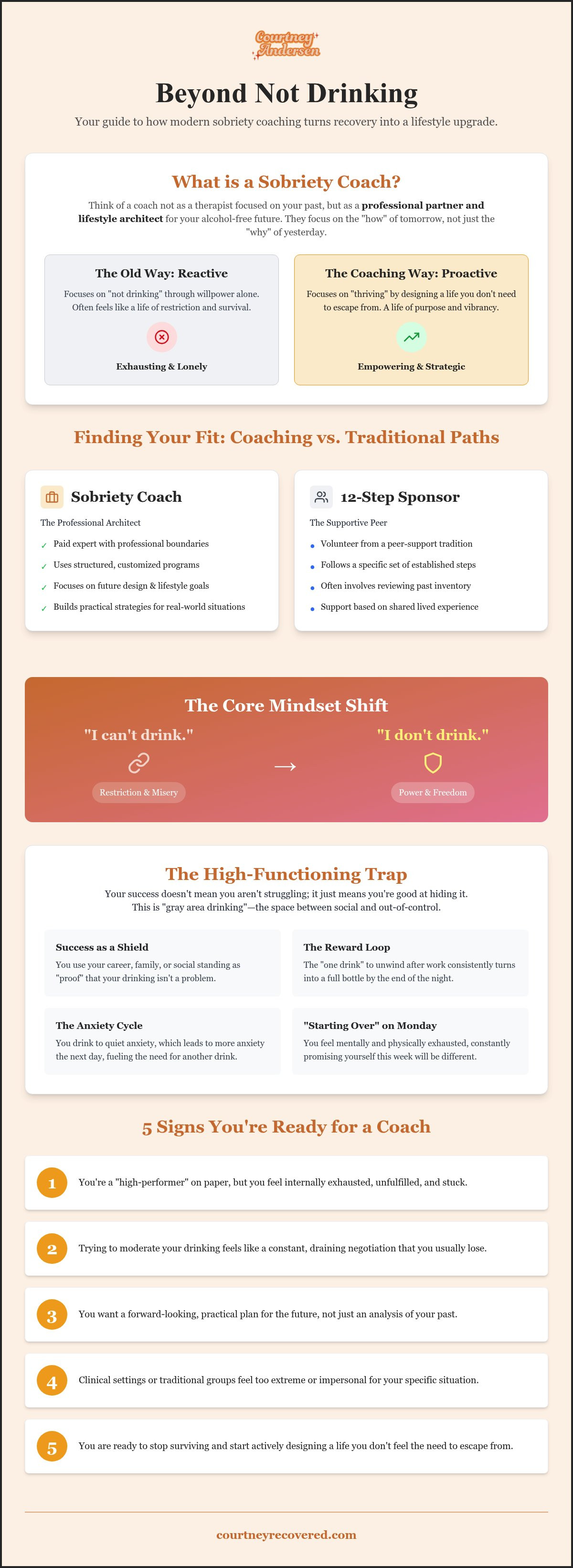
5 Signs You’re Ready to Invest in a Professional Sober Coach
Deciding to work with a sobriety coach isn't a sign that you've hit rock bottom. It is a sign that you've hit a ceiling. You are doing well, but you know you could be doing better if you weren't dragging a suitcase full of empty wine bottles behind you. If you are waiting for a "moment of clarity," this is it. Here are five unmistakable signs that you are ready to trade the DIY struggle for professional mentorship.
- The "Moderation" Game is Exhausting: You've tried the "only on weekends" rule or the "two-drink limit," and you've realized that negotiating with yourself is a full-time job you're ready to quit.
- You’re Physically Present but Mentally Absent: You are at the dinner table or in the boardroom, but you’re secretly calculating how much is left in the bottle or when you can get the next pour.
- You’re a "Day 1" Expert: You are great at starting over on Monday morning, but you lack the proven roadmap to get past the three-week itch or the 100-day milestone.
- You Already Outsource Your Success: You have a personal trainer for your fitness and a consultant for your business. You understand that expert guidance is the fastest way to get results.
- You Want a Party, Not a Funeral: You are done with the somber, "poor me" vibe of traditional recovery. You want a non-clinical space that celebrates your new life rather than mourning your old habit.
Moving Beyond 'Stop-Start' Cycles
Willpower is a finite resource, and if you've been relying on it alone, you're probably exhausted. The relapse loop isn't a failure of character; it is a failure of structure. A sobriety coach helps you shift your mindset from "I have to quit" to "I want to see who I am without this." We move away from the white-knuckle energy of "staying dry" and move toward the vibrant curiosity of discovering your true identity. When you have a mentor, you aren't just trying to stop a bad habit. You are starting a new evolution.
Investing in Your Future Self
It is time to reframe how you look at the cost of change. Coaching fees aren't just an expense; they are an investment in your health, your time, and your mental clarity. Think about the ROI of a sober life: better sleep, deeper relationships, and a career focus that actually moves the needle. You're trading the cost of hangovers and hidden struggles for a life of unapologetic freedom. If you are ready to stop the "someday" talk and start the "today" work, taking the first step is as simple as booking a 1:1 sobriety coaching consultation to map out your new reality.
How Courtney Recovered Rewrites the Sobriety Roadmap
At Courtney Recovered, we don't do "boring." We definitely don't do "somber." Our mission is to flip the script on what it means to be alcohol-free by introducing the vibrant sobriety philosophy. This isn't about deprivation or mourning a lost habit; it is about recognizing that sobriety is a massive gain, not a restrictive loss. When you work with a sobriety coach here, you're trading a blurry, half-present existence for a high-definition reality. We guide you through every stage of the journey, from those shaky early days in our Stop Starting Over program to the expansive freedom of "The After."
The heart of this transformation lies in the 1-on-1 sobriety coaching experience. It is a deeply personalized partnership designed to dismantle the specific barriers holding you back. Whether you're navigating the boardroom or a backyard BBQ, we provide the strategic roadmap to keep you centered and celebrated. Beyond the individual work, we've built the Sobriety Circle, a community of like-minded women who are all choosing clarity over chaos. You don't have to do this alone, and you certainly don't have to do it in the dark.
The Courtney Andersen Approach
Courtney Andersen brings a unique blend of lived experience and professional mentorship to the table. She isn't a detached authority figure; she is the "cool older sister" who has already walked the path and survived the gray area struggle. Her approach is a mix of tough love realism and a celebratory, high-energy spirit. To keep you grounded between sessions, we provide practical tools like the Sober Vibes Book and the Sober Toolkit. These aren't just theoretical guides. They are daily maintenance manuals for your new, vibrant life.
Your Next Step Toward a Vibrant Life
Getting started is as simple as deciding that you deserve better than "functional." Whether you choose the intimacy of 1:1 sessions or the collective energy of the Sobriety Circle, your first 90 days will be focused on radical honesty and radical lifestyle design. You can expect to move from the exhaustion of the "stop-start" cycle to a place of sustainable, joyful momentum. Your best life isn't just waiting for you on the other side of that last drink; it's already calling your name. Take the first step today. We've got the roadmap ready for you.
Your Vibrant Future is One Decision Away
You've spent enough time stuck in the gray area loop, wondering if there's a better way to live. We've explored how a sobriety coach turns the struggle of "not drinking" into the excitement of designing a life you actually love. Whether you're breaking out of the high-functioning trap or looking for a real-world alternative to the rehab bubble, the path forward is about gain, not loss. You deserve a mentor who has walked this path and understands that your success shouldn't come at the cost of your clarity.
As the author of Sober Vibes and the founder of the Sobriety Circle community, I've spent years helping women move from "Day 1" to a permanent, celebratory reality. My approach combines lived sobriety with professional strategy to ensure your new life feels like a massive upgrade. You don't have to navigate this alone or settle for being half-present in your own world. It is time to stop the negotiation and start the evolution.
Ready to stop starting over? Book your 1:1 Sobriety Coaching discovery call here.
Your most vibrant self is waiting just on the other side of this choice. Let's go get her.
Frequently Asked Questions
What exactly does a sobriety coach do during a session?
A coaching session is a high-energy strategy meeting for your alcohol-free life. Your sobriety coach helps you identify triggers for the upcoming week and builds a custom roadmap for social events or high-stress work situations. We use tools like the Sober Toolkit to replace old habits with new, vibrant routines. It's less about dwelling on the past and more about designing a future you actually want to show up for.
Is a sobriety coach the same as a therapist?
No, a coach is not a therapist. While therapists are licensed professionals who treat clinical mental health and deep-seated trauma, a coach is a lifestyle mentor focused on present action and future goals. We don't diagnose or treat medical conditions. Instead, we act as a bridge between your current struggle and the vibrant, connected reality you're building through practical, real-world strategies.
How long do most people work with a sober coach?
Most clients commit to at least three to six months of consistent mentorship. This timeframe allows you to move past the initial white-knuckle phase and into sustainable, joyful habits. Many women choose to continue into "The After" phase for long-term accountability as their life expands. The goal isn't just to stop drinking; it's to firmly establish a new identity where alcohol no longer has a seat at the table.
Can a sobriety coach help me if I've already relapsed?
Absolutely, a coach is often the best resource after a slip. Relapse isn't a sign that you've failed; it's valuable data that shows where your current plan needs more support. We use structured programs like Stop Starting Over to analyze the triggers and build a more resilient foundation. We don't do shame here. We do solutions that get you back on track with more wisdom and better tools.
Does insurance cover the cost of a sobriety coach?
Sobriety coaching is typically not covered by health insurance. Since it's a non-clinical service rather than a medical treatment, most providers won't foot the bill. However, you should check your specific Health Savings Account (HSA) rules. Some plans may allow for wellness services depending on how they are classified, so it's always worth a quick call to your provider to see if you can use those funds.
How do I know if I'm a 'gray area' drinker or if I need rehab?
You probably need rehab if you require a medical detox for physical safety. If you are a high-performer who is functional but secretly exhausted by the mental gymnastics of drinking, you are likely in the gray area. Coaching is designed for women who still have their lives intact but have hit a ceiling. It's for those who want a lifestyle transformation rather than a clinical, hospital-style intervention.
What is the difference between a sobriety coach and an AA sponsor?
A sponsor is a volunteer peer, while a coach is a paid professional. A sponsor focuses specifically on the 12-step tradition and shared experience. A sobriety coach provides a structured, professional partnership that includes lifestyle design, mindset shifts, and personalized tools. While both offer support, a coach provides a level of high-level accountability and strategic planning that mirrors a professional business or fitness mentorship.
Can I work with a sobriety coach while still attending meetings?
Yes, you can absolutely do both. Many women find that the community aspect of meetings works perfectly alongside the personalized strategy of 1:1 coaching. While meetings offer a broad sense of belonging, a coach provides the specific, private deep dives into your unique career and lifestyle challenges. They are complementary tools that can significantly strengthen your foundation for long-term freedom and a life you don't need to escape from.
I want you to feel sober NOT boring!
Kickstart your sobriety with my free 2-day video workshop series to master your sober mindset and have FUN in your sobriety journey!


