
Life After Rehab: Building a Life You Don't Need to Escape
Sep 09, 2026
What if the biggest threat to your recovery isn't a bar or a bad day, but the soul-crushing fear that your new life is actually just a boring version of your old one? You've done the hard work of detox; now you're facing the reality of maintaining sobriety after rehab without a clinical bubble to protect you. It's that specific moment when the "Pink Cloud" finally evaporates. You're left standing at a professional mixer with a lukewarm sparkling water, wondering if you'll ever feel like the life of the party again.
I know that exact knot in your stomach. You're terrified of being the boring friend or losing your edge because you traded cocktails for clarity. It feels like you're stuck in survival mode, just trying to make it to bed without a slip. But here's the truth: sobriety shouldn't feel like a life sentence of restriction. I'll show you how to move past the struggle and build a high-energy, vibrant identity that feels like a massive upgrade. We're diving into a roadmap for managing daily stress, crushing social anxiety, and finding a modern community that actually gets it. It's time to stop just staying sober and start actually thriving.
Key Takeaways
- Learn why the "Pink Cloud" eventually evaporates and how to transition from surviving in a clinical setting to thriving in your everyday life.
- Discover how to build a proactive Sober Toolkit that uses lifestyle design and Quit-Lit to reshape your subconscious beliefs about alcohol.
- Master the "Sober and Social" mindset for maintaining sobriety after rehab, so you can navigate weddings and happy hours with total confidence.
- Identify the "accountability gap" and why trading solo willpower for a professional coach or community is the key to avoiding burnout.
- Move beyond the "recovering" label and step into a vibrant identity that makes alcohol feel like a small, irrelevant part of your past.
The Post-Rehab Reality Check: Why Survival Mode Isn’t a Strategy
You’ve just walked out of those rehab doors with a certificate and a genuine sense of "I’ve got this." But then Tuesday happens. The laundry is piling up, your boss is breathing down your neck, and that clinical bubble you lived in for 30 days feels like a distant memory. This is the post-rehab reality check. Simply surviving the day isn't a long-term strategy for maintaining sobriety after rehab. If you're just white-knuckling your way through the hours, you're not actually free; you're just on a very long, very stressful leash.
The biggest threat to your new life isn't usually a massive crisis. It's the lack of structure. In treatment, every minute was accounted for. In the wild, you have "choice," and choice can be exhausting when you're tired. Many people fall into what I call the "Functional Trap." You’re doing great at work, and your family is finally smiling again, so you think you’ve got it beat. But professional success can mask the internal burnout that leads straight back to the bottle. Understanding the Relapse Prevention Model helps you see that a slip starts in the mind long before you pour the first drink. You have to move from "clinical sobriety," which is just the absence of alcohol, to "vibrant sobriety," which is the presence of a life you actually enjoy.
The "Pink Cloud" Crash and How to Handle It
The Pink Cloud is a physiological and emotional honeymoon phase where your brain is flooded with relief and "new life" dopamine. It’s a beautiful ride, but it usually evaporates around day 30 or 60. When that high-energy buzz fades, you might feel bored, flat, or even irritable. Don't panic. Boredom is actually a sign your nervous system is finally healing and recalibrating after years of chaos. Instead of trying to escape that quietness, use it as a pivot point. This is the moment to explore high-vibe hobbies that actually light you up, not just fill time.
Transitioning from Clinical Care to Lifestyle Coaching
Rehab was your emergency room; it gave you the "what" of staying alive. But maintaining sobriety after rehab in the real world requires the "how" of actually living. You aren't a "patient" anymore. You’re an empowered person building a brand new identity. This is why 1:1 sobriety coaching is such a game changer. While clinical care often focuses on your past mistakes, coaching focuses on your future. It bridges the gap, helping you move away from a "recovery" mindset and into an empowered, mentor-led path where you design a life you're proud of.
Crafting Your High-Vibe Sober Toolkit for the Real World
The old "one day at a time" mantra is a literal lifesaver when you’re in the thick of early recovery. But eventually, you want more than just another day of not drinking. You want a life that feels like a massive upgrade. Proactive lifestyle design is the secret sauce for maintaining sobriety after rehab. It’s about moving away from the defensive "I can't drink" stance and stepping into an offensive "I choose this vibrant life" mindset. This requires a toolkit that is as sophisticated as your career and as portable as your favorite designer bag.
Reshaping your subconscious beliefs about alcohol is the most important work you'll do. This is where "Quit-Lit" comes in. By flooding your brain with stories and science that de-glamorize the glass of Chardonnay, you stop feeling deprived. You start seeing alcohol for what it is: a thief of your energy and potential. While there are many addiction recovery resources available to help you stay on track, your daily success depends on the anchors you set for yourself every morning and night.
Essential Resources: The Sober Vibes Book and Beyond
Think of the Sober Vibes Book as your daily mentor. It’s designed for the woman who is tired of the sterile, somber recovery narrative and wants a voice that sounds like her. When you're facing high-stress professional triggers, your Sober Toolkit needs to be ready. It’s not just about willpower; it’s about having a plan for the corporate retreat or the high-stakes meeting. Shifting your mindset with the Stop Starting Over approach means you stop looking at sobriety as a chore and start seeing it as the ultimate power move.
Daily Rituals That Replace the Five O’Clock Pour
Your evening routine is the most vulnerable time of day. For years, the five o’clock pour was your signal to shut down. Now, you need a new ritual that tells your brain it’s time to rest without the wine. Identifying gray-area drinking triggers is a key part of maintaining sobriety after rehab before they escalate into full-blown cravings. Maybe it’s a specific podcast, a luxury tea, or a skincare routine that feels like a treat. These non-negotiable anchors keep you grounded when the world gets loud and provide the structure you need to thrive.
Socializing Without the Sip: Rewriting Your Identity in the Wild
The biggest lie your brain tells you after treatment is that your social life is officially over. It paints a picture of you sitting home alone on a Friday night while everyone else is out having the time of their lives. That’s just not the reality. Maintaining sobriety after rehab isn't about avoiding the world; it’s about learning to show up in it with a new kind of confidence. You don't have to hide from the bachelorette party, the wedding, or the corporate happy hour. You just have to bring the energy instead of the booze.
When you enter these spaces, you’ll likely face the "Why aren’t you drinking?" question. Most people don't actually care what’s in your glass, but for the ones who do, have your scripts ready. You don't owe anyone a medical history. A simple "I feel so much better without it" or "I'm retired from that lifestyle" usually ends the conversation. If you notice "Sober Envy" from friends who seem uncomfortable with your change, remember that their reaction is a reflection of their own relationship with alcohol, not yours. Stay grounded in your vibe and let your clarity speak for itself.
The Art of the Alcohol-Free Exit
Confidence comes from having a plan. Your best social weapon is the "escape hatch." Always drive yourself or have your own ride ready so you can leave whenever you want. Every party has a moment when the conversation goes from witty to sloppy. That is your cue to exit. You’ve already had the best part of the night, and you'll actually remember it the next morning. Staying sober at high-pressure events gets easier every time you prove to yourself that you can have fun without a liquid crutch.
Finding Your Vibe: The Sobriety Circle
You shouldn't have to do this alone. Reclaiming your social identity is much faster when you’re surrounded by people who are doing the same thing. You need a Sober Community Online that feels like a group of friends, not a clinical support group. The Sobriety Circle provides high-energy peer support that makes you feel included, not isolated. It’s about finding your tribe of modern, upbeat women who are building lives they love, proving that being sober is the ultimate social upgrade.
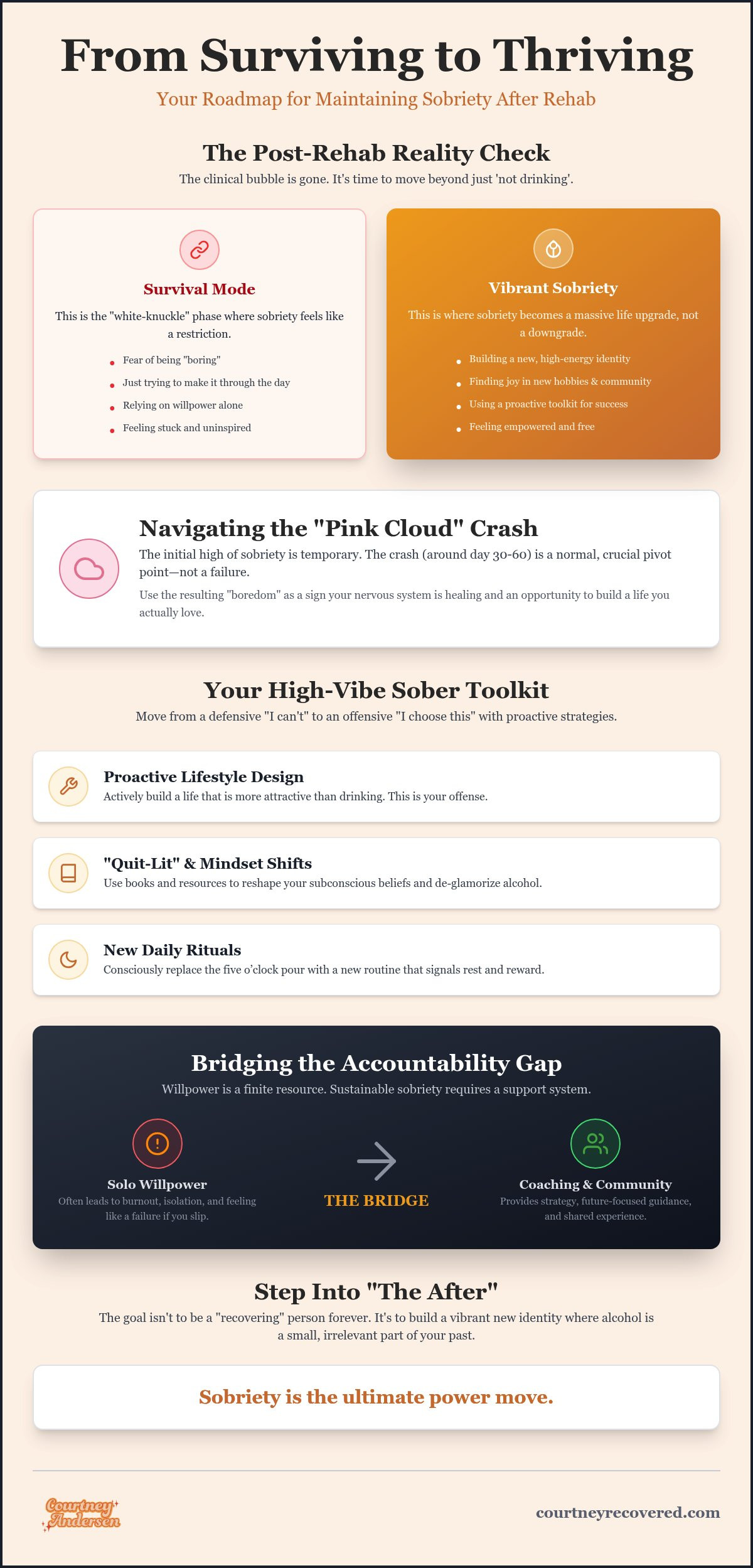
The Accountability Gap: Why Your "Willpower" Isn’t Enough
You think you can grit your teeth and just "not drink." But willpower is like a phone battery; it drains every time you make a decision, handle a stressful email, or walk past the wine aisle. Research shows that 40-60% of individuals experience a relapse at some point in their journey, with the first year being the most vulnerable period. White-knuckling your way through those first 365 days is a fast track to burnout. Maintaining sobriety after rehab requires a strategy that doesn't rely on your mood or your energy levels. It requires a system that holds you up when you’re too tired to hold yourself.
The "Stop Starting Over" cycle happens because we focus on the "not drinking" part while ignoring the "why I drank" part. If you don't address the root cause of your stress and anxiety, your willpower will eventually snap. You need a bridge between the clinical support of treatment and the chaotic reality of your daily life. That is where you move from being a passenger in your recovery to driving your new, high-energy identity.
Coaching vs. Sponsorship: Which One Do You Need?
Your inner circle needs a serious audit. There’s a massive difference between supporters who cheer for your clarity and enablers who secretly miss your "party" self. You have to be bold enough to ask your partner and family for what you need, whether that’s a dry house or a different social schedule. Willpower is a finite resource, while community is infinite. Maintaining sobriety after rehab becomes much easier when you stop trying to be a hero and start being a leader of your own life. When you have a squad that values your evolution, you no longer feel like you're missing out; you feel like you're leveling up.
Stepping Into "The After": Building a Life You Actually Love
The finish line of your first year isn't actually the end of the race. It’s the beginning of a whole new chapter I call "The After." For a long time, you’ve likely identified as "recovering," a word that implies you’re still in the middle of a struggle. But at some point, you transition to "recovered." This doesn't mean you're cured or that you stop being mindful; it means your identity is no longer defined by what you don't do. Maintaining sobriety after rehab eventually stops feeling like a daily battle and starts feeling like your natural, high-energy state of being.
Healing your relationships and rediscovering who you are without a bottle in your hand is the most rewarding part of this journey. The goal was never just to stop drinking. The goal was to become vibrantly alive. In "The After" program, we focus on navigating life beyond that first 365-day milestone, ensuring that your growth doesn't plateau just because the crisis has passed. You’re building a foundation that is strong enough to handle big promotions, deep grief, and massive celebrations without ever needing to escape your own reality.
Identity Rediscovery: Who Are You Now?
For years, alcohol was likely your primary "reward" for professional success or a hard day’s work. Now, you have to find hobbies and passions that actually excite your sober brain. Whether it’s morning yoga, weekend hiking, or finally starting that side hustle, these aren't just "distractions." They are the building blocks of your new life. When you stop using substances to numb out, your true personality finally has room to breathe. You can learn more about this evolution in my guide on Life After Sobriety: Build a Life You Don’t Need to Escape, which dives deep into creating a lifestyle that feels like a constant upgrade.
Long-Term Maintenance and Growth
As the "newness" of your sober life becomes your normal, it’s easy to let your guard down. This is why continuing to use your Sober Toolkit is non-negotiable, even years into the process. Statistics show that after five years of continuous sobriety, the relapse rate drops significantly, with over 85% of individuals maintaining their path. To stay in that winning percentage, keep your inspiration high and your community close. Don't wait for a craving to strike before you reach out for support. Join the Sobriety Circle to keep your momentum high and stay connected with women who are also choosing a life of clarity and connection. Maintaining sobriety after rehab is a lifelong celebration, and you deserve a squad that cheers for every single win.
Your Most Vibrant Chapter Starts Now
Building a life you don't need to escape is about more than just staying away from a drink; it's about designing a reality that actually excites you. We've covered why moving beyond survival mode is essential and how a personalized toolkit can turn your evenings from a struggle into a sanctuary. By trading solo willpower for high-energy community and professional strategy, you're not just maintaining sobriety after rehab. You're reclaiming your social power and stepping into a "recovered" identity that feels like a massive upgrade.
You don't have to navigate this transition alone. Whether you're diving into the Sober Vibes Book, finding your tribe in the Sobriety Circle, or breaking the cycle with the Stop Starting Over program, there is a roadmap waiting for you. Founder Courtney Andersen has walked this path and is ready to help you bridge the gap between treatment and true freedom. Ready to thrive in "The After"? Book your 1:1 Sobriety Coaching session today. Your new life is waiting, and it’s going to be better than you ever imagined.
Frequently Asked Questions
How do I stay sober after rehab without AA?
You can absolutely stay sober without traditional 12-step programs by focusing on lifestyle design and modern community. While AA works for many, others find success through professional coaching, reading "Quit-Lit" like the Sober Vibes Book, and joining peer-led groups like the Sobriety Circle. The key is to replace the clinical structure with a vibrant, proactive routine that addresses your specific triggers and goals. It’s about finding what resonates with your own unique personality and lifestyle.
What are the most common triggers for relapse in the first 90 days?
The most common triggers often involve the "Pink Cloud" crash, social pressure, and unmanaged stress. During the first 90 days, your brain is still recalibrating its dopamine levels, making you susceptible to emotional swings. Statistics show that 60-70% of relapses occur within the first year, often triggered by old social circles or professional burnout. Identifying these patterns early is vital to maintaining sobriety after rehab and staying on the right path for good.
How can I explain my sobriety to friends and coworkers?
You don't owe anyone a deep dive into your medical history; keep it light and confident. Try saying, "I'm just retired from drinking," or "I feel so much better without it." If you’re at a work event, hold a soda with lime; most people won't even notice what's in your glass. Your confidence is the best explanation. Focus on how much more energy and clarity you have now. Your new life is yours to share.
Is it possible to be social and go to bars after rehab?
Yes, it is possible, but it requires a solid "Sober Toolkit" and a clear escape plan. Wait until you feel grounded in your new identity before testing the waters. When you do go, always have your own ride and a non-alcoholic drink in hand immediately. If the vibe shifts from fun to sloppy, that is your cue to leave. You’ve already had the best part of the night. You can still be social.
What is a sobriety coach and do I really need one?
A sobriety coach is a professional mentor who helps you bridge the gap between clinical rehab and your real-world life. Unlike a sponsor, a coach provides a tailored, professional strategy for your specific lifestyle and career goals. While not everyone "needs" one, having that 1:1 accountability is often the difference between white-knuckling your way through the week and actually thriving. It’s an investment in your long-term success and your overall peace of mind.
How do I handle "sobriety fatigue" or feeling bored?
Sobriety fatigue is a sign that your nervous system is finally resting after years of overstimulation. Instead of viewing boredom as a threat, see it as an invitation to rediscover what actually lights you up. This is the perfect time to explore new hobbies, from high-energy fitness to creative projects. Maintaining sobriety after rehab means learning to sit with yourself and realizing that "quiet" doesn't have to mean "boring." It’s about finding your new rhythm.
What should I do if I feel like I’m about to relapse?
Reach out to your support squad immediately and change your environment. If you're at a party, leave. If you're home alone, call your coach or a friend from the Sobriety Circle. Relapse often starts in the mind days before the actual slip, so acknowledge the feeling without judgment. Use your Sober Toolkit, practice deep breathing, and remember that this craving is a temporary wave that will eventually pass. You have the power to stay on track.
How does the "Stop Starting Over" mindset help with long-term recovery?
The "Stop Starting Over" mindset shifts the focus from the "not drinking" part to addressing the root causes of your habits. It moves you away from the exhausting cycle of shame and constant resets. By focusing on why you wanted to escape in the first place, you can build a life that you actually enjoy living. It’s about sustainable growth and reclaiming your power so you never have to "start over" again. You're building forever.
I want you to feel sober NOT boring!
Kickstart your sobriety with my free 2-day video workshop series to master your sober mindset and have FUN in your sobriety journey!


