
How to Stop Starting Over in Sobriety: Break the Day 1 Cycle for Good
Sep 22, 2026
What if the reason you keep relapsing isn't that you're weak, but because you've been sold a version of recovery that feels like a prison sentence? It is soul-crushing to wake up to another "Day 1" when you're a high-achiever who usually gets things right. You feel like a failure, hidden behind a mask of professional success, terrified that life without a glass of wine will be boring and lonely. I've been exactly where you are, staring at the ceiling and wondering how to stop starting over in sobriety when your willpower has completely run dry.
I agree that the cycle is exhausting, but here's the truth: you don't need more discipline; you need a better roadmap. This isn't about grit; it's about building a life you don't want to escape from. We're going to ditch the clinical jargon and dive into the mindset shifts and practical tools you need to move past the shame. We'll explore how to gain confidence in social situations and create emotional stability that actually lasts. Get ready to discover how to build a vibrant, connected reality where sobriety feels like the ultimate gain, not a restrictive loss.
Key Takeaways
- Understand that the "Day 1" loop is a mismatch between your environment and your identity, providing the ultimate answer for how to stop starting over in sobriety.
- Shift your mindset from "quitting" to "becoming" so you can stop mourning alcohol like a lost friend and start treating it like an ex who no longer serves you.
- Build a tangible Sober Toolkit with resources like the Sober Vibes Book to create a daily defense system that supports your evolution.
- Learn how to audit your social circle and set firm boundaries to protect your energy and avoid the "relapse merry-go-round."
- Discover how to move beyond survival mode and into a life you actually love through the structured roadmap of the Stop Starting Over program.
The "Day 1" Loop: Why You Keep Starting Over (and Why It’s Not Your Fault)
You woke up today with that familiar, heavy feeling in your chest. Again. The "Day 1" loop is a special kind of hell, especially when you’re someone who usually crushes it at work and shows up for everyone else. It feels like a personal failure, but I’m here to tell you it’s actually a system failure. The "Start-Over Cycle" happens when a massive mismatch exists between your intent and your environment. You have the heart to change, but you’re trying to build a sober life using a blueprint designed for someone who still drinks.
One of the biggest hurdles is the myth of the "rock bottom." We’ve been told we have to lose everything before we deserve to stop, but that’s total nonsense. You don’t need to wait for a catastrophe to decide you’re done with the hangovers and the hidden bottles. Waiting for things to get "bad enough" is exactly what keeps you stuck in the cycle of relapse. You deserve a life you love right now, not after you’ve hit a theoretical floor. Realizing how to stop starting over in sobriety begins with accepting that your desire for more is enough of a reason to quit for good.
The Willpower Trap: Why "Trying Harder" Fails
If your strategy for staying sober is just "white-knuckling" it through the cravings, you’re setting yourself up for exhaustion. This creates a deep sense of deprivation, making you feel like you’re missing out on the party. The science of decision fatigue shows us that every choice we make throughout the day, from what to wear to how to handle a difficult client, drains our mental energy. Think of your willpower as a leaky battery; it might start the day strong, but without a backup generator, it’s going to leave you stranded in the dark by dinner time.
For high-achieving women, professional success is the ultimate mask. You tell yourself that because you’re making six figures, raising great kids, or keeping a clean house, your drinking isn't a "real" problem. This is the trap of Gray Area Drinking: when your habit becomes a Burden. You aren't falling apart on the outside, but you’re dying a little on the inside every time you break a promise to yourself.
The "I’m not that bad" justification is a dangerous comfort. It keeps you in a secret cycle where you drink to manage the stress of your high-pressure life, then wake up needing to start over. Learning how to stop starting over in sobriety means recognizing that your external success doesn't negate your internal struggle. You don't have to be "that bad" to want to feel better.
The Mindset Shift: Moving from "Quitting" to "Becoming"
If you feel like you’re white-knuckling your way through every happy hour, it’s probably because you’re still acting like a "drinker who isn’t drinking." This is a state of constant deprivation. You’re essentially holding your breath, waiting for the moment you can finally exhale and have a glass of wine. To truly understand how to stop starting over in sobriety, you have to shift your identity. You aren't just quitting a habit; you are becoming a sober person. This isn't about what you’re giving up. It’s about who you’re stepping into.
Stop mourning alcohol like it’s a lost best friend. In reality, alcohol is more like a toxic ex-partner who promised you the world but left you with a headache and a depleted bank account. You wouldn't keep a photo of a cheating ex on your nightstand, so stop romanticizing the "good times" with the bottle. When you reclaim your identity through the lens of vibrancy and freedom, the desire to go back starts to fade. The "all or nothing" mentality often keeps you stuck because one tiny slip feels like a total collapse. Real life is lived in the gray areas; your sobriety should be built on consistency, not perfection.
Sobriety as a Gain, Not a Loss
We’ve been conditioned to think that a life without booze is a life without fun. That is a lie. When you flip the script, you realize that sobriety is actually the ultimate life hack for high-performers who want to unlock their next level of power. You aren't missing out on the party; you’re finally present enough to actually enjoy it. Consider these sober perks that go way beyond just avoiding a morning headache:
- Consistent High Energy: No more 3 PM crashes or "hangxiety" fueled by dehydration.
- Radical Mental Clarity: Your brain becomes a sharp tool rather than a foggy mess.
- Authentic Confidence: You learn to navigate social situations without a liquid crutch, which is a massive flex.
- Financial Freedom: Check your banking app; those $15 cocktails add up to a luxury vacation pretty quickly.
If you're struggling to see these gains on your own, a professional sober coach can help you reframe your perspective in real time.
The Power of "Yet" in Your Recovery Journey
Language matters. There is a world of difference between saying "I can’t drink" and "I don’t drink." The first implies you’re being punished; the second declares your power. If you’re still feeling shaky, use the power of "yet." You might not feel fully comfortable at a wedding without a drink *yet*, but you’re learning. This shift allows for self-compassion, which is a far better fuel for momentum than shame.
Shame is the primary driver of the relapse cycle. When you treat yourself with the same empathy you’d give a friend, you create space for growth. You start to ask, Who am I Without Alcohol? Rediscovering Your Identity becomes an exciting quest rather than a scary void. This journey is about evolution, not just abstinence.
Building Your Sober Toolkit: The Infrastructure of Lasting Change
Willpower alone is like trying to build a house with just a hammer. You need a full chest of tools if you want the structure to actually stand. This is where your Sober Toolkit comes in. It’s your daily defense system against a world that is constantly trying to hand you a drink. For tactile learners, physical resources like the Sober Vibes Book are game-changers. There is something powerful about holding a book, writing in the margins, and having a physical reminder of your commitment sitting on your nightstand. It helps deprogram the toxic "mommy wine culture" marketing that tells us we need alcohol to handle our kids or our jobs.
Bookending your day with intention is the secret to staying grounded. A morning routine that starts with reading "Quit Lit" or a quick meditation sets the tone for your identity as a sober person. An evening routine focused on rest and reflection helps you process the day's stress without reaching for a bottle. These routines aren't just chores; they are the scaffolding of your new life. Learning how to stop starting over in sobriety requires more than just a mindset shift; it requires a physical and digital infrastructure that supports your evolution every single day.
Must-Have Items for Your Daily Toolkit
The "Witching Hour" is that 5 PM to 7 PM window when cravings usually hit hardest. You need non-alcoholic alternatives ready to go before the urge even strikes. Whether it’s a spicy ginger beer or a functional seltzer, having a ritualistic drink in your hand satisfies the habit without the regret. You also need journaling prompts to catch a "mental relapse" before it becomes a physical one. The Sober Toolkit gives you a menu of options to navigate triggers in real time, so you aren't guessing what to do when things get stressful.
Digital and Social Support Systems
Your environment isn't just your kitchen; it’s your phone. If your Instagram feed is full of "Rosé All Day" memes and influencers clinking glasses, it’s time for a digital detox. Curate your feed to reflect the vibrant, high-energy life you’re actually building. When you’re alone at night and the thoughts start spiraling, a 24/7 online community is your lifeline. Finding your "vibe" in an online sober community means you have people who get it, no matter the hour. This is how to stop starting over in sobriety; you stop trying to be a lone wolf and start leaning on a pack that celebrates your wins.
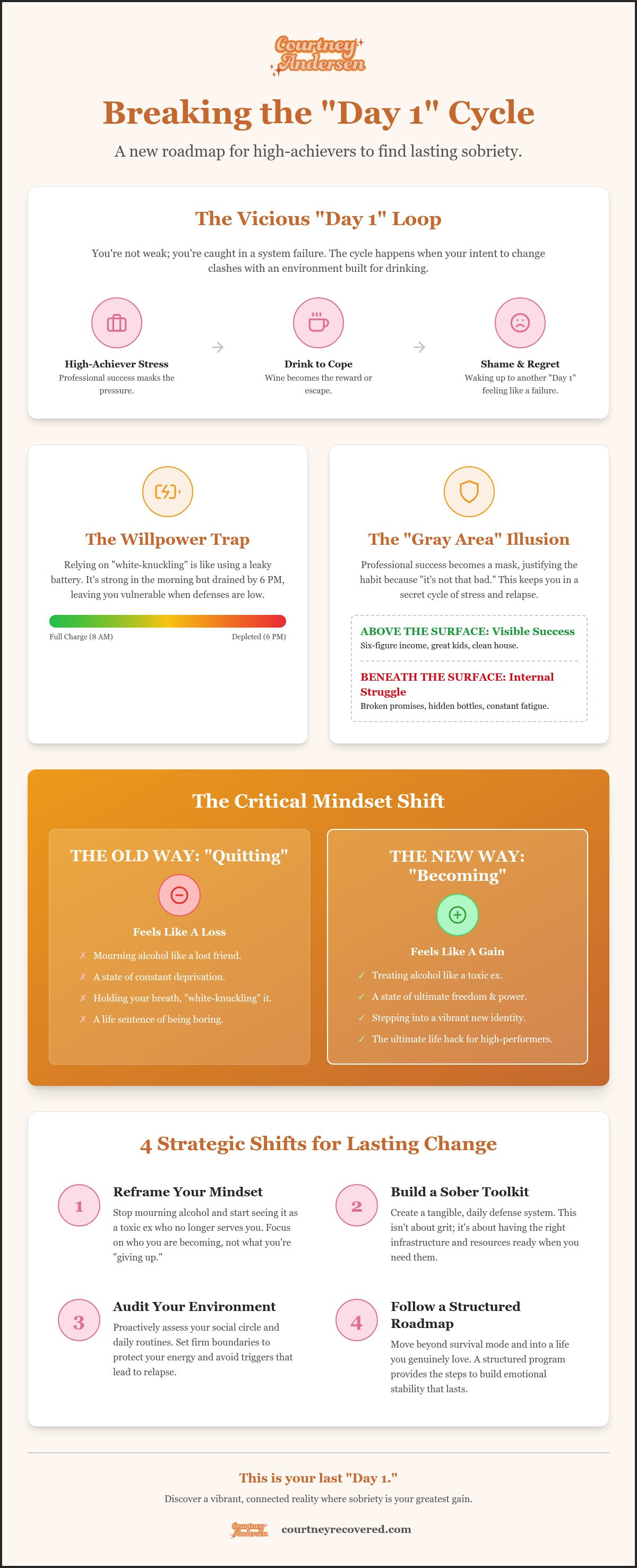
4 Strategic Shifts to Stop the Relapse Merry-Go-Round
Breaking the "Day 1" cycle requires more than a wish; it requires a tactical plan. Most people treat recovery like a willpower test, but it’s actually a lifestyle design project. If you want to know how to stop starting over in sobriety, you have to look at the four pillars that hold up a long-term sober life. First, audit your social circle. If your friends only know the "party" version of you, they might accidentally sabotage your progress. Setting "Sober Boundaries" isn't about being mean; it's about protecting your peace. Second, look at your calendar. Identify those high-risk times, like Friday night happy hours or Sunday brunch, and pre-plan exactly what you'll do instead.
The Accountability Factor
Doing it alone is the fastest way back to Day 1. Peer support is great, but there’s a massive difference between a friend who listens and a 1-on-1 sobriety coach with a proven roadmap. A coach provides the objective accountability you need when your brain starts making excuses at 5 PM. Asking for help isn't a sign of weakness; it’s a strategic investment in your future self. You wouldn't try to learn a new professional skill without a mentor, so why try to navigate the complexities of how to stop starting over in sobriety without an expert in your corner?
If you're tired of the guessing game, explore my 1:1 coaching programs to get the personalized support you deserve.
Navigating the Social Minefield
You don't owe anyone a medical history or a deep explanation for why there is sparkling water in your glass. If someone asks why you aren't drinking, a simple "I’m not drinking tonight" or "I feel better without it" is a complete sentence. You can even use scripts like "I'm on a health kick" or "I have an early morning" if you aren't ready to share your journey yet. The goal is to keep the conversation moving, not to justify your choices.
If the party vibe shifts from fun to messy, it's time for the "French Exit." This is the ultimate tool for social survival. First, spot the shift; usually when the music gets too loud or the stories get repetitive. Second, find your keys. Third, leave without a long goodbye. Your sobriety matters more than a polite farewell to someone who won't even remember you left by the next morning. Protecting your energy is a massive flex.
Your Last Day One: How the "Stop Starting Over" Program Works
You’ve spent enough time in the exhausting cycle of regret. It’s time for a definitive roadmap that actually works. The Stop Starting Over program isn't about generic, clinical advice; it’s a structured, high-energy path designed to move you out of survival mode and into a life where you actually thrive. This is how to stop starting over in sobriety for the very last time. By choosing a 1:1 approach, we can dismantle the specific, long-term habits that keep you stuck in your unique environment. We replace those old patterns with a lifestyle that feels like a massive promotion. We call this vibrant reality "The After." It’s the place where sobriety isn't a daily chore, but your ultimate superpower for success and connection.
What to Expect in Your First 30 Days
The first month is a wild ride of physical and mental milestones. Your sleep will start to regulate, your skin will clear up, and that constant hum of "hangxiety" will begin to fade. You might experience the "Pink Cloud," which is that initial rush of euphoria where everything feels amazing. While it’s a total blast, we focus on grounding that energy so you don't set yourself up for a crash when real life hits. Instead of looking for massive transformations overnight, we celebrate "Micro-Wins." This might be choosing a mocktail at dinner, handling a stressful work call without a drink, or simply waking up on a Saturday morning with total clarity. These small victories are what build the lasting confidence you need to stay the course for good.
Joining the Sobriety Circle
You don't have to navigate this massive life transition in isolation. Joining the Sobriety Circle gives you immediate access to a community of women who are walking the same path and facing the same social pressures. It’s a space where you can be seen, heard, and celebrated without an ounce of judgment. In this circle, you’ll learn to master the Sober Toolkit and join group coaching sessions that keep your momentum up, even when things get tough. This isn't just a reset of your sobriety clock; it's a total life upgrade. This Day 1 can be the official launch of your best life, and I’m here to provide the roadmap. If you’re ready to ditch the shame and embrace a life of vibrancy, it’s time to stop the cycle and choose the freedom you deserve.
Ready to Make This Your Last Day One?
You now have the blueprint to move from a "drinker who isn't drinking" to a vibrant, sober woman who actually loves her life. Breaking the cycle isn't about having more willpower; it's about building a lifestyle that supports your new identity. By auditing your social circle and using your Sober Toolkit, you've already taken the first steps toward permanent change. This is exactly how to stop starting over in sobriety; you stop fighting against your old life and start creating a new one that feels like a massive win.
I’ve supported over 10,000 women in the Sobriety Circle and shared my roadmap in the Sober Vibes Book, so I know exactly what it takes to make it stick. You don't have to do this alone. If you're ready for a personalized 1:1 coaching roadmap that guides you into "The After," I'm here to help you cross that bridge with confidence.
Stop the cycle and start your last Day 1 with the Stop Starting Over program today!
Your best life is waiting for you on the other side of this decision. It’s time to step into your power and stay there!
Frequently Asked Questions
Why do I keep relapsing even when I really want to stay sober?
Relapse often happens because you’re relying on willpower instead of infrastructure. For high-achievers, willpower is like a battery that drains by 6 PM. If you don't have a plan for the "Witching Hour," your brain defaults to old habits. Understanding how to stop starting over in sobriety means recognizing that your intent is strong, but your system needs an upgrade. You aren't failing; you're just trying to drive a car without an engine.
Is it possible to stop starting over without going to AA?
Absolutely. While AA is a famous route, it’s definitely not the only one. Many women find that a non-clinical, high-energy approach works better for their lifestyle. Programs like the Sobriety Circle provide community and support without the somber atmosphere. You can build a sober life you love through 1:1 coaching and practical resources like the Sober Vibes Book. It’s about finding the vibe that empowers you to stay consistent and confident.
What is the "Stop Starting Over" program by Courtney Recovered?
The Stop Starting Over program is a structured roadmap Courtney Andersen designed to move you from the exhaustion of "Day 1" into a life of freedom. It focuses on breaking long-term habits through personalized 1:1 coaching and mindset shifts. Instead of just "not drinking," the program helps you build a vibrant reality where alcohol no longer has a place. It’s the definitive solution for high-functioning women who are ready to finally make sobriety stick.
How long does it take for sobriety to feel "normal" and not like a chore?
Sobriety usually starts feeling like a lifestyle gain rather than a chore after the first 30 to 90 days. This is when your physical health stabilizes and your new routines become second nature. Once you reach "The After," you stop focusing on what you’re missing and start celebrating your clarity and energy. With the right Sober Toolkit in place, staying sober becomes a source of pride and a massive life hack for your professional success.
What should I do immediately after a relapse to stop the cycle?
First, ditch the soul-crushing shame. Shame fuels the relapse cycle. Treat the slip as data rather than a disaster. Ask yourself what was missing from your toolkit and reach out for professional accountability immediately. Whether it’s talking to your coach or checking in with the Sobriety Circle, getting back on track is about adjusting your system so you can learn how to stop starting over in sobriety.
Can a sobriety coach help me if I’m a high-functioning drinker?
Yes, and this is where coaching truly shines. Professional success often masks the internal struggle, making it easier to justify "just one glass." A 1:1 sobriety coach provides the objective accountability you can’t get from friends or family. We work to unmask "gray area" drinking patterns and build a personalized roadmap that fits your high-pressure career. You don't have to hit a "rock bottom" to deserve a life that feels authentic and clear.
What are the best tools to include in a sober toolkit for beginners?
A great beginner toolkit should include the Sober Vibes Book for mindset work and the Sober Toolkit for daily maintenance. You also need a go-to non-alcoholic alternative for social events and the "Witching Hour." Curating your digital environment is just as important; unfollow accounts that glamorize wine culture and join an online community like the Sobriety Circle. Having these physical and digital resources ready ensures you aren't guessing what to do when a craving hits.
How do I handle social pressure to drink when I’m trying to stay sober?
Handling social pressure is all about having a plan. Use simple, direct scripts like "I'm not drinking tonight" or "I've got an early morning." You don't owe anyone a deep explanation for what's in your glass. If the environment becomes too centered on alcohol, use the "French Exit" and leave without a long goodbye. Protecting your energy and your sobriety is a major flex that proves you’re prioritizing your long-term happiness over temporary politeness.
I want you to feel sober NOT boring!
Kickstart your sobriety with my free 2-day video workshop series to master your sober mindset and have FUN in your sobriety journey!


