
First Year of Sobriety: What to Expect on Your Journey to 365 Days
Jul 19, 2026
What if your first year without alcohol wasn't a long list of things you're losing, but a high-energy reconstruction of the person you were always meant to be? You might be staring at the calendar right now, feeling a mix of pride and pure panic about the messy middle of emotions or the physical exhaustion of PAWS. If you're wondering about the first year of sobriety and what to expect, you're likely bracing for social isolation, but the reality is much more empowering than a sterile list of clinical symptoms.
I've been exactly where you are, and I promise that emotional stability and genuine social confidence await you on the other side of this transition. This is your real-talk, season-by-season roadmap to navigating the physical, emotional, and social shifts of your first 365 days. We're going to break down how to handle the hard stuff and reclaim your joy, so you can finally build a vibrant life that is actually fun without a drink in your hand.
Key Takeaways
- Map out your 365-day journey with a season-by-season guide on the first year of sobriety what to expect, from physical healing to emotional resilience.
- Identify the "Pink Cloud" trap and the "Dopamine Deficit" so you can stay steady and grounded when the initial excitement of quitting fades.
- Tackle the social gauntlet of holidays and weddings with total confidence while learning how to spot the difference between real friends and drinking buddies.
- Understand how to manage PAWS (Post-Acute Withdrawal Syndrome) and those annoying "phantom hangovers" that can sometimes pop up late in the game.
- Discover how to transition from the constant struggle of "recovering" to the vibrant reality of just living a life you don't need an escape from.
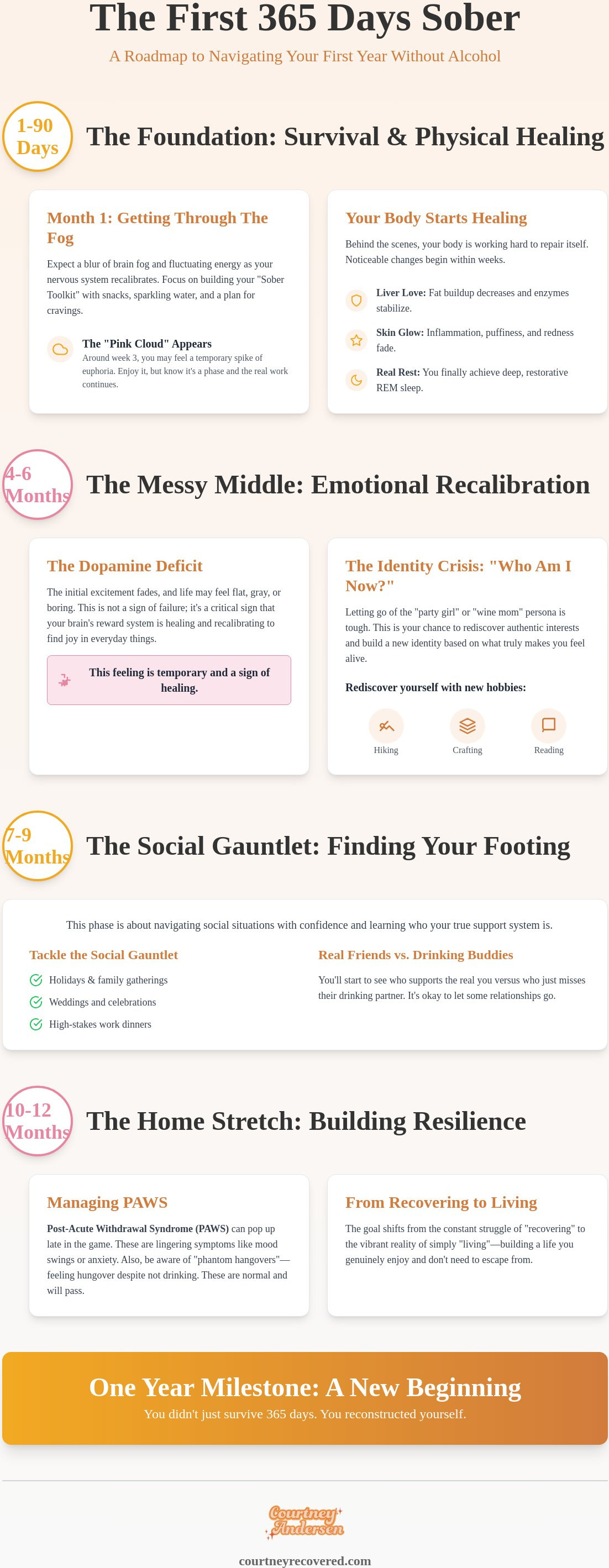
The First 90 Days: Survival, Physical Healing, and the "Pink Cloud"
The first three months are the ultimate initiation. It's a period of intense shedding, where your body finally gets a break from the constant inflammatory cycle of alcohol. When people ask about the first year of sobriety what to expect, I tell them the first 90 days are the loudest. Your brain is recalibrating; your liver is sighing in relief; and you're learning how to exist without a liquid shield. Achieving true Sobriety isn't just about stopping the pour. It's about surviving the physical and mental rewiring that follows.
The First Month: Getting Through the Fog
Day 1 to 30 is often a blur of brain fog and fluctuating energy. One minute you're ready to run a marathon; the next, you're face-down on the sofa. This is normal. Your nervous system is trying to find its "level" again. To survive that first sober weekend, don't just try to white-knuckle your way through. Use your Sober Toolkit to stay busy. Load up on sparkling water, grab your favorite snacks, and have a plan for that 5 PM witching hour. Around week three, you might hit the "Pink Cloud." The Pink Cloud is a temporary dopamine spike that creates an intense sense of euphoria and misplaced confidence early in recovery. It feels amazing, but don't let it trick you into thinking the journey is over.
During this first month, your body is doing some heavy lifting behind the scenes:
- Liver Love: Within weeks, fat buildup in the liver begins to decrease, and enzyme levels start to stabilize.
- Skin Glow: Alcohol-induced inflammation fades, which reduces puffiness and that classic "wine face" redness.
- Real Rest: You finally enter deep REM sleep without the alcohol-induced rebound effect, meaning you actually wake up feeling rested.
As your energy returns, you may feel ready to tackle other health goals. For those navigating the unique challenges of a physically demanding job while recovering, Blue Collar Fit offers tailored support to help you stay fit and energized, even after long shifts.
Days 60-90: When the Novelty Wears Off
This is where the "new car smell" of sobriety starts to fade. The initial excitement is gone, and you're left with a stressful Tuesday and no wine buffer. You might face your first big trigger, like a high-stakes work dinner or a fight with your partner. This is the danger zone for the "just one" lie. When you look at the first year of sobriety what to expect, remember that these first 90 days are the foundation. Instead of falling back into old patterns, you need a strategy to Stop Starting Over. This mindset shift helps you realize that a craving is just a feeling, not a command. By day 90, you're building the muscle memory of a woman who simply doesn't drink.
Months 4-6: Navigating the "Emotional Messy Middle"
Welcome to the "messy middle." If the first 90 days were about physical survival and the high of the "Pink Cloud," months four through six are where things get real. The initial excitement has likely evaporated. You might find yourself suddenly crying at a laundry detergent commercial or feeling a flash of white-hot rage because your partner breathed too loudly. When people look into the first year of sobriety what to expect, they often overlook this phase, but this is exactly where the internal architecture of your new life is built. Your brain is dealing with a "Dopamine Deficit." After years of artificial spikes from alcohol, your system is recalibrating to find joy in normal, everyday things. Right now, life might feel a bit gray, flat, or even boring. That isn't a sign that sobriety isn't working; it's a sign that your brain is healing.
As you recalibrate, finding pleasure in small, tactile rituals can help you stay grounded; you can check out Reset Razor to see how their eco-friendly products can turn a simple grooming routine into a mindful moment of self-care.
While many resources for Alcohol Use Disorder (AUD) Treatment focus heavily on the first 30 days, the emotional heavy lifting happens now. You may start to recognize old Gray Area Drinking patterns in your thoughts, like the "just one" lie or the idea that you weren't "bad enough" to quit forever. This is the time to shift your focus from simply "not drinking" to actively building a life you don't feel the need to escape from. It is about moving from restriction to expansion.
The Identity Crisis: Who Am I Now?
Letting go of the "party girl" or "wine mom" persona can feel like losing a best friend. You've spent years using a glass of Chardonnay as a social shield and a personality trait. Now, you have to figure out who you are without the liquid courage. This is your chance to audit your life, which might include refining your digital presence with Content Removal to ensure your online history reflects your current values. Finding new hobbies isn't just about filling time; it's about the vital work of rediscovering your authentic interests and the activities that actually make you feel alive. Whether it's morning hikes, late-night painting, or finally learning to cook, these are the bricks of your new identity.
Building Emotional Resilience
This is a high-risk phase for relapse because the "newness" has worn off and "real life" has set in. Managing "Sober Boredom" is a skill you have to practice. This is exactly why 1:1 Sobriety Coaching is such a powerful tool during these months. It provides the accountability and "tough love" you need to navigate the emotional spikes without reaching for a bottle. You are preparing for "The After," the stage where sobriety stops being something you "do" and becomes the foundation of who you are. If you're feeling stuck, a mentor who has walked this path can be the shortcut you need to stay on track.
Months 7-9: The Social Gauntlet and Identity Shifts
By the time you hit month seven, the novelty of your new lifestyle has likely worn off and the emotional "messy middle" is starting to stabilize. Now comes the social gauntlet. If you want to know the truth about the first year of sobriety what to expect, it's this: you're going to have to learn how to have fun in the wild without a glass in your hand. This is the season of the "Friendship Audit." You'll quickly realize which friends were actually there for you and which ones were just there for the happy hour. While it can feel a bit stinging at first, it's actually a massive win. You're clearing out the social clutter to make room for deep, authentic connections. Navigating this social gauntlet is a pivotal part of the first year of sobriety what to expect, as it forces you to reclaim your identity in settings where you used to hide behind a drink.
This is exactly why finding a community like the Sobriety Circle becomes your secret weapon. It is the ultimate cure for that "sober and lonely" phase. Having a squad of women who are navigating the same weddings, vacations, and stressful Tuesdays makes the journey feel like a shared adventure rather than a solo mission. You're not just "quitting"; you're joining a movement of women who are choosing a more vibrant way to live.
Surviving the Big Events
Bachelorette parties, weddings, and high-stakes work events used to be your playground. Now, they might feel like a minefield. The key to surviving is preparation and the "Exit Strategy." If the vibe shifts from a fun dinner to sloppy shots, that is your cue to head out. Leaving early isn't a failure; it's your new superpower that protects your peace and your progress. You handle "drink pushers" with grace and grit by having a simple, firm script ready like, "I'm not drinking tonight, but this mocktail is amazing." You don't owe anyone a long explanation or a medical history; your "no" is a complete sentence.
Deepening Relationships
Sobriety changes the dynamic of every relationship in your life, especially your marriage. Without the wine buffer, you're forced to have "hard conversations" in real-time. It might feel more difficult at first because you're actually feeling your feelings instead of numbing them with a bottle of Cabernet. This is the perfect time to look into 1-on-1 sobriety coaching or specialized support from experts like Tracy Kimberg. Repairing years of drinking patterns and learning how to communicate authentically takes work. Having a mentor to guide you through this relationship repair phase can be the shortcut you need to move from conflict to true connection.
The Home Stretch: Resilience, PAWS, and the One-Year Milestone
You’ve survived the "messy middle" and stared down the social gauntlet. Now, you’re finally eyeing that 365-day finish line. It’s a massive achievement, but as you enter the home stretch, you might notice something strange. You’re still occasionally waking up feeling groggy, irritable, or "off," even though you haven't touched a drop in months. This is a normal part of the first year of sobriety what to expect, and it often catches people off guard. You're not backsliding; you're just experiencing the final stages of a deep internal renovation. Your perspective is likely shifting from the restrictive "I can’t drink" to the empowering "I don’t drink," which is the hallmark of entering the vibrant life I call "The After."
Managing Phantom Hangovers and PAWS
Post-Acute Withdrawal Syndrome, or PAWS, is the psychological side of healing that follows the initial physical detox. While the physical cravings might be gone, your brain is still rewiring its pleasure centers. This can lead to "phantom hangovers," where you feel physically depleted for no apparent reason. Research suggests that PAWS symptoms can last up to 24 months as your nervous system finds its new baseline. PAWS is just your brain recalibrating its chemistry after years of being suppressed by alcohol. To manage this late-stage fatigue, you need to lean into your Sober Toolkit. Prioritize high-quality sleep, stay aggressively hydrated, and don't be afraid to say no to extra commitments. You're still healing, so give yourself the grace to rest without guilt.
For high-performers looking to optimize their recovery and balance their body’s chemistry during this phase, you can check out 5280 Restorative Medicine for expert functional medicine guidance on reclaiming your vitality.
How to Celebrate Your First Soberversary
Hitting one year is a monumental win that deserves more than a pat on the back. This is the time to mark your progress with something that reflects the new, vibrant person you’ve become. Forget the bar; celebrate with a spa weekend, a solo hiking trip, or a high-end dinner where you actually savor every bite of the dessert. If you want to keep the momentum going, the Sober Vibes Book is the perfect gift to yourself to keep your mindset sharp as you head into Year 2. It’s about moving from "survival mode" into a phase of true thriving. Setting new goals, like running a 10k, starting that business you used to talk about over wine, or learning about apartment investing with Multifamily Schooled, keeps you looking forward instead of backward.
Watch out for the "Milestone Trap." Many women let their guard down after Day 365 because they feel they’ve "proved" they can do it. Remember that your sobriety is a living thing that requires consistent nourishment. Don't let the one-year mark be a finish line; let it be the grand opening of the rest of your life. If you're ready to take your growth to the next level and ensure your second year is even better than your first, explore the personalized support available at Courtney Recovered.
Beyond Day 365: Life in "The After" with Courtney Recovered
Congratulations. You've officially crossed the threshold into "The After." This is the stage where sobriety stops being a project and starts being your superpower. When you first started looking into the first year of sobriety what to expect, the focus was likely on just getting through the day. Now, the focus is on how big your life can actually get. You're no longer just "recovering" from a past version of yourself. You're actively living a vibrant, connected life that doesn't need an escape hatch. This first year was just the foundation; now you get to build the skyscraper. You've learned that you don't need a drink to be funny, brave, or relaxed. You just needed to meet the real you.
Part of meeting the real you is rediscovering your capacity for deep focus and intellectual achievement. Whether you're returning to school or leveling up in your career, you can explore Clarami Pro to streamline your research and professional writing as you build this next chapter of your life.
The "The After" isn't about being perfect. It's about being present. My "Stop Starting Over" framework is designed to help you break the relapse cycle for good by focusing on empowerment rather than restriction. It’s about moving away from the "I can't" mindset and leaning into a life where alcohol is simply irrelevant. You’ve done the hard work of clearing the wreckage. Now, your job is to keep that momentum going by staying connected to the tools and people that got you here. The first year of sobriety what to expect was a roadmap for change, but Year 2 is where you start to see the compound interest of your consistency.
Sustainable Sobriety Tools
Complacency is the only real enemy now. To stay sharp, you have to keep your Sober Toolkit fresh. What worked on Day 30 might not be what you need on Day 400. As you evolve, your strategies should too. This is why ongoing community is non-negotiable. Joining The Sobriety Circle keeps you plugged into a high-vibe group of women who are also choosing growth over the status quo. It’s also where you get to pay it forward. Mentoring others who are just starting their journey is one of the best ways to solidify your own resilience. When you share your roadmap with someone else, you remind yourself how far you’ve come.
Ready for Your Personalized Roadmap?
Maybe you've hit the year mark but still feel like you're white-knuckling parts of your life. Or maybe you're reading this on Day 3 and want to ensure you actually make it to Day 365 without the constant struggle. You don't have to guess your way through this. If you want to skip the "starting over" cycle and move straight into a life that feels like a celebration, let's talk. You are closer to emotional freedom than you think, but sometimes you need a mentor to point out the shortcuts and keep you accountable. This is your life. It’s time to live it out loud. Book your discovery call and make this the last Day 1 ever.
Your Vibrant Life is Just Getting Started
The journey through your 365-day reconstruction is about so much more than just putting down the glass. It’s about rediscovering the woman who doesn’t need a liquid shield to be bold, funny, or resilient. From surviving the physical fog of the first 90 days to mastering the social gauntlet of weddings and holidays, you've learned that sobriety is an upgrade, not a restriction. Understanding the first year of sobriety what to expect is the first step, but the real magic happens when you stop surviving and start truly living in your authentic power.
As a professional coach and author, I've seen firsthand how an empowerment-focused, non-clinical approach can change everything. You don't have to navigate the "messy middle" or the loneliness of the friendship audit alone. Our vibrant community of high-achieving women is ready to welcome you with open arms and zero judgment. Ready to stop starting over? Join the Sobriety Circle today!
You’re closer to that vibrant, connected reality than you think. Keep going, because the best version of you is waiting just beyond the next milestone. You've got this, sister.
Frequently Asked Questions
Is the first year of sobriety really the hardest?
Yes, it’s often the toughest because you’re navigating every single holiday, anniversary, and life stressor for the first time without your liquid buffer. When people ask about the first year of sobriety what to expect, I tell them it’s a massive learning curve. You’re building new neural pathways while shedding an old identity. It gets significantly easier after you’ve survived each "first" and realized you didn't need a drink to get through it.
What are the physical stages of sobriety in the first year?
It starts with acute withdrawal in the first week, followed by a surge in energy as your liver enzymes stabilize around month three. By the six-month mark, your skin clarity and eye brightness are usually undeniable. The final stage is the long-term neurological repair of your dopamine receptors. This physical transformation is a huge part of the first year of sobriety what to expect, turning your body from a site of inflammation into a powerhouse of health.
How do I handle social anxiety in my first year without alcohol?
You handle it by having a plan before you even walk through the door. Bring your own fancy non alcoholic beverage so you always have something in your hand. Give yourself permission to leave early if the vibe gets too "sloppy." Most social anxiety is just the fear of being seen without a mask. Once you survive a few events, you’ll realize that most people aren't even watching what’s in your glass.
Will I ever stop thinking about drinking?
Absolutely. The constant mental chatter eventually quiets down into a whisper. In the beginning, you might think about alcohol every hour, but by the end of the year, you’ll go days or even weeks without it crossing your mind. It stops being a daily battle and starts being a non-issue. You’ll transition from "I can't drink" to "I just don't drink," and the freedom in that shift is incredible.
What is the "Pink Cloud" phase and how long does it last?
The Pink Cloud is that early surge of euphoria where you feel like you’ve discovered the secret to the universe and will never be sad again. It usually hits around week three and can last for a few weeks or a couple of months. It’s a wonderful feeling, but it’s temporary. Enjoy the high, but make sure you’re also doing the hard work of building a toolkit for when the cloud eventually drifts away.
What happens if I relapse during my first year?
If you slip, you don't lose the progress you made. You just gain a new data point about what triggered you. Instead of falling into a shame spiral, look at what went wrong and adjust your plan. Relapse happens to many, but it doesn't have to be your story. Use it as a reason to lean harder into coaching or community support rather than an excuse to give up entirely.
How does my brain change after one year of no alcohol?
Your brain undergoes a massive renovation. Your prefrontal cortex, which handles decision-making and impulse control, becomes much stronger. Your dopamine receptors also heal, which means you start finding genuine pleasure in simple things like a sunset or a good cup of coffee again. After 365 days, your brain is no longer waiting for a chemical spike to feel "normal." It’s finally back in the driver's seat.
When does sleep finally go back to normal after quitting?
Most women notice a massive improvement in sleep quality within the first 30 days. You’ll stop waking up at 3 AM with a racing heart and start experiencing real REM cycles. By month three, your sleep architecture usually stabilizes completely. You’ll wake up feeling actually rested instead of just "less tired." It’s one of the most immediate and rewarding physical wins of the entire journey.
I want you to feel sober NOT boring!
Kickstart your sobriety with my free 2-day video workshop series to master your sober mindset and have FUN in your sobriety journey!


