
Explain Why You Quit Drinking Without Ruining the Vibe
Oct 14, 2026
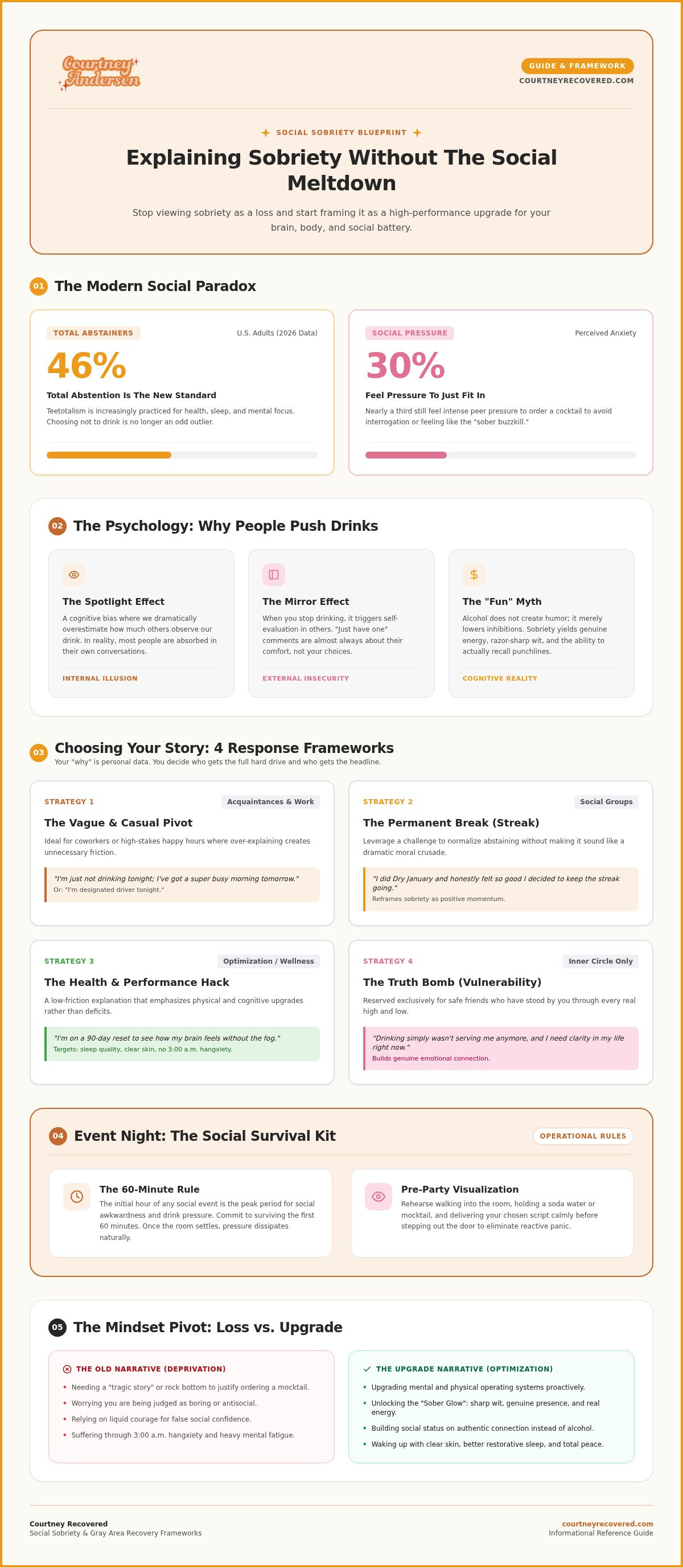
Did you know that 46% of U.S. adults are now total abstainers, yet 30% of us still feel intense peer pressure to order a cocktail just to fit in? It's incredibly common to feel like you're one "Why aren't you drinking?" away from a total social meltdown. You want to stay connected to your crew without feeling like the "sober buzzkill" or having to justify your personal evolution over loud music. I get it because I've been in those exact shoes, staring at a soda water and wondering if my social life just died.
The truth is that explaining to friends why you quit drinking doesn't have to be a heavy confession or a vibe-ruiner. You can protect your peace and keep your social status intact while feeling empowered, not deprived. We'll dive into the psychology of why people push drinks, how to use the "Spotlight Effect" to your advantage, and the exact scripts you need to shut down interrogation with total confidence. You're about to master the art of social sobriety so you can stop canceling plans and start owning the room.
Key Takeaways
- Stop viewing sobriety as a loss and start framing it as a high-performance upgrade for your brain, body, and social battery.
- Master the art of explaining to friends why you quit drinking by using specific scripts tailored to your inner circle versus casual acquaintances.
- Neutralize peer pressure instantly by understanding that "just have one" comments are usually about the other person’s insecurity, not your choices.
- Survive your first big event with a social survival kit that includes pre-party visualization and the essential 60-minute rule for navigating initial awkwardness.
- Move beyond the explanation phase and embrace a lifestyle where your social status is fueled by genuine connection rather than liquid courage.
Why Explaining Your Sobriety Feels So Scary (And Why It Doesn’t Have to Be)
If you didn't have a dramatic, "public" rock bottom, explaining to friends why you quit drinking can feel like you're trying to justify a crime you didn't commit. You might feel like you need a doctor's note or a tragic story to earn your seat at the table with a mocktail. This is the classic "Gray Area" fear. When your drinking wasn't a visible train wreck, you worry that people will think you're being dramatic or, worse, that you're judging them. But here is the secret: you aren't quitting a hobby; you're upgrading your entire mental and physical operating system. Social sobriety is a proactive choice, not a reactive necessity.
Most of the anxiety comes from the "Spotlight Effect." This psychological quirk makes us overestimate how much other people are actually paying attention to us. We think everyone is staring at our glass of ginger ale, but 2026 data shows that 46% of U.S. adults are now total abstainers. More people than ever are practicing teetotalism for health, sleep, or just plain curiosity. Your choice is becoming the new social standard, not a weird outlier.
The 'Fun' Myth: Debunking the Sober-Equals-Boring Trap
That internal monologue telling you that you won't be funny or relaxed without a buzz is lying to you. Alcohol doesn't give you a personality; it just lowers your inhibitions until you don't care if you're being repetitive. When you stop numbing out, you gain the "Sober Glow." This mix includes genuine energy, sharp wit, and the ability to remember the punchline of your own joke. If your habit started feeling like a heavy backpack you were tired of carrying, you might be dealing with Gray Area Drinking, where the costs simply outweigh the "fun" benefits.
Your Friends' Reactions Are Usually About Them, Not You
When you tell someone you're done with drinks, it often triggers the "mirror effect." Your choice to level up can make others feel subtly evaluated on their own consumption. A supportive friend will celebrate your clarity. A "saboteur" might hit you with the classic, "But you weren't even that bad!" This comment isn't about your history; it's about their comfort. If you weren't "that bad" and you quit, they might have to look at their own habits too. Recognizing this shift helps you stay firm when the "just have one" pressure starts to mount.
Choosing Your Story: 4 Ways to Tell Your Friends You’re Done with Drinks
One of the biggest mistakes people make when explaining to friends why you quit drinking is thinking they owe everyone the same level of detail. You don't. Your "why" is personal data; you get to decide who gets the full hard drive and who just gets the headline. Whether you are at a high-stakes work happy hour or a casual Sunday brunch, having a pre-set script prevents that panicked, deer-in-headlights feeling when someone asks what you're having.
For casual acquaintances or coworkers, the "Vague and Casual" approach is your best friend. You can simply say, "I'm just not drinking tonight; I've got a busy morning," or "I'm the designated driver." These aren't lies; they are boundaries. If you are transitioning from a temporary challenge, the "Permanent Break" script works wonders. Try saying, "I did Dry January and honestly felt so good I decided to keep the streak going." Strengthening your drink refusal skills allows you to stay in control of the conversation without making your sobriety the main event of the evening.
The 'Health and Wellness' Pivot
This is the ultimate "low-friction" explanation. People in 2026 are obsessed with optimization, so framing your choice as a performance hack usually shuts down any pushback. Focus on the tangible gains like better sleep, clearer skin, and the end of 3:00 a.m. hangxiety. You might say, "I'm on a 90-day reset to see how my brain feels without the fog." Citing specific body benefits, like those found in a 90-day no alcohol challenge, gives you solid ground to stand on. It shifts the conversation from what you're "missing" to what you're gaining: energy, focus, and a serious glow-up. If you want a physical reminder of your "why" during these events, carrying the Sober Toolkit can be a total game-changer for your confidence.
Going Deep: When to Share Your Struggle
The "Truth Bomb" is reserved for your inner circle. These are the "safe" friends who have seen you through the highs and lows. Vulnerability with these people doesn't ruin the vibe; it actually strengthens the relationship. You don't need a medical diagnosis to say, "Alcohol was taking more than it was giving, so I'm done." When you share the real, vulnerable "why" with people you trust, you stop being the "person who isn't drinking" and start being the person who is evolving. Real friends will hold your story with care and likely become your biggest cheerleaders when the "just have one" crowd starts getting loud.
How to Handle the 'Just Have One' Pushback
We’ve all got that one friend. The one who slides a tequila shot your way and says, "Come on, just one won't hurt!" Let's call them the "Pusher." It’s vital to realize that their persistence has nothing to do with your self-control and everything to do with their own discomfort. When you don't drink, you unintentionally hold up a mirror to their habits. If you can socialize without alcohol, it proves they could too, and that’s a scary thought for some people.
When explaining to friends why you quit drinking, you might find yourself stuck in a loop of justifications. Stop that immediately. Use the "Broken Record" technique. It’s as simple as saying, "No thanks, I’m good," and repeating it every time they push. You don't need a new reason; you just need to stay firm. If things feel too serious, pivot to humor. Tell them, "Trust me, I’m much more expensive to hang out with when I’m drinking!" It keeps the vibe light while shutting down the interrogation.
Setting Boundaries Without Being a 'Buzzkill'
You don't have to be the person in the corner sipping lukewarm tap water. The "mocktail in hand" strategy is your secret weapon. If you have a glass with a lime wedge and some bubbles, 90% of people won't even ask what's in it. This camouflage lets you focus on the conversation, not the contents of your cup. If you find that your current circle just isn't getting it, check out a sober community online to connect with women who are navigating these exact same social waters. You aren't a buzzkill; you're the one who will actually remember the hilarious thing that happened at midnight.
What to Do When the Pressure Gets Uncomfortable
Sometimes, the "just have one" comments turn into a full-blown deposition. This is when you need an exit strategy. It is perfectly okay to use "white lies" like "I’m driving" or "I have a 6:00 a.m. workout" if it helps you maintain your peace. These are social buffers, not moral failings. Use your Sober Toolkit as a mental anchor to remind yourself why you’re doing this. If the pressure doesn't stop, recognize that the environment is no longer serving your growth. Walking away isn't losing; it’s choosing your future self over a temporary social obligation.
The Social Survival Kit: Navigating Your First Big Event Sober
Walking into your first wedding, bachelorette party, or birthday bash without a drink can feel like stepping onto a stage without your lines. But social success isn't about the liquid in your glass; it’s about the strategy in your pocket. Before you even leave the house, pre-game your mindset. Visualize yourself walking in, ordering a soda with lime, and having a blast. Visualizing your successful sober exit helps your brain realize that a night without booze isn't a threat; it's a victory. Explaining to friends why you quit drinking is much easier when you’ve already decided that your presence is the prize, not the party favors.
The "First Hour" Rule is your best friend. The first 60 minutes of any event are usually the most awkward because everyone is settling in and feeling self-conscious. Once that initial hour passes, the "pusher" friends usually have a few drinks and stop caring about what you're doing. If you can get through that first hour with a mocktail in hand, you're golden. Master your order: ask for a spicy ginger beer or a club soda with a splash of cranberry. It looks like a cocktail, tastes great, and keeps you included in the social ritual without the morning-after regret.
Arriving with Confidence
The golden rule for your first sober outing is to arrive early and leave early. When you get there first, you can stake out the bar and see the non-alcoholic options before the crowd gets thick. Check the menu online beforehand so you aren't flustered in line. Always have your own transportation. Knowing you can leave the second the vibe shifts from "fun" to "sloppy" gives you a massive sense of control. If the conversation starts to loop or people get too loud, it’s time for the Irish Exit. Just slip out without a grand announcement. Trust me, nobody will notice, and you’ll wake up feeling like a million bucks.
Finding Your 'Sober Wingman'
You don't have to do this alone. Identify one person at the event you can be honest with, someone who will support your choice without making it a "thing." If you don't have that person in the room, keep your phone handy. Staying connected to the Sobriety Circle for real-time support can be the difference between staying firm and giving in. As I always say, "Community is the antidote to social pressure; when you know your tribe has your back, the opinions of the room lose their power." If you feel like you need a secret weapon for these high-pressure nights, book a 1:1 coaching session to build your personalized social game plan.
From 'Explaining' to Just 'Living': The Long-Term Mindset
Eventually, the constant need for explaining to friends why you quit drinking simply evaporates. You stop being "the person who isn't drinking" and start being the person who is incredibly present, energized, and clear-headed. This is the shift from a reactive state, where you're defending your choices, to a proactive identity. You aren't just surviving the party anymore; you're owning your life and your future.
Building a life you don't need to escape from, often called The After, means creating a reality so vibrant and connected that you don't feel the urge to numb it out. While explaining to friends why you quit drinking might feel like a full-time job at first, it eventually becomes a non-issue. Your friendships will inevitably change during this process. Some people might naturally fade away as your interests shift from late-night bar crawls to early-morning hikes or creative projects. That is not a failure; it’s an evolution. You're making room for connections that actually fuel you instead of just draining your battery.
Redefining Your Social Identity
Who are you when you aren't holding a glass of wine? This is the most exciting part of the journey. You get to rediscover hobbies you abandoned and explore new ways to connect with people without a hangover. Moving from the restrictive "I can't drink" to the empowered "I don't drink" changes the entire energy of your social interactions. For a deeper look at maintaining this momentum long-term, check out my guide on Life After Sobriety. It’s about more than just staying dry; it’s about thriving in your new, authentic skin.
Your Next Step: Don't Do This Alone
You don't have to white-knuckle your way through social anxiety or friend drama. Working with a sobriety coach is the fastest way to build unbreakable social confidence. Instead of guessing your way through high-pressure events, you get a roadmap from someone who has already walked the path. My programs, like Stop Starting Over, are designed to help you break the cycle for good and finally stick the landing without the constant internal struggle.
You've already taken the first step by deciding you want more for yourself. Now, let's make sure you have the community and tools to keep going. Stop surviving your social life and start celebrating it. Join the Sobriety Circle today and find women ready to cheer you on every step of the way.
Step Into Your Sober Social Power
You now have the scripts and the mindset shifts to walk into any room with your head held high. Sobriety isn't a loss; it's a massive upgrade to your mental and physical operating system. When you're explaining to friends why you quit drinking, remember that you don't owe anyone a heavy confession. You're simply choosing a more vibrant, connected reality where you are the most present person in the room.
As the author of Sober Vibes and the creator of the Sobriety Circle, I’ve spent years helping women master the nuances of Gray Area Drinking. I know exactly how it feels to worry about the "sober buzzkill" label, but I also know the absolute freedom of waking up without a shred of social regret. Ready to navigate your social life with total confidence? Book your 1:1 Sobriety Coaching discovery call here! You are building a life you won't ever want to escape from. Go out there and show them how good vibrant living looks on you.
Common Questions About Social Sobriety
Is it okay to lie and say I'm on antibiotics to avoid the conversation?
It is absolutely okay to use "social buffers" in high-pressure situations. While being open is great for your inner circle, a white lie about antibiotics or an early morning workout can protect your peace during a hectic party. These scripts are temporary tools in your Sober Toolkit. They help you navigate the night without giving a deep, personal explanation to every casual acquaintance you meet.
How do I handle my 'drinking buddy' who is upset that I quit?
Recognize that their reaction is a reflection of their own relationship with alcohol, not a judgment of you. When you change, it forces them to look in the mirror, and that can be uncomfortable. Stay firm but kind by suggesting new ways to hang out that don't revolve around a bar. If they can't support your evolution, it might be time to find friends who celebrate your growth.
Should I tell my friends I'm quitting before the party or at the party?
Tell your "safe" inner circle beforehand so they can act as your sober wingmen. For everyone else, explaining to friends why you quit drinking is often easier to handle in the moment with a casual, punchy script. You don't need to make a grand announcement on social media; sometimes just showing up with a mocktail in hand is the most powerful way to set your new boundary.
What if I feel boring at social events without alcohol?
This is a common fear, but it's usually just your brain adjusting to genuine stimulation. You aren't boring; you're actually becoming more present and observant. Use the first hour rule to get past the initial awkwardness. You will soon realize that you are much funnier and more engaging when you aren't numbed out. True confidence comes from being yourself, not from a glass of liquid courage.
How do I stay sober at a bachelorette party or wedding?
Preparation is your secret weapon for these high-stakes events. Check the menu for non-alcoholic options ahead of time and always have your own transportation so you can leave whenever you want. Connect with a sober community online if you feel your resolve wavering. Having a plan for the "Irish Exit" ensures you stay in control of your night and wake up feeling refreshed while everyone else is struggling.
What happens if I slip up and drink after I already told everyone I quit?
Don't let a single slip turn into a total slide. If you drink, be honest with your support system and use the "Stop Starting Over" mindset to get right back on track. Shame is the enemy of progress, so forgive yourself and look at what triggered the moment. Every day is a new opportunity to choose your clarity, and one mistake doesn't erase all the progress you've made.
Do I have to stop going to bars and clubs forever?
You don't have to stop, but you might find that you naturally want to. As you build a life you don't need to escape from, loud and messy environments often lose their appeal. You can still go out to dance or see your favorite band, but you'll likely find yourself leaving earlier than you used to. Your social life is evolving to match your new, high-energy identity.
I want you to feel sober NOT boring!
Kickstart your sobriety with my free 2-day video workshop series to master your sober mindset and have FUN in your sobriety journey!


