
Beyond Willpower: 2026 Guide to Sobriety Coping Skills
Sep 28, 2026
What if the hardest part of your recovery isn't actually the "not drinking" part, but learning how to actually enjoy your life without a liquid safety net? You have probably spent way too many nights white-knuckling your way through a loud wedding or trying to "turn off" your brain after a brutal Tuesday without reaching for a bottle. It is exhausting to feel like you are just surviving instead of actually living. Most people feel bored, lonely, or socially anxious in early recovery, and that is exactly why relying on willpower alone is a trap. To stay in the 85 percent of people who maintain long-term sobriety after five years, you need practical, high-momentum coping skills for sobriety that work in the real world.
I am here to tell you that you can trade that constant struggle for a life that feels genuinely better than the one you left behind. This guide will show you how to build a toolkit that makes your alcohol-free life feel like a massive upgrade rather than a restrictive loss. We are diving into practical tools for emotional regulation, ways to find your social confidence, and how to embrace a "whole-person" approach to wellness that keeps you moving forward. It is time to stop just getting by and start building a life you don't want to escape from.
Key Takeaways
- Stop treating sobriety like a test of strength; willpower is a finite resource that usually bails on you right when you need it most.
- Learn how to stack your physical and mental "Sober Toolkit" with high-momentum coping skills for sobriety that ground you the moment a craving strikes.
- Master the "Exit Strategy" and the mocktail trick to navigate social events without feeling like the "boring" person or answering awkward questions.
- Reclaim your 5 PM "Witching Hour" by building a daily rhythm that feels like a reward instead of a restriction.
- Discover why trading isolation for a vibrant community is the fastest way to move from just surviving to truly thriving in your new life.
Why Willpower Isn’t a Strategy (and What Coping Skills Really Are)
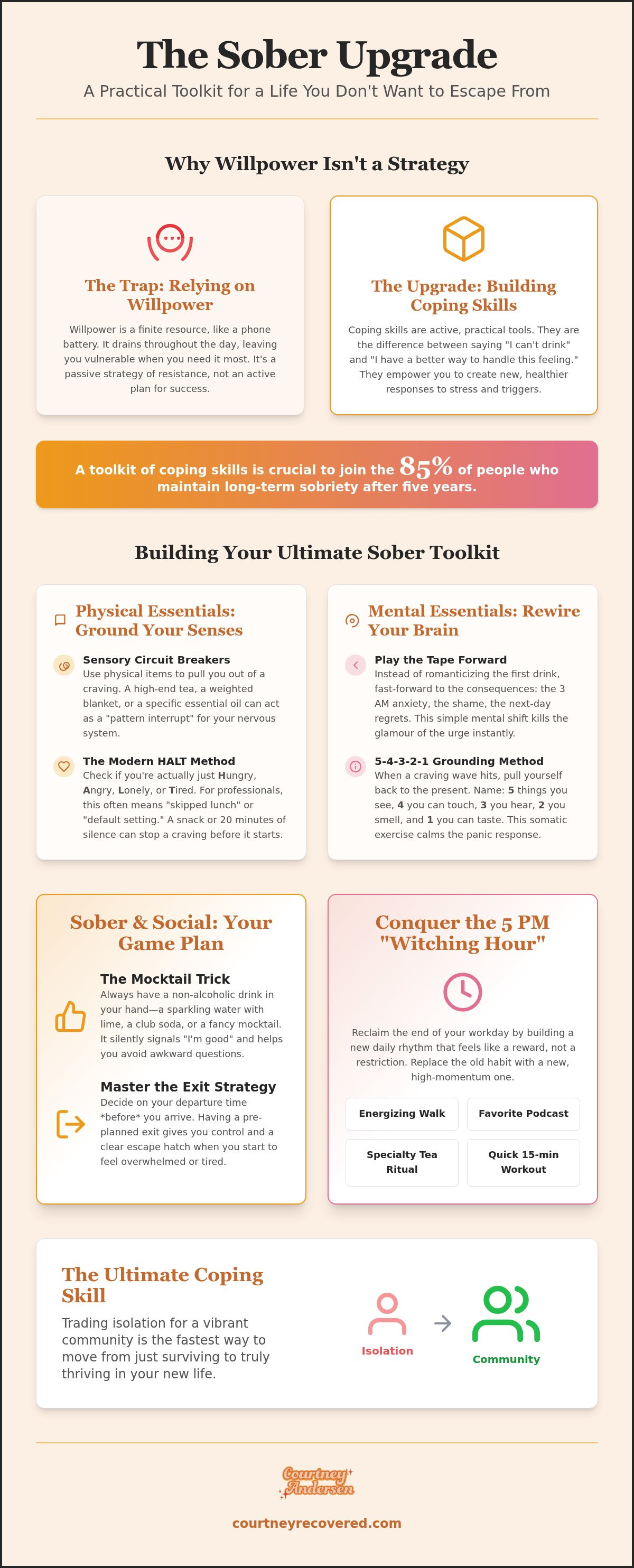
We have all been there. It is 5:00 PM on a random Tuesday, and that "strong" morning resolution has totally evaporated. Willpower is like a phone battery; it drains throughout the day as you make decisions, handle stress, and manage other people's energy. By the time you hit the "witching hour," your battery is at 2 percent. Relying on willpower is just passive resistance, like trying to hold back a flood with a paper plate. Real coping skills for sobriety are active tools. They are the difference between "I can't have a drink" and "I have a better way to handle this feeling." This is especially true for gray area drinkers who feel like they should be able to "control" it because they are successful everywhere else.
The Myth of the "Strong-Willed" Recoveree
You are likely a high-achiever. You boss your career, your family, and your fitness. So why can't you just "boss" yourself into being sober? The truth is that your brain has carved deep grooves, like a well-worn hiking trail, that lead straight to the bottle when you are stressed. You don't need more effort; you need new trails. This is where Relapse Prevention Strategies come in. These strategies focus on changing your response to triggers, not just trying to ignore them. When you use my "Stop Starting Over" methodology, you break the shame cycle of the Day 1 loop. You stop fighting your biology and start working with it.
Reframing Sobriety as a Gain, Not a Loss
Let's stop using words like "quitting" or "giving up." You aren't losing your social life or your ability to relax. You are evolving. Using coping skills for sobriety allows you to access a high-energy, vibrant lifestyle that alcohol actually suppresses. You are trading a dull, repetitive habit for a life where you are actually present for the good stuff. Sobriety is the ultimate life upgrade. It is about building a version of yourself that is so well-equipped and connected that drinking starts to look like a massive downgrade. You are not losing a friend; you are losing a weight that has been holding you back from your best self.
Building Your Ultimate Sober Toolkit: Mental and Physical Essentials
Imagine trying to fix a leaky pipe with your bare hands. That is exactly what trying to stay sober without a plan feels like. You need a literal and figurative toolkit to handle the pressure when life gets loud. A physical toolkit grounds your senses when the "witching hour" hits. It might include your favorite high-end tea, a weighted blanket, or even a specific essential oil that signals "safety" to your brain. These physical items act as a circuit breaker for your nervous system. They pull you out of the craving and back into the room.
We also need to update the classic HALT method for your high-performance life. For the modern professional, "Hungry" often means you skipped lunch for a back-to-back meeting schedule, and "Tired" is basically your default setting. Recognizing these physical states is one of the most effective coping skills for sobriety because it stops a craving before it even starts. When you feel that familiar itch for a glass of wine, ask yourself if you actually just need a snack or twenty minutes of silence. My Sober Vibes Book acts as a 24/7 mentor in these moments, offering the "quit-lit" perspective you need to stay on track.
Tactical Tools for Immediate Cravings
Cravings are like waves; they peak, and then they subside. You just have to learn how to surf them without drowning. Using a physical Sober Toolkit gives you a sensory distraction that pulls you out of your head and back into your body. Try the 5-4-3-2-1 method: identify five things you see, four you can touch, three you hear, two you smell, and one you can taste. This somatic grounding shuts down your brain's panic response. It is a simple way to ride the wave until the urge passes, which usually takes less time than you think.
Mental Shifts for Long-Term Resilience
Long-term success comes down to how you talk to yourself in the quiet moments. "Playing the tape forward" is a total game-changer. Instead of focusing on the first "relaxing" drink, imagine the 3 AM heart palpitations, the parched throat, and the "what did I say?" shame of the next morning. It kills the glamour of the urge instantly. Shrink your timeline if "forever" feels too heavy. Just commit to "Not Today." This keeps you present and prevents the overwhelm that leads to relapse. Journaling also helps you spot "Gray Area" triggers before they turn into a full-blown crisis. If you want to dive deeper into these mental patterns, 1:1 sobriety coaching can help you build a custom roadmap for your specific lifestyle.
Social Coping Skills: How to Be Sober and Social Without the Awkwardness
You don't need to hide under your covers until you feel "strong" enough to face a happy hour. That is a recipe for loneliness, and loneliness is the fast track to a relapse. Real coping skills for sobriety involve taking up space in the world exactly as you are. One of the most powerful moves you can make is mastering the "Exit Strategy." This isn't about being rude; it's about knowing that you have a car, a ride-share app, or a polite excuse ready the moment the vibe shifts from fun to messy. Having a way out gives you the psychological safety to show up in the first place. You are in control of your time and your energy.
Then there is the "Drink in Hand" trick. Most people don't actually care what you are drinking; they just want to make sure you are participating in the ritual. Grab a club soda with lime or a fancy mocktail in a stem glass. It provides a sensory distraction and stops the "Can I get you a drink?" loop before it starts. You are transitioning from the "Party Girl" who needed a drink to be fun to the "Vibrant Sober Woman" who is actually the life of the party because she is present, sharp, and genuinely engaged. You aren't the boring one. You are the one who will actually remember the conversation the next morning.
The Social Script: What to Actually Say
When someone asks why you aren't drinking, remember that "No" is a full sentence. You don't owe anyone a medical history or a deep dive into your journey. For colleagues, a simple "I'm not drinking tonight" or "I have an early morning" works perfectly. With close friends, you can be more honest, but keep it high-energy. Try saying, "I'm on a health kick and feeling amazing," or "I realized I'm way more fun without the hangover." Use humor to deflect. If things get pushy, just smile and change the subject. You are protecting your peace, not defending a court case.
Navigating High-Pressure Events
Weddings and bachelorettes can feel like a gauntlet. The key is the "Pre-Game" for sobriety. Before you walk in, set a clear intention for how you want to feel when you leave. If you are working with a coach, send a quick check-in text to ground yourself. Once you are there, scan the room for other people who aren't overdoing it. You will be surprised to find that the most interesting people usually aren't the ones at the bottom of a bottle. Focus on the connection, the music, or the food. These social coping skills for sobriety turn scary events into opportunities to prove to yourself that you have got this.
Daily Maintenance: Creating a Routine You Don’t Need to Escape
Sobriety isn't just about the big "no" you say to a glass of wine; it's about the thousand small "yeses" you say to yourself every day. If your life is a chaotic mess of stress and burnout, you'll naturally want to escape it. Building a life you love is the ultimate defense. Real coping skills for sobriety are about creating a daily rhythm that supports your nervous system instead of frying it. This starts the moment you wake up. A morning routine that focuses on hydration and light movement sets a tone of self-respect. You aren't waking up to a "shame-over" anymore. You are waking up to a life that actually feels good.
The most dangerous time for most of us is the "Witching Hour" between 5 and 7 PM. Your blood sugar is low, your decision fatigue is high, and your brain is looking for a shortcut to relaxation. Studies show that relapse rates for substance use disorders are between 40% and 60%, and many of those slips happen when we are tired and unprepared. This is where you need a ritual shift. Instead of reaching for the corkscrew, reach for a high-energy mocktail or a 10-minute walk. Stabilizing your mood with proper nutrition during this window is non-negotiable for daily maintenance.
The 5 PM Pivot: Reclaiming Your Evenings
You have probably told yourself "I deserve this" after a brutal day at the office. But let's get real. You deserve a clear head, a restful night, and a regret-free morning. You don't deserve a habit that makes tomorrow harder. Replace the "Wine O'Clock" ritual with a specific micro-habit, like listening to a sober podcast or practicing a somatic grounding exercise. These small shifts rewire your brain to find pleasure in things that actually serve you. It is about trading the temporary "off switch" for a permanent sense of peace.
Sleep and Recovery: The Natural High
One of the biggest wins of an alcohol-free life is the transformation of your sleep. Real, restorative sleep is a natural high that wine can never replicate. To protect this, build a "Sober Sanctuary" in your home. Make your bedroom a place of total peace. Using the Sober Vibes Book as a nightly anchor helps ground your thoughts before bed. It keeps your mindset focused on the gain of your evolution rather than the loss of a habit. If you are ready to stop the cycle of starting over and want a custom roadmap for your new life, my 1:1 sobriety coaching provides the high-momentum support you need to make these routines stick.
The Ultimate Coping Skill: Why Community Beats Isolation Every Time
You can have the best morning routine and the fanciest mocktails in the world, but if you are doing this alone, you are playing on hard mode. Loneliness is the absolute biggest trigger for a relapse. When you are isolated, that voice in your head that says "one drink won't hurt" starts to sound a lot more convincing. Research shows that relapse rates for substance use disorders sit between 40% and 60%, and much of that comes down to a lack of connection. Connection is the secret sauce that makes all your other coping skills for sobriety actually stick. It turns a "white-knuckle" struggle into a shared adventure.
A massive difference exists between a somber support group and a vibrant community. You don't need to sit in a sterile room and talk about how hard life is; you need a space that celebrates your wins and cheers for your evolution. A sober community online provides that 24/7 accountability that a weekly meeting just can't touch. It is about having a tribe of women in your pocket who "get it" when you are navigating a stressful Tuesday or a high-pressure wedding. While community gives you breadth of support, 1:1 coaching helps you identify personal "blind spots" you might be too close to see.
Finding Your Vibe in the Sobriety Circle
It is time to move beyond the "basement meeting" stigma. You aren't "recovering" from a broken life; you are creating a masterpiece. The Sobriety Circle is a celebratory space for high-achieving women ready to thrive. Shared experience is the fastest way to heal the specific shame that often comes with gray-area drinking. When you hear another successful woman describe the exact same internal monologue you've been having, the weight of isolation just evaporates. Being seen and understood by people who share your lifestyle is a total game-changer for your confidence.
Stop Starting Over: Taking the Next Step
Learning coping skills for sobriety is the first step, but living a sober life is the ultimate goal. You need a roadmap that takes you from "just getting through the day" to "loving every minute of it." My "Stop Starting Over" methodology breaks the relapse cycle for good by giving you a structured path forward. You don't have to figure this out by trial and error. You can choose a high-momentum path that leads straight to the vibrant, alcohol-free life you deserve. Join the Sobriety Circle or book a 1:1 session today.
Your Vibrant, Alcohol-Free Life Starts Now
You've spent enough time fighting against your own biology and trying to "boss" your way through cravings. It's time to stop the white-knuckle struggle and start using a roadmap that actually works for your high-performance lifestyle. By trading finite willpower for active coping skills for sobriety, you aren't just surviving; you're evolving into a version of yourself that's sharper, more connected, and genuinely happier. You've learned how to build your physical toolkit, master social scripts, and reclaim your evenings from the "witching hour" trap. It's time to evolve.
With over 10 years of lived experience, Courtney Andersen has helped thousands of professional women move beyond the "Day 1" loop. Our vibrant community has been featured in major recovery publications because we focus on celebration, not deprivation. You don't have to do this alone or in a sterile environment. You deserve a space where women who truly get it see you and support you. Tired of starting over? Grab your Sober Toolkit and join the Sobriety Circle today! You have everything you need to build a life that feels way better than drinking ever did. Your future self is already cheering for you.
Frequently Asked Questions
What are the most effective coping skills for early sobriety?
The most effective coping skills for sobriety in the early days are those that ground your senses and disrupt the autopilot urge to drink. This includes somatic techniques like the 5-4-3-2-1 grounding method or reaching for a physical Sober Toolkit to signal safety to your brain. You also need a solid "Exit Strategy" for social events and a morning routine that builds momentum before your day even begins.
How do I deal with social pressure to drink at work events?
You handle work events by always having a "Drink in Hand" ritual. Grab a club soda with lime immediately so nobody asks if you need one. If a colleague pushes, use a short, punchy script like "I'm on a health kick and feeling amazing" or "I've got an early start tomorrow." You don't owe anyone your medical history. Focus on being the sharpest, most present version of yourself in the room.
Can I stay sober without going to AA?
Absolutely. While AA works for some, many professional women prefer a vibrant, celebratory community like the Sobriety Circle. We focus on a non-clinical, high-energy approach that frames sobriety as a positive gain rather than a restrictive loss. You can build a successful, alcohol-free life through 1:1 coaching and peer support that aligns with your specific lifestyle and goals without following a traditional 12-step path.
What should I do when I have a sudden, intense craving for alcohol?
When a sudden craving hits, remember that urges are like waves; they peak and then subside. Practice "Urge Surfing" by observing the feeling without acting on it. Use your physical Sober Toolkit to distract your senses with essential oils, tea, or a weighted blanket. Reach out to your online community for immediate accountability. Most cravings pass within twenty minutes if you have a tactical tool ready to disrupt the thought loop.
How do I handle "sober boredom" in the first few months?
Boredom is often just your brain recalibrating its dopamine levels. Instead of sitting with the "loss" of drinking, fill that space with high-momentum activities you actually enjoy. This is the perfect time to explore new rituals, like a specific evening movement practice or diving into "quit-lit" like the Sober Vibes Book. Sobriety isn't about being bored; it is about finally having the energy to pursue a life you don't want to escape from.
What is the "HALT" method and how do I use it?
HALT stands for Hungry, Angry, Lonely, and Tired. These are the four most common physical and emotional states that trigger a craving. When you feel the itch to drink, stop and check in with your body. Do you actually need a glass of wine, or do you just need a snack and a twenty-minute nap? Using HALT as one of your coping skills for sobriety helps you address the root cause of the urge.
How can a sobriety coach help me develop better coping skills?
A sobriety coach acts as a relatable mentor who has already walked the path. They help you identify personal "blind spots" in your routine that may be driving a relapse cycle. Through 1:1 coaching, you get a customized roadmap that replaces generic advice with tactical tools tailored to your career and social life. It provides the high-level accountability you need to move from "trying to quit" to actually thriving.
What are some healthy alternatives to drinking for stress relief?
Trade the "off switch" of alcohol for rituals that actually restore your nervous system. Try somatic movement, deep breathing, or a dedicated evening wind-down routine in your "Sober Sanctuary." High-end non-alcoholic tonics can satisfy the ritual of a "grown-up" drink without the heart palpitations. The goal is to find activities that make you feel better the next morning, not just for the next hour. You deserve real peace, not just a temporary blur.
I want you to feel sober NOT boring!
Kickstart your sobriety with my free 2-day video workshop series to master your sober mindset and have FUN in your sobriety journey!


