
Beyond the Counter: 5 Powerful Alternatives to Sobriety Apps in 2026
Oct 01, 2026
Your sobriety shouldn't feel like a high-stakes math project. If checking your day-counter app gives you a shot of anxiety instead of a sense of peace, you haven't failed; you've just outgrown the digital cage. Those blinking numbers were a great training wheel, but staring at a screen can't replace the magic of real human energy. You're a person with a big, beautiful life to lead, not just a data point on a developer's dashboard.
I get it because I've been there, refreshing the screen and waiting for a digital badge to make me feel whole while still feeling totally isolated in my own kitchen. It's time to look at alternatives to sobriety apps that prioritize connection over calculations. You deserve a recovery that feels like a celebration, not a chore. In this article, you'll discover why digital counters might be holding you back and how human-centered shifts can help you build a sober life you actually love. We're diving into five powerful ways to move beyond the phone and into a vibrant, connected reality through coaching, community, and tactile tools that work in the real world.
Key Takeaways
- Understand why "Day Zero" anxiety is a real thing and how moving away from digital counters can actually protect your mental health.
- Discover the best alternatives to sobriety apps that replace glitchy notifications with high-energy human connection and real-time accountability.
- Learn how to swap "crowdsourced" noise for curated spaces like the Sobriety Circle to avoid the triggers and toxicity found in public forums.
- Explore the power of tactile tools like the Sober Toolkit to bring your recovery into the physical world and out of your phone.
- Get a simple, two-step roadmap to audit your current habits and build a personalized recovery ecosystem that feels like a gain, not a loss.
Why Sobriety Apps Often Fail High-Functioning Women
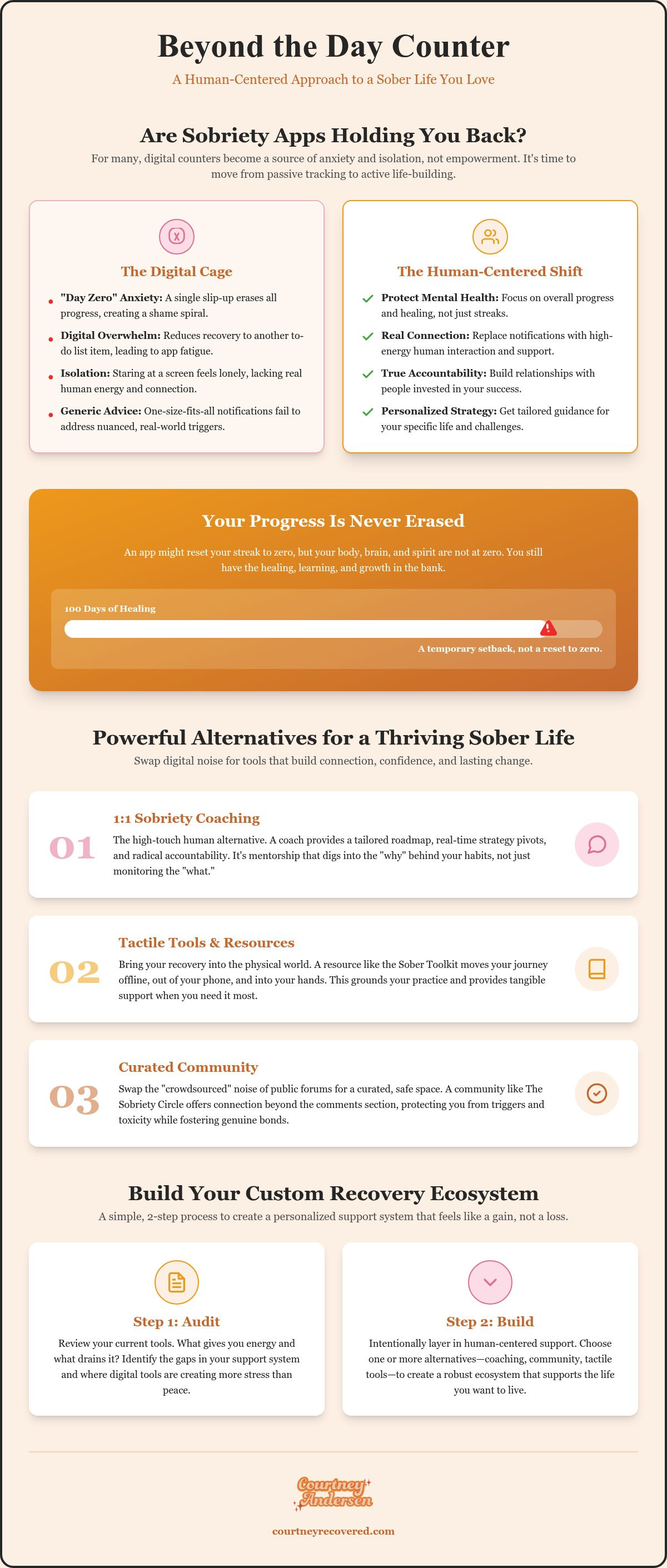
You are a high-achiever. You manage teams, crush deadlines, and keep the household running like a Swiss watch. So when you decided to change your relationship with alcohol, it made sense to download an app and track it like a project. But here's the truth: your sobriety isn't a spreadsheet. For many women, that little digital counter becomes a source of "Day Zero" dread rather than a beacon of hope. When the focus is entirely on a ticking clock, one glass of wine feels like you've set your entire life on fire and erased every ounce of progress. That shame spiral is a trap, and it's one of the biggest reasons people start looking for alternatives to sobriety apps that actually feel human.
Then there's digital overwhelm. We're already tethered to our phones for work, social life, and news. Adding your recovery to that pile can lead to serious app fatigue. App fatigue in 2026 is the psychological burnout that comes from reducing your personal growth to a series of digital pings and pixelated badges that eventually feel like just another item on your to-do list. You don't need another notification; you need a transformation.
The Psychology of the Digital Counter
Digital counters keep you stuck in a "starting over" loop. They gamify your life in a way that suggests you're only as good as your current streak. If you have 100 days and then have a drink, the app tells you you're back at zero. But your body, your brain, and your spirit aren't at zero. You still have those 100 days of healing in the bank. This rigid, binary way of thinking is the opposite of actual lifestyle transformation. Real change happens when you move from passive tracking to active life-building. It's about how you feel in your skin, not the number on your lock screen. While some may find value in community-based recovery programs, many high-performing women need a more nuanced, personalized approach that a standard algorithm simply can't provide.
Why "Functional" Drinking Needs More Than a Push Notification
If you're a high-performing woman, your struggle often looks different. You aren't losing your job; you're just losing your joy. This is the heart of Gray Area Drinking, where the lines are blurry and the social pressures are immense. A bot doesn't understand the nuance of a high-stakes corporate gala or the subtle "mommy wine culture" at the school gates. Generic app advice fails to address these professional and social complexities because it's designed for the masses, not for your specific, vibrant life. You need tools that help you navigate real-world triggers in real-time, not a pre-programmed message that arrives three hours too late.
1:1 Sobriety Coaching: The High-Touch Human Alternative
Apps are great for tracking, but they can't hold your hand when you're staring at a cocktail menu at a high-stakes corporate gala. That's where 1:1 coaching comes in. It's one of the most effective alternatives to sobriety apps because it replaces a silent algorithm with a loud, supportive voice. Think of it as the "cool older sister" effect. You aren't getting clinical data points from a detached authority; you're getting lived experience from someone who has been in the trenches and come out the other side glowing.
A professional coach provides a tailored roadmap that an app simply cannot replicate. If your week goes sideways, a coach pivots your strategy in real-time. They offer radical accountability because they actually know your name, your kids' names, and exactly what triggers your 5:00 PM cravings. You can't just swipe away a text from someone deeply invested in your success. This personal connection is the key to finally breaking the "Stop Starting Over" cycle and moving into a life of sustained, vibrant freedom.
Mentorship vs. Monitoring
Monitoring is what an app does. It watches your behavior and counts your days like a digital prison guard. Mentorship, specifically 1 on 1 Sobriety Coaching, digs into the root cause of your drinking. A coach helps you unpack the "why" behind the habit. They provide personalized scripts for social situations that no blog post or bot could ever generate. Instead of awkwardly nursing a soda water while an app tells you, "Good job!", you'll have a rock-solid plan for handling the "Why aren't you drinking?" question from your nosy neighbor or your boss.
Finding Your Vibe with a Professional Coach
For high-functioning professionals, non-clinical support often feels safer and more relatable. You aren't looking for a diagnosis; you're looking for a lifestyle upgrade. While many individuals find success through evidence-based treatment options like therapy or medication, others find that the missing piece is a high-energy mentor who matches their ambition. A coach brings a level of "tough love" realism that automated apps lack. They'll call you out on your excuses with empathy and humor, keeping you moving forward even when things get messy. If you're tired of feeling like a data point and want to start feeling like a person again, exploring 1:1 Sobriety Coaching is the logical upgrade from a glitchy screen.
Tactile Tools: Why Your Recovery Needs to Move Offline
Your phone is a distraction factory. Every time you pick it up to check your sobriety app, you're one notification away from a stressful work email, a polarizing news alert, or a triggering social media post. This is why moving your recovery into the physical world is a game-changer. Tactile tools are powerful alternatives to sobriety apps because they engage your senses and pull you back into the present moment. You can't touch a pixel, but you can hold a book, light a specific candle, or write in a journal. These physical actions create new neural pathways that digital clicking just can't touch.
Getting out of your head and onto the page is vital to the process. While apps track your behavior, journaling helps you understand your heart. It's about creating a "Sober Sanctuary" at home without a screen. This is a dedicated space where you can retreat when the world gets too loud. It's not just about avoiding a drink; it's about building a life where you don't feel the need to escape.
The Best Sobriety Books and Literature
Quit-Lit isn't just about reading; it's about building a new identity. When you dive into the Sober Vibes Book, you aren't just looking at data points. You're absorbing a new vocabulary and a different way of seeing your future. Reading other people's stories provides a depth of empathy that app gamification lacks. It helps you realize that your struggle isn't a glitch in your system; it's a shared human experience. This narrative immersion is often what makes a structured program so successful. In fact, research from Yale University shows that certain specialized web-based programs outperforms standard addiction treatment. But adding a physical book to that mix gives you a sanctuary away from the blue light and the constant pings of modern life.
Building Your Physical Sober Toolkit
Imagine having a literal box of magic for when things get tough. A physical sobriety toolkit is about more than stuff; it's about immediate, tactile anchors. While an app might send a generic "Stay strong!" message, your Sober Toolkit gives you something to actually do. Maybe it's a specific essential oil that calms your nervous system or a fidget ring to keep your hands busy during a stressful Zoom call. These physical cues manage cravings in the moment by grounding you in your body. Apps keep you in your head, where cravings often live. By using physical tools, you break the "want" circuit and replace it with a "do."
The Sobriety Circle: Community Beyond the Comments Section
Let's be real: scrolling through a public forum at 2:00 AM while you're fighting a craving is a recipe for disaster. Some "crowdsourced" support groups can help in a pinch, but they're often unmoderated, overwhelming, and occasionally toxic. You might go in looking for inspiration and leave feeling more triggered by someone else's horror story. This is a massive reason why high-achieving women are seeking out more intentional alternatives to sobriety apps and anonymous message boards. You don't just need a place to vent; you need a curated community that celebrates life.
The Sobriety Circle isn't about sitting in a circle and talking about how much life sucks without booze. It's the opposite. It's a high-energy space where we focus on what we're gaining, not what we're giving up. We swap the somber "one day at a time" grind for a vibrant lifestyle that feels like a massive upgrade. Whether you're navigating your first sober vacation or looking for shared resources like "Stop Starting Over," having a squad of women who "get it" makes all the difference.
Finding Your People Online
Privacy is a non-negotiable for professional women. You deserve a safe, private space where you can be vulnerable without worrying about your digital footprint or who might see your posts. A curated sober community online acts as a bridge between the isolation of your early struggle and the vibrancy of your new reality. These spaces foster real-world friendships that go way deeper than a "like" on a photo. It’s the difference between being "lonely sober" and being part of a connected, empowered movement.
Structured Support vs. Random Advice
There is a world of difference between a free-for-all forum and a coach-led community. In a structured environment, you get a logical progression for your journey. You aren't just getting random advice from strangers; you're getting expert guidance that helps you navigate the nuances of high-functioning sobriety. Programs like "The After" are designed specifically to help you maintain that momentum long-term. You don't have to figure this out by trial and error when you have a roadmap and a mentor leading the way. If you're ready to trade the digital noise for deep connection, exploring a curated sober community is the best way to find the squad you've been waiting for.
How to Build Your Custom Recovery Ecosystem in 2026
Building a life you love requires more than a download button. To move beyond the digital counter, you need a strategy that covers your heart, your head, and your hands. Start by auditing your current tech. Does your app make you feel like a rockstar or a failure? If it triggers shame every time you forget to log a mood, it's time to hit delete. In 2026, the best alternatives to sobriety apps are the ones that get you off your phone and back into your actual life.
Next, choose your human anchor. Whether it's the 1:1 Sobriety Coaching we talked about or the curated energy of the Sobriety Circle, you need a real person who knows your name and your "why." From there, diversify your tools. Grab the Sober Vibes Book for your nightstand and keep your Sober Toolkit ready for those high-pressure social moments. Finally, shift your focus. Stop counting the days you've gone without a drink and start counting the experiences you've gained because you're present. Commit to a path that feels like a celebration of your potential, not a restriction of your fun.
Making the Shift from Tracking to Living
Transitioning away from a day-counter can feel scary, but it's the key to true freedom. You don't lose accountability when you delete an app; you trade digital monitoring for internal mastery. Focus on your gains. Think about the extra money in your bank account, the glowing skin, and the Sunday mornings where you actually feel like a human. When you stop obsessing over a "Day Zero" reset, you realize that your progress is cumulative. You're building a Life After Sobriety that is rich, textured, and totally worth the effort. This isn't about what you're losing. It's about every single thing you're reclaiming.
The Logical Conclusion: Why You Deserve More Than an App
Your life is too big, too vibrant, and too important to be managed by a $10 monthly subscription. You aren't a data point, and your recovery shouldn't feel like a glitchy notification. You deserve high-touch support that matches your ambition and celebrates your unique journey. Investing in yourself through 1:1 coaching or a curated community is the ultimate power move. It's time to stop settling for automated badges and start demanding the deep connection and expert mentorship you need to thrive. You've outgrown the training wheels, sis; it's time to take the lead and show the world what a truly sober life looks like.
Your Best Life is Waiting Outside the App Store
You didn't decide to get sober just to stare at a different screen. We've explored how moving from digital tracking to human connection completely changes the game for high-functioning women. Whether it's the high-touch support of 1:1 coaching or the tactile grounding of a physical toolkit, your recovery deserves to be as multi-dimensional as you are. Finding alternatives to sobriety apps isn't about being anti-tech; it's about being pro-you and prioritizing real-world energy over pixelated badges.
As the author of the Sober Vibes Book and founder of the Sobriety Circle, I specialize in helping women navigate Gray Area Drinking with zero judgment and maximum celebration. You've got the vision, and now you have the roadmap to build an ecosystem that actually supports your ambition. It's time to stop letting a $10 subscription manage your potential and start investing in the high-energy mentorship you deserve. You've got this, and I'm right here to help you lead the way.
Ready for a vibrant, alcohol-free life? Book your 1:1 Sobriety Coaching session with Courtney today.
Let's make 2026 the year you stop counting days and start making the days count. Your vibrant, connected reality is just one decision away.
Frequently Asked Questions
Can I stay sober without using a sobriety app or day counter?
Yes, you absolutely can. Many women find that moving away from the "day zero" pressure allows them to focus on lifestyle gains rather than just numbers. Instead of a counter, you can use high-touch human support or tactile toolkits to build a life you love. Sobriety is about how you feel in your skin, not just a digital badge on your lock screen. It is about the quality of your life, not the quantity of your days.
What is the most effective alternative to AA and sobriety apps?
For high-functioning women, 1:1 Sobriety Coaching is often the most effective choice. It provides personalized mentorship and real-time strategy that a generic app or a large group meeting can't match. Having a mentor who knows your specific triggers helps you build a custom roadmap. This high-touch approach is one of the best alternatives to sobriety apps for those seeking a vibrant, non-clinical path that actually feels like a lifestyle upgrade.
How much does a sobriety coach cost compared to a paid app?
While a coach is a bigger investment than a monthly app subscription, the value comes from personalized results and deep accountability. Coaching fees vary based on the level of support and session frequency, while apps usually charge a flat monthly or yearly rate. Think of it as investing in a custom-built future rather than just a digital tracker. You are paying for lived experience and a strategy tailored specifically to your professional and personal life.
Is it possible to quit drinking without a digital tracker if I have a history of relapse?
It is not only possible; it might be exactly what you need to break the cycle in 2026. Constant digital reminders can sometimes keep you stuck in a "starting over" mindset. By using structured programs like Stop Starting Over, you shift your focus toward long-term transformation rather than just avoiding a drink today. Real-world accountability from a coach or a curated community often provides the safety net that a simple app notification lacks.
What are the best books to read instead of using a sobriety app?
The Sober Vibes Book is a foundational resource for anyone looking to move beyond passive tracking. It offers deeper insights into the mindset shifts required for a happy, alcohol-free life. Other "Quit-Lit" favorites can help you build a new vocabulary and identity. Reading these stories allows you to see your journey as a positive gain rather than a restrictive loss, which is far more empowering and sustainable than watching a digital clock tick.
How do I find a sober community that isn’t on a public forum like Reddit?
Look for curated, private spaces like the Sobriety Circle. Unlike public forums, these communities are moderated and designed specifically for high-achieving women who want a safe place to share. You get shared resources and real-world friendships without the noise or triggers found on unmoderated boards. It is about finding a vibe that celebrates your growth and keeps your professional privacy intact while you connect with your new squad.
What happens if I stop counting my days? Will I relapse?
Stopping the count doesn't mean you are losing control; it often means you are moving into a more mature phase of recovery. Many women find that once they focus on "The After" and their overall wellness, the specific number of days becomes less relevant. You aren't defined by a streak. If you have a solid support system and a toolkit you trust, your sobriety stays strong because it is built on a lifestyle you actually enjoy.
Why do I feel more anxious when I use a sobriety app?
You are likely experiencing app fatigue or the pressure of the "Day Zero" trap. Staring at a counter can make you feel one mistake away from losing everything, which triggers your nervous system. Seeking out alternatives to sobriety apps allows you to lower that anxiety by focusing on human connection and tactile grounding. You deserve a recovery that feels like a relief, not a high-stakes math project you are afraid of failing.
I want you to feel sober NOT boring!
Kickstart your sobriety with my free 2-day video workshop series to master your sober mindset and have FUN in your sobriety journey!


