
Why Do I Keep Going Back to Alcohol? Breaking the Cycle
Oct 06, 2026
What if the reason you are stuck in that exhausting "Day 1" loop has nothing to do with being weak and everything to do with your life not being fun enough yet? You have the career, the house, and the "perfect" life on paper, yet you are still waking up at 3 AM with a pounding heart, wondering, why do I keep going back to alcohol? It is incredibly isolating to feel like a total fraud when you are crushing it at the office but cannot seem to crush a simple Tuesday night craving. You are not broken, and you definitely do not need another sterile, clinical lecture.
I get it because I have been in that exact shame spiral. Today, we are going to ditch the somber recovery vibes and uncover the real reasons willpower alone is not enough to keep you away from the bottle. I promise to show you how to build a vibrant, high-energy life you actually enjoy living, rather than one you feel punished in. We will explore the hidden triggers that keep you stuck, the myth of the "dull" sober life, and the practical roadmap to stop starting over so you can finally find your tribe.
Key Takeaways
- Stop blaming your willpower and understand how the dopamine loop treats alcohol as a survival tool, making it harder to quit without a real plan.
- See through the "Gray Area Trap" where your career success masks the internal cycle, helping you finally understand why I keep going back to alcohol.
- Identify your specific "Escape Hatch" to see alcohol as a temporary solution for anxiety or boredom rather than a personal failing.
- Learn to use a Sober Toolkit to design a life so fun and connected you won't even want to escape it.
- Discover the "Stop Starting Over" strategy to break the loop of constant Day 1s and step into a roadmap built for long-term freedom.
Why Your Brain Keeps Lobbying for 'Just One Drink'
You aren't a failure. You aren't broken. Your brain is actually doing exactly what it was designed to do: seek rewards and repeat behaviors that it thinks are essential for survival. When you find yourself staring at the fridge at 5 PM asking, why do i keep going back to alcohol, the answer is usually found in your wiring, not your worth. Alcohol has effectively "lobbied" its way into your brain's board of directors, and it is a very persuasive speaker.
The Neural Feedback Loop
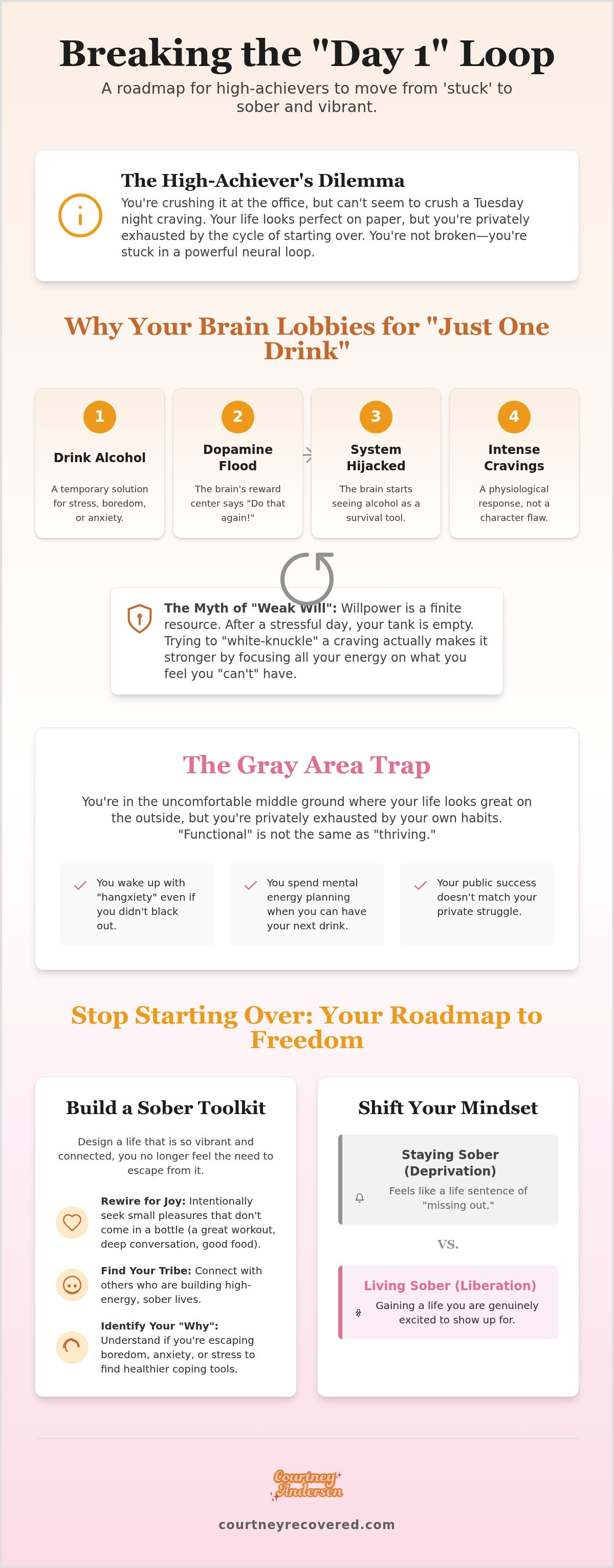
Alcohol is a master manipulator of your reward center. It floods your system with dopamine, the "do that again" chemical, at levels your brain simply cannot produce on its own. Eventually, your brain stops seeing a glass of wine as a treat and starts seeing it as a survival tool. This is why Understanding Alcohol Use Disorder is so vital. It helps you see that your cravings are a physiological response to a hijacked system, not a character flaw.
Neurochemistry also explains why certain milestones feel like a total battle. On Day 3, your body is often finishing its physical detox, leaving you feeling raw, edgy, and desperate for a "fix" to level out. By Day 10, the initial excitement of starting a new habit can fade. Your brain starts screaming for its old, easy dopamine source. To break this, you have to start re-wiring for joy. This means intentionally seeking out small hits of pleasure that do not come in a bottle. Whether it is a killer workout, a deep conversation, or even a really good piece of dark chocolate, you are teaching your brain that joy exists outside of the glass. It takes time, but your brain can learn to love the real world again.
The Myth of the 'Weak Will'
If you are a high-achiever, you are probably used to white-knuckling your way to success. You think if you can run a company or raise a family, you should be able to "just say no" through sheer grit. But willpower is a finite resource. By the time you finish a stressful workday, your willpower tank is bone dry. Trying to "white-knuckle" a craving actually makes it stronger because you are focusing all your energy on the thing you "cannot" have, which creates a sense of panic in the subconscious.
There is a massive difference between "staying sober" and "living sober." Staying sober feels like a life sentence of missing out. Living sober feels like you finally got the keys to the kingdom. Most of my clients fall into the gray area of the drinking spectrum. You haven't lost your job or your house, but you are losing your peace of mind in the cycle. The ultimate sobriety mindset shift is moving from a place of deprivation to a place of total liberation. You aren't giving up your social life; you are gaining a life you actually want to show up for.
The Gray Area Trap: When Being 'Fine' Keeps You Stuck
The biggest lie about alcohol recovery is that you have to lose everything before you can gain anything. We have been conditioned to believe that unless we are drinking out of a paper bag under a bridge, we don't have a "real" problem. This creates the gray area trap. It's that uncomfortable middle ground where your life looks great on Instagram, but you are privately exhausted by your own habits. You keep asking, why do I keep going back to alcohol, simply because you haven't hit a wall hard enough to stop. But waiting for a "rock bottom" is like waiting for a car crash to decide you should stop speeding. It's dangerous, unnecessary, and keeps you stuck in a cycle of "just fine" when you were meant for "vibrant."
Are You a High-Performing Drinker?
Professional success is the ultimate mask. If you are hitting your KPIs, managing a team, and keeping the household running, it's easy to justify that nightly bottle of Chardonnay. You tell yourself it's your reward for a hard day's work. This is where "Mommy Wine Culture" does its worst work, normalizing the idea that motherhood and high-pressure careers require a liquid crutch. You aren't failing at life; you're carrying a heavy secret that is draining your battery. If you feel like your habit is starting to overshadow your potential, check out Gray Area Drinking: When Your Habit Becomes a Burden to see if this resonates with your experience.
- You wake up with "hangxiety" even if you didn't black out.
- You spend a lot of mental energy planning when you can have your next drink.
- You feel like a fraud because your public success doesn't match your private struggle.
Why 'Functional' Isn't Enough
Being "functional" is a pretty low bar for someone with your ambition. When you live in the gray area, alcohol acts like a dimmer switch on your life. It blunts the anxiety, sure, but it also blunts your creativity, your connection with your partner, and your genuine joy. You aren't actually thriving; you are just surviving the days until you can numb out again. Stop asking "Am I an alcoholic?" because that clinical label doesn't help you. Start asking, "Is alcohol getting in the way of the woman I want to be?" If the answer is yes, you don't need a medical diagnosis to decide you deserve better. You can choose a life that feels as good on the inside as it looks on the outside by joining a community that actually gets it in the Sobriety Circle.
Identifying Your Alcohol 'Why' (And Why It Matters)
If you keep asking yourself, why do i keep going back to alcohol, it is time to stop looking at the bottle and start looking at the "why" behind the pour. For most high-achieving women, alcohol isn't actually the primary problem; it is the solution to an underlying feeling that feels too big to handle. Whether it is a buzzing anxiety after a board meeting or a deep sense of boredom on a rainy Tuesday, alcohol acts as a reliable "Escape Hatch." When life gets too loud, too demanding, or just too much, that glass of wine offers a quick exit from the pressure cooker of your own reality.
It is a hard truth to swallow, but "You aren't choosing alcohol; you're choosing a temporary break from your own life." This shift in perspective is everything. It removes the shame of being "weak" and replaces it with the realization that you are simply trying to cope. You are looking for a way to turn down the volume of the world, but the problem is that the escape hatch always drops you right back where you started, usually with a headache and a fresh layer of guilt.
Common Triggers for the Relapse Loop
Identifying your specific triggers is like getting a map of the minefield. For professional women, the "5 PM Witching Hour" is often the biggest hurdle. It is that jarring transition from "Boss Mode" to "Home Mode" where you need a bridge to help you decompress. Without a new toolkit, that bridge is usually a bottle of Pinot. Other common triggers include:
- Social Anxiety: The paralyzing fear that you will be "the boring one" at the party without a drink in your hand.
- The Reward Trap: Using alcohol as the only way to celebrate a win or signal that the workday is finally over.
- Resentment: That "I do everything for everyone" feeling that makes a drink feel like the only thing that is just for you.
The Identity Crisis
One of the scariest parts of breaking the cycle is fearing who you will be on the other side. You might worry that sobriety equals a dull, social-less existence where you just drink sparkling water and go to bed at 9 PM. This is an identity crisis, and it is totally normal. But let me tell you something: the "fun" version of you that alcohol created was just a filtered version of your actual magic. Reclaiming your vibrant identity is about discovering that life after getting sober is actually much louder, brighter, and more connected than the numbed-out version you are living now. You aren't losing yourself; you are finally meeting yourself.
Building a Sober Lifestyle You Actually Like
If your version of sobriety feels like a life sentence of lukewarm water and early bedtimes, it is no wonder you are struggling. You might find yourself asking, why do i keep going back to alcohol, simply because the alternative you have built feels like a punishment. Sobriety is not just the absence of a drink; it is the presence of a life you actually want to show up for. It is about active lifestyle design. Instead of letting the alcohol industry dictate your social life, you get to choose the playlist, the vibe, and the people who actually light you up. This is Celebratory Sobriety. It is a massive win, not a restrictive loss.
Think of it as an upgrade. You are trading "hangxiety" and secret shame for clarity, energy, and genuine connection. The global functional beverage market is projected to reach $178.9 billion by 2026, which proves that the world is shifting. You aren't the "weird one" for not drinking; you are a trendsetter building a vibrant reality that most people are still too numbed out to see. To make this stick, you need more than just good intentions. You need a plan that feels as high-end as your career.
The Essential Sober Toolkit
Willpower is a terrible strategy for long-term success. You need a Sober Toolkit that works in the real world. This means having a curated list of high-end mocktail recipes for when you want something sophisticated in your hand, a stack of "quit-lit" that makes you feel empowered, and an accountability system that doesn't feel like a chore. My Sober Toolkit and Sober Vibes Book are foundational resources designed to give you those practical wins every single day. For a deeper dive into what actually works, explore the Best Sobriety Tools and Resources available to you right now.
Finding Your People
Isolation is the fastest way back to the bottle. But let's be real: most high-achieving women aren't looking for a sterile basement meeting with bad coffee. You want a community that matches your energy and your ambition. Finding a sober community online can be the secret weapon that finally breaks the loop. In the Sobriety Circle, we focus on shared experience and non-clinical support. It is high-energy, inclusive, and designed for women who want to thrive, not just survive. You deserve a tribe that celebrates your sobriety like the superpower it is. Ready to find your people? Join the Sobriety Circle today and stop doing this alone.
Navigating social situations becomes a lot easier when you stop feeling like an outcast and start feeling like the most interesting person in the room. When you show up with your own "sober vibes" and a clear head, you realize that most people are actually envious of your confidence. You aren't missing the party; you are the one who will actually remember it.
Stop Starting Over: Your Roadmap to Long-Term Freedom
Stop starting over. That mantra changes everything. If you find yourself constantly resetting the clock on your phone and asking, why do I keep going back to alcohol, the answer isn't that you need more willpower. You need a roadmap that doesn't feel like a dead end. The Stop Starting Over philosophy is about moving from a state of trying to stay sober to a state of doing life in a way that makes alcohol irrelevant. It is about ending that exhausting loop of guilt and starting a life that actually feels like a celebration. You aren't just quitting a habit; you are initiating a total lifestyle upgrade.
High-functioning women often feel like they should be able to solve this on their own. You have the spreadsheets, the vision boards, and the career wins. But when it comes to the 5 PM craving, you feel like a beginner. This is where personalized support becomes your secret weapon. It is the fast track to understanding your specific triggers without the clinical judgment of traditional programs. Accountability is the bridge between your intentions and your reality, turning your "maybe one day" into a vibrant today.
The Power of 1:1 Coaching
Working with a coach provides the tailored strategies that generic advice simply cannot offer. Think of it as having a relatable mentor or that cool older sister who has already cleared the path for you. We don't talk about medical pathology; we talk about lifestyle design. We look at your schedule, social pressures, and unique triggers to build a defense that holds up in the real world. If you are ready for a personalized approach that matches your ambition, 1-on-1 Sobriety Coaching is the best way to move out of the loop and into your power.
Your Next Step Toward Vibrant Sobriety
You don't have to wait for a crisis to decide you have had enough. You can choose to stop starting over right now. The Stop Starting Over methodology is designed to take you from the isolation of the struggle into the vibrancy of "The After." Life in The After means more energy, better relationships, and a sense of peace no bottle could ever provide. It is the version of you that is no longer wondering why do i keep going back to alcohol because you are too busy enjoying the life you have built.
Your best life is waiting on the other side of this cycle. It is loud, it is bright, and it is completely within your reach. Join the movement, lean into the support of the Sobriety Circle, and let's make this the last time you ever have to say Day 1. You have the magic inside you; it is time to let it shine without the filter of a glass.
Step Into Your Vibrant New Reality
Breaking the loop of constant Day 1s isn't about having more discipline; it is about finally building a life you don't feel the need to escape from. You have learned that your brain isn't broken, it is just wired for rewards, and that being functional in the gray area is a trap that keeps you from your true potential. Stop asking why I keep going back to alcohol and start focusing on the high-energy, connected future that is waiting for you.
You don't have to navigate this transition alone or settle for a dull, social-less existence. With the right mentorship and a practical Stop Starting Over framework, you can swap the shame spiral for a lifestyle that feels like a massive win. You deserve a tribe that gets it and a roadmap that actually works for your busy, ambitious life. So much more is waiting for you on the other side of the bottle.
Ready to stop the cycle for good? Apply for 1:1 Sobriety Coaching today! You will get expert mentorship and access to our vibrant Sobriety Circle community to ensure you never have to start over again. Your most vibrant self is ready to meet you; let's go get her.
Frequently Asked Questions
Is it normal to keep relapsing even when I really want to stop?
It is incredibly common to find yourself in the "Day 1" loop. You aren't failing; your brain is doing what it was programmed to do: seeking high-dopamine rewards. Most people stay stuck because they rely on willpower alone instead of a structured plan. When you wonder why do i keep going back to alcohol, remember it is about your wiring, not your worth. Breaking the cycle requires designing a life you love.
What is gray area drinking and how do I know if I'm in it?
Gray area drinking is the wide space between casual social drinking and hitting a traditional "rock bottom." You know you are in it if you are highly successful at work but spend your evenings privately questioning your habits. If you feel like a fraud because your public success doesn't match your private struggle, you are likely in the gray area. It is about how alcohol feels, not just how much you are consuming.
How can I be sober and still have a social life?
You don't have to become a hermit to stay sober. In fact, the sober-curious movement saw a 92% growth in events between 2024 and 2025, meaning there are more ways than ever to connect without booze. Use sophisticated mocktails, plan activities that don't revolve around a bar, and surround yourself with a high-energy community like the Sobriety Circle. You are gaining a more authentic and memorable social life, not losing your fun.
Why does willpower always seem to fail after a few days of sobriety?
Willpower is a finite resource that usually runs dry by 5 PM. After a full day of making professional decisions and managing a household, your brain is exhausted and defaults to its easiest "reward" system. This is often why I keep going back to alcohol even when my morning self was committed to quitting. To succeed, you need to replace willpower with a practical Sober Toolkit that handles those specific witching-hour triggers.
Do I have to go to AA to stop going back to alcohol?
Not at all. While traditional meetings help some, many women find that a non-clinical, high-energy approach works better for their lifestyle. You can find massive success through 1:1 Sobriety Coaching or membership-based communities that focus on shared experience rather than medical labels. The goal is to find a roadmap that feels like an exciting upgrade to your life rather than a somber or sterile punishment you have to endure daily.
How do I deal with the 'I deserve a drink' feeling after a long day?
That "I deserve this" feeling is usually a sign that you are looking for an escape from stress or boredom. Alcohol is actually a depressant that increases your baseline anxiety, so it is the worst possible reward for a long day. Try reframing the ritual by using a specific tool from the Stop Starting Over program. Swap the wine for a high-end functional beverage or a sensory experience that actually recharges your battery.
What are the first steps to take when I'm tired of starting over?
The first step is to stop trying to solve this in isolation. When you are tired of the loop, it is time to move beyond grit and start using proven resources like the Sober Vibes Book or the Sober Toolkit. Identify your specific "Escape Hatch" triggers and consider the power of 1:1 mentorship. Joining a movement of women who "get it" provides the immediate safety and momentum you need to finally stop starting over.
How long does it take for my brain to stop wanting alcohol?
Your neurochemistry begins to level out quickly, though the first few weeks are often the most intense for cravings. While the physical detox happens in days, the mental re-wiring for joy takes consistent practice. Structured programs like The After help you navigate the transition smoothly. Most people find that once they build a vibrant life they actually enjoy, the desire for alcohol naturally fades as the new, healthier rewards take over.
I want you to feel sober NOT boring!
Kickstart your sobriety with my free 2-day video workshop series to master your sober mindset and have FUN in your sobriety journey!


