
Who Am I Without Alcohol? Rediscovering Your Identity in Sobriety
Aug 05, 2026
Alcohol isn't a personality trait; it's a placeholder that's been hogging the spotlight while the real you waits in the wings. For years, you might have leaned on the "party girl" or "wine mom" archetype as a social shield, using it to navigate every happy hour and wedding toast. Now that you're considering a change, the terrifying question starts looping: who am I without alcohol? It's a heavy thought that can make you feel like you're about to become the most boring person in the room.
I totally get it. It's completely normal to feel like your social life and your very identity are tied to a glass of Chardonnay. But here is the truth: you aren't losing yourself; you're finally meeting yourself. This article is your roadmap to trading that liquid buffer for genuine confidence and a life that actually feels like yours. We are going to explore how to rediscover your true hobbies, handle your emotions like a boss, and build a future that is way more vibrant than any drunken night out. Get ready to stop hiding and start living as the most authentic version of you.
Key Takeaways
- Learn why the "sobriety identity crisis" is actually a massive opportunity to upgrade your life rather than a loss of your personality.
- Answer the scary question "who am I without alcohol" by auditing which of your current hobbies are real and which were just excuses to have a drink.
- Bust the common myths that alcohol makes you more creative or social, and see how it actually dilutes the most vibrant parts of your character.
- Get practical tools like "Sober Scripts" to help you handle parties and social events with genuine confidence and zero awkwardness.
- Explore how specialized support like "The After" program can help you build a long-term identity that feels authentic, exciting, and completely drink-free.
The Sobriety Identity Crisis: Why 'Who Am I?' is the Scariest Question
If you've spent years identifying as the girl with the cocktail in hand, the thought of putting it down feels less like a health choice and more like a total ego death. This is the Sobriety Identity Crisis. It is that terrifying, hollow space between the person you were when you were drinking and the person you haven't quite met yet. This specific fear is the number one reason so many women stay stuck in gray area drinking for years. You know the booze isn't serving you, but you're too scared of the void to let it go.
We cling to archetypes like the "Wine Mom" or the "High-Achieving Drinker" because they give us a ready-made script. They tell us how to act at brunch, how to bond with other parents, and how to decompress after a brutal work week. When you remove the drink, you feel exposed, like you've shown up to a party without your clothes on. Sociologists often discuss personal identity as a collection of roles we play, and for many of us, "drinker" was the lead role. But here is the reality: You aren't losing yourself; you're losing the liquid mask that's been doing the talking for you.
Asking the question, who am I without alcohol, is the first step toward actual freedom. It is a sign that the placeholder personality you've been using is no longer enough. You are finally ready to meet the vibrant woman who doesn't need a chemical buffer to be interesting, capable, or loved.
The 'Boring' Myth: Why Your Brain is Lying to You
Your brain is a bit of a liar during those first few weeks of sobriety. Because your dopamine receptors are used to the massive, artificial spikes from alcohol, everyday life feels incredibly flat by comparison. This neurological "flatness" makes you think you've become a dull person. It's important to realize that your first 30 days are not a reflection of your true personality. You aren't boring; you are just currently un-stimulated by toxins. Your brain needs time to recalibrate so it can find joy in a sunset or a great conversation again.
The High-Functioning Trap
For high-achieving women, alcohol is often framed as the ultimate reward for a job well done. We buy into the "work hard, play hard" mentality, using wine to signal that the workday is over. This creates a false sense of self based entirely on performance. You've been performing a version of yourself that needs a chemical "off" switch to relax. Sobriety forces you to move from performance to presence. It allows you to actually experience your success instead of just numbing out the stress that came with it. Who am I without alcohol becomes a much more exciting question when you realize the answer is "someone who is actually present for her own life."
Myth-Busting: Why Alcohol Never Actually Gave You a Personality
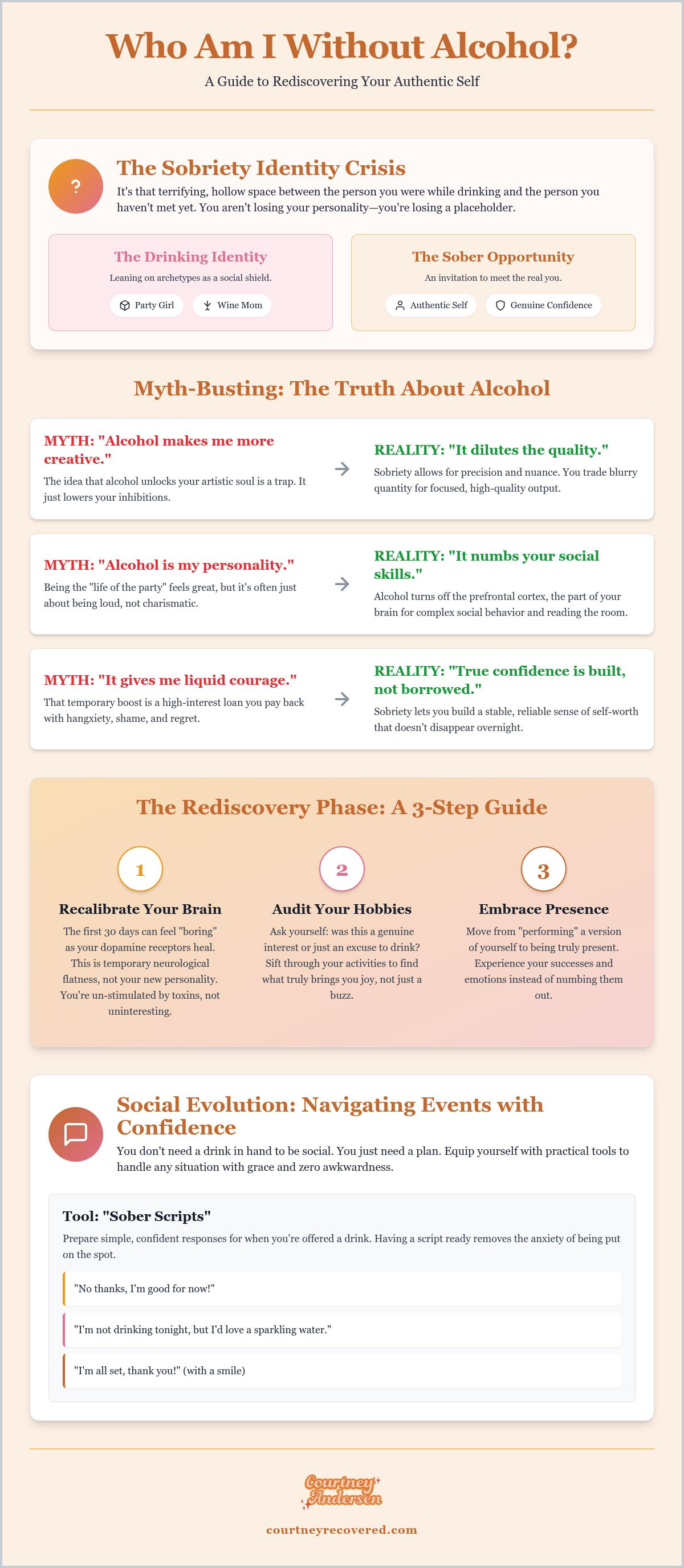
Let's burn the script that says you're better with a drink in your hand. We've been sold a lie that alcohol is a personality enhancer, a magical serum that makes us funnier, smarter, and more creative. In reality, alcohol is a personality placeholder. It fills the gap when you're too tired, too anxious, or too insecure to let the real you take the lead. When you start wondering, who am I without alcohol, you aren't looking for a replacement. You're looking for the original version of yourself that's been buried under years of "wine mom" memes and happy hour traditions.
The creativity myth is one of the biggest traps. We think a bottle of red opens the door to our artistic soul. It doesn't. It just lowers the barrier to entry so you stop overthinking, but it simultaneously dilutes the quality of what you produce. You might be more prolific in the moment, but you're less precise. The same goes for being the "life of the party." Alcohol doesn't make you more charismatic. It just makes you less observant of boundaries. You aren't reading the room better; you've just stopped caring if you're annoying it. Scientific research on how alcohol affects the brain and body confirms that it numbs the prefrontal cortex. This is the part of your brain that handles complex social behavior. When you drink, you're literally turning off the parts of yourself that make you a nuanced, thoughtful human being.
The Liquid Courage Illusion
Alcohol mimics confidence, but it's a cheap imitation. It gives you a temporary boost that always comes with a bill the next morning. That "drunk confidence" is a loan you pay back with interest in the form of hangxiety and shame. You wake up wondering what you said or who you offended. Real, unshakeable confidence can only be built while you're sober. It comes from knowing you can handle a social event or a stressful day without needing a chemical crutch to get through it.
Mimicking Connection vs. Creating It
We've all had those 2 AM bar conversations that felt like soul-level bonding. Then you wake up and realize you barely know that person's last name. Alcohol creates the illusion of intimacy without the effort of actually being present. Sobriety is where the real magic happens. When you're clear-headed, you can create the kind of vibrantly optimistic connections we celebrate in the Sobriety Circle. You get to remember the jokes you told, the stories you shared, and the people you met. That is how you stop asking who am I without alcohol and start answering with a list of genuine friends and real memories.
The Rediscovery Phase: A Step-by-Step Guide to Meeting the Real You
Now that we've cleared the wreckage of those old myths, it's time for the actual work. If you're still staring at the mirror asking, who am I without alcohol, don't panic. This isn't a search for a needle in a haystack; it's an archaeological dig. You aren't building a new human from scratch. You're simply uncovering the vibrant, authentic version of yourself that's been waiting for you to sober up and notice her. This phase is about curiosity, not perfection. It's about trying on new versions of yourself to see what actually fits.
To get started, follow this simple four-step framework to begin your personal rebrand:
- Step 1: Audit your "Drunk Hobbies." Be brutally honest. Did you actually enjoy that loud trivia night, or was it just a place where drinking three pitchers of beer was socially acceptable? If an activity feels like a total chore without a buzz, it wasn't a hobby. It was an excuse. Let it go.
- Step 2: Excavate your childhood interests. What did you love at age ten? Before the wine aisle ever beckoned, you had natural passions. Maybe you were a bookworm, a painter, or a backyard explorer. Those childhood sparks are the blueprints for your sober joy.
- Step 3: Practice "Micro-Dosages" of social interaction. Socializing is a muscle that has likely atrophied. Don't start with a four-hour wedding. Try a forty-five-minute coffee date or a quick walk with a friend. Test your boundaries in small, manageable bursts.
- Step 4: Use your tools. Track your discoveries in the Sober Toolkit. When you document your moods and energy levels, you'll start to see the physical evidence of how alcohol affects the brain and body as your natural chemistry begins to balance out.
Excavating Your Authentic Voice
Journaling is your secret weapon during this identity shift. Ask yourself: "If no one was watching and no one would judge me, what would I actually do with my Saturday night?" You might find that you actually love early nights and expensive tea. Learning to sit with the silence is also vital. In early sobriety, boredom feels like an enemy, but it's actually the birthplace of creativity. If you feel stuck in the mud, 1-on-1 sobriety coaching can be the fast-track you need to dismantle those old beliefs and uncover the suppressed parts of your personality that alcohol was hiding.
Testing New Archetypes
You're allowed to trade in the "Party Girl" persona for something that actually serves your future. Maybe you're "The Early Riser" who hits the trail while everyone else is hungover. Maybe you're "The Present Friend" who actually remembers the details of a conversation. Embracing a "Sober Professional" identity doesn't make you a social outcast; it makes you a powerhouse. You're the one with the clarity and the stamina that others lack. It's okay, and frankly necessary, to change your mind about who you are as you grow. Your identity is a living thing, not a fixed point.
Social Evolution: Navigating the World Without a Drink in Hand
Once you've started the internal work, the next big hurdle is taking your new identity out for a test drive. Socializing is often where the fear of being "the boring one" feels most intense. You might find yourself standing at a party, soda water in hand, wondering, who am I without alcohol in this specific room? The truth is, your social life is about to get a massive upgrade. You're moving away from sloppy, repetitive "fun" and toward genuine connection. You'll soon realize that if an event is only tolerable when you're buzzed, it wasn't actually fun to begin with.
The "Sober Script" is your best friend during this transition. You don't owe anyone a medical history or a deep explanation. A simple "I'm not drinking tonight" or "I've realized I feel so much better without it" is enough. This is how you reclaim your narrative. It's also where you start building the most important part of your new self: boundaries. Boundaries aren't walls to keep people out; they are the gates that let the real you breathe. When you set a boundary, you aren't being difficult. You're finally defining the edges of your own who am I without alcohol identity.
Being the 'Life of the Party'—Sober Edition
You can still be the high-energy person everyone loves to be around. The difference is that your energy is now sustainable and real. You don't need a chemical spike to be funny, engaged, or a great listener. In fact, you'll probably find you're much better at all three when you're clear-headed. Try the "Exiter" Strategy: the moment the conversation starts circling and the repetitive "drunk talk" begins, that's your cue to head home. Leaving early isn't a defeat; it's a victory for your authentic self. You get to wake up feeling vibrant while everyone else is paying the hangover price.
Dealing with 'Sober Saboteurs'
Not everyone will cheer for your new identity. Some friends might feel threatened because your sobriety holds up a mirror to their own habits. It's vital to remember that their reaction is a reflection of their struggle, not your personality. If your old social circle makes you feel like an outcast, it is time to find a tribe that celebrates your growth. Joining the Sobriety Circle gives you immediate access to women who actually get it, providing the validation you need to stay confident in your new skin. You deserve a community that values your presence over your glass's contents.
Building Your 'After' Identity with Courtney Recovered
The first few months of sobriety are often about survival, but what happens when the dust settles? This is where the real fun begins. You've moved past the initial "will I die of boredom?" phase and are standing on the edge of a brand new life. Instead of looking back at the "party girl" you used to be with a sense of loss, you get to look forward. The question, who am I without alcohol, stops being a source of anxiety and starts being the most exciting riddle you've ever solved. It's the moment you stop surviving and start designing a life that feels too good to numb out.
Building this long-term identity requires more than just willpower; it requires a strategy. That's exactly why "The After" program was created. It's designed to help you navigate life beyond those first 90 days, focusing on identity maintenance and growth. You aren't just "not drinking" anymore; you're actively building a version of yourself that is so vibrant and connected that alcohol doesn't even make the guest list. This is about moving from the isolation of recovery into the vibrancy of a fully realized, sober life.
The Power of Personalized Mentorship
Sometimes, you need a guide who has already walked the path. While clinical therapy has its place, 1:1 coaching offers a unique, lived-experience perspective that feels less like a medical appointment and more like a strategy session with a mentor. Courtney Andersen's "tough love" approach is about radical honesty and empowerment. It helps you dismantle the specific, deep-seated beliefs that kept you tied to your old drinking persona. You'll work on customizing your Sober Toolkit to fit your actual lifestyle, ensuring you have the practical tools to stay authentic in every situation. This personalized focus is the fast-track to doing the deep identity work that sticks.
Joining the Sobriety Circle
You cannot build a new identity in a vacuum. You need to see yourself reflected in other high-achieving, ambitious women who have already traded the wine glass for genuine clarity. The Sobriety Circle is where your new identity becomes the norm. It's a space where you don't have to explain why you're not drinking, because everyone there is focused on the same goal: living a life that feels amazing. When you surround yourself with a tribe that celebrates your evolution, the question of who am I without alcohol is answered by a chorus of women who see exactly who you are becoming. You're no longer the "sober one" in the room; you're part of a community of women who are finally meeting their true selves.
Ready to meet the real you? Join the Sobriety Circle Today.
Your Most Vibrant Chapter is Just Beginning
The version of you that depends on a glass of wine to feel interesting is just a shadow. By now, you know that alcohol was never your personality; it was just a placeholder. You've learned how to audit your hobbies, navigate social scenes with a script, and lean into the beautiful silence where your real interests live. Asking who am I without alcohol is the bravest thing you've ever done. It's the moment you stop settling for a diluted life and start demanding a vibrant one.
As the author of the Sober Vibes Book and an expert in quitting drinking alcohol and in gray area drinking, I've seen hundreds of women in our Sobriety Circle find their spark again. You don't have to do this identity work alone. You aren't becoming a "boring" person; you're finally becoming the person you were always meant to be. I've navigated this path, and I'm ready to hand you the roadmap to your most authentic self.
Ready to rediscover your vibrant, alcohol-free self? Book 1:1 Coaching with Courtney.
Your authentic life is waiting. Go get it.
Frequently Asked Questions
Is it normal to feel like a completely different person after quitting alcohol?
It is entirely normal to feel like you've undergone a personality transplant because you are finally shedding a chemical filter. For years, alcohol was the one doing the talking, so meeting your sober self can feel like meeting a stranger. This shift isn't a loss; it is just the real you finally getting some airtime without a depressant dulling your edges or clouding your judgment.
How long does the 'identity crisis' phase of sobriety usually last?
The most intense part of the identity shift usually peaks during the first 90 days as your brain chemistry recalibrates. While everyone's timeline is different, most women find their sense of self begins to solidify once they move past the initial dopamine crash. Programs like The After are specifically designed to help you navigate this transition once you have cleared the initial survival mode of early sobriety.
What if I realize I don't actually like my friends when I'm sober?
This is a common and often painful realization, but it is a sign of genuine growth. If your friendships were built solely on the foundation of shared drinking, they might not survive the transition to a healthier lifestyle. It doesn't mean you're a bad person or that they are; it just means your values have shifted. You deserve a tribe that connects with your authentic self, not just your drinking persona.
Can I still be a 'cool' or 'fun' person without drinking?
You will actually be more fun because your energy will finally be genuine and sustainable. When you stop asking who am I without alcohol, you will discover that being "cool" is really about how comfortable you are in your own skin. You will have sharper wit, better stories, and the incredible ability to actually remember the great times you've had with the people you care about.
How do I explain my new sober identity to my family and coworkers?
Keep your explanation short, confident, and focused on the positive benefits you are experiencing. You don't need a formal announcement; a simple "I've realized I feel so much better and more productive without it" usually shuts down any awkwardness. Your family and coworkers will eventually stop seeing "the person who doesn't drink" and start seeing the high-achieving, present version of you that is much more reliable.
What are some practical tools to help me find new hobbies in sobriety?
Start by using the Sober Toolkit to track what actually brings you joy versus what was just a "drunk hobby." Look back at what you loved doing as a child or teenager before alcohol entered the picture. Experimenting with "micro-dosages" of new activities, like a single morning hiking group or a quick creative class, allows you to test the waters without feeling overwhelmed by a major commitment.
Will my personality ever 'level out' after the initial dopamine crash?
Yes, your brain is incredibly resilient and will reach a new, healthier baseline with a little time. The initial "flatness" you feel is just a temporary side effect of your dopamine receptors healing from years of overstimulation. Within a few months, you will find that you can feel high-energy and excited about life again without needing a chemical boost to get there. It just takes patience and some tough love.
Do I need professional help to figure out who I am without alcohol?
While not everyone needs a clinical setting, having a mentor can fast-track your identity work significantly. Asking who am I without alcohol is a big question that is often easier to answer with the support of someone who has been there. 1:1 coaching or joining a community like the Sobriety Circle provides the validation and practical roadmap you need to stop starting over and finally embrace your new life.
I want you to feel sober NOT boring!
Kickstart your sobriety with my free 2-day video workshop series to master your sober mindset and have FUN in your sobriety journey!


