
What to Do When Sobriety Feels Boring: The Sober Gal's Guide to Reclaiming Your Spark
Jul 13, 2026
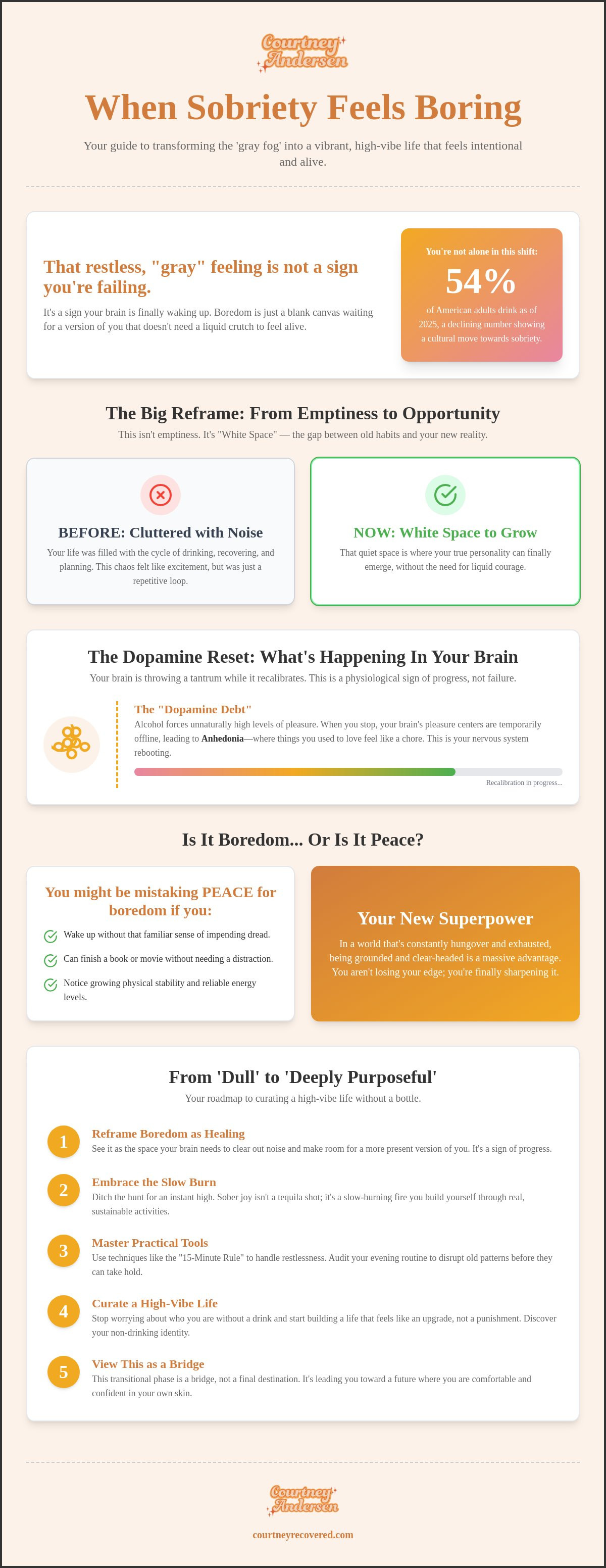
What if that nagging, restless feeling isn't a sign that you're failing, but a sign that your brain is finally waking up? We've all been there; it's 6:00 PM on a Tuesday, the "gray" feeling is settling in, and you're wondering if you'll ever be the "fun friend" again. When you're stuck in that loop, knowing what to do when sobriety feels boring is the difference between white-knuckling your way through the night and actually loving your life. With only 54% of American adults drinking as of 2025, you're far from alone in this shift. Boredom is just a blank canvas waiting for a version of you that doesn't need a liquid crutch to feel alive.
I get it because I've lived it. The transition from "party girl" to "sober girl" can feel like you've traded technicolor for a dusty VHS tape. But here's the truth: your spark isn't gone; it's just being recalibrated. In this guide, I'm going to show you how to transform those dull evening hours into a life that feels intentionally curated and vibrantly alive. We'll dive into how to find genuine excitement in new activities, feel comfortable in your own skin without a cocktail, and create a structured plan to handle those restless nights so you can finally move toward your new, connected reality.
Key Takeaways
- Reframe boredom as a sign of healing; it's the space where your brain clears out the noise to make room for a version of you that's actually present.
- Discover exactly what to do when sobriety feels boring by ditching the hunt for an instant high and embracing the slow burn of real, sustainable joy.
- Master practical tools like the 15-Minute Rule to handle restlessness and audit your evening routine to disrupt old patterns before they take hold.
- Stop worrying about who you are without a drink and start curating a high-vibe life that feels like an upgrade to first class rather than a prison sentence.
- View this transitional phase as a bridge, not a destination, leading you toward a future where you're comfortable and confident in your own skin.
Table of Contents
-
Why Sobriety Feels Like a Gray Fog (And Why It’s Actually a Good Sign)
-
From 'Boring' to 'Brilliant': Your Long-Term Sobriety Roadmap
Why Sobriety Feels Like a Gray Fog (And Why It’s Actually a Good Sign)
Let’s be real for a second. It’s 7:00 PM on a Friday, and while you’re proud of your streak, you’re also staring at the wall wondering if this is it. Is this the "abundant life" everyone promised? If you’re feeling like the world has lost its color, I want you to know that it's okay to admit sobriety feels "meh" right now. You aren't doing it wrong. In fact, this gray fog is actually a massive green flag. Knowing what to do when sobriety feels boring starts with recognizing that this isn't a permanent state of being; it's just the gap between your old, high-octane habits and your new, peaceful reality.
You aren't empty. You're finally available. Think of this boredom as "White Space" on a canvas. For years, your life was cluttered with the noise of drinking, recovering from drinking, and planning the next drink. Now that the clutter is gone, the emptiness feels loud. But that space is where your actual personality, the one that doesn't need a liquid courage boost, is finally going to grow. If you're wondering what to do when sobriety feels boring, remember that your brain is simply clearing the deck for a version of you that is much more interesting than a barstool regular.
The Dopamine Reset: What’s Happening in Your Brain
Your brain is currently throwing a toddler-sized tantrum. Alcohol is a massive dopamine sledgehammer; it forces your brain to release pleasure chemicals at levels that are physically impossible to sustain naturally. When you stop, your brain is left in a "Dopamine Debt." This often manifests as Anhedonia in early sobriety, where even things you used to love feel like a chore because your pleasure centers are temporarily offline while they recalibrate.
Think of this as a necessary nervous system reboot. The Pink Cloud is the "honeymoon phase" of early sobriety where everything feels new and exciting, whereas the Gray Fog is the physiological leveling out where your brain is working overtime to find its new normal. It’s a sign of progress, not a sign of failure.
Boredom vs. Peace: Learning the Difference
We spent years mistaking "chaos" for "fun." If there wasn't a dramatic story to tell or a frantic apology to make the next morning, we felt like we weren't really living. Now, the absence of a crisis feels like boredom because your nervous system is still stuck in "fight or flight" mode. You're learning what tranquility feels like for the first time, and let's be honest; tranquility is quiet. It doesn't demand your attention with a siren and a headache.
You might be experiencing peace rather than boredom if you notice these signs:
-
Waking up without a localized sense of impending dread in your chest.
-
Being able to finish a book or a movie without a desperate need for a distraction.
-
A growing sense of physical stability and reliable energy levels.
Here is the "cool older sister" take: being "boring" is your new superpower. In a world that is constantly hungover, exhausted, and chasing the next temporary high, being the woman who is grounded and clear-headed is a massive advantage. You aren't losing your edge; you're finally sharpening it for a life that actually matters.
The Mindset Shift: From 'Dull' to 'Deeply Purposeful'
Most of us spend early sobriety waiting for a lightning bolt of joy. We think one day we’ll wake up and suddenly find knitting as thrilling as a third round of tequila shots. But sober joy isn’t an instant shot; it’s a slow burn. If you’re searching for what to do when sobriety feels boring, the first step is to stop waiting for that "click" and start building the fire yourself. You're learning how to live again, and like any new skill, it takes a minute to feel natural.
Let’s have a little tough-love moment. We often mourn the loss of our "fun" self, but were you actually that fun? Or were you just blurred? Most of the time, alcohol didn't make us more interesting; it just made us less aware of how repetitive our stories had become. Reclaiming your spark means realizing that you don't "have" to drink to be the life of the party. In fact, the most powerful shift you can make is moving from "I can't have that" to "I don't want that." That is where the real magic happens. You aren't missing out on the party; you are finally present enough to decide if the party is even worth your time.
Rediscovering Your Non-Drinking Identity
The identity crisis is real. When you strip away the "party girl" label, it can feel like there's nothing left but a blank space. But you aren't a blank slate; you're a masterpiece that’s been covered in years of dust. Try this: list three things you absolutely loved doing before alcohol took center stage. Maybe it was photography, hiking, or just baking. It’s okay to outgrow the version of you that lived for happy hour. If you're ready to dive deeper into who this new version of you actually is, work with a sober coach to navigate the identity shift through programs like The After.
Embracing the 'Neutral' Zone
Society tells us we need to be "on" all the time. If we aren't at a concert or a high-energy dinner, we’re told we are "wasting" our youth. That’s a lie. There is immense beauty in a quiet Tuesday night. It’s not a waste; it’s a win for your nervous system. When the restlessness hits, try these tips for coping with boredom to ride out the wave. I often suggest grabbing the Sober Vibes Book to journal through these feelings. Putting pen to paper helps you realize that "boring" is often just another word for "peace" that you haven't learned how to enjoy yet.
5 Actionable Steps to Kill the Boredom Without a Bottle
Boredom isn't a life sentence; it’s a signal that your old routine is dead and your new one hasn't quite arrived yet. If you're wondering what to do when sobriety feels boring, the answer isn't to sit and suffer. You have to get aggressive with your joy. Transitioning from a lifestyle of "blurred nights" to "vibrant days" requires a tactical approach to your time and energy.
-
Audit your 'Witching Hour': Most of us don't feel bored all day. It usually hits at a specific time, like 5:30 PM when the work laptop closes. Identify your trigger window and schedule a non-negotiable activity that forces you out of your normal environment during those exact sixty minutes.
-
Master the 15-Minute Rule: Boredom cravings are like waves; they peak, and then they break. When the restlessness feels unbearable, tell yourself you only have to stay sober for the next 15 minutes. Usually, by the time the clock runs out, the intensity has faded, and you've found something else to do.
-
Plan Micro-Adventures: You don't need a plane ticket to find novelty. Try a new workout class, visit a bookstore in a different neighborhood, or go for a sunset hike. These are low-stakes ways to inject a sense of discovery into your week without needing a drink to make things "interesting."
-
Connect with a 'High-Vibe' Tribe: You need a community that is actually living, not just surviving. Surrounding yourself with women in the Sobriety Circle helps you see that life after alcohol is bigger, not smaller.
-
Invest in Your Growth: Use the Sober Toolkit to stay engaged with your progress. When you have a plan, you aren't just "not drinking"; you are actively building a life you love.
Disrupting the Routine
If you always used to drink while sitting on your velvet sofa, stop sitting on that sofa at 6:00 PM. Change your physical environment immediately. The "Sober Activity" hack is all about leaning into things you literally could not do while buzzed. Go for a drive to get a fancy mocktail, start a complex 1,000-piece puzzle, or sign up for an evening kickboxing class. A Sober Toolkit is a curated collection of practical resources and immediate distractions designed to snap you out of a restless state and remind you why you started this journey. It’s your "break glass in case of boredom" emergency kit.
Finding Your New 'Social' Flow
You can still be the life of the party without being the liability of the party. The secret to knowing what to do when sobriety feels boring at events is having a strategy. Learn how to be sober and social without feeling like an outcast by focusing on genuine connection rather than just "getting through" the night. My favorite power move? The Early Exit. Leaving the party at 10:00 PM while you’re still feeling great is a total flex. You get the social hit, you avoid the sloppy "drunk talk" hour, and you wake up on Saturday morning feeling like a million bucks while everyone else is searching for ibuprofen.
Curating Your High-Vibe Life: More Than Just 'Not Drinking'
Sobriety isn't a prison sentence; it's an upgrade to first class. If you're a high-achieving woman used to a fast-paced lifestyle, the sudden "quiet" of a sober evening can feel like a vacuum. For years, you probably used alcohol as a dimmer switch to turn off your brain after a long day of making decisions. Now that the switch is gone, the silence feels loud. This is exactly what to do when sobriety feels boring: stop viewing it as a lack of activity and start seeing it as the opportunity to build "The After." You aren't just "not drinking." You are intentionally curating a life that you no longer feel the desperate need to escape from.
We need rituals to signal the end of the day. The act of pouring a glass of wine was a powerful psychological marker that work was over and "me time" had begun. You can't just remove that marker and leave a hole; you have to replace it with something celebratory. With the global non-alcoholic beverage market projected to hit $1.55 trillion in 2026, you have more options than ever before. Spend that old booze budget on high-end mocktails, a luxurious ten-step skincare routine, or a high-energy movement flow. In Phoenix, switching from an alcoholic drink basket to a non-alcoholic one saves an average of $8.20 per night. That’s money you can reinvest into things that actually make you glow from the inside out.
The Power of Community (The Sobriety Circle)
Isolation is the absolute fuel for boredom. If you're sitting on your couch alone, scrolling through social media, life is going to feel "meh." You need a social hit that doesn't come from a bottle. This is where the Sobriety Circle changes the game. It isn't a somber support group where we sit in a circle and talk about our "problems" in a clinical basement. It's a vibrant, high-energy community of women who are actually living. It’s the difference between surviving your nights and thriving in them. Having a tribe that understands your "high-vibe" goals provides the connection you used to seek at the bottom of a glass, but without the 3:00 AM anxiety.
Investing in Yourself
If you find yourself stuck in the "boredom-relapse" loop, it’s usually because you haven't identified what actually lights you up yet. This is where the Stop Starting Over methodology comes in. You need to move past the "Day 1" mentality and start looking at long-term evolution. 1:1 coaching serves as a personalized roadmap to help you rediscover your spark. Instead of guessing what to do when sobriety feels boring, you work with someone who has already navigated the "gray area" and found the brilliant reality on the other side. You've already stopped the habit; now it's time to start the life.
Ready to stop the cycle and start building a life you love? Book a 1:1 coaching session to find your personalized path out of the gray area.
From 'Boring' to 'Brilliant': Your Long-Term Sobriety Roadmap
Boredom is not the end of the road. It’s a bridge. When you’re in the thick of it, that restless feeling can seem like a permanent state of "meh," but it’s actually the construction site for your new life. Understanding what to do when sobriety feels boring means recognizing that the quiet isn't a void; it’s the silence before the best part of the song starts. You are moving away from a life defined by what you don't do and toward one defined by who you are becoming. This transitional phase is where your real personality finally gets to take the stage.
You are becoming the most interesting version of yourself because your passions are now rooted in reality, not a liquid delusion. You aren't the "boring" friend. You’re the friend who actually remembers the conversation, shows up for the sunrise hike, and possesses the genuine spark that everyone else is trying to find at the bottom of a glass. As the percentage of American adults who drink fell to 54% in 2025, you are part of a massive cultural shift toward a more intentional, vibrant way of living. You aren't missing out; you are leading the way.
The Timeline of Joy
Your brain needs time to finish its remodel. While the initial fog starts to lift in the first few months, real neurological magic happens over the long haul. It can take roughly 14 months for your brain's pleasure centers to fully return to a healthy baseline after years of over-stimulation. This is why the second year of sobriety is often where the real "fun" begins. You’ve moved past the survival mode of the first twelve months and into a phase of genuine discovery.
Take the Next Step
Don't navigate this gray fog alone. If you're feeling stuck right now, the Sober Toolkit is your immediate first step to handle the restless hours tonight. It gives you the practical "how-to" for those moments when you're tempted to go back to what’s familiar just to escape the quiet. For those who want a personalized roadmap out of the gray area and into a brilliant reality, 1:1 Sobriety Coaching is the ultimate game-changer. We’ll work together to identify your personal spark and ensure you never have to guess what to do when sobriety feels boring again. You’ve already done the hard work of stopping. Now, let’s do the fun work of starting.
You aren't boring. You're just getting started.
Your Spark is Waiting on the Other Side of the Fog
You've officially flipped the script on sober boredom. We’ve explored how that restless "gray" feeling is actually a sign of your brain’s dopamine reset; it’s proof that you’re healing. By auditing your witching hour and embracing the slow burn of real joy, you're learning that peace is far more rewarding than the blurred chaos of the past. Knowing exactly what to do when sobriety feels boring isn't just about finding a random hobby. It’s about deciding that you finally deserve a life you don't feel the need to escape from.
Don’t let the silence of a Tuesday night trick you into going backward. Whether you need the high-energy, vibrant community of women in the Sobriety Circle or the practical, non-clinical tools in the Sober Toolkit, support is ready for you. If you're craving expert mentorship from Courtney Andersen to navigate "The After" and find your personalized roadmap, let's get to work. Ready to build a life you don't want to escape? Join the Sobriety Circle or book 1:1 Coaching today!
You’re doing the brave work of becoming yourself. Trust the process; the world is finally about to see you in technicolor.
Frequently Asked Questions
Is it normal to feel bored in early sobriety?
It is 100% normal to feel bored when you first stop drinking. Your brain has been conditioned to expect massive dopamine spikes from alcohol, and without them, everyday life can feel flat for a while. This period is just your nervous system recalibrating. It doesn't mean your life is over; it means you're finally clearing out the noise to make room for real joy that doesn't require a hangover.
How long does the 'gray' feeling last after I stop drinking?
The "gray" feeling usually peaks in the first few months, but your brain’s reward system can take over a year to fully return to a healthy baseline. While the intensity of the boredom fades as you build new routines, the deep "color" often returns in the second year. This is why sticking with it past the initial discomfort is so vital for finding your long-term spark and reclaiming your energy.
What are some high-energy sober activities that aren't just puzzles or reading?
Forget the "quiet" hobbies if they don't light you up. Try high-impact activities like kickboxing, night hiking, or joining a high-energy dance class. You could also lean into activities you couldn't do while drinking, like taking a late-night photography course or driving to a different city for a concert. These options provide the "social hit" and novelty your brain is craving without the liquid crutch.
Why do I feel more bored now than I did when I was drinking?
You feel more bored now because alcohol acted as a constant distraction from the mundane parts of life. When you were drinking, you weren't necessarily having more fun; you were just less aware of the repetition of your nights. Now that you're sober, you're actually present for your life. This clarity can feel heavy at first, but it's the only way to identify what you actually want to change.
Can I still go to parties if I find them boring without a drink?
You can absolutely still go to parties, but you need a new social flow to keep things interesting. If a party feels boring without a drink, it might just be a boring party. Knowing what to do when sobriety feels boring at social events often means using the "Early Exit" strategy. Leave when the "drunk talk" starts so you can wake up feeling like a million bucks the next morning.
How do I find a sober community that doesn't feel like a clinical support group?
Look for lifestyle-oriented groups like the Sobriety Circle that focus on living a "high-vibe" life rather than just talking about the struggle. You want a tribe that celebrates your wins, plans adventures, and shares practical tools for evolution. Finding a community that feels celebratory rather than clinical makes sobriety feel like a lifestyle upgrade rather than a restrictive medical requirement you have to endure.
Will I ever feel 'fun' again without alcohol?
You will feel "fun" again, and it will be a much more authentic version of fun than the blurred version. Alcohol gives you a temporary, artificial sense of confidence, but sober fun is rooted in genuine connection and laughter you actually remember. As your brain heals, you'll find you can be the life of the party without the morning-after "hangxiety" or needing a drink to speak up.
What should I do during the 'witching hour' when I usually start drinking?
Disrupt your routine immediately when the witching hour hits to snap your brain out of its habitual loop. If you usually drink at 6:00 PM on the couch, get in your car or go for a walk at 5:55 PM. Use tools like the Sober Toolkit to find immediate distractions. Changing your physical environment is the fastest way to signal to your brain that the "old rules" no longer apply
I want you to feel sober NOT boring!
Kickstart your sobriety with my free 2-day video workshop series to master your sober mindset and have FUN in your sobriety journey!


