
What to Do After a Relapse: 24-Hour Recovery Reset
Aug 15, 2026
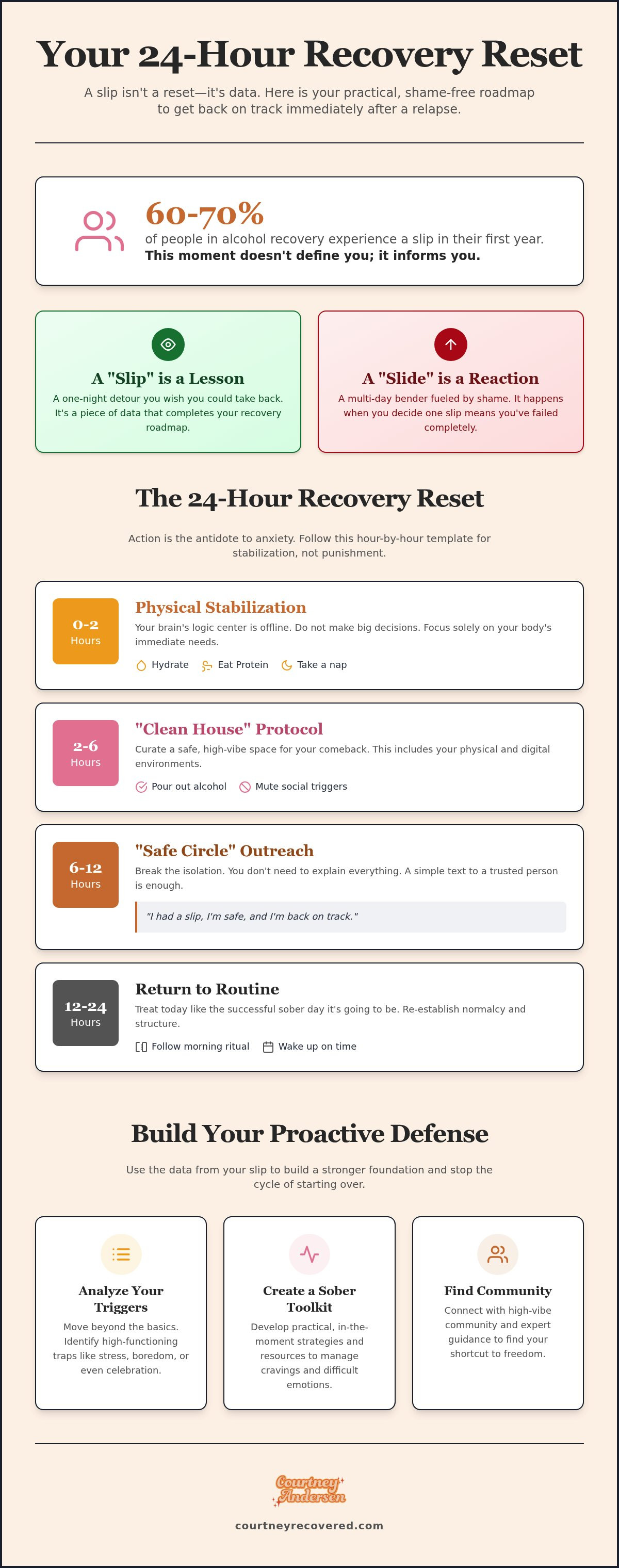
A relapse isn't a reset button; it's a high-stakes piece of data that's going to complete your recovery roadmap. If you're sitting there right now with a pounding head and a heart full of "here we go again" anxiety, you aren't a failure. You're just at a crossroads. Knowing what to do immediately after a relapse is the difference between a one-night detour and a month-long bender that steals your joy. Since statistics show that 60 to 70 percent of people navigating alcohol recovery experience a slip in their first year, please know you're in good company. This moment doesn't mean you've lost your progress; it means you're human.
It's easy to get sucked into a shame spiral and feel like you have to start from zero, but that's just the hangover talking. You deserve a plan that feels like a lifeline, not a lecture. This guide provides a practical, 24-hour recovery reset designed for the woman who is officially done with the "Day One" cycle. We'll walk through how to quiet the emotional noise, handle the physical exhaustion, and regain your sense of hope. You'll get a clear roadmap to get back on track without the clinical jargon or the heavy guilt. Let's get you back to the vibrant life you were building.
Key Takeaways
- Stop the shame spiral by learning why a slip isn't a reset and how your previous sober days still count toward your long-term success.
- Discover exactly what to do immediately after a relapse with a practical 24-hour roadmap that focuses on physical stabilization and removing digital triggers.
- Move beyond basic triggers by using the Vibrancy Check to identify high-functioning traps like stress, boredom, or celebration.
- Build a proactive defense with the Sober Toolkit and the Stop Starting Over framework to ensure you aren't stuck in a cycle of starting again.
- Learn how 1:1 Sobriety Coaching and the Sobriety Circle provide the high-vibe community and expert guidance needed to find your shortcut to freedom.
Stop the Shame Spiral: Why Day 1 is Not a Death Sentence
You’re panicking. I get it. The very first thing you need to know about what to do immediately after a relapse is that you haven't lost your progress. We need to distinguish between a "slip" and a "slide." A slip is that one night you wish you could take back. A slide is the multi-day bender that happens when you decide that because you "messed up," you might as well keep going. A slip is a lesson; a slide is a reaction to shame. Your sober counter might say "Day 1," but your brain, body, and spirit still carry the healing from every day you stayed dry before this moment. Sobriety isn't a prison sentence you're serving. It’s a vibrant, high-energy life you’re building. A Relapse is a temporary detour on your journey, not a bridge collapse that destroys the entire road you've built.
The High-Achiever Shame Trap
For the woman who kills it in the boardroom and manages a million moving parts at home, drinking feels like the one thing she "can't control." This creates a massive identity crisis. You think, "I’m successful, so why can’t I just stop?" Here is the tough love truth: your professional success doesn't make you immune to the way alcohol affects the human brain. When you tie your entire identity to a specific sobriety date, a slip feels like a personal character flaw. It isn't. Shame is the highest-octane fuel for the next drink. If you stay in the "I’m a failure" headspace, you’re practically inviting the next bottle into the house. You have to separate who you are from what you did last night.
Immediate Mindset Shifts for 2026
In 2026, we treat recovery like a long-term management plan, not a moral test you either pass or fail. Stop saying "I failed" and start saying "I am gathering data on what didn't work." Maybe it was a specific social trigger or a Sunday afternoon slump. Think of me as your cool older sister who has been exactly where you are. You are still the same powerful, capable woman you were yesterday. Knowing what to do immediately after a relapse starts with radical self-compassion. White-knuckling your way through today with pure willpower is a trap. It’s exhausting, and it usually leads right back to the liquor store. Instead of trying harder, we’re going to try something different by focusing on connection and practical tools rather than just "being stronger."
The 24-Hour Recovery Reset Template
Action is the ultimate antidote to the anxiety that follows a slip. When you're wondering what to do immediately after a relapse, the most powerful move you can make is to stop ruminating and start moving through a pre-set plan. This template isn't about punishment or "paying for your sins." It’s about stabilization. You're essentially performing an emergency reboot on your system so you can get back to your vibrant self without the lingering fog of guilt. Let's get you through the first 24 hours with your dignity intact.
Your Hour-by-Hour Action Plan
Hours 0 to 2 are strictly for physical stabilization. Your brain is currently experiencing a neurochemical dip. The Science of Addiction shows us that your prefrontal cortex, the part of your brain responsible for logic, is temporarily offline. Don't make big life decisions or start a deep emotional inventory yet. Instead, focus on hydration, eat something with protein, and take a "no-choice" nap. If you have your Sober Toolkit handy, use the physical comfort resources inside to ground yourself.
From hours 2 to 6, execute the "Clean House" protocol. This means more than just pouring out the remaining wine. It’s about digital boundaries too. Unfollow or mute the "drinking buddies" or social media accounts that make alcohol look like a harmless accessory. If a specific influencer's "wine mom" content triggers a sense of FOMO, hit that mute button immediately. You are curating a safe, high-vibe space for your comeback, and that requires some ruthless editing of your environment.
As you move into hours 6 to 12, it's time for the "Safe Circle" outreach. Reach out to your accountability for sobriety partner or a trusted friend. You don't need to write a novel or explain yourself. A simple text saying, "I had a slip, I'm safe, and I'm back on track," is enough to break the isolation. Finally, hours 12 to 24 are for routine. Wake up at your normal time, do your morning ritual, and treat the day like the successful sober day it’s going to be.
What to Say to Your Support System
Telling a partner or a friend often feels like the hardest part of what to do immediately after a relapse. You might feel like you're letting them down, but remember: you aren't a victim. You're a woman taking ownership of her journey. Use scripts that focus on solutions rather than drama. Try saying: "I had a setback last night, and I've already identified the trigger. I’m back on my plan today and would love some extra support this evening." This shows you have a strategy and keeps the conversation focused on your agency.
If you're tired of the "start-stop" cycle and want a more personalized roadmap, 1:1 Sobriety Coaching can be the shortcut you need to make this slip your very last.
Avoid the people who want to "analyze" your mistakes in a way that makes you feel small. You need high-vibe energy right now, not a clinical autopsy of your character. Set boundaries by saying, "I'm not ready to talk about the details yet, but I'm focused on my 24-hour reset." Keeping it simple protects your peace and keeps your momentum moving forward toward the life you actually want to live.
Analyzing the Data: Why Did This Relapse Happen?
Once the initial panic subsides, it’s time to put on your detective hat. Instead of spiraling into "why am I like this," we’re looking for the "why did this happen" data points. Think of this relapse as the missing piece of your sober puzzle that finally shows you where your boundaries were a little too thin. You aren't dissecting a failure; you're Enhancing Motivation for Change by understanding your own patterns. When you're figuring out what to do immediately after a relapse, this analytical step can prevent the next one. We have to look at the "Gray Area" traps that traditional programs often miss.
Traditional recovery focuses on HALT: Hungry, Angry, Lonely, Tired. Those are valid, but for the modern, high-functioning woman, we need a "Vibrancy Check." Are you drinking because you're actually hungry, or because your life feels monotonous and you’re craving a "glimmer" of excitement? Stress is an obvious trigger, but boredom and celebration are the sneakier traps. You need to distinguish between an emotional trigger, like feeling "less than" at a high-stakes event, and an environmental cue, such as that specific wine glass you always use at 6:00 PM.
Identifying Your Unique Triggers
For many professional women, alcohol is the ultimate "off" switch. You use it as a reward for surviving a grueling day of meetings or managing household chaos. It’s the "I earned this" trap that hits when your brain is tired of making decisions. Then there’s the social pressure. You worry that without a glass in hand, you’ll suddenly become the "boring" friend. To combat this, keep a list of sobriety quotes on your phone. They act as a quick mental circuit breaker when that old reward system starts whispering that you need a drink to be fun or relaxed.
Filling the Gaps in Your Strategy
Often, a relapse happens because there’s a gap between "not drinking" and active recovery. Not drinking is passive; it’s just the absence of a bottle. Active recovery means you are proactively using tools to protect your peace. If your previous plan relied solely on willpower, it was destined to fail. Willpower is a finite resource that runs out by Tuesday at noon. This is where the "Stop Starting Over" framework comes in. It’s about building a life you don’t want to escape from. If you felt isolated, your gap might be a lack of community. If you felt overwhelmed, your gap might be a lack of practical, high-vibe tools to handle a bad day.
How to Stop Drinking After Relapse: Building a New Toolkit
You’ve analyzed the data and identified the gaps. Now, it’s time to build the fortress. Knowing what to do immediately after a relapse is about more than just willpower; it's about swapping that "white-knuckle" struggle for a system that actually works. Willpower is like a phone battery that drains by the end of the day. A toolkit is like a portable charger that keeps you powered up when life gets loud. We aren't looking for sterile medical guides that make you feel like a patient. We’re building a high-vibe, celebratory lifestyle that makes alcohol look like a boring, low-energy choice you simply don't have time for anymore.
Essential Resources for the Reset
The first 30 days back on track require a specific kind of mental nourishment. This is where "Quit-Lit" becomes your best friend. Resources like the Sober Vibes Book are essential because they help rewire your brain’s perception of alcohol. Instead of seeing it as a "treat" you’re missing out on, you start to see it as the obstacle to the life you actually want. This isn't just about reading; it's about active reprogramming. When you combine this with a daily routine that feels like a luxury rather than a chore, sobriety stops being a restriction and starts being a gain.
The Stop Starting Over program is specifically designed to be the antidote to the relapse cycle. It moves you past the "Day 1" panic and into a proactive framework for long-term change. If your previous attempts felt like you were just waiting for the next craving to hit, this program gives you the offensive strategy you’ve been missing. It’s about building a life so vibrant that drinking feels like a downgrade. You deserve a roadmap that respects your ambition and your desire for a connected, high-energy reality.
Creating a "Relapse-Proof" Environment
Your physical space needs to reflect your new, alcohol-free identity. If your kitchen still screams "wine o'clock," it’s time for a makeover. Stock a "Sober Bar" with vibrant, fun alternatives like craft mocktails, sparkling botanicals, and high-end teas. This isn't about hiding; it's about replacing. When you have a delicious, complex drink in a beautiful glass, you satisfy the ritual without the regret. Your environment should be a sanctuary that supports your reset, not a minefield of old triggers.
When a craving does strike, you need a "first aid kit" for your brain. One of the best tools from the Sober Toolkit is the 5-minute craving hack. Most cravings are just neurochemical waves that peak and dissipate within a few minutes. If you can distract your brain for just 300 seconds, the intensity drops significantly. Use that time to move your body, call a friend, or grab a high-vibe snack. If you're ready to stop the cycle for good, you can grab the Sober Toolkit right now and start building your personalized defense system.
Your Shortcut to Freedom: Coaching and Community
You’ve navigated the physical reset and analyzed the data. Now comes the most important part of the journey: ensuring you never have to do this alone again. The first few hours are about stabilization; the rest of your life is about transformation. Knowing what to do immediately after a relapse is a vital survival skill, but coaching and community are the tools that shift you from "surviving" a slip to "thriving" in your new reality. You don't need a sterile clinical environment to find your footing; you need a high-vibe strategy that matches your ambition.
The Power of 1:1 Mentorship
The fastest way to break the cycle of starting over is to stop trying to coach yourself. When you invest in 1-on-1 sobriety coaching, you get a bespoke roadmap that accounts for your specific triggers, your lifestyle, and your professional goals. This isn't about sitting in a circle and talking about your "defects." It’s about professional accountability and "tough love" realism that helps you move beyond the "Gray Area" for good. A mentor who has walked this path provides the shortcut you’ve been missing, helping you bypass the common traps that lead to the next bender.
Finding Your Tribe in the Sobriety Circle
Isolation is where the shame spiral grows. Connection is where it dies. The Sobriety Circle is designed for women who want a community that is inclusive, optimistic, and entirely stigma-free. Having a tribe of like-minded women who "get it" is the ultimate relapse prevention strategy. You need people who will celebrate your wins and hold you up when things get heavy, without making you feel like a patient in a hospital. This is about reclaiming your social life and proving that sobriety is the ultimate upgrade, not a boring compromise.
The first 24 hours were about stopping the bleeding. The rest of your life is about building The After—that vibrant, connected space where alcohol no longer has a seat at the table. If you're done with the "Day 1" routine, the next step is simple. Stop trying to white-knuckle your way to freedom and join a community that’s already living it. Your high-energy, alcohol-free life is waiting for you to claim it. Let’s make this the last time you ever have to wonder what to do immediately after a relapse. You’ve got the plan; now get the support you deserve.
Your Vibrant Life is Still Waiting
You’ve got the roadmap; now it’s time to take the first step. Remember that a slip is just a piece of data that helps you build a stronger, more resilient version of yourself. By following the 24-hour reset and filling the gaps in your toolkit, you’re choosing growth over guilt. Now that you know exactly what to do immediately after a relapse, you can stop the cycle of starting over and move into a permanent mindset shift. Sobriety isn't a punishment; it’s the ultimate gain.
Led by Courtney Andersen, author of Sober Vibes, our approach is vibrantly optimistic and intentionally non-clinical. You don't have to navigate this journey in isolation. Join over 1,000 women in the Sobriety Circle who have traded the shame spiral for a life they actually love living. Whether you need the immediate safety net of a community or the bespoke strategy of a mentor, we have the tools to help you thrive.
Apply for 1:1 Sobriety Coaching and stop starting over today. You are still the powerful woman you were before last night. Your vibrant, alcohol-free future is closer than you think, and I can't wait to see you get there.
Frequently Asked Questions
Is it normal to feel suicidal or deeply depressed after a relapse?
Yes, feeling a massive emotional "drop" is a common reaction to the chemical crash and the weight of the shame spiral. If you're feeling unsafe or have thoughts of self-harm, please call or text the 988 Suicide and Crisis Lifeline immediately. This intense depression is often a temporary state caused by neurochemistry and the "hangxiety" of the moment; it isn't your permanent reality.
How do I stop drinking after a relapse if I feel like I have no willpower?
You stop by switching from willpower to a system. Willpower is a finite resource that drains like a phone battery, which is why figuring out what to do immediately after a relapse involves using your Sober Toolkit instead of just "trying harder." Focus on tiny, manageable actions like drinking a glass of water or moving to a different room rather than worrying about the next six months.
Should I tell everyone about my relapse immediately?
No, you definitely don't need to announce it to the world. Only tell your "Safe Circle," which includes the people who will support you without judgment or clinical lectures. Protecting your energy and your peace is your number one priority right now while you stabilize your emotions and your environment.
Does a relapse mean I have to start my "sober days" over at zero?
Absolutely not. Your sober counter is just a tool, not a measure of your personal worth or your physical progress. Your brain and body haven't forgotten the healing they did during your previous sober stretch. You're just adding a new chapter of data to your journey, and those previous days still count toward your total experience.
What is the fastest way to get the alcohol out of my system after a relapse?
Hydration and time are the only real answers here. Focus on sipping water with electrolytes and eating a high-protein meal to help your body recover from the physical toll. There are no magic "detox" shortcuts, but physical stabilization is the essential first step in knowing what to do immediately after a relapse.
What if I relapsed after a long period of sobriety (months or years)?
Relapsing after a long time can feel devastating, but it doesn't delete your history or your hard work. You still have all the knowledge, tools, and "sober muscles" you built during that time. This slip is just an expensive piece of data showing you where a new boundary needs to be built or a new tool needs to be added.
Can I stop drinking on my own after a relapse without going to rehab?
Yes, many women find freedom through high-energy, non-clinical support like coaching and community. While some individuals require medical detox for safety, others find that a proactive framework like the Sobriety Circle provides the exact bridge they need to move forward. It’s about finding the level of support that matches your specific needs and lifestyle.
What is the "Stop Starting Over" program and how can it help me right now?
The Stop Starting Over program is a proactive framework designed specifically for the woman who is done with the exhausting Day 1 cycle. It gives you the tools to build a life you don't want to escape from, moving you from a mindset of restriction to one of vibrant gain. It helps you identify your "Gray Area" triggers and provides a permanent roadmap for the life you want to live.
I want you to feel sober NOT boring!
Kickstart your sobriety with my free 2-day video workshop series to master your sober mindset and have FUN in your sobriety journey!


