
Sobriety Milestones: A Guide to Celebrating Your Alcohol-Free Wins in 2026
Oct 06, 2026
Counting days isn't just a math problem; it's a massive psychological power shift that changes how you see the world. I know it feels like every single day is a battle right now. You're probably worried about missing out on the party, or maybe you're wondering if your "gray area drinking" even qualifies for a celebration. It's totally normal to feel isolated when you first ditch the bottle, especially in 2026 when more people than ever are questioning the glass. Your progress matters, and those early sobriety milestones prove you're reclaiming your spark and your sanity.
You deserve to know exactly what's happening to your body and brain as you hit your goals without all the boring medical jargon. I'm going to show you how to navigate the physical and mental shifts of your first year sober while keeping the vibe high and celebratory. We'll break down a clear timeline of your first-year wins and show you exactly how to celebrate this vibrant new life. Get ready to trade the daily struggle for a roadmap that actually makes sense for your real, alcohol-free life.
Key Takeaways
- Learn how to reframe sobriety milestones as powerful identity shifts that give your brain the dopamine boost it needs to keep going.
- Get a relatable, no-nonsense timeline of the physical and mental breakthroughs you can expect during those first critical 90 days.
- Master the "invisible" wins, like navigating your first major social event or high-stress conflict without reaching for a glass.
- Discover practical, high-vibe ways to celebrate your progress that ditch the old, toxic reward cycles for experiences that actually feel like a treat.
- Understand how to transition from just "getting sober" into a thriving, vibrant life where your alcohol-free status is your greatest asset.
Beyond the Calendar: Why Sobriety Milestones Are Your New Superpower
Sobriety milestones are way more than just numbers on a screen or scratches on a wall. They're internal identity upgrades. You're moving from "someone who is trying not to drink" to "someone who just doesn't drink," and that shift is massive. When you first start, you're likely dealing with heavy Day 1 fatigue. Alcohol has spent months or years hijacking your reward system, leaving your brain's natural joy chemicals feeling totally depleted. These milestones provide the necessary dopamine hits you need to keep your momentum high while your biology catches up to your new lifestyle.
If you're coming from a background of gray-area drinking, you might feel like you don't "deserve" to celebrate because your life didn't look like a rock-bottom tragedy. That's total BS. Choosing to live an alcohol-free life in 2026 is a power move regardless of how much you used to pour. We're moving away from the somber, clinical "recovery" vibe and stepping into celebratory sobriety. This is a lifestyle upgrade, not a punishment, and every milestone proves you're winning.
The Psychology of the Win
Hitting small goals literally rewires your brain. After alcohol has flattened your ability to feel pleasure, these wins act as a jumpstart for your nervous system. In my Stop Starting Over approach, we shift the narrative from shame to genuine pride. For professional women especially, tracking these wins is a non-negotiable tool for success. We're often perfectionists who overlook little progress because we're chasing the next big promotion or life goal. Tracking your sobriety milestones forces you to stop, acknowledge your growth, and combat that "all or nothing" mindset that usually leads to burnout and relapse.
Days vs. Decades: Why Early Milestones Carry the Most Weight
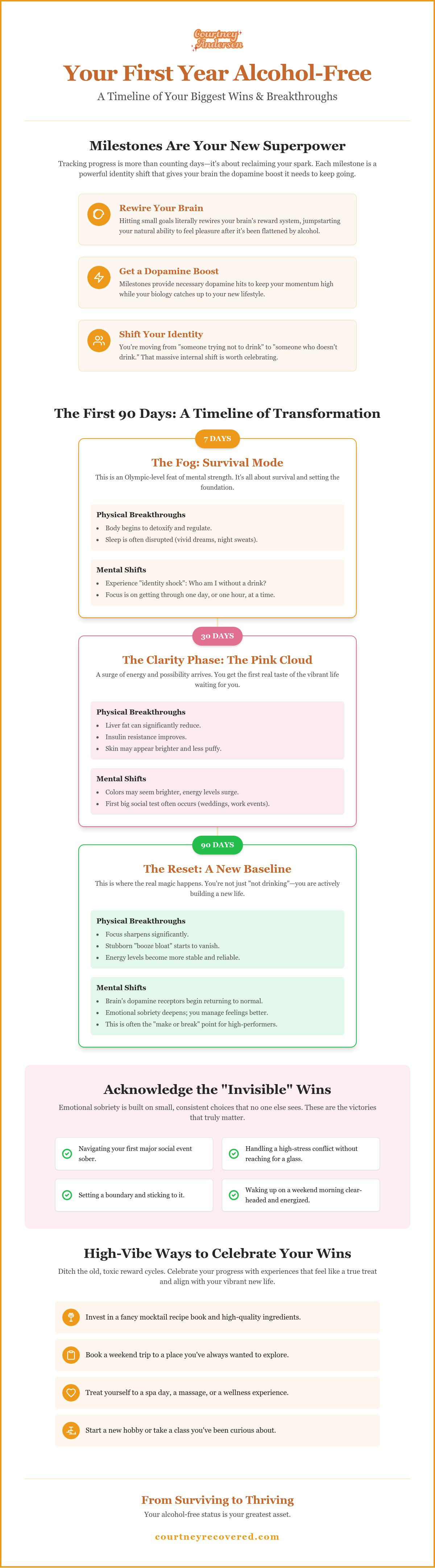
The first 24 hours take more grit than the entire second year. Breaking the cycle and surviving that initial week is an Olympic-level feat of mental strength that deserves way more credit than it gets. While some people focus on decades of abstinence, those early days are where the real transformation happens. By Day 30, you're often navigating a surge of energy or the first real taste of clarity, which can feel much more intense than Day 300. Historically, people have used physical tokens like a Sobriety coin to make these invisible wins feel tangible and real. It's about making the internal change visible to yourself.
A milestone is a psychological anchor you drop into your history to give you a steady point of resilience for every future challenge you face.
The First Year Timeline: Physical and Mental Breakthroughs
The first year of an alcohol-free life is a wild ride of internal renovation. You aren't just quitting a habit; you're literally rebuilding your biology. During the first seven days, expect "The Fog." Your sleep will likely be a disaster as your brain tries to remember how to rest without a sedative, often leading to vivid dreams or night sweats. You might feel a strange identity shock, wondering who you even are without a drink in your hand. These early sobriety milestones are about survival and setting the foundation for the vibrant life waiting for you on the other side.
30 Days: The Clarity Phase
By the one-month mark, many people hit the "Pink Cloud." This is a surge of energy where everything feels possible, and colors seem brighter. Your liver is already doing a happy dance; research shows that just 30 days of abstinence can significantly reduce liver fat and improve insulin resistance. You'll likely notice your first real taste of gray-area drinking clarity, realizing that the "social lubricant" was actually just a social barrier. This is also when the first big social test usually pops up. Whether it's a wedding or a work happy hour, having your Sober Toolkit ready is the secret to getting through the 30-day itch without a slip.
90 Days: The Brain's New Baseline
Three months in is where the real magic happens for your cognitive function. Scientific studies indicate that it takes roughly 90 days for your brain's dopamine receptors to begin returning to their natural baseline after chronic alcohol use. This is the "Reset." Your skin looks brighter, that stubborn "booze bloat" starts to vanish, and your focus sharpens. For high-functioning drinkers, this is often the make-or-break point. It's the moment you realize you aren't just "not drinking"; you are actively building a new life. This level of Emotional Sobriety allows you to manage your feelings and stress without needing a liquid crutch to numb the edges.
From six months to the one-year mark, you enter "The Integration." Your sobriety milestones stop being a daily chore and start being your default setting. You don't wake up thinking about not drinking; you just wake up ready for the day. If you want to fast-track this process and hit these goals with total confidence, my 1:1 Sobriety Coaching is the ultimate shortcut to making these wins permanent and powerful. You've already done the hard part by starting; now it's time to see how good your life can actually get.
Emotional Sobriety: The 'Invisible' Milestones That Actually Matter
While the physical glow-up gets all the headlines, the invisible sobriety milestones are what actually keep you sober long-term. These are the internal breakthroughs that happen in the messy middle of real life, away from the tracking apps and calendar alerts. It's surviving that first "Social Crisis," like a high-pressure wedding, a chaotic bachelorette, or your first dry holiday, and realizing you didn't just survive it; you actually had a good time. That moment when you’re on the dance floor or deep in a conversation and suddenly realize you’re genuinely having fun without a liquid crutch? That’s a superpower.
Another massive, often overlooked win is the "First Fight." Conflict used to be the ultimate trigger for a pour, but handling a disagreement with a partner or a stressful deadline at work without reaching for a bottle is a game-changer. It proves you can sit with discomfort and come out the other side intact. This is also when you’ll likely set your first hard boundary with a family member or an old drinking buddy. It might feel awkward at first, but every "no" you say to someone else is a "yes" to your own growth and sanity. These moments are the true building blocks of a resilient, alcohol-free identity.
Reclaiming Your Social Identity
Language is a powerful tool in your sobriety toolkit. A major linguistic milestone happens when you stop saying "I can't drink" and start saying "I don't drink." One sounds like a restriction; the other sounds like a lifestyle choice you’re proud of. When the inevitable "Why aren't you drinking?" question comes up, you don't owe anyone a medical history. A confident "I just feel better without it" is all you need to shut down the noise. If you're looking for a crew that understands this shift and helps you find your new vibe, connecting with a sober community online can make all the difference in feeling supported rather than isolated.
The 'Boredom' Breakthrough
Early on, boredom feels like a threat. It’s that itchy feeling of not knowing what to do with your hands or your thoughts at 7:00 PM on a Tuesday. But here’s the truth: boredom is actually a sign that your nervous system is healing. You’re learning how to exist without a constant chemical spike. The milestone of finding a new hobby, whether it’s early morning yoga, photography, or finally reading those books on your nightstand that don't involve a happy hour, is a sign that you’re reclaiming your time. You’re no longer looking for an escape hatch; you’re building a life you don't need to escape from.
How to Celebrate Your Sober Wins Without a Drink
Let’s talk about the "treat yourself" trap. For years, we used alcohol as the ultimate reward for surviving a Tuesday or finishing a big project. Now that you're hitting your sobriety milestones, it's time to redefine what a reward actually looks like. We're moving away from the toxic cycle of swapping one numbing habit for another and stepping into high-vibe, experience-based celebrations. Think spa days that actually leave you feeling refreshed, weekend trips where you remember every sunrise, or finally snagging that designer item you’ve been eyeing with the cash you used to literally pour down the drain.
Celebrating isn't just about the stuff you buy; it's about the people who get it. Sharing your wins in the Sobriety Circle is where you get those collective "woo-hoos" from women who know exactly how hard you worked for that Day 60 or Day 180. And when it comes to your "Sober Anniversary," don't be afraid to throw a party that people actually want to attend. Focus on high-end mocktails, incredible food, and genuine connection. You’re showing your inner circle that an alcohol-free life isn't a boring life; it’s the main event.
Investing Your 'Booze Budget'
If you’ve been spending an average of $15 a day on wine or cocktails, hitting 100 days sober puts an extra $1,500 back in your pocket. That isn't just "extra" money; it’s your freedom fund. Use it to upgrade your environment or invest in your growth. Many women choose to gift themselves 1-on-1 sobriety coaching as a milestone gift to their future self. It’s the best way to ensure you have the support you need to turn those early wins into a lifelong transformation. Upgrading your lifestyle is the best psychological reward for the hard work of hitting your sobriety milestones.
Meaningful Rituals
Create a "Sober Box" or a dedicated journal to track the wins that don't show up on a scale or a bank statement. Write down the first time you laughed until you cried without a drink, or the first night you fell asleep without the "3 AM scaries." On your one-year mark, write a "Soberversary" letter to your former self, acknowledging the grit it took to start this journey when everything felt impossible. Treat your 6-month mark like a graduation from the survival phase into the thriving phase of your new, connected reality.
Keep the Momentum: Moving from Surviving to Thriving in 'The After'
You’ve done the heavy lifting. You’ve navigated the fog, the pink cloud, and the social tests. Now comes the part where you actually get to live. Transitioning from the grit of "getting sober" to life after getting sober is a massive pivot in your journey. The one-year mark isn't a finish line; it’s the official launch of your "Vibrant Life" era. This is where you stop thinking about alcohol and start thinking about your legacy. You’re no longer just avoiding a drink; you’re actively curating a life that feels too good to numb.
But let's be real. Sometimes long-term sobriety hits a plateau. You might hit a phase where you think, "Is this it?" That feeling isn't a sign that sobriety is failing; it’s a sign that you’re ready for a new challenge. This is exactly why I created The After program. It’s the roadmap for your new identity, designed to keep you moving forward when the initial excitement of being "newly sober" wears off. It’s about maintaining the momentum you’ve built through your earlier sobriety milestones and turning them into a permanent state of thriving.
The Identity Shift
At some point, you move past the label of "recovering." You aren't recovering anymore; you’re just living. Your professional relationships will evolve because you’re more reliable, sharper, and more present than ever. Personally, your circle might change, but the connections you keep will be deeper and more authentic. You might even find yourself mentoring others who are just starting out. Sharing what you’ve learned about hitting those first sobriety milestones is one of the best ways to stay grounded in your own truth while helping someone else find theirs.
Your Next Step
If you want to keep this momentum, don't try to do it in isolation. The Sobriety Circle is where we keep each other accountable and high-vibe for the long haul. It’s a community that celebrates your wins and understands your struggles without the clinical judgment. Here is a final "tough love" reminder: you are worth every bit of work it takes to hit that next milestone. You deserve a life that is wide awake and fully felt.
If you’re reading this and you’re still stuck on Day 3, struggling to break the cycle, my Stop Starting Over program is exactly what you need to get the wheels in motion. You’ve seen what’s possible for the future; now let’s make it your reality. Whether you’re on Day 1 or Day 1,000, the best time to commit to your vibrant life is right now.
Your Vibrant Life is Just Getting Started
Your journey to an alcohol-free life isn't about restriction; it's about expansion. You've learned that sobriety milestones are the psychological anchors that prove you're reclaiming your power. From the initial fog of Day 1 to the deep clarity of 90 days and beyond, every win is a step toward a version of yourself that doesn't need to numb out to handle reality. You’ve got the timeline and the tools to celebrate these breakthroughs with the pride they deserve. It's time to stop surviving and start thriving in your new reality.
You don't have to navigate this path alone. I've built a vibrant community of high-achieving women who are trading the "gray area" for gold. With my non-clinical, lifestyle-first approach and direct mentorship from professional coach Courtney Andersen, you'll find the support you need to make these changes stick. Ready to stop starting over? Join the Sobriety Circle and celebrate your next win with us.
You are worth the work it takes to live fully awake. Your next milestone is right around the corner; let's make it the best one yet.
Frequently Asked Questions
What are the most common sobriety milestones for beginners?
Common markers for beginners include the first 24 hours, the first week, 30 days, 90 days, six months, and one year. These specific dates are popular because they align with major biological and psychological shifts in your recovery. Many beginners also track "firsts," such as surviving their first sober wedding or holiday. These early sobriety milestones help build the momentum you need to move from surviving to thriving.
Is it okay to celebrate milestones if I'm a gray area drinker?
You should absolutely celebrate your wins, no matter how much you used to drink. Gray area drinkers often feel like they don't "qualify" for celebrations because they didn't hit a stereotypical rock bottom, but that is total nonsense. Choosing to ditch alcohol in a booze-soaked culture is a massive power move. Whether you're celebrating 30 days or your first dry vacation, these wins validate that your health and happiness matter.
How do I celebrate one year sober without feeling awkward?
Celebrate in a way that feels like a lifestyle upgrade rather than a clinical requirement. You could host a high-end dinner party with sophisticated mocktails, book a luxury spa weekend, or buy a designer item with the money you saved. If a big event feels forced, a quiet solo retreat or a meaningful letter to your former self is just as powerful. Focus on what you've gained, not what you've lost.
What happens to my body at the 90-day sobriety milestone?
By the 90-day mark, your brain’s dopamine receptors are finally returning to their natural baseline. This shift leads to sharper focus, more stable moods, and the end of the "booze bloat" for most women. You will likely notice clearer skin and much deeper REM sleep. It is the point where you stop just "not drinking" and start feeling the physical vibrancy of a body that is finally well-rested and fully hydrated.
Why do I feel depressed after hitting a big sobriety milestone?
It is common to experience a "milestone letdown" because the dopamine spike from hitting a goal naturally dips afterward. You might also feel a sense of "Is this it?" as the initial novelty of being sober wears off. This shows your nervous system is still calibrating to life without chemical shortcuts. Instead of panicking, lean into your community or use your Sober Toolkit to find new ways to spark genuine joy.
Can I count milestones if I had a small slip-up or relapse?
You get to decide how you track your journey, but many find that a "day one" reset provides the most clarity and integrity. A slip-up is a data point, not a destination, and you don't lose the lessons you learned. However, restarting the clock helps you stay honest about your commitment. If you are stuck in a cycle of relapse, programs like Stop Starting Over can help you break through to long-term success.
Should I tell my coworkers about my sobriety milestones?
Sharing your progress at work is a personal choice that depends on your office culture and comfort level. You don't owe anyone your medical history, but being open can sometimes help set a helpful boundary at social work events. If you aren't ready for a deep dive, a simple "I'm on a health kick" or "I just feel better without it" satisfies the curious without making you feel exposed or oversharing your private life.
What is the hardest sobriety milestone to reach?
Most people find the first 24 hours and the 90-day mark the hardest hurdles. The first day is a gritty battle against habit and physical craving, while the 90-day mark is often when the "pink cloud" fades and real-life stress tests your new coping skills. Reaching these sobriety milestones takes serious grit, but they are also where your resilience grows most, setting you up for true long-term freedom.
I want you to feel sober NOT boring!
Kickstart your sobriety with my free 2-day video workshop series to master your sober mindset and have FUN in your sobriety journey!


