
Sobriety Journal Prompts: 50+ Questions to Fuel Your Vibrant Alcohol-Free Life
Sep 18, 2026
What if the secret to your most vibrant, high-energy life wasn't hidden at the bottom of a glass, but waiting at the tip of a pen? It sounds almost too simple, but when the noise of wine culture starts telling you that sobriety is a boring loss, you need a tool that talks back. If you're wondering how to start a sobriety journal to finally quiet the internal chaos, you're already on the right track. You've likely felt that sting of "starting over" after a relapse or the weird identity crisis that hits when you realize alcohol was your only personality trait. It's exhausting to feel like you're losing yourself when you're actually trying to save yourself.
I get it because I've been there. Journaling isn't a clinical chore; it's your personal, high-energy GPS for navigating cravings and rediscovering your most authentic self. I promise that by the end of this article, you'll have a clear roadmap to use writing as a tool for unshakeable confidence and mental clarity. We're diving into over 50 prompts designed to clear your mental space and help you build a life you no longer want to escape. Let's get started on your vibrant, alcohol-free evolution.
Key Takeaways
- Understand how journaling works as a brain dump to quiet the constant mental noise of gray-area drinking and slow the urge to reach for a glass.
- Learn how to start a sobriety journal that breaks the relapse cycle by identifying the specific emotions you're trying to numb.
- Challenge the toxic "wine culture" norms and professional happy hour pressures that make sobriety feel like a massive gain instead of a restrictive loss.
- Rediscover your authentic self by exploring the hobbies and interests you loved as a child before alcohol took center stage.
- Build a sustainable daily habit using tools like the Sober Vibes Book to turn your reflection into a source of unshakeable confidence and joy.
Why Journaling is Your Secret Weapon for a Vibrant Sober Life
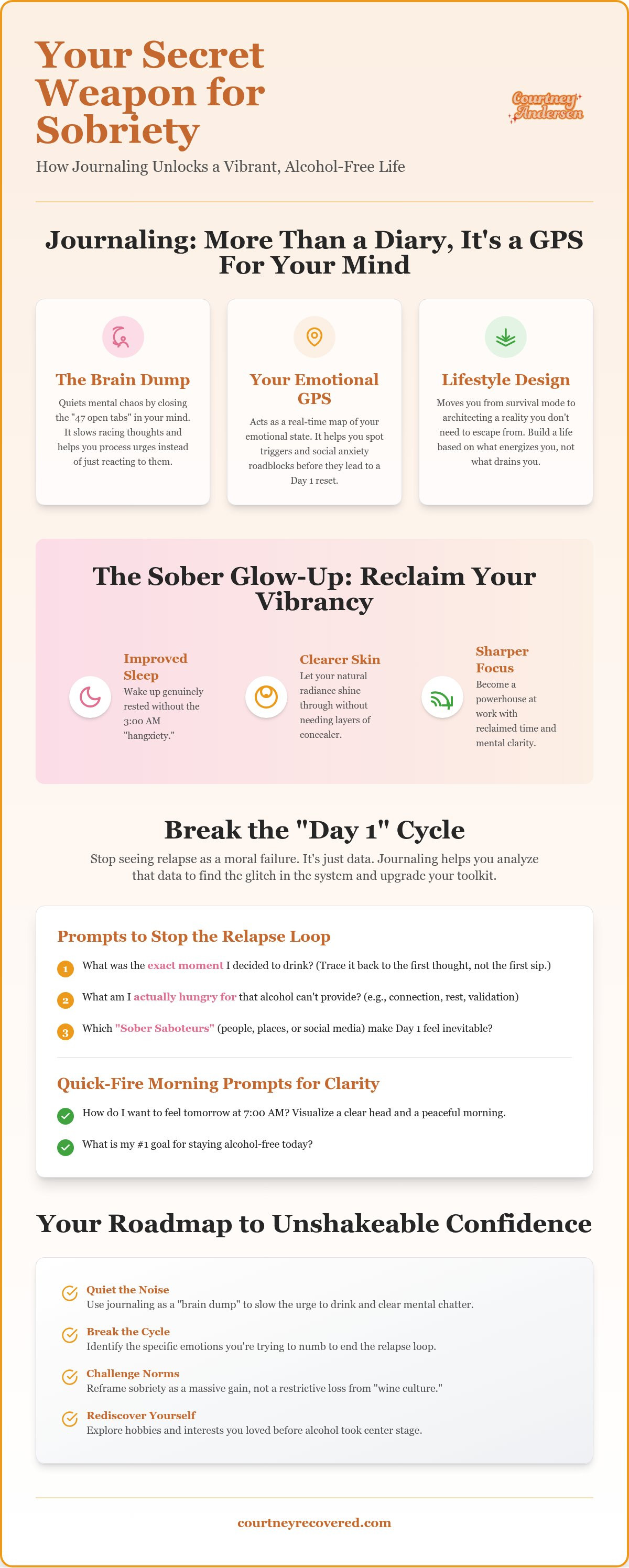
Forget everything you think you know about "dear diary" moments. We aren't here to write somber entries about our struggles in a clinical, sterile way. Instead, think of your journal as a high-energy brain dump. When you're stuck in the mental chatter of gray area drinking, your mind is basically a browser with 47 tabs open, and 46 of them are screaming about wine o'clock. Writing it all down closes those tabs. It clears the static so you can actually hear your own intuition again.
There is real power in the "science of the pen." Research into Journal therapy shows that the physical act of writing slows down your racing thoughts. It forces your brain to process the "why" behind an urge instead of just reacting to it. This isn't just about fixing a "problem." It is about moving from survival mode into lifestyle design. When you are honest with yourself on the page, you build the exact foundation we use in 1 on 1 sobriety coaching. You can't navigate to a new destination if you're lying about where you're starting from.
The GPS Analogy: Navigating Life Without the Fog
Think of your journal as a high-tech GPS for your soul. It acts as a real-time map of your emotional state, helping you spot roadblocks like specific triggers or social anxiety before they lead to a frustrating Day 1 reset. Sober journaling is a proactive lifestyle tool that helps you build a reality you don't need to escape. By tracking your wins, you create a roadmap for future social success. You start to see patterns in what makes you feel electric and what drains your battery, allowing you to choose your path with total confidence.
Non-Clinical Benefits: More Than Just Recovery
We need to talk about the glow-up. While the internal work is huge, the external side effects of learning how to start a sobriety journal are a total vibe. You'll notice improved sleep that actually leaves you rested, clearer skin that doesn't need three layers of concealer, and a sharper professional focus that makes you a powerhouse at work. You are literally reclaiming your time from the wine o'clock loop. Instead of spending three hours drinking and six hours recovering, you're building a life where your confidence comes from your own vibrant energy, not liquid courage.
Prompts for the Early Days: Breaking the Day 1 Cycle
The "Day 1" treadmill is absolutely exhausting. You wake up with a headache, a heart full of regret, and a pinky-promise to yourself that this time is different. If you're tired of starting over with sobriety, you need more than just willpower. You need a way to look under the hood and figure out why the cycle keeps repeating. Most of us aren't drinking because we're "failures." We're drinking because we're trying to numb a specific emotion that feels too loud to handle.
Using Journaling for Emotional Wellness allows you to sit with those uncomfortable feelings without reaching for a corkscrew. It's about getting curious instead of judgmental. When you learn how to start a sobriety journal, you stop being a victim of your cravings and start becoming the architect of your own peace.
Stopping the Relapse Loop
When you stop looking at a slip-up as a moral failure, you can finally treat it like a scientist. A relapse is just data, not a destination. It's a signal that your current toolkit needs an upgrade. Dig into these prompts to find the glitch in your system:
- What was the exact moment I decided to drink yesterday? (Trace it back to the first thought, not the first sip.)
- What am I actually hungry for that alcohol can’t provide?
- Which Sober Saboteurs- those people, places, or even specific social media accounts- make Day 1 feel inevitable?
Quick-Fire Morning Prompts for Clarity
Your morning entry sets the energy for the entire day. Visualization is your best friend here. Instead of focusing on what you're "giving up," focus on the gain. Ask yourself: "How do I want to feel tomorrow morning at 7:00 AM?" Imagine the crispness of a clear head and the lack of 3:00 AM "hangxiety."
Try these rapid-fire questions to stay focused:
- What is my #1 goal for staying alcohol-free today?
- How will I handle the 5:00 PM itch today?
Integrating these questions into your routine is a foundational pillar of building a sobriety toolkit. If you want to go deeper, my sobriety coaching can help you design a plan that actually sticks.
Sobriety Journal Prompts for Gray Area Drinkers & High-Performers
You're crushing your KPIs, your kids are thriving, and your life looks like a highlight reel on social media. So why does that 6:00 PM glass of Chardonnay feel like a non-negotiable survival tool? This is the gray area drinking trap. It's the space where you haven't "hit rock bottom" by society's standards, but you're definitely not hitting your full potential either. You're high-functioning, but you're also high-exhaustion.
When you're learning how to start a sobriety journal as a high-achiever, you aren't just looking for a place to vent. You're looking for an executive summary of your own soul. You need to pull back the curtain on the "functioning" mask and see what's actually going on underneath. Ask yourself this: what would my career or business look like if I had 100% of my energy back instead of operating on a 30% hangover tax every morning?
The Professional Woman’s Truth
In a world that glamorizes "mommy wine culture" and professional happy hours, staying sober can feel like a social rebellion. But leadership requires clarity, and you can't lead effectively if you numb out the moment the laptop closes. Use these prompts to audit your professional and personal boundaries:
- Am I drinking to celebrate my success or to tolerate the pressure of it?
- What boundaries have I let slip because I was too tired or tipsy to hold them?
- How does alcohol actually interfere with my leadership or parenting style when I think no one is noticing?
Deconstructing the Reward Myth
We've been conditioned to believe that a drink is the ultimate "reward" for a hard day's work. It's a lie. A real reward doesn't leave you with a headache, dry mouth, and dread at 3:00 AM. If you're figuring out how to start a sobriety journal that actually changes your life, you have to redefine what it means to treat yourself. If alcohol was a person, how would you describe your current relationship? Is it supportive, or is it a toxic friend who steals your time and money?
Challenge yourself to list five non-liquid ways to decompress tonight. Whether it's a high-intensity workout, a skincare routine that feels like a spa day, or finally reading that book on your nightstand, you need a new script. You deserve a life that feels good on the inside, not just one that looks good on LinkedIn. It's time to trade the liquid courage for the real kind.
The Identity Shift: Who Are You Without the Glass?
Who are you when the glass is empty? For many of us, alcohol didn't just take our time; it slowly replaced our personality. We became the "fun one" at the bar or the "relaxed one" with the wine. When you are learning how to start a sobriety journal, the most exciting part is the excavation of your real self. It is about navigating life after getting sober and realizing that you aren't losing an identity. You are finally meeting the person you were always meant to be.
Think back to when you were ten years old. What did you love doing before alcohol became your main hobby? Maybe you were a painter, a hiker, or a total bookworm. Alcohol has a way of making us forget our passions because it becomes the only activity on the menu. Use your journal to bridge that gap. Ask yourself: what is one bold thing I would do if I knew I wouldn’t be hungover tomorrow? Maybe it is a sunrise yoga class, a weekend road trip, or starting that side hustle you've been dreaming about. Sobriety gives you back the energy to actually follow through on those dreams.
The Sober Vibe Audit
You get to decide your new vibe. Instead of being the person who is always chasing the next drink, you can be the one who's present, high-energy, and reliable. This isn't about being "boring." It is about being vibrant. When you focus on how to start a sobriety journal with an eye toward the future, you stop looking back at what you "can't" have and start looking at who you are becoming. Use these prompts to define your new persona:
- How do I want people to describe me now that I am alcohol-free?
- What parts of my personality are actually better when I’m sober? (Think about your wit, your empathy, or your ability to actually remember a conversation.)
- What is one trait I used to hide with alcohol that I can now celebrate?
Socializing and Connection
Parties feel different when you aren't using liquid courage. You might feel a little social anxiety at first, and that's okay. It's just a sign that you're actually feeling your feelings instead of drowning them. Vibrant sobriety is a social superpower because it allows you to connect on a level that booze-fueled small talk never could. You become the person who can actually listen, laugh genuinely, and drive home safely with your dignity intact.
Reflect on your circle with these questions:
- Who in my life truly supports my vibrant, sober self?
- How can I show up more authentically in my sober community online?
- What does a "fun night out" look like when I prioritize connection over consumption?
If you're ready to fully embrace this new identity and stop the cycle of starting over, it's time to get the support you deserve. Work with me 1:1 to design a life that feels as good as it looks.
Building Your Sober Toolkit: How to Make the Habit Stick
You have the prompts, you have the vision, and you have the "why." Now comes the part where most people stumble: actually doing it. Knowing how to start a sobriety journal is one thing, but turning it into a non-negotiable part of your vibrant life is where the magic happens. Your journal shouldn't be a dusty notebook that makes you feel guilty when you ignore it. It needs to be your high-energy companion. That is exactly why I wrote the Sober Vibes Book. It is designed to be the ultimate partner for this practice, giving you a structured place to land every single day.
To make this habit stick, bake it into your daily flow. Try a "bookend" approach. In the morning, use your journal to set your energetic intention before the world starts demanding things from you. In the evening, use it as a brain dump to process the day so you don't carry that stress into your sleep. If a craving hits at 4:00 PM, grab your Sober Toolkit and start writing. Putting pen to paper in real-time acts like a circuit breaker for that "just one drink" loop. Plus, when you share those "aha!" moments inside the Sobriety Circle, you accelerate your growth through community-led accountability.
Creating a Ritual, Not a Chore
Stop treating journaling like homework. Create a ritual that you actually look forward to. Light a candle, pour a fresh cup of coffee, and bring a "tough love" attitude to the page. You don't have to write a novel. In fact, five minutes of raw, unfiltered truth is always better than thirty minutes of being "polite" to your notebook. Use the Stop Starting Over framework to review your entries at the end of the week. Look for patterns. Are you always stressed on Tuesdays? Is a certain friend a consistent trigger? This data is your roadmap to a life you don't need to escape from.
Next Steps: From Paper to Practice
The best time to start was yesterday; the second best time is right now. Pick just one prompt from the list above and write for three minutes. Don't overthink it; just let it flow. If you want to go deeper and get your hands on all the resources I've mentioned, check out the Sober Toolkit for a comprehensive set of growth tools. Ready for the next level of connection? Come join us in the Sobriety Circle. It is the place to share your journal insights, crush your goals, and celebrate your vibrant, alcohol-free life with people who truly get it. You've got this, and I've got you.
Your Vibrant, Alcohol-Free Evolution Starts Now
You've now got a high-energy GPS to navigate the fog of early recovery and the gray-area drinking trap. By learning how to start a sobriety journal, you're doing more than putting pen to paper; you're actively designing a life you no longer want to escape. You've seen how these prompts can help you crush cravings, break the Day 1 cycle, and finally meet the authentic, sober self who's been waiting under the surface.
This journey doesn't have to be a solo mission. The tools we've discussed are the same ones I use with clients as a professional sober coach. They're featured in the Sober Toolkit and used daily by our incredible community in the Sobriety Circle. If you're ready to make these insights stick and build unshakeable confidence, it's time to take the next step toward your most electric self.
Grab your copy of the Sober Vibes Book and start your journey today! It's specifically designed by me, Courtney Andersen, to be your ultimate companion on this path. You deserve a life that feels clear, connected, and totally yours. Let's make it happen together.
Frequently Asked Questions
Do I have to journal every single day for it to work?
Consistency is your best friend, but don't beat yourself up if you miss a day. The goal is to build a lifestyle ritual, not to add another stressful "to-do" to your list. If you're figuring out how to start a sobriety journal, try aiming for four or five days a week. It's about creating a space where you can be raw and honest, which keeps your momentum high even when life gets hectic.
What if I am afraid of someone reading my sobriety journal?
Privacy is non-negotiable for true radical honesty. If you're worried about prying eyes, use a password-protected app or a physical journal with a lock. Some people even keep their journal in a hidden spot that only they know about. You can't fully dive into the identity shift required for long-term sobriety if you're editing your thoughts for an audience. Your journal is your safe space to be totally unfiltered.
Is journaling better than going to an AA meeting?
It isn't about which tool is "better," but which one fits your vibrant, non-clinical lifestyle. Journaling is a private, high-energy way to process your internal monologue, while meetings provide external community support. Many members of the Sobriety Circle use both. Journaling helps you do the deep individual work, while community programs provide the accountability you need to stay on track. Both can be powerful pillars in your personalized Sober Toolkit.
How long should my journal entries be?
Focus on the quality of your truth rather than the word count. Sometimes a single, punchy paragraph can reveal more than five pages of rambling. When you're learning how to start a sobriety journal, try writing for just five to ten minutes. If you have more to say, keep going, but don't force it. Unfiltered honesty is much more valuable for your recovery than filling up pages with polite, surface-level observations.
What is the best time of day to use these sobriety prompts?
The best time is whenever you can actually stick to it. Many high-performers love a morning "brain dump" to set a clear intention before the workday starts. Others prefer an evening ritual to process stress so they don't carry it into sleep. If you're using the Sober Vibes Book, you might find that a quick check-in during "wine o'clock" is the perfect way to navigate cravings and stay focused on your goals.
Can I use a digital journal or is pen and paper better?
Both options are great, so pick what feels most accessible. Pen and paper offer a unique "science of the pen" benefit that slows down your thoughts and helps you process emotions more deeply. However, a digital journal is perfect for when you're on the go and need to manage a craving in real-time. The most important thing is having a reliable place to capture your insights and track your progress.
What should I do if a prompt makes me feel triggered or upset?
Feeling triggered is actually a sign that you're hitting on something important. If a prompt feels too heavy, it's okay to take a breath and step back. You don't have to solve everything in one sitting. This is where having a supportive community like the Sobriety Circle is huge. You can bring those tough insights to the group and get the empathetic "tough love" you need to work through the discomfort safely.
How do I know if my journaling is actually helping my recovery?
Look for the "glow-up" markers in your everyday life. Are you sleeping better? Is your professional focus sharper? Do you feel more confident in social situations without needing a drink? When you review your entries using the Stop Starting Over framework, you'll start to see patterns and wins that weren't obvious before. If you feel more connected to your authentic self and less controlled by cravings, your journaling practice is definitely working.
I want you to feel sober NOT boring!
Kickstart your sobriety with my free 2-day video workshop series to master your sober mindset and have FUN in your sobriety journey!


