
Sobriety Coach vs. Support Group: Which Path Leads to Your Vibrant New Life?
Aug 28, 2026
What if your "boring" sober life actually felt more like a social promotion than a clinical sentence? You might be sitting there right now, feeling like a "functional" drinker who doesn't quite fit into the sterile, somber world of traditional rehab, yet you’re exhausted by the isolation of trying to quit on your own. It’s totally normal to fear that putting down the glass means losing your spark, but I’m here to tell you that sobriety is actually a massive lifestyle upgrade.
Deciding between a 1:1 sobriety coach vs support group doesn't have to be a guessing game. You deserve a path that feels like a gain, not a restrictive loss. In this article, you’ll discover the key differences between high-touch personal coaching and the energy of virtual support groups so you can choose the momentum that actually sticks. We’re diving into how a personalized roadmap can break your relapse cycle and how the right community fuels your vibrant new life. Get ready to trade the "white-knuckle" struggle for a life that’s unapologetically loud and free.
Key Takeaways
- Understand why a sobriety coach acts as your personal lifestyle architect while a virtual support group provides the essential social "fuel" to keep your momentum high.
- Learn how to navigate high-stakes social events like weddings or bachelorette parties with the bespoke accountability of 1:1 coaching.
- Discover why the "Me Too" factor in communities like the Sobriety Circle is the ultimate antidote to shame and isolation.
- Compare the depth and investment of a sobriety coach vs support group to determine which path fits your current "Day 1" needs and long-term goals.
- Get a practical strategy for your first 30 days, including how to audit your triggers and build a personalized Sober Toolkit that actually works.
Understanding the Landscape: Sobriety Coaching and Virtual Support Groups
You’re standing at a crossroads. You know the booze isn't serving you anymore, but the traditional options feel dusty, clinical, and like they’re meant for someone else. This is the first hurdle in the sobriety coach vs support group debate: realizing that "support" doesn't have to mean sitting in a basement with fluorescent lights and bad coffee. It’s about finding the right architecture for your new, vibrant life.
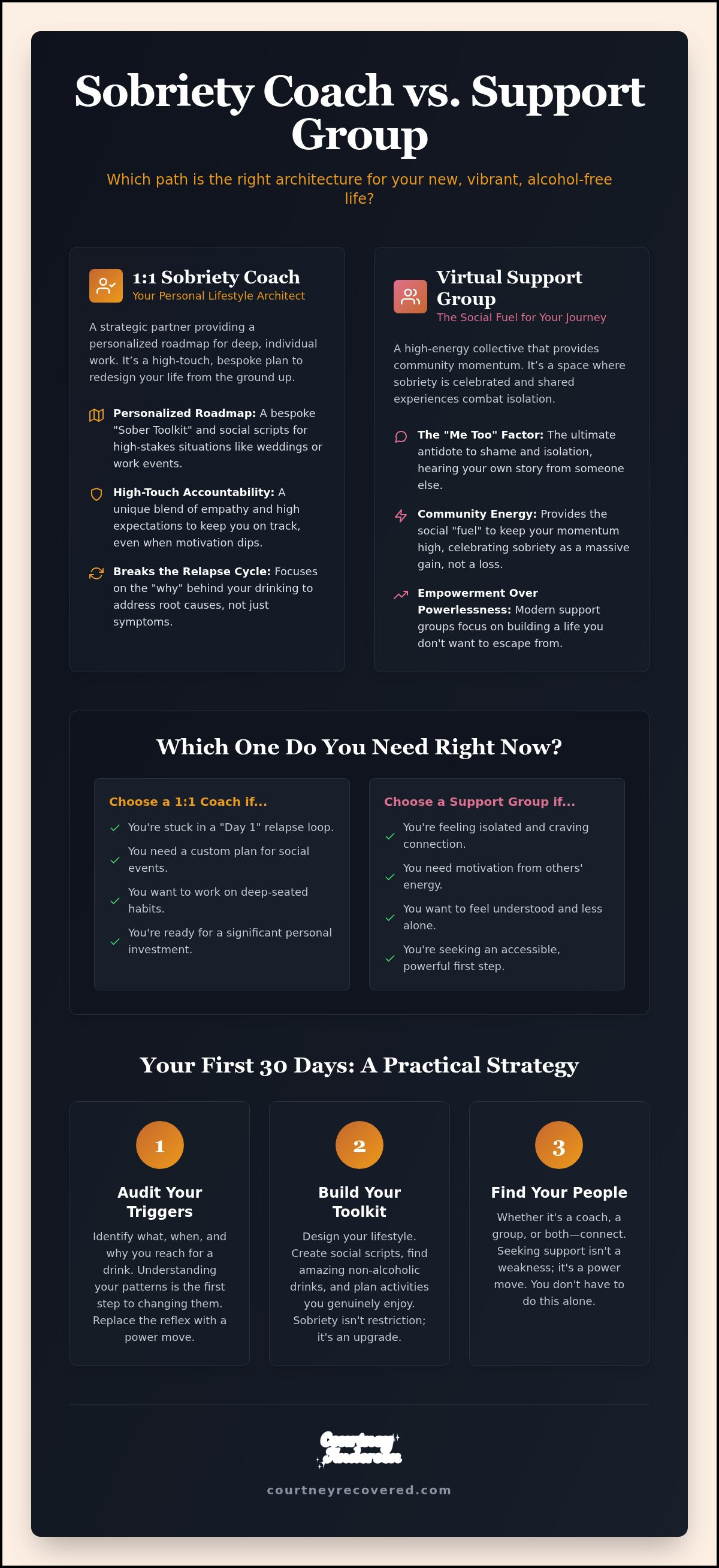
A sobriety coach acts as your personal lifestyle architect. They aren't there to diagnose you or dig into clinical trauma like a therapist might. Instead, they’re a mentor who helps you design the "now" and the "next." They provide the tactical tools you need to handle a high-stakes work dinner or a Friday night in without a bottle of Rosé. Virtual sober support groups, on the other hand, provide the community fuel. You can find different types of support groups today that focus on empowerment rather than powerlessness, creating a space where sobriety is celebrated as a major win.
The Rise of Non-Clinical Recovery
For many of us, clinical settings feel completely "off." If you haven't lost your job or your home, walking into a traditional rehab facility feels like wearing someone else's shoes. We’re seeing a massive shift toward models that treat sobriety as a social promotion. Sobriety coaching is a personalized partnership for lifestyle design, focused on your specific goals and evolution. It’s about building a life you don't want to escape from, rather than just "quitting" a substance. Choosing between a sobriety coach vs support group often comes down to whether you need a bespoke roadmap or a high-energy collective to keep you moving forward.
Why Your "Functional" Status is a Trap
Being "high-functioning" is a double-edged sword. Your professional success and tidy home mask the internal chaos that only you feel. You think, "I'm not that bad," because you still make it to the gym and pay your bills on time. This "not bad enough" mindset is the ultimate trap of gray-area drinking. It keeps you stuck in a loop of "moderate" drinking that leaves you feeling half-alive and constantly anxious. Seeking help isn't an admission of weakness; it’s a power move. It’s deciding that "fine" isn't good enough for your one beautiful life. Whether you choose a coach or a group, you’re finally choosing yourself.
The 1:1 Sobriety Coach: Your Personalized Roadmap to Freedom
Imagine having a "cool older sister" who has already navigated the minefield of early sobriety and come out the other side glowing. That’s the magic of a coach. While virtual sober support groups offer incredible community energy, a coach is your strategic partner for the deep, messy, personal work. They don't just tell you to "not drink"; they help you figure out why you wanted to in the first place.
This 1:1 focus is a game-changer in the sobriety coach vs support group debate. You get to dive into the emotional side of sobriety, learning how to process feelings without a liquid buffer. If you're tired of the "Day 1" loop, our 1-on-1 sobriety coaching uses the Stop Starting Over framework to break the relapse cycle for good. It’s about building a life that feels like a social gain, not a clinical loss.
Accountability That Actually Works
Your best friend loves you, but she might not have the heart to call you out when you’re romanticizing that "one glass of wine." A coach provides a unique blend of empathy and high expectations. We look at the root causes of your habits, not just the symptoms. It’s about identifying why you reach for the bottle after a long Tuesday and replacing that reflex with a power move. This "tough love" approach ensures you stay on track even when your motivation dips.
Building Your Bespoke Sober Toolkit
What happens when you’re invited to a bachelorette party or a high-pressure networking event? A coach helps you build a custom social script so you don't feel like the "odd one out." You’ll learn how to hold a mocktail with confidence and leave early without an ounce of guilt. We also include practical resources like the Sober Vibes Book to keep you in the game every day. It’s not about restriction; it’s about lifestyle design. You aren't losing your social life; you’re upgrading it.
Virtual Sober Support Groups: The Social Fuel for Your Journey
If 1:1 coaching is your personal trainer, a virtual support group is your high-energy fitness class. It’s the social fuel that keeps your engine running when the initial excitement of "quitting" starts to fade. In the debate of sobriety coach vs support group, the group is where you find your "sober squad." These are the people who actually get why a Tuesday night at a bar feels like a minefield and why a morning without a hangover feels like winning the lottery.
The "Me Too" factor is the ultimate antidote to shame. When you hear someone else describe the exact same 4:00 PM craving or the same awkward conversation with a pushy mother-in-law, the weight of isolation just evaporates. Extensive research on support groups confirms that this shared identity is a powerful driver for long-term change. It transforms sobriety from a private struggle into a collective power move. You aren't just "staying sober"; you’re evolving alongside a tribe that refuses to settle for a dull, muted life.
The Sobriety Circle Experience
Forget the somber images of folding chairs in church basements. A modern, membership-based community like the Sobriety Circle is vibrant, digital-first, and available 24/7. It isn't just about "venting" about the hard days; it’s about constructive growth. We focus on what we gain, not just what we give up. Through shared resources like The After, you get the tools for long-term maintenance while staying connected to a tribe that celebrates every milestone with you. It’s about consistency and having a safe space to land whenever the world feels a little too "boozy."
Combating the "Sober and Lonely" Phase
Let’s be real: isolation is the biggest threat to your evolution. When you stop drinking, your social circle often shifts, and that can feel incredibly lonely at first. Virtual groups bridge the gap between coaching sessions, ensuring you never have to white-knuckle a Friday night alone. You’re trading "drinking friends" who only know one version of you for a sober community that sees your full potential. This shift isn't a loss; it’s an upgrade to a higher-vibe social life where connection doesn't require a cocktail. You aren't just quitting a habit; you’re joining a movement that values genuine presence over liquid courage.
Coaching vs. Groups: Which One Do You Need Right Now?
Choosing between a sobriety coach vs support group isn't about finding a "better" option; it's about identifying which tool fits the current season of your evolution. Think of it like this: are you looking for a custom-built engine or a high-octane crew to race with? Both serve the same finish line, but they handle the terrain differently. One provides the deep, surgical precision needed to uproot old patterns, while the other offers the broad, social energy that makes a sober life feel like a party you actually want to attend.
If you’re navigating a high-stakes career or high-pressure social circles where privacy is paramount, coaching is often the move. It lets you do the heavy lifting in a 1:1 container where every minute focuses on your specific triggers and professional "social scripts." On the flip side, if your biggest threat is the crushing weight of loneliness or the fear that life will be boring without a bottle, the "tribe" energy of a group is your antidote. It’s a cost-value analysis where the real investment isn't just money; it's the time you’re no longer wasting in the relapse cycle.
The Hybrid Approach: Why Not Both?
Most women find that the high-momentum path involves a bit of both. Coaching provides the high-level strategy and deep-dive accountability, while a community like the Sobriety Circle provides the daily connection that keeps you from feeling like the "odd one out." Pairing 1:1 sessions with the collective energy of a group creates a holistic recovery ecosystem. You can use your Sober Toolkit to manage a stressful Tuesday, then jump into a group chat to celebrate your win. This combination ensures you have a map for the journey and a squad to cheer you on as you drive.
Identifying Your Current Funnel Stage
Where are you on the spectrum of change? If you’re just "sober curious," a group might be the perfect low-pressure way to test the waters. But if you’re "done starting over" and ready to burn the ships, the intensive support of a coach can fast-track your results. Matching your level of commitment to the right type of support is how you ensure this time actually sticks. Once you break free from the "Day 1" loop, you can start focusing on the vibrant life after getting sober that’s waiting for you.
Ready to stop the guesswork and build a life you love? Book a discovery call today to find the path that leads to your vibrant new reality.
Taking the Leap: How to Start Your Alcohol-Free Evolution
You’ve done the research, you’ve weighed the options, and you’ve seen how the sobriety coach vs support group dynamic can work in your favor. Now comes the part where the rubber meets the road. To stop the cycle of "starting over" every Monday morning, you need to begin with a radical audit of your current life. Look at your "Day 1" triggers with total honesty. Is it the 5:00 PM kitchen transition? Is it the high-pressure client dinners? Identifying exactly where your willpower leaks is the first step in plugging the holes with the right support.
Your "First 30 Days" strategy should set you up for a massive win, not test your strength. This means clearing the house of "just in case" bottles and filling your calendar with activities that don't revolve around a glass of wine. Whether you choose the deep dive of 1:1 coaching or the collective energy of a community, the goal is to create a buffer between you and your old habits. You aren't just "not drinking"; you’re actively building a new identity.
Vetting Your Mentor
When you’re looking for a coach or an online community, don't just look at a list of certifications. You want a vibe match. This is your life we’re talking about, so you need someone who speaks your language. Ask potential coaches how they handle "gray area" drinking or what their stance is on social sobriety. You’re looking for lived experience over clinical coldness. A great mentor should feel like a "cool older sister" who has already walked the path and is holding the map for you. If a community feels too somber or restrictive, it’s not your tribe. Your sober life should feel like a social gain, so find a space that celebrates that vibrancy.
Your First Step Today
Waiting for Monday is the ultimate trap. It’s a procrastination tactic that keeps you stuck in the "just one more" loop. The best time to start your evolution is right now, while the desire for change is fresh. You don't need to have the next ten years figured out; you just need to take one small, manageable step toward your future self. Here are a few ways to grab that momentum:
- Grab the Sober Vibes Book: Start shifting your mindset with daily inspiration and practical tools.
- Join the Sobriety Circle: Dive into a virtual community that provides 24/7 connection and "me too" moments.
- Audit your environment: Use the Sober Toolkit to identify and remove your biggest triggers today.
If you’re ready to burn the ships and commit to a life that’s unapologetically loud and free, exploring Courtney Recovered is your high-momentum path. Your vibrant new life is waiting on the other side of this choice. Let's get started.
Your Vibrant New Life is Calling
Your vibrant life isn't just a possibility; it’s waiting for you to claim it. You’ve learned that the choice between a sobriety coach vs support group isn't about finding a single "right" answer. It’s about finding the specific support that matches your unique evolution. Whether you need the deep, surgical precision of 1:1 strategy to uproot old patterns or the high-energy social fuel of a tribe, you now have the roadmap to make it happen.
As a specialist in gray area drinking, author of the Sober Vibes Book, and founder of the Sobriety Circle community, I know exactly what it’s like to feel stuck in the "not bad enough" trap. You don't have to wait for a rock bottom to reach for a better reality. You deserve a life that feels like a social promotion, full of genuine connection and crystal-clear mornings.
Ready to stop starting over? Book your 1:1 discovery call with Courtney today!
You have the tools. You have the truth. Take that first step toward the unapologetically free version of yourself. I’m right here with you.
Frequently Asked Questions
What is the main difference between a sobriety coach and a sponsor?
A sobriety coach is a paid professional who typically holds specific certifications, whereas a sponsor is an unpaid volunteer within a 12-step program. While a sponsor focuses specifically on the 12 steps, a coach acts as a lifestyle mentor. They help you build a personalized roadmap for your social and professional life. This professional relationship offers structured accountability and bespoke strategy that peer-led sponsorship isn't designed to provide.
Are virtual sober support groups as effective as in-person meetings?
Virtual sober support groups are highly effective because they remove travel and scheduling barriers. Digital platforms have grown rapidly, with some online recovery communities reaching over 800,000 members. These groups provide 24/7 access to a "sober squad" right from your phone. For many women, the comfort and privacy of joining from home makes it much easier to stay consistent and be vulnerable during the early stages of their evolution.
How much does a sobriety coach typically cost in 2026?
In 2026, industry data shows that private sobriety coaches typically charge between $100 and $175 per hour for individual sessions. If you’re looking for high-intensity support, monthly retainer packages can range from $800 to over $3,000. These retainers often include on-call access and regular check-ins. When weighing the choice of a sobriety coach vs support group, it’s helpful to view coaching as a specialized, professional investment in your long-term lifestyle design.
Can I join a support group if I am still drinking but want to stop?
You can definitely join a support group if you’re still drinking but have a desire to stop. Most communities, including the Sobriety Circle, welcome anyone who is "sober curious" or ready to change their relationship with alcohol. It’s actually a power move to start building your community before you feel "perfect." Having that social fuel in place helps you navigate those first few days without the isolation that usually leads to a relapse.
Is sobriety coaching covered by insurance?
Sobriety coaching is generally not covered by private health insurance, but access is expanding through other channels. As of 2026, Medicaid programs in over 40 states now reimburse for peer recovery support services, which often include coaching. If you have private insurance, it’s always worth checking your specific policy for "peer support" coverage. However, most people treat coaching as a personal investment in their evolution rather than a clinical medical expense.
What should I look for in a virtual sobriety community?
Look for a vibe match and a focus on social gain rather than clinical loss. You want a community that feels like a social promotion, not a somber requirement. Check if the group discusses practical life skills, like navigating high-stakes work events or weddings. A great virtual community should offer active engagement and shared resources, like a Sober Toolkit, to help you maintain your momentum every single day of the week.
Do I need a coach if I’ve already been to rehab?
Many women find that a coach is the "missing link" after they leave a clinical rehab setting. Rehab provides the initial break, but a coach helps you design your actual life in the real world. They act as your lifestyle architect, helping you handle the professional social scripts and personal triggers that rehab doesn't always prepare you for. It’s about taking those clinical tools and making them work in your vibrant, everyday reality.
How long do people usually work with a sobriety coach?
The length of time varies, but many people find that a three to six-month partnership is the sweet spot for breaking the relapse cycle. This timeframe allows you to move through the initial "Day 1" triggers and build a solid foundation for your new life. Some choose to continue longer with maintenance programs like The After. The goal is to give you the high-momentum support you need until your sober life feels completely natural and free.
I want you to feel sober NOT boring!
Kickstart your sobriety with my free 2-day video workshop series to master your sober mindset and have FUN in your sobriety journey!


