
Sobriety Coach vs. Sponsor: Which Support System Actually Fits Your Life?
Oct 01, 2026
What if the reason you keep starting over isn't a lack of willpower, but a support system that feels like a chore you never signed up for? You've likely sat in those fluorescent-lit basement meetings feeling like a total outcast, wondering why the "tried and true" path feels more like a heavy restriction than a fresh start. It's incredibly draining to manage a demanding career while trying to force your life into a recovery box that just doesn't fit your schedule or your vibe. You want to stay dry, but you also want to actually enjoy your existence without feeling like you are constantly missing out.
I get it because I've been there. In this breakdown of a sobriety coach vs sponsor, you'll discover the critical differences between traditional peer support and professional life design. This is about helping you choose the specific accountability that finally ends the relapse cycle for good. We are diving into how to move away from the "one-size-fits-all" approach and toward a model that respects your time and your ambition. By the end, you'll have a clear roadmap to a sustainable, high-energy lifestyle that feels like a massive upgrade, not a somber sacrifice.
Key Takeaways
- Stop wondering which path is right for you by uncovering the real-world differences between a sobriety coach vs sponsor.
- Learn why a sponsor focuses on working a specific program while a coach focuses on designing a life you don't feel the need to escape.
- Identify how professional accountability provides the "skin-in-the-game" needed to finally end the exhausting cycle of starting over.
- Discover how to find support that mirrors your ambition and fits your busy schedule without the clinical or somber vibes of traditional recovery.
- Explore how a vibe-aligned mentor can help you transition from just "staying dry" to living a celebratory, connected reality.
Understanding Your Support Options: Why the "Old Way" Isn’t the Only Way
You aren't broken. If you feel like an outsider in traditional recovery rooms, it’s likely because your needs have evolved past the basic "just don't drink" mentality. For decades, the recovery industry relied on a one-size-fits-all model that felt more like a punishment than a promotion. In 2026, we know better. While some people need medical intervention to stop safely, many high-functioning professionals are looking for something else entirely. They are looking for lifestyle mentorship that helps them thrive in a fast-paced world without a drink in their hand.
Choosing between a sobriety coach vs sponsor isn't about picking a "right" or "wrong" side. It's about identifying which energy matches your current life. Both roles fall under Understanding Your Support Options, but they operate on completely different frequencies. One is rooted in a specific historical program; the other is a modern partnership designed to help you build a life you actually enjoy living. It’s okay to want a support system that mirrors your ambition and your schedule.
What is a Sobriety Coach?
A sobriety coach is a professional partner who helps you build a custom roadmap to an alcohol-free life. Unlike clinical providers, a coach focuses on what we call Recovery Capital. This includes the internal and external resources you need to stay successful, such as a supportive home environment, a clear career path, and the emotional tools to handle stress. A sobriety coach is a lifestyle architect for your alcohol-free future. They work with you to identify real-life triggers, from networking events to family dinners, and provide high-momentum strategies to navigate them with confidence.
What is a Sponsor?
A sponsor is a volunteer within a 12-step program, like Alcoholics Anonymous, who has completed the steps and guides others through the same process. This role is rooted in a long tradition of one person helping another without any financial exchange. A sponsor's primary focus is the 12-step curriculum. They help you work the program as written, providing a peer-to-peer connection based on shared history. While this model offers a deep sense of community, it requires a commitment to a specific, structured path that may not always align with a modern, professional lifestyle.
The Role of a Sponsor: Tradition, Service, and the 12 Steps
Sponsorship is the OG of recovery support. It’s a volunteer-based relationship in which someone who has successfully navigated the 12 steps of AA or NA guides a newcomer through the same curriculum. The mentor-mentee dynamic is built on service. You aren't paying for their time; you’re paying with your commitment to the program. This model provides an immediate community of people who have been exactly where you are, which is a powerful antidote to the isolation of drinking. It’s a system rooted in the idea of one alcoholic helping another, creating a bond that has existed for nearly a century.
While the financial cost of a sponsor is zero, the lifestyle cost can be high. You are often expected to show up to meetings, call your sponsor daily, and adopt a specific philosophy. One of the biggest hurdles for modern women is the concept of powerlessness that sits at the center of the 12-step framework. If you are a high achiever who is used to taking charge of your life, being told you have no control can feel counterintuitive. This is a primary point of friction when comparing a sobriety coach vs sponsor; one asks you to surrender, while the other asks you to strategize.
The 12-Step Framework
The 12 steps are the engine of this relationship. It’s a spiritual curriculum that often involves a Higher Power, which can be a stumbling block if you aren't religious or spiritually inclined. You have to decide if that vibe matches your personal beliefs before diving in. Sponsorship focuses heavily on the past and making amends. If working a program feels like a second job you didn't apply for, the traditional 12-step model might feel more like a weight than a wing.
When Sponsorship Might Feel Like a Mismatch
Sponsorship often feels like a mismatch for gray area drinkers who haven't hit a stereotypical rock bottom. If your life looks great on paper but feels messy inside, you might find it hard to relate to the stories shared in traditional meetings. Professional women often struggle with rigid meeting structures that don't account for board meetings or school runs. Research is catching up to this need for variety, as seen in a Peer Recovery Coaching Intervention study that explores how peer support is evolving. Living your life shouldn't be sidelined by your recovery. If you want a path that celebrates your strength, you can explore a partnership that focuses on your future instead of your past.
The Sobriety Coach Advantage: Strategy, Action, and Life Design
Investing in yourself changes the energy of your recovery. When you move from a volunteer-based peer relationship to a professional partnership, you gain a level of skin-in-the-game accountability that is hard to find in traditional rooms. When debating a sobriety coach vs sponsor, the biggest shift is the move from "working a program" to designing a life. You aren't just trying to survive the day without a drink; you are building a high-energy existence that doesn't require an escape. This is about strategy, not just willpower.
A professional coach brings a "tough love" realism that helps you finally stop starting over. Instead of focusing solely on past mistakes, we look at the "Why" and the "How" of your specific daily triggers. We analyze your routines to see where the habit loops live and replace them with sustainable tools. This proactive approach is essential for life after getting sober, ensuring that your new lifestyle feels like a massive promotion rather than a restriction.
Personalized 1:1 Mentorship
Your life is busy, and your support system should respect that. A coach acts as a mentor who understands the pressure of a high-level career and a complex family life. We don't expect you to fit into a rigid, one-size-fits-all schedule. Instead, we tailor your sobriety plan to your real life. This might mean direct access for real-time support during high-stress moments, like a high-stakes networking event or a chaotic holiday dinner. By using resources like the Sober Toolkit, you build daily resilience that allows you to show up as the best version of yourself in every room you enter.
Building Your "After"
The goal isn't just "not drinking"; it's creating a vibrant, alcohol-free identity that you are proud of. Coaching helps you navigate the tricky social waters of bachelorettes, boardrooms, and everything in between without feeling like the "boring" person in the corner. Through 1 on 1 sobriety coaching, we dig into the root causes of the habit. We address the underlying stress or boredom that kept you reaching for a glass in the first place. This is how you move past the exhausting cycle of quitting and relapsing and step into a connected, celebratory reality.
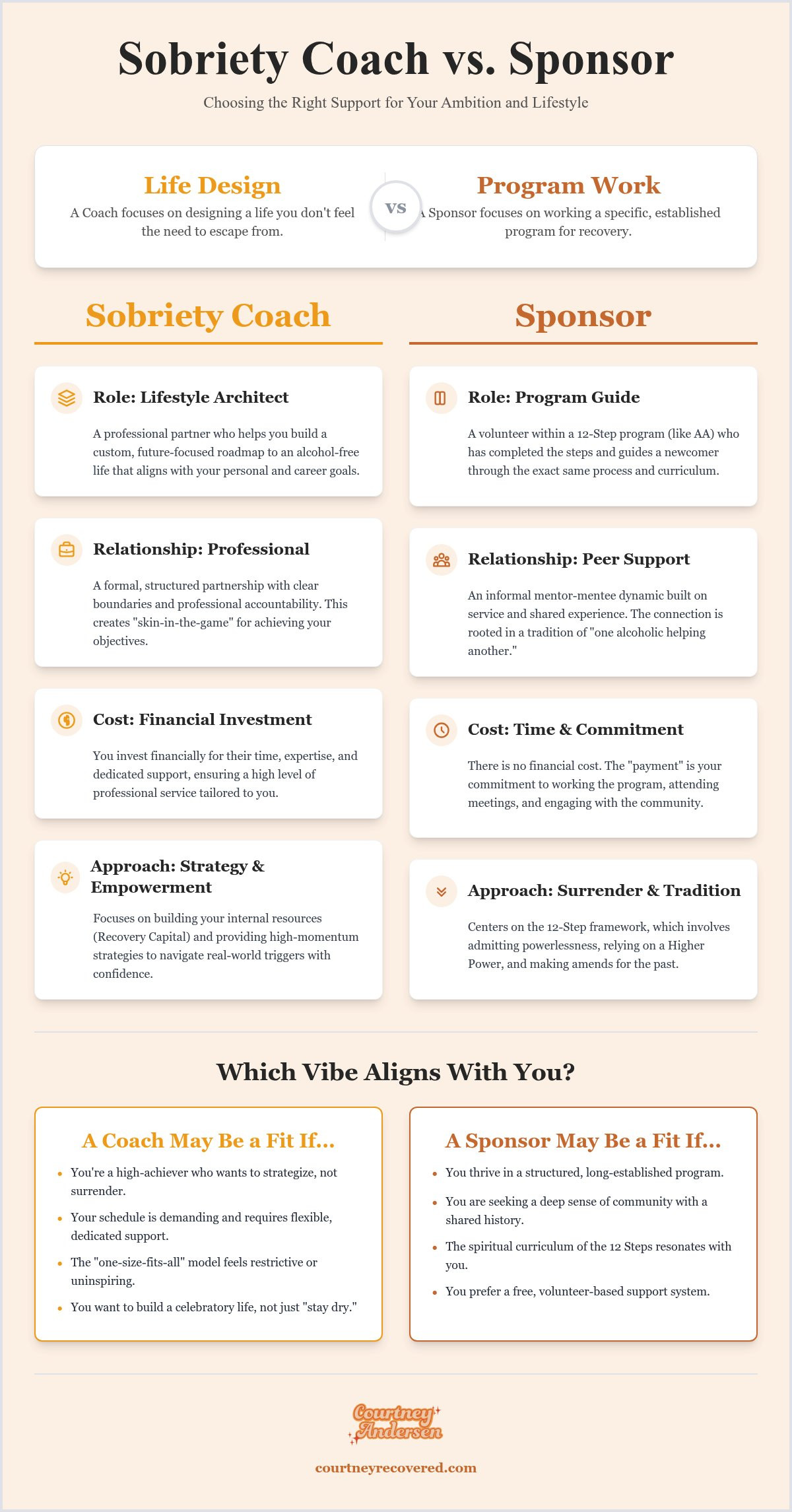
Sobriety Coach vs. Sponsor: A Side-by-Side Comparison
Choosing your support system is a major life decision. When you look at the dynamic of a sobriety coach vs sponsor, you are looking at two very different ways of showing up for yourself. A sponsor is a volunteer who offers peer support based on their own history. A sobriety coach is a trained professional who uses evidence-based strategies to help you reach specific goals. One is about fitting into a fellowship, while the other is about hiring a consultant for your personal evolution. You need to decide if you want a program to follow or a life to build.
Contact frequency is a huge differentiator. With a sponsor, you might be expected to call every morning or find them at a meeting. With a coach, you have scheduled, high-impact sessions that respect your calendar. While a sponsor focuses on step completion, a coach focuses on holistic transformation. This includes everything from your sleep hygiene to your social confidence. If you've been stuck in a cycle of quitting and relapsing, the professional structure of coaching might be the missing piece of the puzzle.
The Accountability Factor
For many high-achievers, "skin in the game" is a powerful motivator. Paying for a service often leads to greater commitment because you are making a financial investment in your future self. A sponsor provides fellowship accountability, which is beautiful for community building, but it lacks the professional boundaries of a coaching relationship. While a coach provides the tough love required to overhaul your habits, a sponsor offers the comfort of shared experience within a specific group. Both have value, but they serve different needs and different types of momentum.
Which One Should You Choose?
The right choice depends on your current stage and what you value most in your recovery journey. Many women find that a hybrid approach works best, using the community of a group alongside the 1:1 strategy of a professional. Consider this quick checklist to see where you land:
- Choose a sponsor if: You want a free, program-specific path and you are comfortable with the 12-step philosophy and spiritual focus.
- Choose a coach if: You want a customized, action-oriented plan that fits a busy professional schedule and focuses on life design.
- Choose both if: You want the deep community of a 12-step group but need the 1:1 strategy of a professional to handle your unique triggers.
No matter which path you take, isolation is the enemy. Finding a sober community online ensures you have support at your fingertips 24/7. If you are ready to move from surviving to thriving, you can start your journey today with a partner who understands exactly how to get you there.
Ready to Stop Starting Over? How Courtney Recovered Can Help
You've spent enough time weighing the pros and cons of a sobriety coach vs sponsor. Now, it's time to move from "thinking about it" to actually doing it. The cycle of quitting on Monday only to find yourself back at the bottom by Friday is exhausting. It drains your confidence and keeps you stuck in a version of yourself that you've outgrown. At Courtney Recovered, we don't do "somber" or "sterile." We do celebratory. We focus on breaking that "Stop Starting Over" loop by giving you a roadmap that works with your high-momentum life.
Courtney Andersen’s approach is intentionally non-clinical because she’s lived every bit of the struggle herself. She knows that for many women, professional success acts as a mask for a drinking problem. She’s here to help you take that mask off in a safe, high-energy environment. This isn't about admitting you are "powerless"; it's about reclaiming your power and designing a life that feels like an absolute promotion rather than a restriction. We focus on the "The After" phase of recovery, where you learn to love your new, connected reality.
Your Personalized Sobriety Roadmap
1:1 coaching sessions provide the tailored support you’ve been missing. We don't just talk about the past; we strategize for your future. You’ll learn how to integrate the Sober Vibes Book into your morning routine to set a positive, resilient tone for the day. Whether you are navigating a boardroom or a high-stakes social event, you'll have the tools to show up as your most authentic self. Your professional success shouldn't be a reason to drink; it should be a reason to stay sharp, present, and fully engaged in your life.
Join the Sobriety Circle
If you want community without the 12-step dogma, the Sobriety Circle is your new home. It’s a vibrantly optimistic space filled with women who "get it"—ambitious, vibe-aligned, and ready to thrive. You’ll get access to the Sober Toolkit for daily maintenance and the collective energy of a group that celebrates every win, no matter how small. This is where you find the accountability that feels like a group of supportive friends rather than a clinical requirement. You can finally stop the exhausting cycle of starting over and start living the upgraded life you deserve.
Book your 1:1 Sobriety Coaching discovery call today!
Design a Life You Don't Need to Escape
You've spent long enough trying to jam your vibrant, ambitious life into a recovery box that just doesn't fit. Choosing between a sobriety coach vs sponsor isn't about finding the "right" answer; it's about finding the support that actually respects your time and your energy. While sponsorship offers a traditional, peer-based fellowship, professional coaching provides the strategic, 1:1 roadmap needed to handle the high-stakes triggers of your career and social life. You deserve a path that feels like a promotion, not a punishment.
As the founder of the Sobriety Circle and author of the Sober Vibes Book, Courtney Andersen specializes in helping women navigate gray-area drinking with a celebratory, high-energy approach. You don't have to stay stuck in the exhausting cycle of starting over. It’s time to step into a sustainable lifestyle where you are fully present and unapologetically yourself. Ready to stop the cycle? Apply for 1:1 Sobriety Coaching with Courtney today. Your most connected, vibrant reality is waiting for you, and I can't wait to see you thrive.
Frequently Asked Questions
Is a sobriety coach the same as an AA sponsor?
No, a sobriety coach and a sponsor are distinct roles with different goals. A sponsor is a volunteer who guides you through the 12 steps of a specific program like AA. A sobriety coach is a paid professional who partners with you to design a custom, alcohol-free lifestyle. While a sponsor focuses on spiritual program work, a coach provides strategic, real-time tools for your career and social life. This distinction is the core of the sobriety coach vs sponsor debate.
Do I have to be an "alcoholic" to hire a sobriety coach?
You definitely don't need to use labels like "alcoholic" to benefit from coaching. Many of my clients are gray-area drinkers who are high-functioning but feel like alcohol is taking up too much mental space. Coaching is about where you want to go, not just where you've been. Whether you want to moderate or quit entirely, we focus on building a life that feels like an upgrade. This applies regardless of how you define your past struggle.
How much does a sobriety coach cost compared to a sponsor?
Sponsorship is a volunteer service and is always free within the 12-step community. Hiring a professional coach is a financial investment in your personal evolution and long-term success. While prices vary across the industry, the cost reflects the professional training, personalized strategy, and higher level of 1:1 accountability you receive. Many high-achievers find that having skin in the game helps them commit more deeply because a free model doesn't always provide enough motivation.
Can I have both a sobriety coach and an AA sponsor?
Absolutely, and many women find this hybrid approach to be the secret sauce for their success. You can lean into a sponsor's community and fellowship while using a coach for high-level strategy and professional life design. This combination gives you the best of both worlds: the shared history of a peer group and the targeted, goal-oriented mentorship of a professional who understands the specific partnership you've been looking for.
What happens if I relapse while working with a coach?
If you slip, we don't treat it like a moral failure or a reason to go back to square one. Instead, we use it as data to understand your triggers and refine your custom roadmap. We look at the why and the how so we can adjust your Sober Toolkit and strengthen your daily resilience. The goal is to stop starting over and move back into a celebratory lifestyle as quickly as possible.
How long do I need to work with a sobriety coach?
The duration of coaching depends on your specific goals and where you are in your journey. Most clients find that working together for three to six months allows them to build a solid foundation and navigate several firsts, like holidays or work events. Some choose longer support through programs like The After to ensure their new identity is fully integrated. We focus on sustainable momentum so you eventually feel confident flying solo.
Is sobriety coaching confidential compared to AA meetings?
Yes, 1:1 coaching offers a high level of professional privacy that is different from a public meeting setting. While AA meetings are built on the principle of anonymity, coaching is a private, professional partnership between you and your mentor. This is often a huge relief for high-profile professionals or those who aren't ready to share their story in a group. You get a safe, non-clinical space to be completely honest about your unique challenges.
Can a sobriety coach help me if I don’t want to do the 12 steps?
Yes, coaching is a premier alternative for those who don't resonate with the 12-step philosophy or the concept of powerlessness. When comparing a sobriety coach vs sponsor, the coach's approach is often more action-oriented and personalized. We use practical tools and lifestyle design rather than a fixed curriculum. You can build a vibrant, alcohol-free life using your own strengths and a strategy that fits your modern, busy schedule without ever stepping into a basement meeting.
I want you to feel sober NOT boring!
Kickstart your sobriety with my free 2-day video workshop series to master your sober mindset and have FUN in your sobriety journey!


