
Sobriety Coach vs. Accountability Partner: Finding Your Person in 2026
Sep 22, 2026
How many times have you woken up on a Monday morning, staring at the ceiling, and promised yourself this "Day 1" would finally stick? Living in that loop is exhausting. You're likely tired of feeling like a burden to your best friend or spouse every time you need to vent about a party where you felt like the only person not holding a wine glass. You want a vibrant life that feels like a gain, not a list of things you're missing out on. When you're looking for support, the choice between a sobriety coach vs accountability partner can feel confusing. You might wonder if you just need a friend to text or a professional to lead the way.
I get it because I've been in that exact spot. Willpower is a finite resource, but the right support is a renewable energy source for a life you don't need to escape. This article breaks down the critical differences between casual support and professional mentorship so you can stop the "starting over" cycle for good. You'll learn how to find a non-judgmental mentor who truly understands your struggle. We're also looking at the practical tools you need to handle social anxiety without booze, helping you move from isolation to a connected, high-energy reality.
Key Takeaways
- Understand why relying on solo willpower leads to decision fatigue and how to finally break the cycle of exhausting "Day 1" resets.
- Explore the 95% success rate that comes from having a specific person to answer to, moving you from wishful thinking to real, lasting results.
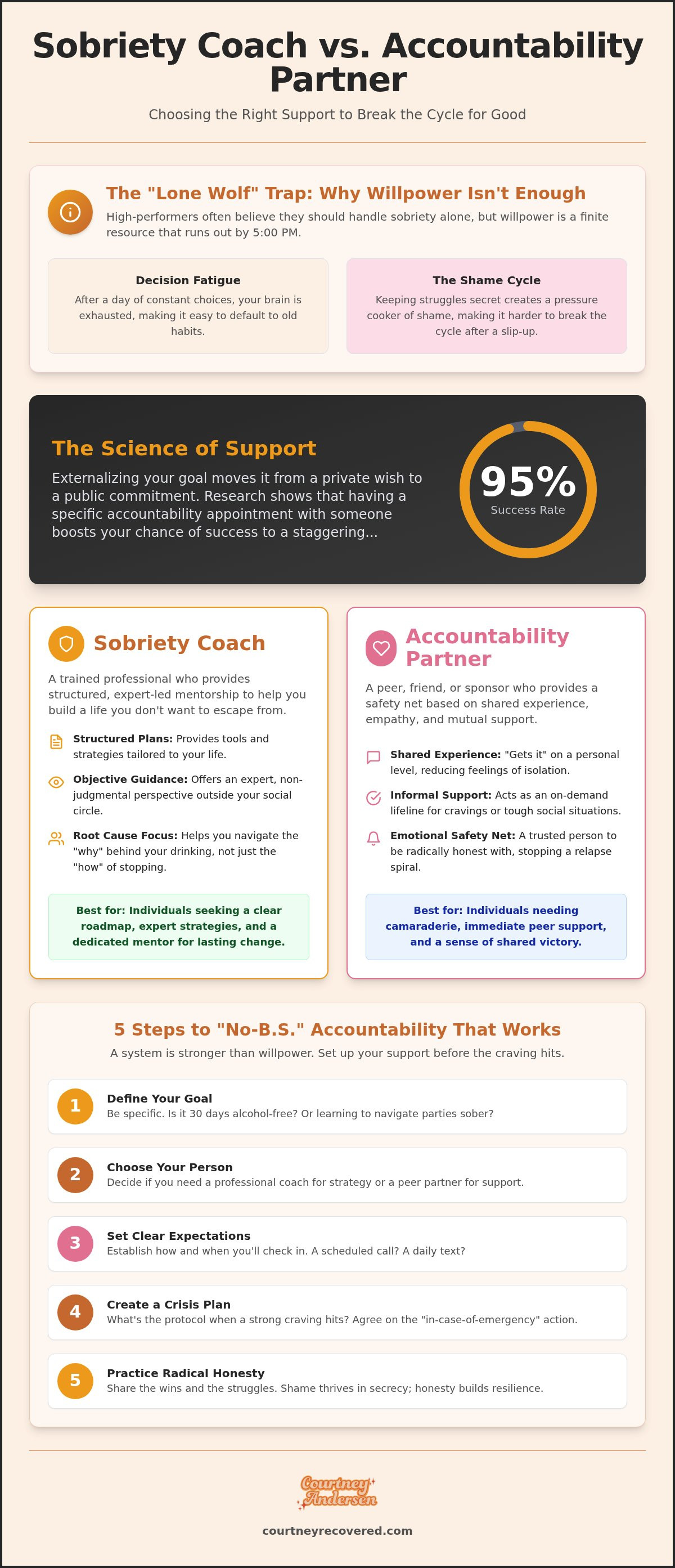
- Weigh the pros and cons of a sobriety coach vs. an accountability partner to decide if you need professional mentorship or a peer-led safety net.
- Master a 5-step strategy for setting "No-B.S." boundaries that ensure your support system actually works when cravings hit at 5:00 PM.
- Discover how joining a community like the Sobriety Circle can replace recovery isolation with a vibrant, high-energy lifestyle.
Why Your "Lone Wolf" Sobriety Strategy is Keeping You Stuck
You're a powerhouse. You manage a career, a household, and a social calendar without breaking a sweat. So, why does that 5:00 PM glass of wine feel like the one thing you can't control? This is the "Lone Wolf" trap. High-performers often believe that because they are successful in every other area of life, they should "just know" how to stop drinking on their own. But sobriety isn't a project you can optimize with a spreadsheet and a little more grit. When you stop trying to be a Lone Wolf, you can start looking at whether a sobriety coach vs. an accountability partner is the missing piece of your puzzle.
Willpower is a finite resource. By the time you've navigated back-to-back meetings and a mountain of emails, your brain is fried. This is decision fatigue in action. When your mental tank is empty, your "f*ck it" button becomes very easy to press. Keeping your struggle a secret only adds to the pressure; it creates a pressure cooker of shame that makes the cycle even harder to break. While the traditional definition of sobriety often focuses on the absence of alcohol, we focus on the presence of a life you actually enjoy. Real strength lies in connection, not isolation.
The Gray Area Trap: Why "Functional" is a Dangerous Label
Being "functional" is one of the sneakiest hurdles to freedom. If you still have the job and the family, it's easy to tell yourself you're doing fine. But a massive gap exists between being "fine" and being truly free. If you spend your day negotiating with yourself about how much you'll drink tonight, your habit has become a burden. You can read more about this in our guide on Gray Area Drinking: When Your Habit Becomes a Burden. Real freedom means your brain isn't constantly running a background program about your next drink.
Willpower vs. Systems
Willpower is a feeling; a system is a fact. Accountability is a proactive agreement made before the craving hits, acting as an external safety net for your brain. When you have a person to check in with, you aren't relying on your exhausted 5:00 PM self to make a good choice. You're following a plan you made when you were clear-headed and strong. Transitioning from white-knuckling to a supported lifestyle changes everything. Understanding the roles of a sobriety coach vs. an accountability partner helps you build a system that actually holds up when life gets messy.
The Science of Support: Why Accountability Boosts Success by 95%
Research shows that having a specific accountability appointment with someone increases your chance of success to a staggering 95%. This isn't just a random number; it comes from social mirroring. When another person "seen" us, our brain treats our goals differently. We move from a private, internal negotiation to a public commitment. This externalization makes your sobriety "real" to your subconscious. Whether you choose a sobriety coach vs accountability partner, that human connection is what bridges the gap between a "wish" and a lifestyle.
You also get a massive dopamine hit when you celebrate small wins with someone who actually gets it. In the past, you might have rewarded a hard day with a drink. Now, you reward a hard day by checking in and being heard. This shift in brain chemistry is backed by clinical data on accountability, which proves that external support systems are vital for long-term behavior change. It turns your recovery into a shared victory rather than a lonely battle.
Breaking the Cycle of Shame
Shame thrives in the dark. When you try to do this alone, a slip-up feels like a catastrophe you have to hide. Radical honesty with one trusted person stops that relapse spiral before it starts. If you're at a high-risk social event, like a wedding or a work dinner, an immediate check-in can be the difference between a "Day 1" reset and a victory. Peer support is the ultimate antidote to the loneliness that often hits in early recovery. If you're feeling isolated, joining a community like the Sobriety Circle provides a ready-made safety net of people who speak your language.
Building Emotional Sobriety
Staying sober is about more than just "not drinking." It's about healing the root cause of why you wanted to escape in the first place. You're likely navigating an identity crisis as you figure out who you are without a glass in your hand. A partner helps you move through this transition without losing your mind. If you want a deep dive into your specific patterns, 1 on 1 Sobriety Coaching: Your Personalized Roadmap to a Vibrant, Alcohol-Free Life can help you fast-track that personal evolution. It's about moving from surviving to thriving.
Choosing Your Person: Friends, Sponsors, or a Professional Sober Coach?
You’ve decided you can’t be a Lone Wolf anymore. Great. Now, who do you call? Many people default to their best friend or partner. While their hearts are in the right place, this often backfires. A friend might unintentionally enable you because they don't want to "ruin the fun" or they feel guilty about their own drinking. When comparing a sobriety coach vs accountability partner, the difference often lies in the level of professional distance and specific expertise. You need someone who can call you out on your B.S. without it ruining Sunday dinner.
Finding your "person" is really about finding your vibe. You want someone who radiates the energy of a life you actually want to live. If the support feels heavy, somber, or restrictive, you probably won't stick with it. You aren't just looking for someone to help you avoid a hangover; you're looking for a mentor who celebrates a high-energy, vibrant life. Choose the person who makes sobriety feel like the ultimate upgrade, not a boring consolation prize.
Why Your Spouse Shouldn’t Be Your Only Accountability
Your spouse is your teammate, not your parole officer. Relying solely on them creates a "burden" factor that can strain even the best marriages. You might start hiding the truth from them because you don't want to see the disappointment in their eyes, which just leads right back to that secret shame cycle. They lack objectivity because they’re too close to the fire. Setting healthy boundaries means keeping your recovery support outside the home so your home remains a sanctuary, not a courtroom.
The Professional Edge of Coaching
Then there’s the traditional sponsor. While the 12-step model works for some, many professional women find the hierarchy and dogma a bit stifling. This is where professional 1:1 coaching shines. It’s the fast track for those who want results without the clinical atmosphere. A professional coach brings a structured roadmap to the table, using programs like Stop Starting Over to give you a clear path forward.
You have picked your person. Now, you need a system that actually holds up when the initial excitement wears off. Whether you are working with a sobriety coach vs accountability partner, the magic happens in the structure you build together. Accountability isn't about being "policed"; it is about creating a roadmap that makes your success inevitable. If you are ready to stop the "starting over" cycle, follow these five steps to set your support system on fire.
- Step 1: Define your "No-B.S." Rule. Give your partner explicit permission to call you out. If you start acting "squirrelly" or making excuses, they need to feel safe telling you the truth.
- Step 2: Set the rhythm. Decide how often you'll contact each other. Is it a 7:00 AM daily text or a weekly deep-dive call? Consistency beats intensity every single time.
- Step 3: Use your tools. Integrate a resource like the Sober Toolkit to track your progress. Having data to look at makes your growth feel tangible.
- Step 4: Establish the "SOS" protocol. Know exactly what to do when a craving hits. This is your fire extinguisher for high-stress moments.
- Step 5: Celebrate the gains. Don't just talk about the struggle. Spend time discussing "The After" life you are building and the vibrant person you are becoming.
Practical Check-In Scripts
One of the biggest hurdles is knowing what to say when things get tough. If you are at a wedding and the "just one" thought starts screaming, text your person immediately. Try this: "The 'just one' thought is loud right now. Remind me why I want the morning version of me more than this drink." If you slip up, radical honesty is your only way out. Instead of ghosting, text: "I had a drink. I feel like hiding, but I’m checking in instead. Help me get back on track." This level of transparency comes more easily when you connect with a Sober Community Online: Finding Your Vibe and Your People in 2026.
Using Daily Anchors
Your brain needs daily reminders of who you are becoming. Using the Sober Vibes Book as a daily anchor gives your accountability sessions focus. It helps you shift from a "restriction" mindset to a "growth" mindset. This is where the choice between a sobriety coach vs accountability partner matters; a coach often provides these specific frameworks to keep you moving forward. If you want to explore more ways to support your journey, check out The Best Sobriety Tools and Resources to Kickstart Your Alcohol-Free Life in 2026. Ready to fast-track your freedom? Start your 1:1 journey today and build a life you don't need to escape.
Join the Sobriety Circle: Your Ready-Made Safety Net
You have done the research. You finally understand the nuances of a sobriety coach vs accountability partner. But what if you could have the best of both worlds in one high-energy, inclusive space? That is exactly why the Sobriety Circle exists. It is more than a membership; it is a ready-made safety net for women done with the somber, clinical vibes of traditional recovery. In the Circle, accountability isn't a chore. It is a collective energy that reminds you that you are never alone in this journey.
Group coaching removes the heavy stigma that often keeps us stuck in secret. When you see other successful, professional women navigating the same social anxieties and celebrating the same wins, the "fun" naturally comes back into your life. You stop being the "person who doesn't drink" and start being the person who is too busy living a vibrant life to care about a glass of wine. This community-centric approach bridges the gap between isolated struggle and a connected, alcohol-free reality. It is about moving from the exhausting "starting over" cycle into a lifestyle that feels like a massive gain.
Stop Starting Over and Start Living
The Stop Starting Over program is the backbone of our community strategy. It is specifically designed to identify the "glitches" in your system that keep you stuck in that frustrating relapse loop. We don't do "soft" here; we provide the tough-love realism required for lasting change. Professional coaching gives you the outside perspective to see patterns you've been blind to for years. I invite you to commit to your very last "Day 1" today and step into a structure that actually holds you up when life gets messy.
Build a Life You Don’t Need to Escape
The ultimate goal of this work isn't just a dry calendar or a count of days. It is emotional sobriety and authentic connection. We are building a reality where your joy doesn't depend on a bottle and your Tuesday nights feel just as vibrant as your Saturday nights used to. Learn more about this transition in our guide, Life After Sobriety: Build a Life You Don’t Need to Escape. Whether you need the deep dive of 1:1 mentorship or the collective power of a group, the roadmap is ready for you.
Ready for real accountability? Book your 1:1 session or join the Circle now!
Step Into Your Vibrant After
You have spent enough time stuck in the "starting over" loop. Choosing between a sobriety coach vs accountability partner is about more than just checking a box; it is about choosing a life that feels like a massive upgrade. We have seen over 100 women find their footing in the Sobriety Circle by trading the "Lone Wolf" trap for a community that actually gets it. You now know that willpower is a finite resource, but the right system is a renewable energy source for your freedom. Whether you need the deep, structured mentorship of professional coaching or the collective power of a circle, you don't have to white-knuckle this alone anymore.
As the author of the Sober Vibes Book, I have seen firsthand how radical honesty and the right support can turn a somber struggle into a high-energy celebration. Your future self is waiting for you to make this move. It is time to stop the Monday morning resets and start living a life you don't need to escape. Ready to stop starting over? Join the Sobriety Circle or book your 1:1 coaching session today! You have everything it takes to make this your last "Day 1."
Frequently Asked Questions
What is an accountability partner for sobriety?
An accountability partner is a peer who provides mutual support and keeps you honest about your recovery goals. Unlike a professional mentor, this is usually a reciprocal relationship where you both check in daily or weekly. It is a low-pressure way to ensure you aren't doing this alone. While helpful, it lacks the professional framework found when comparing a sobriety coach vs accountability partner, as peers are often navigating the same early hurdles you are.
How is a sobriety coach different from an AA sponsor?
A sobriety coach is a professional mentor who provides a structured, lifestyle-oriented roadmap, whereas a sponsor focuses on 12-step dogma and hierarchy. Coaching with Courtney Recovered is non-clinical and celebratory, focusing on building a vibrant life rather than just avoiding a drink. We use tools like the Sober Toolkit to create measurable progress. Sponsors are volunteers, but a coach is an investment in your personal evolution and your long-term life in "The After."
Can my husband or wife be my sobriety accountability partner?
While your spouse is your biggest cheerleader, they shouldn't be your primary accountability source. Relying on a partner often creates a heavy "burden" that can lead you to hide the truth to avoid causing them pain. They lack the objectivity needed to call you out on your excuses without it sparking a domestic argument. It is much healthier to keep your recovery support external so your marriage remains a sanctuary of authentic connection and joy.
What should I do if I relapse while I have an accountability partner?
Practice radical honesty immediately instead of ghosting or hiding in shame. A relapse is often just a data point showing a glitch in your current system that needs fixing. Reach out to your partner and say, "I had a drink, and I need help getting back on track." This is where programs like Stop Starting Over come in, because they help you identify why the loop happened so you can finally break the cycle for good.
How often should I check in with my sober accountability partner?
Consistency beats intensity, so aim for a daily morning text to set your intention for the day. Many successful women in the Sobriety Circle also schedule a weekly deep-dive call to discuss challenges and celebrate wins. The frequency depends on your current stress levels; during high-risk events like weddings, you might check in multiple times an hour. The key is to establish a rhythm that feels supportive, not like a chore.
Do I really need an accountability partner if I only drink on weekends?
Yes, because weekend-only drinking often signals a "gray area" habit that is still draining your mental energy throughout the week. If you spend your Monday through Thursday negotiating with yourself about Friday night, you aren't truly free. Having a partner helps you navigate the social pressure of weekend gatherings and breaks the cycle of Monday morning regret. It is about reclaiming your weekends for high-energy activities instead of wasting them on a hangover.
What are the best digital tools for sober accountability in 2026?
The most effective tools combine progress tracking with immediate community connection. We recommend using the Sober Toolkit for daily monitoring and the Sobriety Circle for real-time peer support. Digital platforms allow you to access a global network of women who understand the specific nuances of professional life without booze. These tools turn your phone into a safety net, giving you practical resources to handle social anxiety or cravings the moment they strike.
How do I find a sober accountability partner who understands gray area drinking?
Look for spaces specifically designed for professional women, such as the Sobriety Circle. You want a partner who doesn't just focus on "rock bottom" stories but understands the subtle burden of functional drinking. When deciding between a sobriety coach vs accountability partner, a coach can often match you with peers who share your lifestyle. This ensures your support system celebrates the same vibrant goals and understands the specific social pressures you face daily.
I want you to feel sober NOT boring!
Kickstart your sobriety with my free 2-day video workshop series to master your sober mindset and have FUN in your sobriety journey!


