
Sobriety and Relationships: How to Navigate Connection Without the Cocktails
Aug 14, 2026
What if that cocktail in your hand is actually the wall keeping you from the deep, soul-level connection you're craving? It is a terrifying thought. You worry that without the "liquid courage," you'll be the boring one at the party or that your partner won't recognize the person you're becoming. Maybe you're already feeling that sharp edge of resentment when they pour another glass; perhaps those old codependent habits are finally surfacing now that the alcohol isn't there to mask them. Mastering sobriety and relationships can feel like trying to dance without music at first, even though Gallup reports that only 54% of Americans are still drinking, the lowest number since 1939.
But here is the truth: sobriety doesn't kill your spark; it just burns away the fake stuff so you can build something real. You'll discover exactly how to rebuild trust, set firm boundaries, and find your tribe while handling the messy, beautiful reality of your new life. We are diving into how you can rebuild intimacy without the booze, feel total confidence saying "no" to a drink, and find a community that truly understands your journey. You don't have to do this alone, and you definitely don't have to be boring to be loved.
Key Takeaways
- Learn how to navigate the massive identity shift that comes with quitting drinking so you can show up as your most authentic self.
- Discover the truth behind the "no dating for a year" rule and how to avoid swapping the bottle for a new romance.
- Find out how to rebuild trust and intimacy within sobriety and relationships even when the weight of the past feels heavy.
- Get practical tools for setting boundaries at social events like weddings and happy hours without ever feeling like a buzzkill.
- Learn why finding a sober community is essential for your growth and how to build a tribe that understands your journey without explanation.
Why Sobriety Changes Every Relationship You Have (And Why That’s a Good Thing)
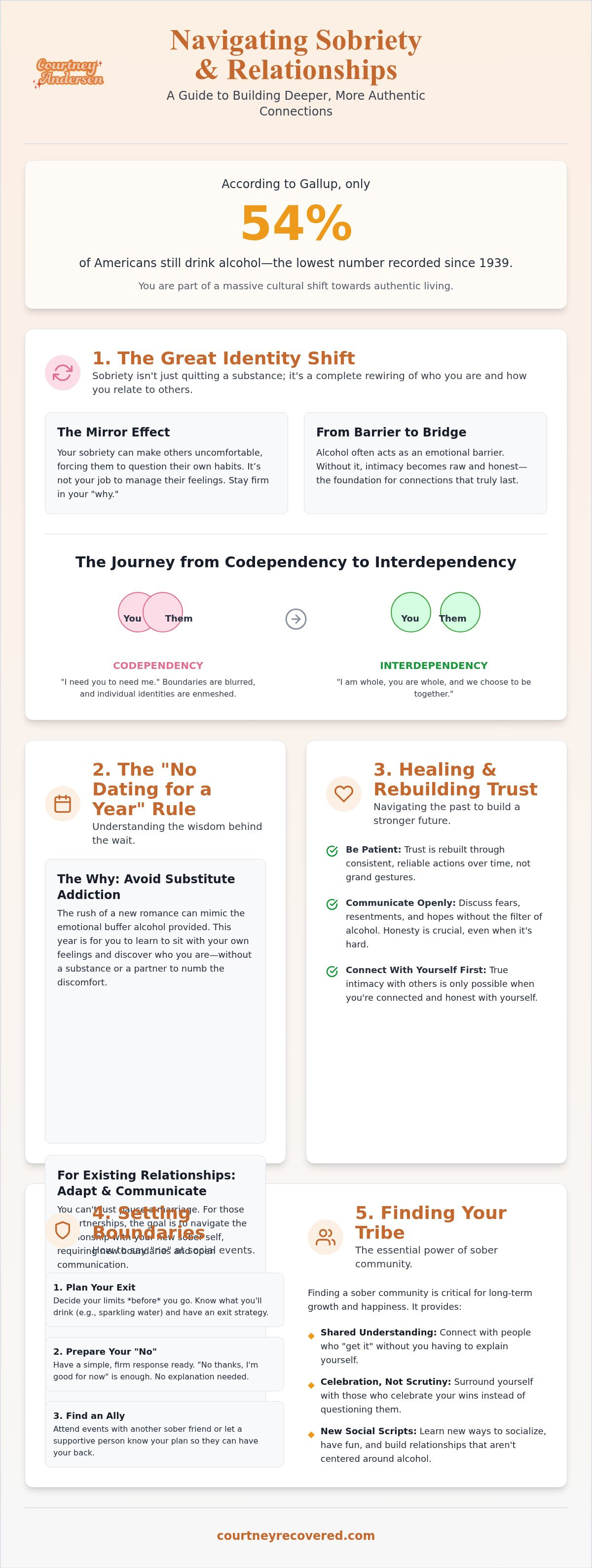
Sobriety is a total identity shift. It is not just about swapping your evening Chardonnay for a sparkling water; it is a complete rewiring of how you show up in the world. When you change your internal landscape, everyone in your life has to adjust to the new view. This is why sobriety and relationships are so deeply intertwined. You cannot change the lead actor in the play and expect the rest of the cast to keep following the old script. The definition of sobriety is often framed as simple abstinence, but for us, it is about finally becoming present enough to actually experience the people we love.
Early on, you might hit what we call the "Pink Cloud" phase. Everything feels electric, and you're suddenly convinced you can fix every broken dynamic in your life overnight. You're high on life, but be careful. That cloud eventually drifts, and you might feel a bit of a crash when you realize your partner or friends haven't undergone the same radical transformation you have. Relationship sobriety is the process of reconnecting with yourself first so you can eventually connect with others from a place of wholeness.
We are often told that alcohol is a social lubricant. In reality, it is usually an emotional barrier. It acts as a fuzzy filter that keeps you from feeling the sting of a lonely conversation or the heat of a real argument. Without that buffer, intimacy gets raw and honest. It can be uncomfortable at first, but it is the only way to build a connection that actually lasts. If you're feeling overwhelmed by these shifts, 1:1 Sobriety Coaching can provide the personalized roadmap you need to handle these changes without losing your mind.
The Mirror Effect: Why Your Sobriety Makes Others Uncomfortable
Your new lifestyle acts like a giant, neon mirror. When you stop drinking, people who are still in that "gray area" habit start questioning their own nightly bottle. They might try "sober-shaming" you or telling you that "you weren't even that bad" just to make themselves feel better about their own choices. It is not your job to make them comfortable with your growth. Stay firm in your "why." If your social circle starts to feel a bit thin, the Sobriety Circle is the perfect place to find women who celebrate your wins instead of questioning them.
From Codependency to Interdependency
Many of us used alcohol to tolerate codependent habits for years. We were the "fixers" or the "people-pleasers" who stayed quiet to keep the peace. Sobriety forces you to meet your own emotional needs instead of looking for a partner to fill your cup. It is the move from codependency (I need you to need me) to interdependence (I am whole, you are whole, and we choose to be together). This shift is the secret sauce for long-term relationship health and true emotional sobriety.
The 'No Dating for a Year' Rule: Myth vs. Reality
You have heard it a million times in recovery circles: "Don't get into a relationship for the first year." It sounds like a prison sentence, but there is a method to the madness. In the First Year of Sobriety: What to Expect on Your Journey to 365 Days, you are basically an emotional toddler learning to walk again. Swapping the bottle for a new boyfriend is a classic substitute addiction. It is incredibly tempting to use the rush of a new romance to numb the discomfort of early sobriety, but you are just trading one buffer for another. You need this time to figure out who you are without the haze before you try to merge your life with someone else's chaos.
However, this "rule" often ignores the reality of women who are already married or in long-term partnerships. You cannot just pause your life or kick your partner out for 365 days. The dynamic of sobriety and relationships becomes much more complex when you are sharing a kitchen with someone who still drinks. It is about finding the balance between staying put and starting fresh, knowing that your growth might create some necessary friction. If you are feeling stuck in the middle, my 1:1 Sobriety Coaching offers a personalized roadmap to help you navigate these tricky waters.
Navigating an Existing Marriage or Partnership
If your husband still drinks, you need "house rules" to protect your peace of mind. Maybe the alcohol stays in a locked cabinet, or you ask him not to drink around you for the first few months. Research shows the deep impacts of addiction on relationships, and healing takes serious intentionality. When you are sober and handling the "how not to hate your husband after kids" grind, the irritation can feel amplified. You need separate hobbies and your own support systems to stay grounded.
The 90-Day Reset: Why You Need a Relationship Sabbatical
Think of Day 1 through Day 90 as a period of internal discovery. You don't necessarily need to leave your partner, but you do need a mental sabbatical. Communicate your needs clearly: "It is not you, it is my recovery." This isn't the time to file for divorce, move across the country, or quit your job. Your brain is still recalibrating its chemistry. Give yourself three months of focusing entirely on your own needs before making any major life decisions. Use the tools in the Sober Toolkit to manage the daily cravings while you navigate this high-stakes reset.
Healing the Connection: Rebuilding Trust and Navigating Resentment
Trust is built in drops and lost in buckets. That is the cold, hard truth of sobriety and relationships. When you finally put down the glass, you might expect a standing ovation, but your partner is often still standing in the wreckage of the past. We call this "The After." It is that heavy, awkward space where you are doing the work, but the ghost of who you were still haunts the living room. You cannot fix years of broken promises with one grand apology or a bouquet of flowers. Healing happens in the boring, everyday moments where you actually do what you said you were going to do.
You might notice your partner getting "detective-y" lately. They might check your eyes when you walk through the door or sniff the air when you lean in for a hug. It is incredibly frustrating to feel like you are still on probation when you are working so hard. But remember, they're protecting their heart from another bucket-sized loss. Instead of getting defensive, try acknowledging the fear. A simple, "I know I broke your trust, and I'm here to earn it back," can take the power out of their suspicion and put you both on the same team again.
Moving Past Resentment (On Both Sides)
Resentment is a two-way street that can easily become a dead end. You might feel a sharp edge of resentment toward them for still drinking or for not "getting" how much effort it takes to stay sober. Meanwhile, they might still be carrying heat from the times you weren't present. Use the strategies in the Sober Toolkit to manage your triggers during those heated Tuesday night arguments. If the resentment feels like a brick wall you can't climb, 1:1 Sobriety Coaching provides the personalized roadmap you need to dismantle those old patterns and start fresh.
Re-learning Intimacy Without the Wine
Let's talk about the elephant in the room: sober sex. It is terrifying at first because the "liquid courage" is gone and you are actually, fully there. No wine to blur the edges or lower your inhibitions. This requires a brand new level of vulnerability and "Emotional Sobriety" in the bedroom. You have to learn to communicate your needs with words instead of hiding behind a buzz. Start by finding new date night rituals that don't revolve around a bar stool. Try a late-night hike, a comedy show, or a mocktail tasting at home. When you remove the alcohol, you finally make room for a connection that is actually real.
Setting Boundaries Without Being a 'Buzzkill'
When you first start managing sobriety and relationships, the word "boundary" can feel like a dirty word. You worry that saying "no" to the annual wine tour or the neighborhood pub crawl will officially crown you the local buzzkill. Let's flip that script. Boundaries aren't a punishment for the people around you; they are a massive act of self-love that allows you to stay connected without relapsing. If you don't protect your peace, nobody else will do it for you. You have to be the one to draw the line in the sand.
Identifying your hard nos is the first step to staying grounded. If a wedding feels like a trigger minefield, it is okay to skip the reception or leave right after the cake is cut. You're allowed to say no to specific people who only ever want to talk about their latest hangover. Learning to handle the "Why aren't you drinking?" question with total confidence is a superpower that takes practice. If you need help finding that voice and building your confidence, 1-on-1 Sobriety Coaching: Your Personalized Roadmap to a Vibrant, Alcohol-Free Life can help you build the strength to stand your ground.
Scripts for Social Situations
You don't owe anyone a medical history or a deep confession at a party. For casual acquaintances, keep it short and sweet: "I'm not drinking tonight, but I'll take a ginger ale." If they push, a simple "I feel so much better when I don't" usually shuts down the conversation. For close friends and family, you can try the deep and honest approach: "I've decided to quit because it wasn't making me happy anymore, and I'd love your support in this." When the "witching hour" hits, usually around 9:00 PM when the music gets louder and the conversations get sloppier, give yourself permission to vanish. The Irish goodbye is a sober person's best friend.
Protecting Your Peace at Home
Your home should be your sanctuary, not a place where you're constantly dodging triggers. Some women need a strictly dry house to feel safe, while others are okay with a partner having a drink as long as it's not "in their face." Be clear about what you need to feel secure. This might mean setting boundaries around "drinking talk" or simply opting out of alcohol-centric events hosted at your place. If someone crosses a boundary, have a Sober Accountability plan ready. This could be a quick text to a mentor or a check-in with your community. To start building your own support system, join the Sobriety Circle and find women who truly get it.
Finding Your New Tribe: The Power of Sober Community
You have probably heard the saying that you can't heal in the same environment that made you sick. In the context of sobriety and relationships, this is your new North Star. If your entire social life was built on a foundation of happy hours and wine nights, those foundations are going to crack. It is not because those people are "bad," but because they are part of a version of you that no longer exists. Trying to stay sober while surrounded by people who miss the "fun" version of you is like trying to run a marathon with your shoelaces tied together. It is frustrating, exhausting, and usually ends in a fall.
This leads many women straight into the "Sober and Lonely" trap. It is that awkward middle ground where you have left the bar scene behind but haven't yet found the people who get why you are excited about a 7:00 AM Saturday morning hike. You need a tribe that understands the nuances of sobriety and relationships without you having to explain yourself every five minutes. You need people who celebrate your "day 100" with more enthusiasm than they ever did for your birthday. This is why the Sobriety Circle exists. It is a vibrant, high-energy alternative to those sterile, clinical groups that make recovery feel like a chore. We are here to build a life we actually love, not just one we "manage."
The Difference Between a 'Drinking Buddy' and a Friend
It is time for an honest circle audit. A drinking buddy is someone you only see with a glass in your hand. If you remove the alcohol and the conversation dies, the connection wasn't that deep. Real friends are the ones who support your growth, even if it makes them look at their own habits. Making new friends as an adult woman is intimidating, but it is much easier when you are looking in the right places. If you feel lost in the shuffle, 1:1 Sobriety Coaching acts as your personalized roadmap. Think of it as a mentor who provides nonjudgmental accountability as you navigate the social awkwardness of your new life.
Next Steps: Join the Sobriety Circle
The Sobriety Circle is more than just a support group; it is a safe space for relationship venting and massive wins. Whether you are dealing with a partner who still drinks or you are navigating the dating world for the first time without a buffer, we have your back. You can also grab the Sober Vibes Book for that daily dose of inspiration when things feel heavy. Stop trying to survive "The After" on your own. Join the community that celebrates your vibrant, sober life and start building a reality you don't want to escape from. You've stopped starting over; now it is time to actually live.
Step Into Your Most Authentic Life
You've traded the fuzzy, filtered mask of alcohol for something much better: the truth. Navigating sobriety and relationships is a wild, messy, and ultimately gorgeous ride. You've learned that trust is built in drops, that boundaries are a form of deep self-love, and that your real tribe is out there waiting for you. This isn't about what you're losing; it is about every single thing you're gaining. You are finally present enough to experience the connections you've always craved.
You deserve a support system that feels like a celebration, not a clinical chore. Between the daily inspiration in my "Sober Vibes" book and our community-led support for women, we offer a non-clinical, empowering approach to your new life. You don't have to figure out "The After" on your own. You have the tools, the roadmap, and a community of women who have walked this path before you.
Ready to build a life you love? Join the Sobriety Circle today!
Your vibrant, alcohol-free life is just getting started. Keep showing up, keep setting those boundaries, and keep choosing yourself. We're all rooting for you, and we can't wait to see you shine.
Frequently Asked Questions
Should I break up with my partner if they won't stop drinking?
Not necessarily, but you must prioritize your own recovery above everything else. It depends on whether they respect your boundaries and if your home remains a safe space for your new lifestyle. If their drinking constantly triggers you or leads to a toxic environment, you might need to re-evaluate the partnership. You can't force them to change, but you can choose what you are willing to tolerate.
How do I tell my friends I'm sober without making it awkward?
Be direct and keep it light to set the tone for the rest of the conversation. You don't need a long, somber speech; just say "I'm not drinking these days because I feel so much better without it." If you act like it is a positive lifestyle choice rather than a restrictive loss, your friends will usually follow your lead. Most people are actually less interested in your glass than you think.
Is it normal to feel lonely in early sobriety even if I have a partner?
Yes, it is completely normal to feel a sense of isolation as you navigate sobriety and relationships without your old coping mechanisms. You are processing raw emotions for the first time in a long time, and your partner might not fully understand the massive internal shift you are experiencing. This is why finding a community of women who truly get it is so vital for your mental health.
Can a relationship survive if only one person gets sober?
Absolutely, but it requires a lot of honest communication and new "house rules" to keep things balanced. The relationship will naturally evolve as you change, and the other person needs to be willing to support your new path even if they don't join you in abstinence. It works best when both people are committed to growing individually while respecting the new boundaries you have put in place.
What should I do if my partner doesn't take my sobriety seriously?
Sit them down for a serious conversation about why this change is non-negotiable for your future. If they continue to push drinks on you or mock your choice, they are showing a lack of respect for your well-being. You might need to seek outside support to help you navigate these difficult dynamics. Your sobriety is your priority, and anyone who loves you should eventually want to protect that with you.
How long should I wait before I start dating again in recovery?
Many people suggest waiting a full year, but the real answer depends on your own emotional stability. You want to make sure you aren't just using a new romance as a high-speed substitute for your old drinking habits. Give yourself enough time to feel solid in your own skin before trying to merge your life with someone else's world. Your first relationship in recovery should be with yourself.
What is the '13th step' and why should I avoid it?
The "13th step" happens when someone with more time in recovery tries to date a newcomer in a support group. It is often predatory and can be incredibly dangerous because it takes advantage of someone in a very vulnerable state. Avoid it at all costs to keep your focus on your own healing, not a messy, high-stakes distraction that could lead you back to a drink.
How do I deal with social anxiety in relationships now that I'm sober?
Start small by practicing social interactions in low-stakes environments like morning coffee dates or afternoon walks. You have to learn how to manage your nerves without the "liquid courage" buffer you used for years. Over time, your confidence in sobriety and relationships will grow as you realize that you are enough exactly as you are. You don't need a drink to be interesting, funny, or lovable.
I want you to feel sober NOT boring!
Kickstart your sobriety with my free 2-day video workshop series to master your sober mindset and have FUN in your sobriety journey!


