
Sobriety Accountability Tools: Your 2026 Guide to Staying Sober and Vibrantly Connected
Sep 18, 2026
Willpower is a total lie. If white-knuckling your way through a bachelorette party or a high-stakes work dinner feels like an exhausting chore, it's because you're treating your freedom like a prison sentence. You've likely felt that crushing weight of "starting over" every Monday morning, wondering why you can't just make it stick. It's not that you're weak; it's just that you're lacking the right sobriety accountability tools to turn your recovery into a celebration. You deserve a life that feels like a massive upgrade, not a restrictive loss.
I know exactly how it feels to worry that being sober means becoming the "boring" friend who stays home. I promise you that the opposite is true. We're going to dive into the high-energy, non-clinical systems that keep you connected and confident in any social setting. This 2026 guide previews the best apps, communities, and personal strategies that move you past the struggle phase and into a reality where you're vibrantly present. Let's look at how to build a scaffolding of support that makes your alcohol-free life the most exciting thing about you.
Key Takeaways
- Stop relying on willpower alone and start using a proactive system that treats sobriety as a lifestyle upgrade rather than a chore.
- Learn how to combine digital micro-wins with deep human connection using modern sobriety accountability tools that actually fit your high-energy lifestyle.
- Discover the latest 2026 wearable tech and monitoring systems to help you navigate work events and bachelorette parties with total confidence.
- Audit your specific triggers to build a customized daily routine that anchors your morning and evening for long-term, vibrant success.
- Unlock the "secret weapon" of community and professional coaching to move from feeling isolated to being vibrantly connected in a space that truly gets it.
Why Willpower is a Liar (and Why You Need Accountability Tools)
Let's be real. If willpower was the only thing you needed to stop drinking, you would have done it years ago. You're a high-achiever. You crush your fitness goals, lead teams, and manage a chaotic household with grace. Yet, when 5:00 PM hits, that "just one glass" often turns into a bottle. This isn't a character flaw; it's the Willpower Gap. Willpower is a finite resource that drains with every hard decision you make at work. By the time you're staring at a wine menu, your mental battery is at zero.
Instead of relying on a broken battery, you need a proactive system. Real accountability isn't a reactive punishment for a slip-up. It's a strategy that prevents the slip-up in the first place. While the traditional definition of What is Sobriety? focuses on the absence of substances, I want you to focus on the presence of joy. We're shifting the goal from "staying out of trouble" to building a life so vibrant you actually want to be present for it. Using sobriety accountability tools turns this process from a chore into a lifestyle upgrade.
The Myth of the Lone Wolf
You might think you can handle this alone because you handle everything else alone. That’s a dangerous trap. Professional success often masks a total lack of personal accountability. When you're the one in charge of everyone else, who's looking out for you? The psychological relief of handing over the "policing" to a coach or a group is life-changing. It stops being a battle of "I have to stay sober" and becomes a celebration of "I get to be free." Doing it alone is the slowest, most painful way to recover.
Willpower vs. Systems
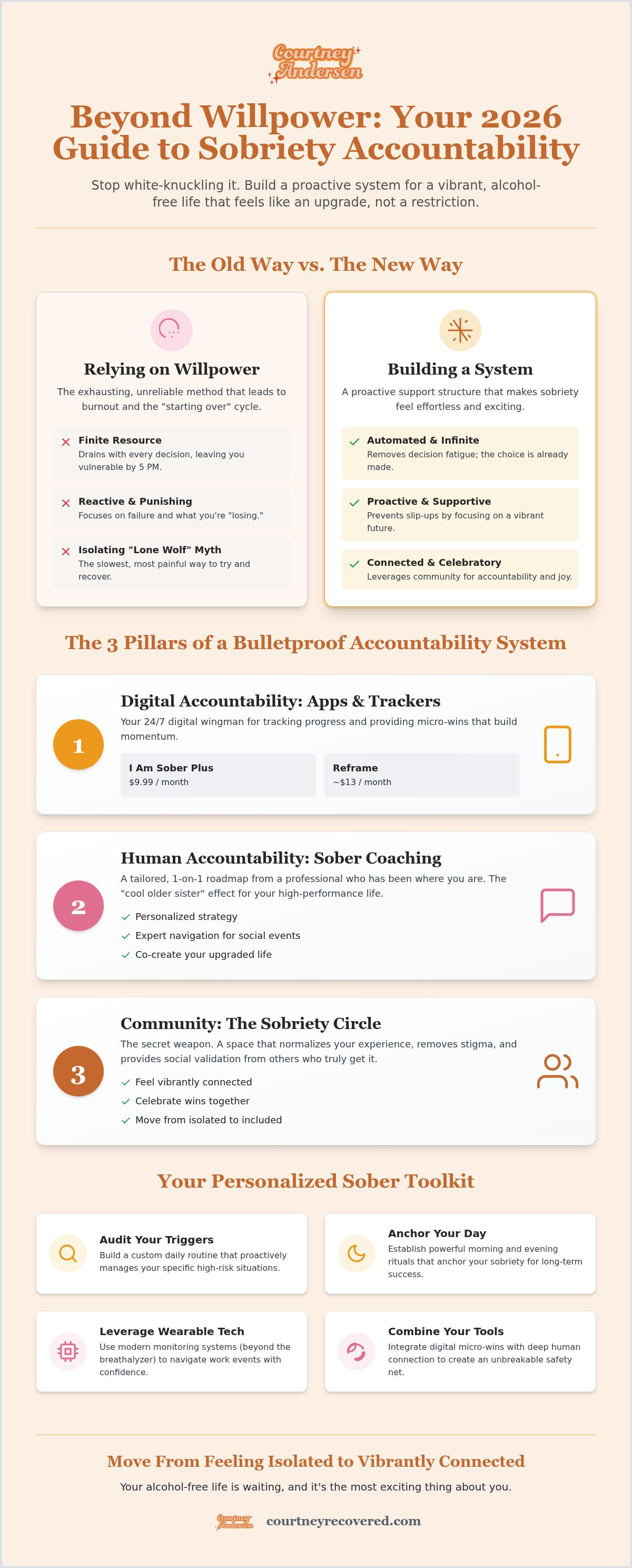
Systems are automated and infinite, while willpower is shaky and unreliable. Every time you have to decide not to drink, you're experiencing decision fatigue. Modern sobriety accountability tools take that weight off your shoulders. With a tracker, a coach, or a community check-in, the decision is already made. You don't have to debate with yourself at the end of a long day because your system runs in the background. Accountability Scaffolding is the support structure for early sobriety. It holds you up while you're still finding your footing, making sure your new lifestyle sticks without the constant mental exhaustion.
The 3 Pillars of a Bulletproof Accountability System
Building a life you love requires more than just a "no thank you" at happy hour. It takes a system. In 2026, the gold standard for success is a hybrid approach. This means you aren't just relying on one thing; you're stacking your deck. According to the HHS definition of recovery, this process is highly personal and involves various support systems. By layering digital tools, human connection, and community, you create a safety net that catches you before you even think about reaching for a drink. These sobriety accountability tools work together to turn your new lifestyle from a fragile hope into an unbreakable reality.
Digital Accountability: Apps and Trackers
Think of apps as your 24/7 digital wingman. Tools like I Am Sober Plus, which costs $9.99 per month, or Reframe, at approximately $13 per month, provide micro-wins that keep your momentum high. They gamify the process, turning days of sobriety into milestones you actually want to reach. Your brain loves to ignore progress when things get tough, but data-driven trackers show you the cold, hard proof of your evolution. Whether you're tracking money saved or viewing health improvements in real time, these tools remove guesswork and decision fatigue. You can see the physical and financial gains of your choice every time you unlock your phone.
Human Accountability: The Power of a Sober Coach
While apps are great for data, they can't give you a pep talk at 9:00 PM on a Friday. That is where 1 on 1 sobriety coaching changes the game. Unlike a traditional sponsor who might focus on a rigid set of steps, a professional coach provides a tailored roadmap designed for your specific, high-performance life. It is the "Cool Older Sister" effect. You get mentorship from someone who has been exactly where you are and knows how to navigate a boardroom or a beach vacation without a cocktail. You aren't just following a generic program; you're co-creating a life that feels like an upgrade.
The final piece of the puzzle is community. The Sobriety Circle offers the social validation that keeps you from feeling like the "odd one out" in your social group. When you see other women thriving and celebrating their wins, it normalizes your experience and removes the stigma. If you're feeling ready to stop the cycle of starting over, investigating a professional partnership is the smartest move you can make. Combining these three pillars ensures that your sobriety isn't just a phase. It's the foundation of your most vibrant, connected self.
Beyond the Breathalyzer: Modern Tech Tools for 2026
The landscape of staying alcohol-free has shifted away from sterile, clinical environments and into our pockets and onto our wrists. In 2026, the most effective sobriety accountability tools blend seamlessly into your high-vibe lifestyle. You don't need a clunky device that screams "I'm in recovery" during a lunch meeting. Instead, we're seeing a rise in sophisticated tech that prioritizes discretion and data. Even the DEA's list of recovery tools now recognizes the power of digital resources in maintaining long-term success. It's about using technology to support your evolution, not to police your every move.
Wearables and Biofeedback
Your smartwatch is doing more than just counting steps; it's revealing the "Dopamine Reset" happening in your brain. By monitoring Sleep Scores and Heart Rate Variability (HRV), you get a front-row seat to your body’s healing process. When you see your resting heart rate drop and your deep sleep cycles double after just two weeks of sobriety, it gives you a hit of motivation no lecture ever could. Biofeedback acts as an internal accountability tool by giving you real-time data on how your body reacts to stress and cravings without the need for an external monitor. It turns your physical health into a game you’re finally winning.
Discreet Tools for the Professional World
For the woman navigating a boardroom or a high-pressure industry event, privacy is everything. You need tools that act as a "sober shield" without drawing unwanted questions. Remote breathalyzers like BACtrack View, which costs between $79.99 and $129.99 per month, offer police-grade accuracy with a sleek app interface. While these are incredibly helpful for rebuilding trust with a partner or yourself, they can feel a bit clinical for some. If you prefer something softer, digital templates and scripts for saying no to alcohol socially allow you to have an exit strategy ready before you even walk through the door.
Modern social apps like Loosid are also changing the game by helping you find local, alcohol-free events that don't revolve around a bar scene. Whether you're looking for a sober hiking group or a sophisticated mocktail tasting, these platforms ensure you stay connected without the pressure to drink. In 2026, your phone isn't just a communication device; it's a personalized sobriety accountability tools hub that keeps you anchored in your goals while you’re out living your best life. You choose the level of monitoring that feels empowering, keeping your journey your business.
Building Your Personalized 'Sober Toolkit'
You wouldn't build a house without a blueprint, and you shouldn't try to build a vibrant, alcohol-free life without a plan. A generic list of hobbies isn't enough to keep you grounded when life gets loud. You need a customized set of sobriety accountability tools that act as your personal armor. This isn't about restriction; it's about preparation. By auditing your physical, emotional, and social triggers, you can see exactly where your defenses need a boost. Once you know your weak spots, you can build a protocol that makes saying "no" the easiest decision of your day.
The Daily Reset: Morning and Night Rituals
The first 15 minutes of your day matter most. If you wake up and immediately scroll through stressful emails, you're already draining your willpower battery. Instead, use a resource like the Sober Vibes book as a daily grounding tool to set your intention. This morning anchor keeps your goals front and center before the world starts making demands. At night, closing the loop is just as vital. A quick reflection on your wins and challenges helps you process the day so you don't carry that stress into tomorrow. These rituals are the bookends that keep your sobriety from feeling like a balancing act.
Breaking the Relapse Cycle
We've all been there: the "day one" that happens every single Monday morning. It's time to adopt the Stop Starting Over mindset. If you slip up, don't just wallow in shame. Use it. A "Relapse Autopsy" is one of the most powerful sobriety accountability tools in your kit. It involves looking at exactly what happened without judgment so you can build a better system for next time. You're transitioning from the survival mode of early recovery into "The After," where your systems run on autopilot. This is where you move from white-knuckling to actually loving your lifestyle.
Your toolkit needs an emergency protocol for when cravings hit hard. Whether it's a specific person you call or a physical activity that resets your nervous system, have it written down. Finally, commit to a container that holds you high. Whether that's a community that "gets it" or specialized coaching, having a structure is the ultimate insurance policy. If you're ready to stop the cycle for good, investing in a proven system is the fastest way to find your footing. You deserve a life that feels like an upgrade, and it starts with the tools you choose today.
The Ultimate Tool: The Sobriety Circle and Professional Coaching
Apps, wearables, and biofeedback data are fantastic for tracking your progress, but they can't give you a pep talk when you're feeling shaky before a holiday party. When we talk about the most powerful sobriety accountability tools, we mean human connection. Specifically, connection with people who truly get it. There is a massive difference between a generic support group and a high-vibe community designed for women who want to thrive, not just survive. This is where you move from the isolation of being sober and lonely into a space where your alcohol-free life is celebrated as the massive upgrade it truly is.
It is also vital to understand the difference between "support" and "professional accountability." Support is the friend who listens to you vent after a long day. Professional accountability is the coach who provides the framework to ensure that a bad day doesn't turn into a relapse. It’s the difference between having a cheerleader and having a personal trainer. Both have value, but only one provides the structured roadmap and "tough love" realism needed to change your life for good. By investing in a professional container, you are telling yourself that your freedom is worth more than the price of a few bottles of wine.
Finding Your Vibe in the Sobriety Circle
The Sobriety Circle isn't just another forum; it's a 24/7 safety net for your vibrant life. Imagine having a digital room full of women who are navigating bachelorette parties, career promotions, and parenting stress without a glass of Chardonnay. You get real-time accountability through group calls and community connection that normalizes your experience and removes the stigma. Plus, you gain access to exclusive resources like the Sober Toolkit and specialized programs. Seeing other women thrive is the "secret weapon" that makes you realize you aren't missing out on anything. You're finally opting in to your real life.
Why 1:1 Coaching is the Final Piece
If the community is your safety net, then 1:1 coaching is your personalized engine. While group support is vital, a coach provides the deep, tailored mentorship needed for life after getting sober. This is about more than just putting down the glass. It’s about the massive identity shift that happens when you realize you’re a powerhouse who doesn't need liquid courage. We work on healing root causes, building emotional sobriety, and creating a reality you don't feel the need to escape. It is the highest form of sobriety accountability tools because it's built entirely around your goals, your schedule, and your specific triggers.
Ready to stop starting over? Book your 1:1 coaching session with Courtney today, and let's turn your sobriety into a celebratory lifestyle you actually love. You've spent enough time thinking about it; now it's time to start doing it with someone who has already walked the path and found the vibrant, connected reality waiting on the other side.
Claim Your Vibrant, Alcohol-Free Future
Your journey away from alcohol isn't about what you're giving up; it's about every single thing you're gaining. You've seen that willpower is a finite battery that eventually runs dry. By layering modern tech with deep human connection, you create a system that works even when you're exhausted. These sobriety accountability tools are your ticket to a life where you don't just survive the weekend; you actually enjoy it. You've got the roadmap now. It's time to take the first step toward a reality that feels like a massive upgrade.
Using the Stop Starting Over recovery methodology and the mentorship of a Professional Sober Coach, you can finally break the cycle of "Day One." You deserve a vibrant, non-clinical community that cheers for your wins and understands your struggles. Join the Sobriety Circle and build your vibrant, alcohol-free life today! Your most connected, confident, and joyful self is waiting on the other side of this decision. Let's make 2026 the year you finally stop white-knuckling and start truly living.
Frequently Asked Questions
What are the best sobriety accountability tools for beginners?
The best tools for beginners are low-pressure resources that provide immediate structure without feeling overwhelming. I recommend starting with a combination of digital and tangible items to build your foundation:
- The Sober Vibes book for daily grounding and intention setting.
- The Sober Toolkit for practical, hands-on recovery strategies.
- A simple tracker like Nomo or I Am Sober to visualize your micro-wins.
These entry points ensure you aren't doing the heavy lifting alone while you're still finding your footing.
Do I really need an accountability partner to stay sober?
You can technically start this journey alone, but a partner is the ultimate shortcut to long-term success. Human connection provides the "tough love" and shared experience that an app simply cannot replicate. Whether it is a professional coach or a peer from the Sobriety Circle, having someone to check in with removes the isolation of gray-area drinking. It turns your recovery into a shared celebration rather than a private battle of willpower.
How do sobriety apps actually help with alcohol cravings?
Sobriety apps act as a vital pattern interrupt during high-stress moments or social events. When a craving hits, opening a tracker like Reframe or Loosid forces your brain to engage with your long-term goals instead of your immediate impulses. These sobriety accountability tools often include community message boards or breathing exercises that help you ride out the wave. Seeing your "days sober" count increase in real-time also provides a hit of dopamine.
What is the difference between a sober coach and a sponsor?
A sober coach is a professional mentor who provides a tailored roadmap for your specific, high-performance lifestyle, whereas a sponsor typically guides you through a specific 12-step program. Coaching is non-clinical and focuses on personal evolution and identity shifts. It is a paid partnership that offers high-level accountability and strategic planning. Sponsors are peers who offer support based on their own recovery journey, often within a more traditional and rigid framework.
How can I stay accountable if I want to keep my sobriety private?
You can maintain total discretion by using sobriety accountability tools that live entirely on your phone or in private sessions. 1:1 Sobriety Coaching is a confidential space where you can do the deep work without anyone in your professional or social circle knowing. Discreet apps and wearable tech allow you to track your biofeedback and progress privately. You get all the benefits of a support system without making a public announcement.
Are there non-clinical sobriety tools for gray area drinkers?
Absolutely. Most modern tools are designed specifically for gray area drinkers who don't fit the clinical "alcoholic" label but want to change their relationship with alcohol. Programs like Stop Starting Over focus on lifestyle upgrades rather than medical interventions. These tools prioritize emotional sobriety and social confidence. They are perfect for high-performers who want to remove the "boring" stigma and embrace a life that feels more connected, energetic, and authentic.
What happens if I fail my accountability check-in?
If you miss a check-in or have a slip, we use it as valuable data through a "Relapse Autopsy." In a non-clinical setting, there is no room for shame or punishment. We look at the triggers and the timing to see where your system needs a boost. Failing a check-in is just a signal that your current scaffolding needs adjustment. It is an opportunity to refine your toolkit and move forward with more clarity.
Can community support replace professional coaching?
Community support and professional coaching serve different roles in your journey. A community like the Sobriety Circle provides 24/7 social validation and a sense of belonging among women who get it. Professional coaching, however, offers the personalized strategy and deep identity work required to heal root causes. While community is the safety net that keeps you from feeling lonely, coaching is the high-performance engine that drives your long-term transformation and ensures you never go back.
I want you to feel sober NOT boring!
Kickstart your sobriety with my free 2-day video workshop series to master your sober mindset and have FUN in your sobriety journey!


