
Sober Curious Resources: A No-Pressure 2026 Guide
Oct 21, 2026
What if you didn’t have to call yourself anything to get curious about your drinking? Maybe you’re wondering whether alcohol affects your sleep, mood, or weekends, but you’re not sure you want to make a big change. That in-between space is real, and resources for the sober curious can help you explore it without pushing you toward a label or a single “right” answer.
You don’t have to choose between ignoring your questions and committing to forever. Conflicting advice about moderation, abstinence, and recovery can make a small experiment feel complicated, especially when drinking is part of familiar routines or social plans. You can start by reflecting on when and why you drink, try an alcohol-free occasion if it feels appropriate, and notice what you learn.
This guide covers practical ways to explore, from books and reflection tools to community and personalized, non-clinical coaching. You’ll find ideas for handling social pressure, choosing support that fits your needs, and recognizing when it’s important to talk with a healthcare professional. No label required. Just honest information and room to decide what comes next.
Key Takeaways
- Sober curiosity starts with questions about alcohol, not a required label or permanent decision.
- Choose resources for the sober curious according to what you need: learning, reflection, connection, practical tools, or personalized guidance.
- Shape an alcohol-free experiment around a question that matters to you, then reflect on what you notice without treating the result as a diagnosis.
- Choose support that fits your next step, from peer community and non-clinical coaching to a conversation with a healthcare professional.
- Books, communities, and coaching can offer useful support, but they don’t replace medical care when it’s needed.
What does “sober curious” mean, and which resources can help?
You might be thinking, “I’m curious about drinking less, but does that mean I have to quit?” Not necessarily. Sober curiosity gives you room to examine alcohol’s place in your life before deciding whether you want anything to change. Start with a question, not a declaration. You might wonder why a drink feels automatic after work, or whether social plans would still feel enjoyable without one.
Sober curiosity is the intentional exploration of alcohol’s role in your life, without requiring a diagnosis, a label, or a predetermined outcome. The Sober curious movement has helped make that exploration more visible, but your experience doesn’t need to fit a trend or someone else’s story. Resources for the sober curious can offer prompts, information, and connection while leaving the decisions in your hands.
Exploring might mean noticing how drinking relates to your mood or routines, trying an alcohol-free evening, or deciding you’re content with your current choices. Curiosity isn’t a hidden promise to stop. It’s a chance to look honestly at what’s working and what isn’t, then choose your next step with more awareness.
Is sober curiosity the same as getting sober?
No. Curiosity is a way of exploring. Getting sober may describe a choice someone makes, but it isn’t the required destination. A personal experiment, such as noticing how you feel on an evening without alcohol, also isn’t the same as a formal recovery or treatment program. Moderation, abstinence, and other forms of support can each be right for different people. There’s no one-size-fits-all answer.
Who might find sober-curious resources useful?
These resources may help if you’re questioning your drinking routines, alcohol’s role in social plans, its connection to your mood, or whether it fits your values. You don’t need to wait for a crisis to get curious. If your habits feel harder to change or more burdensome than you expected, explore gray area drinking and when habits feel burdensome for another perspective.
The right resource depends on what you want from your exploration. A book or educational guide can help you ask better questions. A journal can help you notice patterns. Conversation or community may make change feel less isolating. These tools can support reflection, but they don’t diagnose a problem or replace qualified care. Start where you are. You’re allowed to learn before you decide.
Which resources for the sober curious can support your next step?
The best resource is the one that meets the question you have right now. You don’t need to collect every tool or follow a set program. Think of the options as a menu: learn when you want context, reflect when you want to notice patterns, connect when you want shared experience, and seek professional care when health or safety concerns call for it.
Resource map: Choose a book or podcast to explore ideas, a journal to notice your own patterns, a peer community to feel less alone, practical tools to plan new routines, or personalized coaching for accountability and tailored support.
Books, podcasts, and self-guided reflection tools
Reading and listening can introduce perspectives you hadn’t considered. Rather than searching for one perfect answer, notice which ideas resonate and which don’t. The Sober Vibes Book and other sobriety tools can be a starting point for exploring alcohol-free living. Books and educational materials can prompt useful questions, but they can’t assess your health or replace qualified care.
Pair what you learn with a few honest notes. After a situation where you might usually drink, consider: What was happening? How did I feel before and after? What did I expect alcohol to do? What else could I try next time? Keep the notes simple. The goal is to collect observations, not judge yourself or prove anything.
Online communities, coaching, and professional care
Peer communities offer connection and a chance to hear different experiences. One person’s approach isn’t a rule for everyone, so take what feels useful and leave the rest. If you’re looking for shared support, explore online sober community options.
Coaching is different. It offers individualized, non-clinical guidance and accountability. Courtney Andersen's 1:1 Sobriety Coaching and Sobriety Circle are optional forms of support, not medical care. Coaching and community can’t provide detox or emergency care. For health concerns, withdrawal symptoms, or questions about your safety, contact a qualified healthcare professional. A licensed mental-health professional can help with mental-health needs. Check any coach’s approach and boundaries so you understand what their support includes.
If practical tools or personal accountability would help you explore your next step, take a look at Courtney Andersen resources and see what feels like a fit. You don’t have to choose everything. Start with what would make this feel more manageable today.
Do You Need a Label to Use Sober Curious Resources?
No. You can pick up a book, talk with someone you trust, or reflect on your drinking without declaring that you’re sober, in recovery, or anything else. Exploring a question doesn’t lock you into a new identity or make a permanent promise. Seeking information about alcohol doesn’t decide who you are or what you’ll choose next.
Personal reflection can’t diagnose alcohol-related problems or determine whether changing your drinking is medically safe. Resources for the sober curious can help you learn and consider your options, but they aren’t a substitute for qualified assessment when health or safety is involved.
How to choose resources without pressure or shame
Look for material that treats you with respect, offers practical ideas, and clearly states what it can and can’t do. Step away from advice that relies on shame, fear, or promises of guaranteed results. Strong feelings can arise as you examine a habit, but pressure isn’t proof that a resource is right for you.
It’s fine to compare perspectives. Check health claims against current information from qualified medical sources rather than relying on a social post, personal story, or program alone. A peer’s experience may help you feel understood, but it can’t tell you what’s medically right for your situation.
When self-guided exploration may not be enough
If you think your body may be physically dependent on alcohol, talk with a healthcare professional before stopping suddenly. Withdrawal can be dangerous, and a clinician can help assess your situation and discuss safer next steps. Don’t try to manage a potentially serious withdrawal alone.
Seek urgent medical care for severe or alarming symptoms, including seizures, hallucinations, or severe confusion. Contact local emergency services if there may be an immediate medical emergency.
Keep the roles clear: peer communities offer connection, and coaching can provide non-clinical guidance or accountability. Neither provides medical assessment, withdrawal management, emergency care, or mental-health treatment. A healthcare professional can assess medical concerns, while a licensed mental-health professional can help with mental-health needs. Asking for that kind of support doesn’t mean you’ve failed at exploring on your own. It means you’re choosing the right kind of help for the question in front of you.
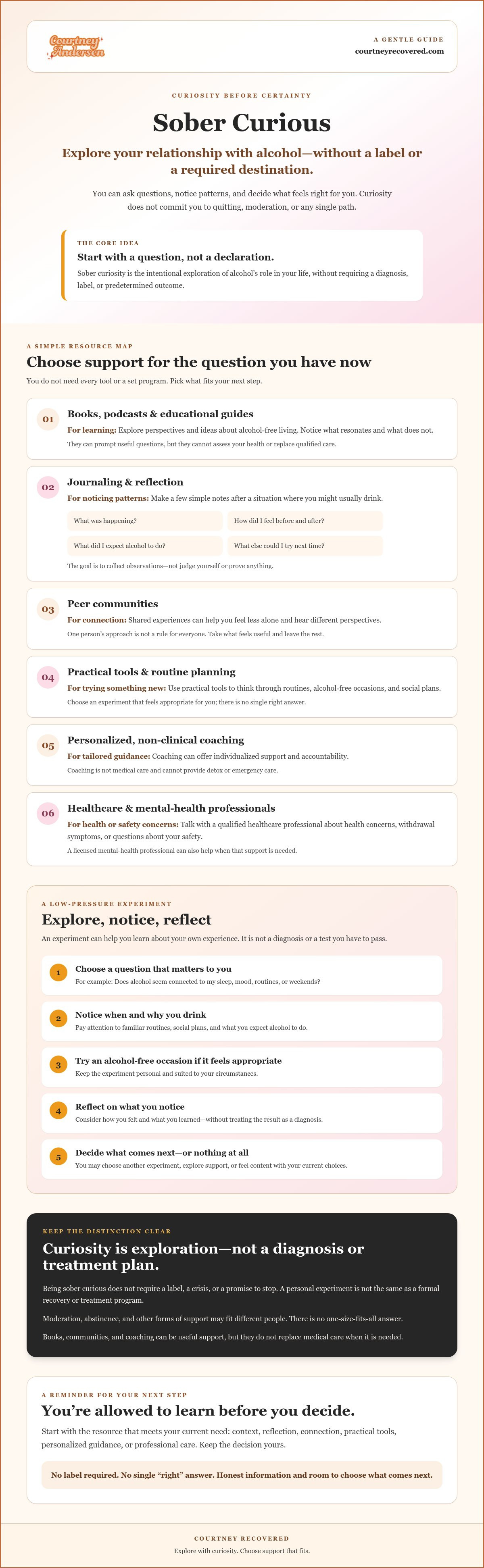
How can you try a sober-curious experiment that fits your life?
A useful experiment doesn’t need to be dramatic or follow someone else’s timeline. Start with a question you genuinely want answered, then choose a manageable way to observe what happens. You might want to see whether an alcohol-free evening changes your sleep, how a different after-work routine feels, or whether you can enjoy a social plan without drinking.
Set an intention and decide what you want to notice
Keep your aim specific and kind. Write down what you’re curious about, then note what you experience without grading yourself as a success or failure. You might track your mood, energy, expectations, or comfort in a particular situation. If the plan feels unhelpful, you can adjust it, pause, or seek support. Changing course is information, not a personal shortcoming.
Make the plan fit your actual life. Think ahead about invitations, familiar moments when you usually pour a drink, and what you’ll say if someone asks about your choice. You might line up an alcohol-free drink you enjoy, suggest a different activity, or tell a trusted person what you’re trying. Support could come from a friend, a peer community, or a practical tool that helps you record your observations.
Use this checklist as a starting point, then adapt it to your circumstances:
- My question: What do I want to understand about alcohol, my routines, or how I feel?
- My experiment: What manageable change will help me explore that question?
- My plan: Which social plans or everyday moments might need a little preparation?
- My support: Who or what can help me feel more prepared?
- My reflection: What did I notice, and what would I like to try next?
There’s no required length and no result that proves whether you have a problem. An experiment is one way to learn about your experience, not a diagnosis or a test you have to pass. If your observations bring up concerns, pause and consider what kind of support makes sense. For ideas about imagining what life could look like beyond old routines, explore ways to build a life after getting sober.
Need practical guidance as you shape your next step? Explore Courtney Andersen’s sobriety resources for optional tools and support.
Where can you find supportive next steps as a sober-curious person?
You don’t have to map out your whole future to take one useful step. The right support depends on what you need today: keep learning with a book or practical guide, talk with peers who understand the questions, seek individualized coaching for accountability, or contact a clinician about health concerns. These routes can complement each other, but they serve different purposes.
When community or personalized support could feel useful
If you want connection, Courtney Recovered’s Sobriety Circle is a membership community centered on shared support and resources. If you’d rather focus on your own goals with someone, 1:1 Sobriety Coaching offers personalized, non-clinical guidance and accountability. Both are optional ways to feel supported as you explore. Neither is medical care or treatment for a health condition.
Other resources for the sober curious may be enough for now. A book, a reflection prompt, or a conversation with someone you trust can help clarify what you’re wondering about. You can also compare options before joining a community or working with a coach. Choose support that respects your pace and is clear about its limits.
Choose one next step that feels doable
Keep the next move small and specific. You might write down one question you want to explore, tell a trusted person you’re thinking about your drinking, or learn more about a resource that interests you. If alcohol-related health concerns, possible withdrawal risks, or questions about your safety are part of the picture, contact a qualified healthcare professional. Coaching and peer connection can offer support, but they can’t replace medical assessment or care.
There’s no deadline for deciding what this means. Try one step, notice how it feels, and give yourself permission to choose differently as you learn more. If Courtney Recovered’s community, coaching, or practical resources sound like a fit, explore Courtney Andersen’s resources and support. Start with what feels doable. You can decide the rest as you go.
Take Your Next Step at Your Own Pace
You don’t need a label or a lifetime plan to get curious about your relationship with alcohol. Start with a question, use a reflection tool or alcohol-free experiment to notice what matters to you, and choose support that fits the moment. The resources for the sober curious are there to help you explore, not dictate where you have to land.
Your next step might be a conversation with someone you trust, connection through the Sobriety Circle community, or personalized, non-clinical guidance through 1:1 Sobriety Coaching. The Sober Vibes Book and Sober Toolkit also offer practical resources to explore. If you have health concerns, withdrawal risks, or questions about safety, contact a qualified healthcare professional. Coaching and community support aren’t substitutes for medical care.
Curious about what support could look like for you? Explore Courtney Andersen’s resources and support, including options for connection, guidance, and practical tools. You can take one small step today. The rest can unfold in its own time.
Frequently Asked Questions
What does it mean to be sober curious?
Being sober curious means intentionally examining alcohol’s role in your life without committing to a label or a particular outcome. You might question how drinking fits your routines, mood, relationships, or values, then decide what you want to explore next. Some people try alcohol-free days; others focus on learning or reflection. Curiosity is a starting point, not a diagnosis or a promise to quit.
Can I be sober curious without deciding to quit drinking forever?
Yes. You can explore your relationship with alcohol without deciding to stop forever. You might try a manageable change, notice how it affects your routines or social life, and reflect on what you learned. There’s no need to make a permanent promise before asking honest questions. If your experiment raises health or safety concerns, a qualified healthcare professional can help you consider appropriate next steps.
What resources are best for someone who is sober curious?
The best resources for the sober curious depend on what you need. Books and podcasts can introduce ideas, while journaling can help you notice situations, feelings, and expectations around drinking. Peer communities offer connection and varied perspectives. Practical tools may help you plan new routines, and coaching can offer individualized, non-clinical guidance. Educational resources can support reflection, but they can’t diagnose a problem or replace qualified medical care.
How can I explore sobriety without joining a 12-step program?
You can explore alcohol-free living through self-guided reading, journaling, personal experiments, peer communities, or coaching. These options differ from a 12-step program and aren’t all treatment. Choose what fits the support you’re looking for. For example, you might track how you feel during an alcohol-free evening or talk with someone you trust. If you have health concerns or may be physically dependent, seek medical guidance before stopping.
Is it safe to stop drinking on my own?
Not always. If you may be physically dependent on alcohol, stopping suddenly can be dangerous. Talk with a healthcare professional before making a change so they can assess your situation and discuss safer next steps. Seek urgent medical care for severe or alarming symptoms, such as seizures, hallucinations, or severe confusion. Peer support and coaching can’t assess withdrawal or provide emergency care. Contact local emergency services if there’s an immediate medical emergency.
Do I need to call myself an alcoholic to seek support?
No. You don’t need to choose a label before asking questions or seeking support. You can describe what you’ve noticed, such as drinking more than you planned or feeling concerned about alcohol’s place in your life. A healthcare professional can help assess health concerns without requiring you to settle on an identity first. Coaching and peer community can offer non-clinical support, but they don’t replace medical or mental-health care.
Where can I find an online community for sober-curious people?
Look for communities that clearly explain their purpose, expectations, and limits, and that welcome questions without pressuring you into a particular choice. Courtney Recovered’s Sobriety Circle is a membership community offering shared support and resources. Review its current details to see whether it fits what you’re seeking. Peer connection can help you hear varied experiences, but members’ stories aren’t medical advice or a substitute for qualified care.
I want you to feel sober NOT boring!
Kickstart your sobriety with my free 2-day video workshop series to master your sober mindset and have FUN in your sobriety journey!


