
Repairing Relationships in Sobriety: From "I’m Sorry" to Living Amends
Sep 05, 2026
What if your family finally stopped looking at you like a ticking time bomb and started seeing you as the reliable, vibrant person you actually are? You've likely said "I'm sorry" so many times the words have lost their flavor. You're living with a massive relationship hangover, feeling the crushing weight of past mistakes while your partner quietly waits for the other shoe to drop. It's exhausting to feel like a permanent project instead of a partner. I know that feeling of walking on eggshells all too well. This guide is your roadmap for repairing relationships in sobriety by moving past the apology phase and into the power of living amends.
You'll learn how to heal your closest bonds and rebuild trust with a practical, non-clinical approach that focuses on your actions over your words. We'll dive into tools for handling their skepticism without it triggering a relapse. We'll also explore how to build a social life that feels connected and high-energy without a drop of alcohol in sight. It's time to stop groveling and start showing up as the woman you were always meant to be. Let's get to work.
Key Takeaways
- Stop relying on "I'm sorry" and learn how to heal the lingering relationship hangover through consistent, visible change.
- Discover why repairing relationships in sobriety is built on daily deposits into the Trust Bank rather than one-time grand gestures.
- Shift your focus from promising you've changed to living your amends by embracing a lifestyle of continuous personal evolution.
- Learn to set firm boundaries that protect your sobriety while you navigate the tricky waters of your new social life.
- Understand why having a supportive squad like the Sobriety Circle is essential for staying grounded while you do the hard work of healing bonds.
The Relationship Hangover: Why "I’m Sorry" Isn’t Enough Anymore
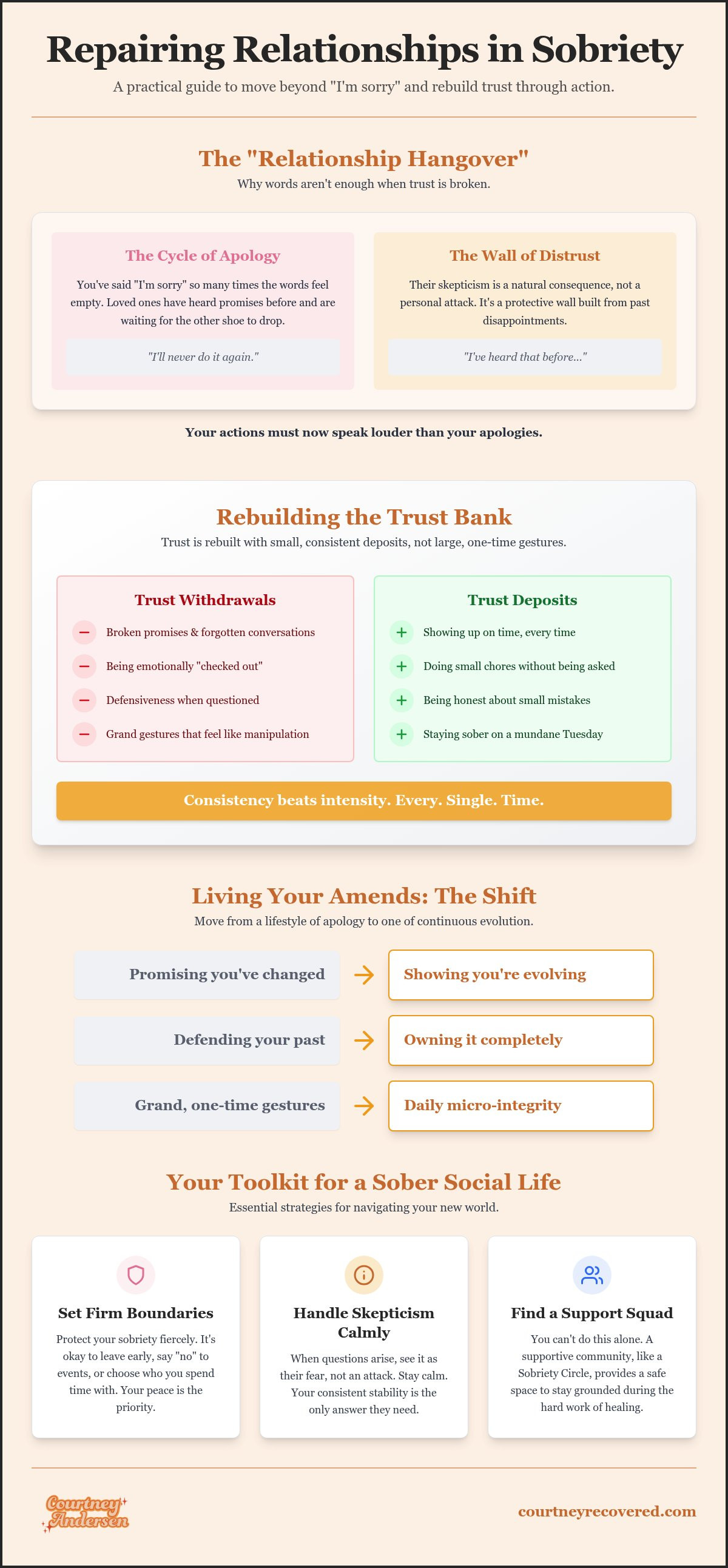
You woke up without the pounding headache, but the air in your house still feels thick enough to cut with a knife. That's the relationship hangover. It's the lingering guilt, the sideways glances, and the massive wall of distrust that remains long after the bottles are in the recycling bin. When you're repairing relationships in sobriety, you quickly realize that your sobriety date is a celebration for you, but it might feel like a warning sign for everyone else. They've heard "I'll never do it again" a thousand times. Right now, your words are just white noise.
The trust gap is the painful space between who you're becoming today and the version of you they remember from last month. While many people find a solid foundation for healing through a Twelve-Step Program, the lifestyle shift required to close this gap is radical. You have to move from defending your past to owning it completely. Validating your shame is part of the process, but you can't stay there. Radical ownership means acknowledging that their skepticism is a natural consequence, not a personal attack on your progress.
The Cycle of Broken Promises
If you were a gray area drinker, the fractures in your intimacy were likely subtle. It wasn't always a dramatic blowout; sometimes it was just being "checked out" on the couch or forgetting a conversation you had at 9:00 PM. These small letdowns stack up. Your loved ones are likely waiting for the other shoe to drop because, in their experience, it always does. Repairing relationships in sobriety requires you to break this loop with a period of intentional silence. Instead of promising change, you have to let your lack of drinking do the talking for you. Consistency is the only thing that will eventually quiet their anxiety.
Moving Past the Cringe
We've all been there. The 2:00 AM "I love you" texts to an ex, the missed school plays, or the messy dinner parties where you were the loudest person in the room. The memory of these moments can make you want to crawl under a rock, but you have to face them to move past them. Emotional sobriety is the ability to sit with discomfort without a drink. You can't expect your partner or friends to forgive a version of you that you still haven't forgiven yourself. Self-forgiveness isn't about letting yourself off the hook; it's about clearing the internal wreckage so you can finally show up for the people who matter most.
Rebuilding the Trust Bank: The Anatomy of Consistency
Think of your relationships like a bank account. For years, you’ve been making massive, unplanned withdrawals. Now, the account is deep in the red. You can't just walk in and demand a million-dollar loan; you have to start with small, daily deposits. Every time you show up when you said you would, that is a deposit. Every time you are honest about a small mistake instead of hiding it, that is a deposit. Repairing relationships in sobriety is a slow game of micro-integrity. It is not about the big, flashy apologies anymore. It is about doing the small things you said you would do, day after day, until the balance starts to shift.
Consistency beats intensity every single time in recovery. You might feel the urge to buy a diamond ring or book a massive vacation to prove you have changed, but big gestures often feel like manipulation when trust is low. They look like a distraction from the real work. Instead, focus on being consistently reliable. Be the person who does the dishes, picks up the kids on time, and stays sober on a mundane Tuesday night. These actionable steps to rebuild trust are the only way to prove you are actually evolving into a different person. If you want more ways to stay grounded during this process, finding the right sober resources can help you keep those deposits coming.
Handling Skepticism Without Blowing Up
When your partner asks where you were or looks at you with that familiar, searching expression, it is easy to get defensive. You are doing the work, so why can't they see it? Remember that their doubt is a side effect of their love. They are not attacking your progress; they are protecting their own hearts from being broken again. Stay calm when they check up on you. If you feel yourself getting triggered by their questions, 1-on-1 sobriety coaching is the perfect place to vent and process those feelings so you can remain a pillar of stability at home.
The Power of "No-Comment" Sobriety
You do not need to announce every sober milestone to a skeptical audience. In fact, there is a certain power in "no-comment" sobriety. Stop trying to convince everyone with your words or your social media posts. Let your presence speak louder than your promises. Building a track record of being exactly where you said you would be is the loudest and clearest message you can send. When you stop talking about your change and start living it, people eventually have no choice but to believe what they see with their own eyes.
Living Amends: Shifting from Apologizing to Evolving
Apologizing is a moment, but living amends is a lifestyle. When you're focused on repairing relationships in sobriety, you have to stop thinking of an apology as a finish line you cross to get back into someone's good graces. It's actually the starting blocks. Living amends is the vibrant, ongoing demonstration that you've truly evolved. It is the difference between saying "I'll be better" and actually being the person who picks up the phone, stays present during dinner, and doesn't disappear into a bottle when things get stressful.
This is where the Stop Starting Over mentality comes into play. You aren't just hitting reset; you're upgrading your entire operating system. Some people in your life might need a deep, sit-down conversation, but many just need to see you stay sober for a year. You have to identify who needs the words and who just needs the witness. For many, your continued presence and reliability are the only "sorry" they actually want to hear.
Understanding the impact of gray-area drinking is a game changer here. Often, the damage wasn't a single, explosive event. It was a slow erosion of trust through small, repeated absences or being "half-there" during important moments. By recognizing these subtle patterns, you can address the specific ways you let people down without even realizing it at the time. This awareness helps you move from generic apologies to specific, meaningful change.
The Difference Between Guilt and Growth
Guilt is a heavy, backward-looking emotion. It keeps you stuck in the "cringe" of what you did last summer. Living amends, however, look through the windshield at where you're going. Stop trying to "people-please" your way out of the doghouse. Doing extra chores or saying "yes" to things you hate just to pay for your past drinking isn't healing; it's penance. It creates a lopsided dynamic that eventually leads to resentment. Instead, set a standard for your "New Normal." Show your family that the sober version of you has healthy boundaries, clear goals, and a high-energy approach to life that doesn't require an apology.
When an Apology is Actually Selfish
Recognize that sometimes, the urge to apologize is actually about your own discomfort. If you're groveling just to stop feeling guilty, you're making your recovery their problem. Timing is everything. Day 30 might feel like a massive milestone to you, but for the people you hurt, it might still feel like yesterday. They are likely still processing the trauma of the "broken promises" cycle. Focus on the other person's healing timeline, not just your own. If they aren't ready to hear from you, the best thing you can do for repairing relationships in sobriety is to keep working on yourself in silence. Your growth will still be there when they are ready to see it.
Setting Boundaries in Your Sober Social Life
Boundaries are your new best friend. When you're repairing relationships in sobriety, it's easy to feel like you have to say "yes" to everything to prove you're still fun or to make up for lost time. Stop that right now. Boundaries aren't walls to keep people out; they're gates that protect your peace. You're navigating a massive identity shift, and that means some of your old "party-girl" friendships might not make the cut. If a friendship was built solely on a shared love for Chardonnay, it might not survive your evolution. That's okay. You're making room for connections that actually fuel your spirit.
When the inevitable "Why aren't you drinking?" question pops up at a party, remember: "No" is a complete sentence. You don't need to turn a happy hour into a therapy session unless you really want to. Protecting your energy is your most important job after getting sober. You're building a new version of yourself, and that requires a lot of emotional bandwidth. If you spend all your time explaining yourself to people who don't truly matter, you'll have nothing left for the people who do.
The Sober Social Script for Professional Women
As a professional woman, you're used to being in control. Drinking often felt like the only way to "turn off" the high-pressure demands of your career. Now, you're transitioning from the "fun drunk friend" to a vibrant sober leader. At work events or networking mixers, you can "own" your choice without sounding like a buzzkill. Try these scripts: "I'm retired from the booze game, but I'll take a sparkling water," or "I'm on a health kick and feeling way too good to stop now." You'll find that people actually respect the discipline. Bring the high energy, lead the conversation, and show them that sobriety is a massive power move, not a social death sentence.
Protecting Your Peace at Home
Healing bonds at home is a different beast, especially if your partner still drinks. You have to communicate your needs without being a martyr. If seeing wine in the fridge is a trigger, ask for a "dry" shelf or a separate area. Create a sanctuary for yourself using tools from your sober toolkit to stay grounded when the house feels chaotic. It's also perfectly okay to skip the booze-soaked wedding or the bachelorette party in your first few months. If your sobriety is at risk, the event isn't worth it. Real friends will understand your absence. If you're struggling to navigate these messy family dynamics, work with me 1:1 to build a boundary-setting plan that actually sticks.
Healing Together: Why You Need a Sober Support Squad
You can't fix a broken house while you're still standing in the middle of the fire. Repairing relationships in sobriety is one of the most emotionally taxing parts of the journey. If you try to do it entirely in a vacuum, you're going to burn out. You need a squad of women who have walked this exact path and a strategist who can help you see through the emotional fog. When things get heated at home, having a neutral third party like a sober coach is a game changer. I act as your strategist, helping you plan those tough conversations and process the triggers that used to send you straight to the wine rack.
Transitioning from the "recovery" phase to a life of vibrant living requires a shift in perspective. You're no longer just "not drinking"; you're building a life that is so fulfilling you don't want to escape it. This evolution is much easier when you're surrounded by a community that gets it. Instead of feeling like a "project" for your family to manage, you become a leader in a tribe of empowered women. This shift in identity moves you past the "Relationship Hangover" and into a future of genuine connection.
Finding Your People in the Sobriety Circle
There is a unique power in seeing other women heal their marriages and friendships in real time. In the Sobriety Circle, you get to witness the "Living Amends" process in action. When your partner is still skeptical or your old friends are being difficult, your circle provides a safe harbor. This group accountability keeps you consistent when things get tough at home. Community is the secret weapon against the isolation that often leads to a "relapse and apologize" cycle. You don't have to carry the weight of your past alone when you have a squad holding the line with you.
Your Next Step: From Messy to Masterful
The journey from "I'm sorry" to a vibrant, connected life is built on three pillars: radical ownership, relentless consistency, and a supportive community. You've learned how to identify the trust gap and how to make those daily deposits into the Trust Bank. Now, it's time to stop the cycle of broken promises for good. You have the tools to move past the cringe of your past and step into your role as a vibrant sober leader. You don't have to navigate the messy middle of relationship repair by yourself. If you're ready to create a roadmap for your "After" stage, book a discovery call for 1:1 coaching today. Let's turn your messy history into a masterful future.
Your Vibrant, Connected Future Starts Now
You've already done the hardest part by putting down the drink. Now, it's time to build a life that's so high-energy and authentic you never want to look back. Repairing relationships in sobriety isn't about groveling for the rest of your life; it's about becoming so consistently reliable that trust becomes the only logical conclusion. By shifting from verbal apologies to living amends and setting the boundaries you need to protect your peace, you're moving from a "project" to a vibrant leader in your home and social circle.
Courtney Andersen is a leading expert in gray-area drinking and knows you don't have to navigate this messy middle alone. Whether you need the 24/7 support of the Sobriety Circle or the action-oriented strategies in the Sober Toolkit, a roadmap is waiting for you. Ready to stop apologizing and start living? Join the Sobriety Circle or book 1:1 coaching today to step into your "After" with total confidence. You've got the strength to heal these bonds. I'm right here with you.
Frequently Asked Questions
How long does it take to rebuild trust after I stop drinking?
Trust takes as long as it takes. Your loved ones are healing on their own timeline, not yours. While you might feel like a brand new person after 30 days, they might need a year of seeing you stay reliable before their guard finally drops. Focus on making those daily deposits into the trust bank. Consistency is your only currency here. Don't rush the process; just keep showing up every single day.
What if my partner refuses to forgive me even though I’m sober?
You can't force someone to forgive you, even if you're doing everything right. Forgiveness is a gift they give themselves, not a reward for your sobriety. If your partner is stuck in the past, focus on your own evolution. Sometimes, repairing relationships in sobriety means accepting that some bonds have changed forever. Keep working on yourself. Your value isn't dependent on their approval or their specific healing timeline.
Should I apologize to everyone I hurt while I was drinking right away?
Slow your roll on the apology tour. Apologizing in the first few weeks is often more about relieving your own guilt than helping others heal. Wait until you have some "sober skin" and can handle a difficult reaction without spiraling. Some people need to see your change for months before they're ready to talk. Focus on staying sober today. The big talks can wait until you're much more grounded.
How do I handle friends who keep pressuring me to "just have one" drink?
Be direct and unapologetic. You don't owe anyone a detailed explanation of your personal choices. Use a punchy script like, "I'm retired from the booze game, but I'm still here for the vibes." If they keep pushing, it's a sign they're more attached to your drinking than your friendship. It might be time to find a squad that celebrates your vibrancy instead of trying to dim your light.
Can my marriage survive my drinking history?
Absolutely, but it won't look like the old version of your marriage. Many couples find that sobriety creates a deeper intimacy they never had while alcohol was the third wheel. It requires you to stop being the "problem" and start being a partner again. This shift takes time and radical honesty. Focus on building a new foundation based on who you are today, not who you were last year.
What is the difference between an apology and a living amend?
An apology is a set of words; a living amend is a way of life. Apologies look backward at what went wrong, while living amends look forward at how you're showing up now. It's the difference between saying "I'm sorry I was late" and being the person who is always five minutes early. Living amends are vibrant proof that you've evolved into someone consistently reliable.
Do I have to tell my boss or coworkers that I am sober?
Your sobriety is your business. You don't have to disclose your recovery status to your boss or colleagues unless you want to. In professional settings, "I don't drink" is a complete sentence. You can own your choice without giving a backstory. Focus on being the vibrant, high-performing leader you are now. Your work results will speak much louder than any announcement about your lifestyle changes ever could.
How can I stop feeling so much shame about my past behavior?
Shame thrives in the dark, so bring it into the light with a community like the Sobriety Circle. Stop beating yourself up for things a different version of you did. Use tools from the Sober Toolkit to stay grounded and focus on the woman you're becoming. Self-forgiveness is the prerequisite for repairing relationships in sobriety. When you celebrate your progress instead of mourning your past, that shame finally starts to lift.
I want you to feel sober NOT boring!
Kickstart your sobriety with my free 2-day video workshop series to master your sober mindset and have FUN in your sobriety journey!


