
Rehab Alternatives for Professionals: How to Get Sober Without Checking Out of Your Life
Sep 15, 2026
What if the biggest threat to your career isn't your drinking, but the fear that getting help means disappearing for thirty days? You've worked too hard to build your reputation to let it vanish behind the locked doors of a clinical facility. It's a common trap for high achievers. You feel like you aren't "bad enough" for traditional rehab, yet you're definitely "too far gone" to just stop on your own. You're looking for rehab alternatives for professionals that respect your schedule and your status.
I get it because I've been there. You want the clarity of sobriety without the sterile, somber atmosphere of the recovery industry. You deserve a path that feels like an upgrade, not a punishment. This article will show you how to break the cycle of gray area drinking and build a vibrant, alcohol-free life without checking out of your world. We'll explore how professional-grade tools like bespoke coaching and high-level peer circles can help you stay successful while you finally get sober for good.
Key Takeaways
- You don't have to wait for your life to fall apart to decide you're done with drinking; success often hides the very struggle you're ready to leave behind.
- Discover effective rehab alternatives for professionals that prioritize your career and privacy while providing the high-level support you actually need.
- Learn why a customized sobriety toolkit is your best defense in high-pressure social and work environments where alcohol is usually the default.
- Shift your focus from what you're losing to what you're gaining, like clear mornings, better performance, and a life you're excited to wake up to.
- Understand how to choose between 1:1 mentorship and a community of like-minded peers to find the level of support that fits your lifestyle.
The High-Functioning Trap: Why Traditional Rehab Often Fails Professionals
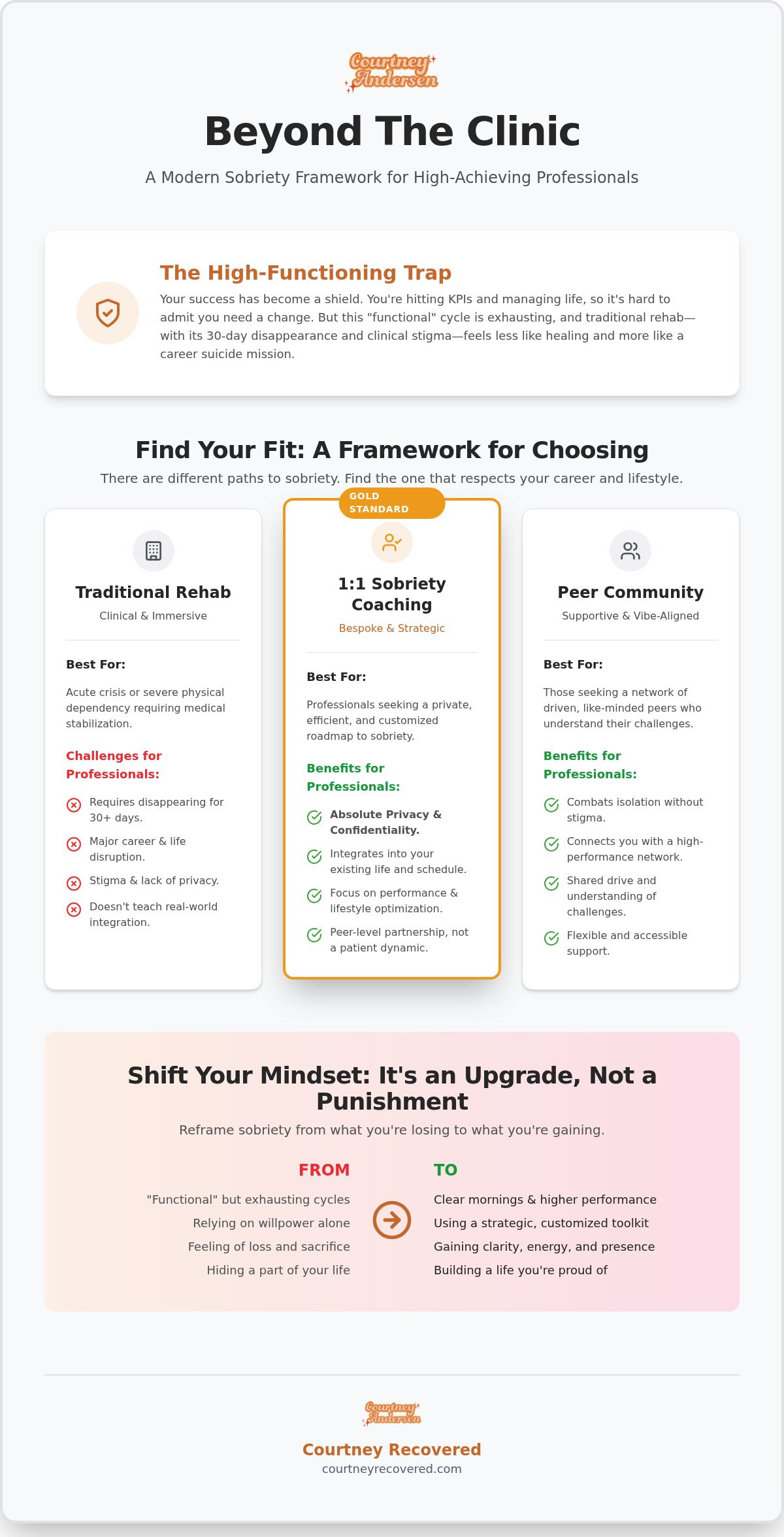
You are crushing it at work, but your nights tell a completely different story. The "functional alcoholic" label is a dangerous myth that keeps high achievers stuck in a cycle of shame for years. If you are still hitting your KPIs and keeping the school running, you might think you don't have a real problem. But success is often the loudest distraction. It's hard to admit you need a change when your bank account and LinkedIn profile say you are winning. This is exactly why many people begin understanding substance use disorder only to find that traditional recovery options feel like a step backward.
Traditional rehab is usually built for a total life crisis. It's often sterile, clinical, and completely detached from the high-pressure world you live in. For a high-achiever, being told to hand over your phone and "surrender" to a 30-day program feels less like healing and more like a career suicide mission. There is also the very real fear of the "rehab" label. For those with professional licenses or high-profile reputations, the stigma of a clinical facility can feel like a permanent stain on a hard-earned resume. Gray area drinking is the space between "social use" and "clinical addiction" where your habit becomes a heavy burden you can't quite drop on your own.
Success as a Shield: The Professional's Dilemma
Your ability to perform at a high level provides a false sense of security. You tell yourself that if you can close a major deal on four hours of sleep, you must be fine. This fuels the "I'll do it myself" mindset. You're used to solving complex problems at work, so you try to "project manage" your drinking. But willpower isn't a strategy. This stubborn self-reliance usually leads to an exhausting cycle: you stop for a few days, then start right back up when stress peaks.
The Cost of Disappearing for 30 Days
In your world, momentum is everything. Checking out for a month isn't just a break; it's a gap that requires an uncomfortable explanation. You shouldn't have to choose between your sobriety and your career trajectory. Privacy isn't just a preference; it's a professional necessity. This is where rehab alternatives for professionals change the game. Real-world recovery means integrating your growth into your actual life. You can maintain your performance and keep your personal evolution private while building a foundation that lasts. It's about getting sober in the environment where you will actually be living, not in a clinical bubble.
Rehab vs. Coaching vs. Community: A Framework for Choosing
Before you dive into coaching, you need to make a crucial safety distinction. If you are experiencing severe physical withdrawal symptoms, medical detox is a non-negotiable first step. We don't provide medical services here, and your safety always comes first. However, once you are medically cleared and ready to tackle the "why" behind your drinking, the real work of lifestyle design begins. This is where you move from surviving to thriving in your actual environment.
A sobriety coach acts as a personal strategist for your life. They don't diagnose you or treat you like a patient; they partner with you as a peer. This is why 1:1 sobriety coaching is the gold standard for professionals who value privacy and efficiency. You get a customized roadmap that accounts for your high-pressure board meetings, social obligations, and travel schedule. It's about radical accountability that fits into your pocket. You aren't just "staying sober"; you are learning how to lead, parent, and play with more energy than you ever had while drinking. This personalized mentorship turns the "loss" of alcohol into a massive gain for your personal brand.
The Sobriety Circle: Community Without the Stigma
Isolation is the enemy of progress. But let's be honest: the idea of sitting in a church basement sharing a "sob story" doesn't exactly scream high-performance. Modern professionals need a vibe-aligned community that shares their drive and their challenges. Joining a sober community online allows you to connect with successful peers who are also navigating the complexities of a high-stakes career without the booze. It's about finding your people without the clinical stigma. If you're ready to swap the happy hour hangover for a network of ambitious, clear-headed leaders, explore our mentorship options to see which path fits your current goals.
Real-World Rehab: Building Your Sobriety Toolkit
You don't need a white-walled room or a hospital gown to get your head straight. In fact, getting sober "in the wild" is often more effective because you're practicing in the environment where you actually live. But let's be clear: skipping the facility doesn't mean skipping the structure. Without a plan, you're just white-knuckling it through your Tuesday afternoon meetings. Choosing rehab alternatives for professionals means you are taking the initiative to build a custom framework that supports your high-octane lifestyle instead of pausing it.
A major part of this framework is building a sobriety toolkit that works for you. This isn't generic advice; it's specific resources ready for when the "work-hard, play-hard" culture starts to feel like a trap. You need a strategy for that 5:00 PM transition. Instead of reaching for a glass of wine to "shut off" your brain, create a new evening ritual that signals relaxation to your nervous system. Whether it's a specific mocktail, a high-intensity workout, or a dedicated transition routine, these tools are your new executive assistants for your mental health.
Essential Tools for the Professional Life
Navigating an open bar at a networking event can feel like walking through a minefield if you aren't prepared. Your Sober Toolkit should include practical office-ready resources and mental scripts. You don't owe anyone a medical history. Simple, confident lines like "I'm not drinking tonight, I've got a big morning," or "I'm on a health kick," are usually enough to end the conversation. The goal is to move through these social situations with so much confidence that no one even notices your glass is filled with sparkling water. This is how you maintain your professional edge while staying true to your personal goals.
Breaking the Relapse Cycle
If you're tired of starting over every Monday morning, it's time to look at the root cause of the loop. Most professionals fail because they try to change their habits without changing their identity or their environment. The "Stop Starting Over" methodology is about consistent, messy progress rather than clinical perfection. It involves identifying your high-stress triggers before they lead to a drink. Are you drinking because of the workload, the isolation of leadership, or just pure habit? Once you name the trigger, you can apply a tool from your kit to handle it. This is how rehab alternatives for professionals create lasting change: by giving you the power to handle your real life in real time.
The Non-Clinical Approach: Healing the Root Cause
Stopping the drinking is only the first step; the real magic happens when you stop needing to escape your life in the first place. For most high-achievers, alcohol isn't a hobby; it's a coping mechanism. You aren't necessarily drinking because you love the wine's vintage or the cocktail's craft. You're drinking because your brain is at a hundred miles per hour and you need a way to hit the "off" switch. That is why gray-area drinking is so prevalent in corporate circles. It's less about the taste and much more about managing the relentless pressure of a high-stakes career.
When you explore rehab alternatives for professionals, you're looking at the emotional root of the habit. Emotional sobriety means learning how to handle a missed deadline, a difficult board meeting, or a personal conflict without reaching for a chemical buffer. It's about building a life that feels so good and so aligned with your values that you don't actually want to numb out. This non-clinical approach focuses on your evolution as a leader and a person, rather than just checking days off a calendar. It's about trading your "liquid courage" for actual, sustainable confidence.
Who Are You Without the Drink?
Many professionals fear that sobriety will rob them of their edge. You might worry that you'll be boring at networking events or less creative during late-night strategy sessions. The truth is the exact opposite. Sobriety isn't a loss of personality, but a gain of clarity. You'll find that your "liquid courage" was actually just a mask for high-stakes anxiety. When you learn to manage that anxiety through coaching and real-world tools, your professional performance doesn't just stay the same; it skyrockets. You become fully present, sharp, and capable of handling any crisis with a level head.
Life After the Initial Quit
Navigating life after getting sober involves more than just avoiding the bar. You'll likely hit a "pink cloud" phase where everything feels amazing, followed by the reality of building a new routine. This is the perfect time to audit your professional networks. You'll find that you can build deeper, more meaningful connections when you aren't bonding over a bottle. The long-term benefits for your career trajectory are massive. Imagine having 30% more energy every single morning and never having to worry about what you said at the office holiday party. If you're ready to stop the cycle and start your evolution, apply for 1:1 sobriety coaching today and let's build that vibrant life together.
How to Start Your Professional Sobriety Journey Today
Ready to stop the "one day" talk and make today "Day One" instead? Starting your journey doesn't require a dramatic exit from your life. It starts with a simple, quiet decision. First, acknowledge the gray area without judgment. You aren't "bad" or "broken"; you're just ready for a higher level of living. Second, decide what kind of support fits your personality. Whether you want the intense, bespoke focus of 1:1 coaching or the collective energy of a group, exploring rehab alternatives for professionals allows you to stay in the driver's seat of your career while you change your life.
Next, audit your environment and set initial boundaries. You don't need to quit your job, but you might need to decline that specific high-pressure happy hour for a few weeks while you find your footing. Finally, commit to a 30-day "Life Upgrade" instead of a 30-day "Rehab." You aren't hiding away in a clinical facility; you're leveling up at home. When you see this change as a major gain for your health and performance, the fear of missing out starts to fade. Choosing rehab alternatives for professionals is about finding a solution that respects your time and your reputation.
Why Courtney Recovered is the Right Fit
I've navigated the exact same high-functioning struggle you're in right now. I know what it's like to have the external success but the internal exhaustion. My approach is intentionally non-clinical and fiercely optimistic. Think of me as the cool older sister who has already been through the fire and is reaching back to pull you through. We don't just focus on "stopping" a habit. We focus on building a vibrant, connected reality that makes alcohol look boring in comparison. You deserve a mentor who understands that your career is a priority, not a distraction from your recovery.
Your Next Practical Steps
If you're ready for a bespoke mentorship, your first move is to book a discovery call for 1:1 Sobriety Coaching. This is where we map out your specific triggers and goals in a completely private setting. If you'd rather dive into a community of like-minded, successful peers, join the Sobriety Circle today for immediate support. If you want to start your education immediately, grab the Sober Vibes Book. It's your roadmap to a life that feels like a gain, never a loss. You've already done the hard part by admitting you want more; now, let's take the first step together.
Your Vibrant, Alcohol-Free Career Starts Now
You've spent years building a reputation and a career you're proud of; you don't have to put it all on hold to find your way back to yourself. Getting sober isn't about sitting in a sterile room and focusing on what you're losing. It's about gaining the clarity, energy, and presence to lead your life with total confidence. By choosing rehab alternatives for professionals, you're opting for a bespoke path that respects your ambition and your schedule.
Courtney Andersen is a leading voice in the gray area drinking space, and her practical, non-clinical approach is featured in major publications and trusted by high-performing women worldwide. Whether you're navigating high-stakes meetings or reclaiming your evenings, you deserve support that actually fits your vibe. It's time to trade the "liquid courage" for real-world resilience and a community of like-minded peers who get it. Ready to build a life you don't need to escape? Explore 1:1 Sobriety Coaching here.
Your best days aren't behind you; they're waiting for you to show up fully. Let's make this the moment you finally stop starting over and begin thriving.
Frequently Asked Questions
Is sobriety coaching as effective as traditional rehab for professionals?
Sobriety coaching is an incredibly effective option for high-achievers who don't require medical intervention. Unlike the clinical atmosphere of a facility, coaching provides bespoke mentorship for your real life. You get to practice new habits in your real environment while maintaining your career momentum. These rehab alternatives for professionals focus on where you are going, not just where you have been. It's about optimizing your performance without the booze.
How do I know if I need medical detox instead of a rehab alternative?
You should seek medical detox if you experience physical withdrawal symptoms like tremors, hallucinations, or seizures. Safety is always the priority, and we do not provide medical services. If your body is physically dependent on alcohol, you must consult a healthcare professional before starting any non-clinical program. Once you are medically cleared and stable, you can transition into a coaching framework to handle the lifestyle and mindset shifts that keep you sober long-term.
Will my employer find out if I work with a sobriety coach?
Your privacy is a top priority, and working with a sobriety coach is entirely confidential. Because this is a non-clinical service, it involves no insurance claims, medical records, or employer notifications. You don't have to explain a thirty-day gap in your resume or worry about professional licensing repercussions. You get to do the work behind the scenes while showing up as your sharpest, most present self in the office every single day.
Do I have to label myself an 'alcoholic' to use these alternatives?
You absolutely do not need to use the "alcoholic" label to find success with these programs. We focus on the concept of gray area drinking, which describes the space where alcohol has become a burden but you haven't hit a "rock bottom." My approach removes the stigma and focuses on the vibrant life you want to build. You simply need to decide that you're ready for a life that feels better without the drink.
Can I really stay sober while attending high-pressure work events?
Staying sober at high-pressure events is entirely possible with the right tools in place. We work together to build a Sober Toolkit that includes specific mental scripts and practical strategies for navigating open bars and networking dinners. You'll learn how to decline a drink with total confidence so it doesn't become a topic of conversation. Many professionals find they actually network better when they are fully present and clear-headed.
What is the 'Sobriety Circle' and how is it different from AA?
The Sobriety Circle is a high-vibe community of successful, like-minded peers, which is a major departure from the traditional "church basement" feel of AA. While AA is a wonderful resource for many, our circle focuses on a celebratory, non-clinical outlook on life. It's an online space where you can share wins and challenges with people who understand the unique pressures of leadership. We prioritize empowerment and personal evolution over the somber atmosphere of clinical recovery.
How much time do I need to commit each week to a sobriety program?
Our programs are designed to fit into a busy, professional schedule without requiring you to check out of your life. For 1:1 coaching, you'll typically spend about an hour a week in deep-dive sessions, plus a few minutes daily using your toolkit. The Sobriety Circle is available whenever you need a quick boost or a peer check-in. It's about integrating growth into your day, not adding another heavy burden to your calendar.
What if I've already tried to quit on my own and failed?
Failing on your own doesn't mean you can't succeed; it just means you haven't had the right framework yet. Willpower is a finite resource, but a structured methodology like Stop Starting Over provides a sustainable roadmap. Most rehab alternatives for professionals succeed because they move beyond the "just stop" advice and address the root causes of stress. We'll identify your triggers and replace them with tools that actually work in your high-pressure world.
I want you to feel sober NOT boring!
Kickstart your sobriety with my free 2-day video workshop series to master your sober mindset and have FUN in your sobriety journey!


