
Quit Lit: Reprogram Your Brain for Sobriety
Sep 30, 2026
What if the glass of Chardonnay you're reaching for isn't actually the "self-care" you've been promised, but the very thing keeping you stuck in a loop of 3:00 AM anxiety? It's easy to feel isolated when the "wine mom" culture tells you that you need a drink to survive your kids, your job, and your life. You might worry that choosing sobriety means a lifetime of missing out or being the "boring" friend at the party.
I've been exactly where you are, and I promise that it doesn't have to feel like a sacrifice. Immersing yourself in quit lit is a tactical way to reprogram your brain and break the cycle of gray area drinking. It's about shifting your mindset so that sobriety feels like a massive gain, not a restrictive loss. By the end of this article, you'll have a curated list of books that resonate with your lifestyle and a clear roadmap to move from reading to taking empowered action. Let's build a life you don't feel the need to escape.
Key Takeaways
- Learn how quit lit shifts the narrative from "giving up" alcohol to gaining a vibrant, high-energy life through stories that mirror your own experience.
- Discover how "mirror neurons" in your brain help make a sober lifestyle feel attractive and completely doable just by reading about others' wins.
- Identify the three must-have book categories—memoirs, science, and tactical guides—to build a toolkit that supports your long-term evolution.
- Master a simple "Reading for Recovery" strategy to audit your environment for triggers and establish a consistent daily Sober Hour.
- Recognize the "Quit Lit Trap" and learn when it's time to move beyond the page into real-world human connection and coaching.
What is Quit Lit and Why is it Trending for 2026?
Forget everything you think you know about recovery literature. We aren't talking about dry, clinical manuals or sterile medical journals that make you feel like a patient. We are talking about quit lit. This genre prioritizes lived experience and raw, honest storytelling over cold statistics. It is the vibrant world of Quit lit (alcohol cessation), where authors share the messy, beautiful, and hilarious reality of trading the bottle for a bigger life. In 2026, we've finally ditched the old shame-based recovery model. We've replaced it with a celebratory outlook that treats sobriety as a luxury lifestyle choice, not a last resort.
For many women, these books act as a low-stakes entry point. You don't have to stand up in a room and introduce yourself with a label you're not ready for. You don't have to commit to a 30-day program. You just have to be willing to see your own reflection in someone else's words. It is a private, powerful way to start questioning the "wine mom" culture that has been sold to us as self-care for far too long. It validates the feeling that maybe, just maybe, the alcohol is the problem, not you.
The Evolution of the Recovery Memoir
The narrative has shifted dramatically. We used to hear only "rock bottom" stories focused on what was lost. Now, the 2026 trend is all about lifestyle design and the "sober glow-up." These modern memoirs focus on high-functioning individuals who realized that "fine" simply wasn't good enough. They highlight the gains: better sleep, vanished anxiety, and renewed creativity. Social media has played a massive role here, turning these personal stories into a global movement where being present is the ultimate status symbol. It isn't about stopping something bad; it's about starting something incredible.
Who Should Be Reading Quit Lit?
This genre is for the woman who looks like she has it all together but secretly worries about her nightly ritual. If you're tired of the marketing machines telling you that you need Chardonnay to survive your kids or your career, these books will be your lifeline. They are for gray-area drinkers tired of the "start-stop" cycle. You don't need to hit a traditional rock bottom to decide you want a better view. If you've ever felt isolated in your struggle or anxious about the idea of a dry wedding, quit lit provides the community and validation you've been looking for. It is for anyone ready to stop surviving and start thriving.
The Science of Story: How These Books Reprogram Your Sober Brain
Ever wonder why a single book can feel more life-changing than a dozen doctor's appointments? It isn't magic. It's science. When you dive into quit lit, you're doing more than just passing the time. You're actually rebuilding your internal architecture. Reading isn't a passive hobby; it's a high-energy workout for your mindset that targets the exact parts of your brain that keep you reaching for the bottle.
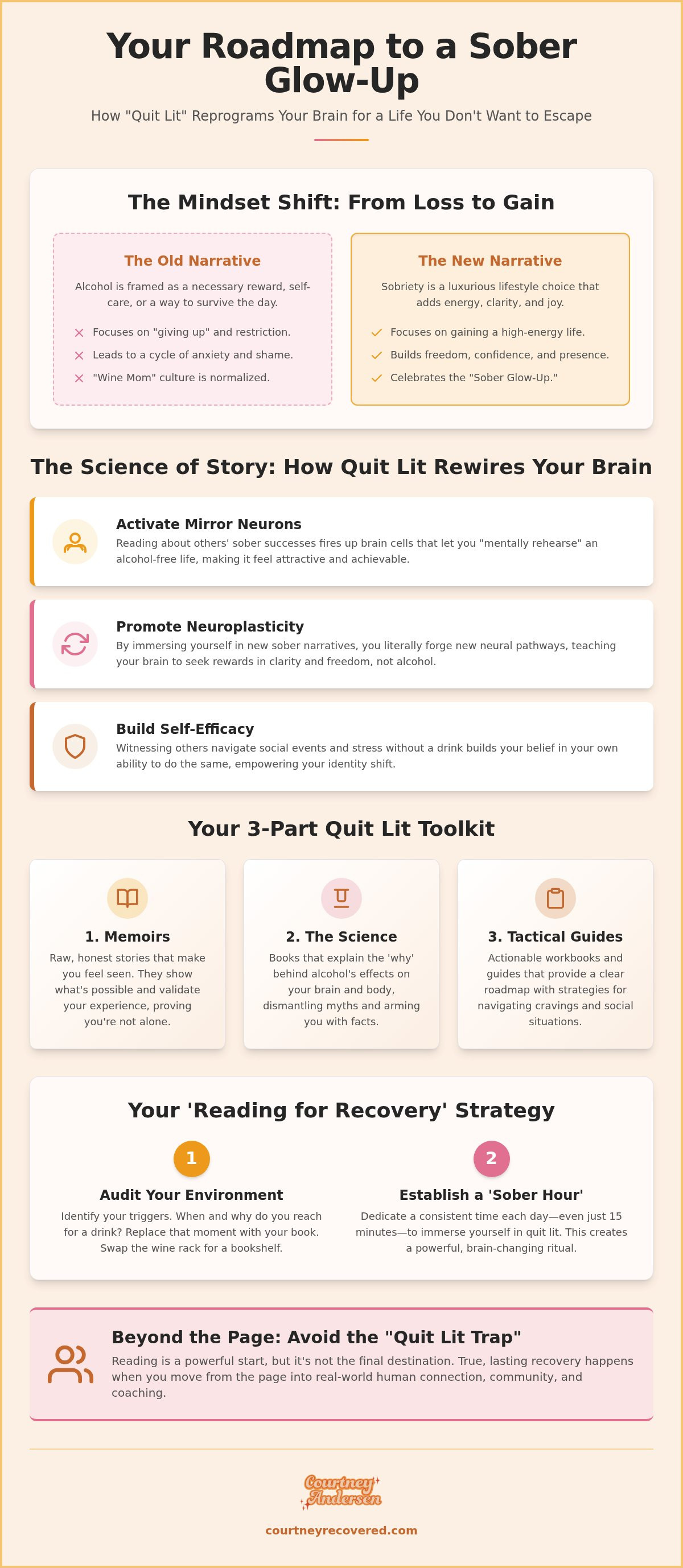
Reading about another woman's success builds something called self-efficacy. This is your belief in your own ability to handle a situation. When you read about someone navigating a wedding or a stressful Tuesday without a drink, your mirror neurons fire up. These specialized brain cells allow you to mentally rehearse a sober life. Suddenly, an alcohol-free existence doesn't just look possible; it looks freaking attractive. You're essentially "trying on" a new reality before you even step out the door.
Neuroplasticity is the brain's ability to forge new, alcohol-free neural pathways simply by consistently exposing yourself to new ways of thinking and living. By immersing yourself in these stories, you're literally teaching your neurons how to fire in a different pattern. You're shifting your brain's reward perception from the chemical hit of alcohol to the lasting dopamine of freedom and clarity.
Breaking the 'Alcohol is a Reward' Myth
For years, the "mommy needs wine" narrative has been played on a loop in our heads. This creates massive cognitive dissonance. You want to be healthy, but you've been told alcohol is your only reward for a hard day. Reading dismantles this myth brick by brick. Seeing your own "secret" thoughts, the ones you were too ashamed to say out loud, printed on a page by someone else is incredibly healing. It replaces that mental fog with a sharp, unapologetic clarity that helps you see alcohol for what it really is: a thief of your potential.
Identity Shifting through Literature
The real shift happens when your identity changes. You move from the restrictive "I can't drink" to the empowering "I don't drink." Literature helps you curate this new persona. You start to see yourself as the woman who values her sleep, her skin, and her presence more than a temporary buzz. This is especially vital if you've been struggling with Gray Area Drinking: When Your Habit Becomes a Burden. As you read, you're not just learning facts; you're adopting a new way of being. If you're looking for a tactical companion to these stories, my Sober Vibes Book serves as a roadmap for this exact evolution, helping you move from the page to the real world with confidence.
The Quit Lit Categories: Finding the Right Book for Your Journey
Building your sober library isn't about grabbing the first bestseller you see. It's about creating a balanced mental diet that feeds your heart, your head, and your hands. To make this lifestyle stick, you need a mix of three specific quit lit categories: the emotional resonance of memoirs, the logical proof of science, and the practical application of tactical toolkits. If you only read memoirs, you might feel seen but stay stuck without a plan. If you only read science, you might understand the "why" but feel isolated in the "how." You need the full spectrum to turn a temporary break into a permanent evolution.
Relatability is your secret weapon here. You need to read authors whose lives look like yours. If you're a high-functioning professional or a busy mom, reading about someone whose experience feels worlds away won't help you dismantle your own triggers. You need stories and tools that speak your language and understand your specific social pressures.
The 'Me Too' Memoirs: Building Empathy
Raw, honest stories are the ultimate antidote to recovery shame. When you see your "secret" thoughts on the page, written by someone else, that heavy feeling of isolation starts to lift. In 2026, we've moved beyond the old "rock bottom" tropes. New releases focus on lifestyle design and the "sober glow-up," showing you don't have to lose everything to want something better. These memoirs act like a sober friend in your pocket. They remind you that while your struggle feels lonely, it's a shared experience among millions of women tired of the "wine mom" marketing machine.
The 'How-To' Toolkits: Taking Action
Once you've felt the empathy and understood the science, you have to get tactical. This is where the real change happens. Tactical toolkits provide the scripts, daily exercises, and mindset shifts you need to navigate a Friday night happy hour or a stressful school run without a second thought. My Sober Vibes Book is a prime example. It's designed as a tactical companion to the memoirs you're already reading, giving you a clear path from the page to the real world. If you want a physical resource to keep you grounded, the Sober Toolkit is an essential addition to your library. It helps you move from passive learning to active, empowered living.
How to Build a 'Reading for Recovery' Strategy
Reading quit lit is a fantastic start, but if you want to actually rewire your brain, you need a plan. Passive consumption is just entertainment. Active strategy is transformation. Let's move from just "liking" the idea of sobriety to actually living it. You've already learned about the science and the categories; now it's time to put that knowledge into a daily practice that sticks.
Step 1: Audit your library. Take a hard look at your shelves. If you still have books that glamorize "blackout" culture or "wine mom" cookbooks, they have to go. You're curating a new vibe, and you don't need those old triggers whispering in your ear. Surround yourself only with voices that support your evolution.
Step 2: Set a "Sober Hour." Don't wait for the mood to strike or for your schedule to magically clear. Pick a time every single day to read. Consistency wins over intensity every time. Even 15 minutes of focused reading can reset your mindset and keep your goals front and center.
Step 3: Journal the "aha" moments. When a sentence hits you like a ton of bricks, don't just keep reading. Stop. Write it down. Ask yourself why it resonated. This reflection is where the real reprogramming happens. You're moving the information from your eyes to your heart.
Step 4: Stack your reading. Don't let the knowledge sit in a vacuum. Combine your books with physical resources like the Sober Toolkit to bridge the gap between theory and reality. This helps turn abstract concepts into tangible, daily wins.
Morning vs. Evening Reading Routines
Your morning reading is about setting your intention. It’s your armor for the day. Use this time for inspiration and mindset setting to ensure you start from a place of power. In contrast, evening reading is your tactical weapon against the "Witching Hour" cravings. When the 5:00 PM urge hits, grab your book instead of a glass. Use the "10-page rule": commit to reading just 10 pages before you decide about drinking. Usually, by page five, the craving has lost its momentum, and your brain has shifted gears.
Engaging with the Sober Community
You don't have to do this alone. In fact, you shouldn't. Joining a sober book club or an online circle turns a solitary activity into a shared mission. Check out my guide, Sober Community Online: Finding Your Vibe, to find your people. Sharing quotes that resonate with you builds public accountability and helps you own your new identity. Ready to move from the page to the practice? Grab the Sober Toolkit and start building a life you don't need to escape today.
Beyond the Page: When Reading Isn't Enough
You’ve spent weeks diving into quit lit. Your nightstand is stacked high, and you’ve highlighted every inspiring quote. But there’s a sneaky phenomenon I call the "Quit Lit Trap." It’s when you become an expert on recovery stories while your own habits stay exactly the same. Learning is comfortable. Doing is where the growth happens. Reading provides the map, but human connection is the fuel that actually gets you to your destination. You can't just think your way into a new life; you have to act your way into it.
Transitioning from a "sober reader" to a "sober liver" requires a shift from passive observation to active engagement. Books can tell you that a life without alcohol is better, but they can’t hold your hand when you’re navigating your first dry vacation. You need a bridge between the theory on the page and the reality of your daily routine. That bridge is built through connection and personalized support that addresses the specific "why" behind your drinking habits.
The Power of Personalized Accountability
A book can't ask you the hard questions. It won't notice the subtle ways you're still holding onto old identities or making excuses for "gray area" slips. That’s why 1-on-1 Sobriety Coaching is the fast track to the results you’ve been reading about. We take those general concepts from your favorite quit lit titles and turn them into a tailored strategy for your specific triggers. We focus on building Life After Sobriety: Build a Life You Don't Need to Escape, ensuring your new lifestyle feels like a promotion, not a punishment. A coach sees the patterns you're too close to see and provides the "tough love" realism needed to break through the plateaus.
Joining the Sobriety Circle
Reading someone else's memoir is a great start, but eventually, you have to start writing your own story. Sharing your experiences in a safe, high-energy environment is how deep healing begins. There is a massive difference between reading a story and sharing your own with people who truly get it. You need a tribe that celebrates your wins and understands your hurdles without the clinical, sterile atmosphere of traditional recovery. Join the Sobriety Circle to put your knowledge into daily practice. It’s time to stop reading about other people’s freedom and start claiming your own. Let's turn those "aha" moments into a permanent, vibrant reality.
Your New Chapter Starts Now
You’ve spent time discovering how quit lit acts as a tactical weapon to dismantle the "wine mom" narrative and forge new neural pathways. By now, you know these books provide the essential roadmap, but the real transformation happens when you move from the page to practice. You’ve got the strategy and the science. Now, it’s time to take that final, bold step toward a life that feels like a massive gain rather than a restrictive loss.
As the author of the Sober Vibes Book and creator of the Stop Starting Over program, I’ve seen thousands of women turn their "one day" into "day one." You don't have to navigate this transition alone or settle for a clinical, somber approach to recovery. You deserve a vibrant, high-energy community that celebrates your evolution every step of the way. If you’re ready to bridge the gap between reading and doing, I’m here to lead the way. Start your personalized journey with 1:1 Sobriety Coaching and let's build a reality you truly don't want to escape. You’ve already done the hard work of opening your mind; now let’s open up your future. Your best life is waiting for you to show up.
Frequently Asked Questions
What is the best quit lit book for beginners?
The best quit lit book for a beginner matches your specific life stage and drinking "vibe." If you’re a professional woman looking for a tactical roadmap, my Sober Vibes Book is your go-to guide. It goes beyond storytelling to give you real tools for daily life. You want a mix of a relatable memoir to feel seen and a "how-to" book to help you take immediate action.
Can I really quit drinking just by reading books?
Reading can definitely spark the initial mindset shift, but for most people, books are just the foundation. While quit lit helps you see that a better life is possible, deep healing often requires human connection and personalized accountability. Transitioning from a reader to a "sober liver" usually happens faster when you pair your reading with 1:1 Sobriety Coaching or a high-energy community like the Sobriety Circle to put those lessons into practice.
Is quit lit only for people who identify as alcoholics?
Absolutely not. This genre is specifically designed for anyone questioning their relationship with alcohol, whether you drink every day or just once a month. It’s particularly powerful for gray area drinkers who don’t resonate with traditional labels like "alcoholic." Most modern readers are simply looking to improve their health, sleep, and mental clarity. It’s about choosing a lifestyle of gain rather than admitting to a life of loss or shame.
How do I find a sober book club or community?
Finding the right community is about matching your energy. You want a group that feels celebratory and inclusive, not somber or sterile. My Sobriety Circle offers a vibrant online space where we dive into themes from your favorite books and apply them to real-world scenarios. Look for groups on social media or dedicated coaching platforms that focus on lifestyle design and shared experiences, not just staying dry.
What is the difference between quit lit and traditional recovery books?
Traditional recovery books often focus on clinical data, medical models, or rigid twelve-step programs. In contrast, this modern genre prioritizes narrative-driven storytelling and lived experience. It feels like a conversation with a cool older sister, not a lecture from a doctor. It focuses on the "sober glow-up" and the positive gains of an alcohol-free life, making the process feel empowering and exciting rather than something you’re forced to do.
Are there quit lit books specifically for professional women?
Yes, there is a massive wave of literature specifically targeting the high-functioning professional woman. These books dismantle the "wine mom" marketing machine and address the unique pressures of balancing a career, family, and social life without using alcohol as a crutch. They focus on reclaiming your time, energy, and presence. My programs, like Stop Starting Over, were built specifically to help professional women navigate these specific social and internal hurdles with confidence.
How many sobriety books should I read in early recovery?
Consistency matters more than the total number of books you finish. In early recovery, aim to read at least one memoir and one tactical guide per month. Pair this with a daily "Sober Hour" where you read 10 to 15 pages of a resource like the Sober Toolkit. This keeps your goals top of mind without causing overwhelm. The goal is to keep your brain consistently exposed to new, vibrant ways of thinking.
I want you to feel sober NOT boring!
Kickstart your sobriety with my free 2-day video workshop series to master your sober mindset and have FUN in your sobriety journey!


