
Online Sobriety Support Groups: Find Your People and the Right Fit
Oct 19, 2026
What if the right sobriety support group online isn’t the biggest or most popular one, but the one that fits your real life? If you’re craving connection but worrying about awkward introductions, judgment, or sharing more than you’re ready to, you’re not alone. Finding your people should feel supportive, not like another test you have to pass.
Online groups can offer connection between milestones, but their formats, expectations, and privacy practices vary. Before joining, find out what participation involves and what information other members may see. Trying a group doesn’t mean you have to stay if it isn’t a fit.
This guide will help you compare peer-led and structured options, weigh schedule, comfort, and privacy, and recognize signs of a welcoming community. You’ll also learn when peer support may not be enough on its own, and how one-to-one sobriety coaching or professional treatment can provide different kinds of support. Your next step doesn’t have to be perfect. It just needs to feel right for you.
Key Takeaways
- An online sobriety support group can offer peer connection before you have everything figured out.
- Meeting formats vary, so check how participation works instead of assuming every group offers the same setup.
- Compare peer groups, in-person support, coaching, and clinical treatment by the kind of interaction and support you need.
- Use a simple fit check: clarify your needs, review the group’s guidelines and privacy practices, try a session, then reflect.
- Explore the Sobriety Circle as one community option, and consider whether individualized coaching or professional care may also be appropriate.
What a Sobriety Support Group Online Can Give You
An online sobriety support group brings people together to share recovery experiences, encouragement, and practical ideas. You might listen, talk through a difficult moment, or hear how someone else handled a familiar situation. It’s peer connection, not a promise that every member will have the same goals or follow the same path.
You don’t need a perfect plan before you join. Maybe you’re sober-curious, newly sober, or working to maintain sobriety. Wanting company and understanding is reason enough to explore support. A group can provide a regular place to check in, celebrate progress, ask questions, and build accountability with people who understand why this matters. For a broader look at the different kinds of drug addiction recovery groups, explore how approaches and communities vary.
Is an online sobriety group right for you?
Remote support may suit you if getting to an in-person meeting is difficult, you prefer connecting from a familiar space, or you want another point of connection between meetings. It may also help if you’re still figuring out what kind of support feels comfortable. But a virtual group isn’t automatically the right fit. Consider whether its approach, community expectations, and format work for you. You’re allowed to try a group, reflect, and choose differently.
Peer support, coaching, and treatment are different
In a peer group, members share lived experience and support one another. Coaching is more individualized, with guidance and accountability shaped around your goals. Clinical treatment is separate: qualified healthcare professionals can assess health needs and provide appropriate care. These forms of support serve different roles, and peer connection shouldn’t replace medical attention when it’s needed.
Community support can help you feel less alone; professional treatment addresses healthcare needs. One doesn’t cancel out the other. If you want personal guidance alongside community, one-to-one sobriety coaching may complement peer support. If you have health concerns or need an assessment, reach out to a qualified healthcare professional. Choosing support isn’t about proving you’re struggling enough. It’s about finding the kind of help that fits what you need now.
What Happens When You Join an Online Sobriety Support Group?
There’s no single online meeting format. One group might gather for scheduled video calls, while another may center on written discussions or a member community. Some offer more than one way to connect, but don’t assume a group includes ongoing chats, private forums, or live meetings unless its details say so. Before signing up, check the format, meeting times and time zone, accessibility options, group guidelines, and how moderation works.
Participation can be flexible, too. You might introduce yourself and share, listen quietly while you get a feel for the group, or ask for support with something specific. A good fit shouldn’t require you to tell your whole story on day one.
What should a first online meeting feel like?
A first session may include introductions, shared experiences, and an explanation of group guidelines. The facilitator may invite people to speak, but ask whether sharing is optional if you’re unsure. You can observe before deciding whether the space feels comfortable. A group may have privacy rules, but don’t assume absolute confidentiality. Check its stated policies and remember that privacy also depends on members’ conduct.
How online groups build connection between meetings
Some communities have discussion spaces or other ways for members to stay connected between live sessions. Others meet only at scheduled times. Ask which communication channels are included, who can access them, how members are expected to participate, and whether notifications or replies are part of the group’s culture. These details can help you find an online sobriety support group that fits your routine without adding pressure to be constantly available.
If you’re exploring a broader community, read more about finding an online sober community as you compare options. After a session, consider whether you felt respected, could participate at your own pace, and understood the group’s approach. One visit can offer useful clues, but you can take time and try another space if the fit isn’t right.
If a membership-based community is on your list, learn about the Sobriety Circle community and check its current format, participation details, and membership inclusions before deciding whether it suits your needs.
Online Sobriety Support Groups Compared With Other Support Options
No single kind of support is the gold standard for everyone. An online sobriety support group may make connection easier to fit into your day, while in-person meetings offer face-to-face contact. Coaching and clinical treatment serve different needs. Use this comparison to identify what you want more of, rather than to rank your options.
| Option | Purpose and interaction | Flexibility and individual attention | May fit if you... |
|---|---|---|---|
| Online peer group | Shared experience and encouragement through live meetings or online spaces, depending on the group. | Can reduce travel; individual attention varies. | Want remote connection or more options around your schedule. |
| In-person group | Peer connection in a shared physical space. | Requires travel and a set meeting time; interaction is face-to-face. | Feel more connected in person and can access a suitable meeting. |
| One-to-one sobriety coaching | Individual guidance and accountability shaped around your goals. | More personalized than group discussion; scheduling depends on the service. | Want focused attention alongside or apart from peer support. |
| Clinical treatment | Healthcare assessment and care for needs that go beyond peer support. | Individual care depends on the provider and treatment setting. | Need help assessing health concerns or exploring treatment options. |
Online groups versus in-person meetings
Online meetings can save travel time and connect you with groups beyond your immediate area, but time zones and technology can affect access. In-person meetings require getting there, yet some people find sharing a room creates a different sense of connection. Either format can feel personal or impersonal depending on the group’s culture, facilitation, and privacy practices. Check the details, then choose what feels comfortable and workable in your life.
Peer support versus sobriety coaching or treatment
Peers offer shared experience, not individualized healthcare. A coach can focus more closely on your goals and accountability, while a treatment provider can assess healthcare needs outside a peer group’s role. These options can work alongside one another; choosing one doesn’t mean you must reject the others. If you’re considering one-to-one sobriety coaching, look into how its approach and support style match what you’re seeking. For health concerns, contact a qualified healthcare professional.
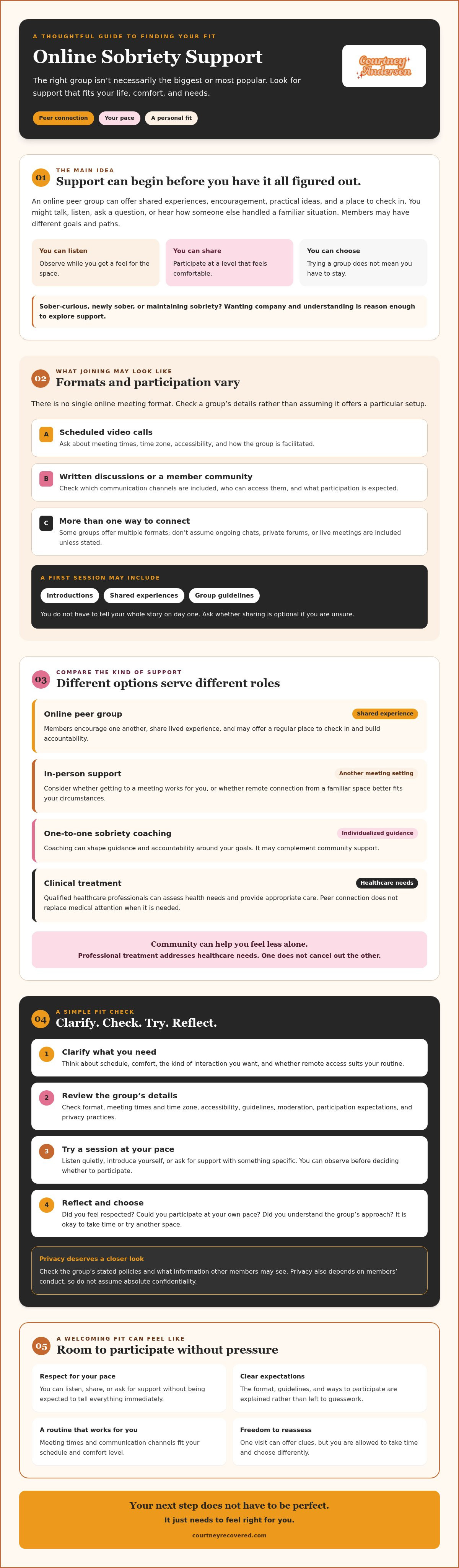
How to Choose an Online Sobriety Support Group That Fits
The right group should fit your real life, not an imaginary version with unlimited time and zero nerves. Use this process to narrow your options and decide whether a group feels like a good fit.
- Name what you need. Are you looking for shared experience, regular encouragement, accountability, or a place to listen while you explore sobriety?
- Review the format. Check whether the group meets by video, uses written discussions, or offers another way to participate. Confirm the schedule, time zone, accessibility, and any membership requirements directly.
- Check the boundaries. Read the community rules and privacy practices. Find out how the group is moderated, what information other members can see, and how people ask for support.
- Try a session if you can. Treat your first visit as a chance to observe, not a commitment to share or stay.
- Reflect afterward. Ask yourself whether you felt respected, whether the group’s approach matched your goals, and whether its practical details work for you.
Questions to ask before joining
Get clear answers before sharing personal details. Who facilitates the group, and how does it explain its purpose and guidelines? What information will other members see, and what privacy limits apply? Confirm participation expectations, accessibility, meeting times, and membership details with the group itself. Online spaces can’t promise absolute privacy, so decide thoughtfully what you’re comfortable sharing.
How to tell whether a group feels like your people
Notice how members respond when someone speaks. Are different experiences treated with respect? Can you pass, set boundaries, or ask for support without pressure or judgment? A group doesn’t have to feel instantly familiar, but you should have room to participate at your own pace. If it doesn’t feel right, you can leave and explore another format. For broader ideas, look for a guide to finding an online sober community.
Looking for a community option to evaluate? Explore the Sobriety Circle, then review its current format, participation details, and membership inclusions to see whether they match what you’re looking for.
Explore the Sobriety Circle as Your Next Step
If you’re looking for peer connection, Courtney Recovered’s Sobriety Circle is a membership-based community to consider. Think about what matters to you: the group’s approach, its boundaries and privacy practices, how members participate, and whether the practical details fit your routine. The name alone can’t tell you whether a community is right for you, so get familiar with the current offering before deciding.
What to consider before exploring the Sobriety Circle
Compare the community’s current format with the kind of support you want. Before joining, confirm how participation works, what membership includes, and whether it’s currently available. Check any guidelines and privacy information, too. Those details can change, and it’s reasonable to ask questions before you commit. Exploring an option doesn’t obligate you to join. The goal is an informed choice that feels right for you.
If you want more individualized guidance and accountability, one-to-one sobriety coaching is a separate option from community membership. Courtney Recovered offers personalized coaching as well as the Sobriety Circle. Coaching can complement peer support, but neither coaching nor a community replaces medical care.
If the Sobriety Circle sounds worth exploring, review the community and confirm its current membership details before deciding. No pressure. Fit matters more than rushing into a choice.
When peer support should not be your only support
A peer group can offer understanding and shared experience, but members aren’t there to assess or manage medical withdrawal risks. If you’re concerned about withdrawal, your health, or whether you need treatment, contact a qualified healthcare professional promptly. Getting medical guidance is a practical step, not a failure of willpower.
If you’re in the United States and facing immediate danger, call 911. If you’re in emotional distress or thinking about suicide, call or text 988 to reach the 988 Suicide & Crisis Lifeline. Peer support can be one meaningful part of your recovery, alongside professional care when you need it. You deserve support that fits where you are right now.
Take Your Next Step Toward More Connection
The right sobriety support group online is one that feels workable, respectful, and aligned with what you need. You don’t need your whole recovery plan before reaching out. Start by checking how a group works, what its privacy boundaries are, and whether you can take part at your own pace.
Peer connection, one-to-one coaching, and clinical care have different roles. You can choose the mix that fits your needs, and seek qualified healthcare support for medical concerns. There’s no prize for doing it alone.
Courtney Andersen is a professional sober coach and author. Courtney Recovered offers the Sobriety Circle, a membership-based community, as well as one-to-one sobriety coaching for personalized guidance and accountability. Explore the current community details and decide whether the format feels right for you.
Explore the Sobriety Circle and find your people. Review the current details and take the next step toward community if it feels like a fit.
Frequently Asked Questions
Is an online sobriety support group effective?
An online sobriety support group can offer connection, shared experience, and a place to build accountability, but no group can promise a particular result. How useful it feels may depend on your goals, participation, and whether the group’s approach suits you. Consider whether its meeting format, community guidelines, and privacy boundaries feel workable. Peer support can be one part of recovery, but it isn’t a substitute for professional assessment or treatment when needed.
Can I join an online sobriety group if I am not sure I want to quit drinking?
Possibly, but each group sets its own purpose and eligibility guidelines. Some may welcome people who are exploring their relationship with alcohol, while others may focus on sobriety. Check the group description and ask about expectations before joining. You deserve an honest answer, not pressure to claim certainty you don’t feel. If you’re worried about your drinking or health, consider discussing those concerns with a qualified healthcare professional.
Are online sobriety support groups confidential?
Not completely. Privacy policies, platform settings, and member practices vary, and a group can’t guarantee that every participant will keep shared information private. Before joining, review its rules and ask how moderation works and what other members can see. Consider using a display name or keeping identifying details private until you’re comfortable. Group guidelines can encourage respect, but they can’t remove every risk of sharing personal information online.
How do I choose the right online sobriety support group?
Compare each group’s purpose, format, facilitation, privacy practices, accessibility, and community culture. Check practical details such as meeting times and whether you can listen without sharing. If a trial session or observation is permitted, use it to notice whether members treat one another respectfully and whether the group feels useful to you. You don’t have to make the first group work. Trying another is a reasonable next step if the fit feels off.
Can an online support group replace alcohol treatment or medical help?
No. Peer support can provide connection, but it can’t replace medical assessment, treatment, or care for potentially dangerous alcohol withdrawal. If you have health concerns, are experiencing withdrawal symptoms, or think you may need treatment, contact a qualified healthcare professional for guidance. A group can sit alongside appropriate care, but it isn’t equipped to assess medical needs. If you or someone else is in immediate danger, contact local emergency services now.
What is the difference between an online sobriety group and sobriety coaching?
An online sobriety group brings people together for shared peer connection and experience. Sobriety coaching is generally individualized, offering guidance and accountability shaped around a person’s goals. Neither should be treated as clinical care unless a service explicitly provides it through qualified healthcare professionals. Think about whether you want community, one-to-one attention, or both. If you have healthcare needs, seek qualified clinical guidance rather than relying on peer support or coaching alone.
How often should I attend an online sobriety support group?
There’s no universal schedule that suits everyone. How often you attend may depend on the group’s meeting times, your needs, and what you can sustain alongside daily life. Check whether the group has participation expectations rather than assuming every community requires the same commitment. You might start with a manageable level of involvement, then reassess whether it helps you feel connected. Keep other appropriate supports in place, and adjust your routine as your needs change.
I want you to feel sober NOT boring!
Kickstart your sobriety with my free 2-day video workshop series to master your sober mindset and have FUN in your sobriety journey!


