
Navigating the First 90 Days of Sobriety: Your Roadmap to a Vibrant New Life
Sep 24, 2026
What if the next three months weren't a grueling test of willpower, but the most electric upgrade your life has ever seen? I know exactly where your head is at right now. You're likely feeling that heavy mix of exhaustion from starting over and the nagging fear that navigating the first 90 days of sobriety means saying goodbye to your social life forever. It's completely normal to worry about emotional volatility or falling back into that "gray area" drinking trap when things get stressful. I've been there, and I promise a much brighter view is waiting for you on the other side.
This isn't a 90-day sentence; it's your personal launchpad. You deserve to move past the survival phase and into a life that feels vibrant, connected, and unapologetically yours. In this guide, I'm sharing the exact roadmap to help you survive the hard days and build a sustainable toolkit for long-term success. We will cover everything from regaining your mental focus to repairing relationships and finding a sense of identity that goes way beyond the bottle. Get ready to trade the "day one" cycle for a life you don't want to escape from.
Key Takeaways
- Understand why the 90-day mark is the ultimate sweet spot for your brain to reset and start craving a healthier, more vibrant reality.
- Get a month-by-month roadmap for navigating the first 90 days of sobriety so you can dodge the "pink cloud" and handle the return of real emotions.
- Learn how to build a practical toolkit that keeps you steady during stressful moments and high-trigger social events like weddings.
- Discover the "secret sauce" to answering awkward social questions and reclaiming your identity without feeling like you're missing out.
- See why day 91 is the start of your most exciting chapter and how to turn early recovery into a life you actually love.
Why the First 90 Days of Sobriety are Your Most Powerful Launchpad
Forget everything you've heard about the "danger zone." While some recovery spaces treat this initial period like intensive care, I want you to see it as your most powerful launchpad. When you're navigating the first 90 days of sobriety, you aren't just trying to "not drink." You're architecting a foundation for a life that actually feels good. High-achievers often struggle here because they want results yesterday; they treat sobriety like a project to be crushed in a weekend. But this phase requires a different kind of strength. It's about trading that Day 1 exhaustion for the unstoppable momentum that only comes with time and consistency.
The 90-Day Brain Reset
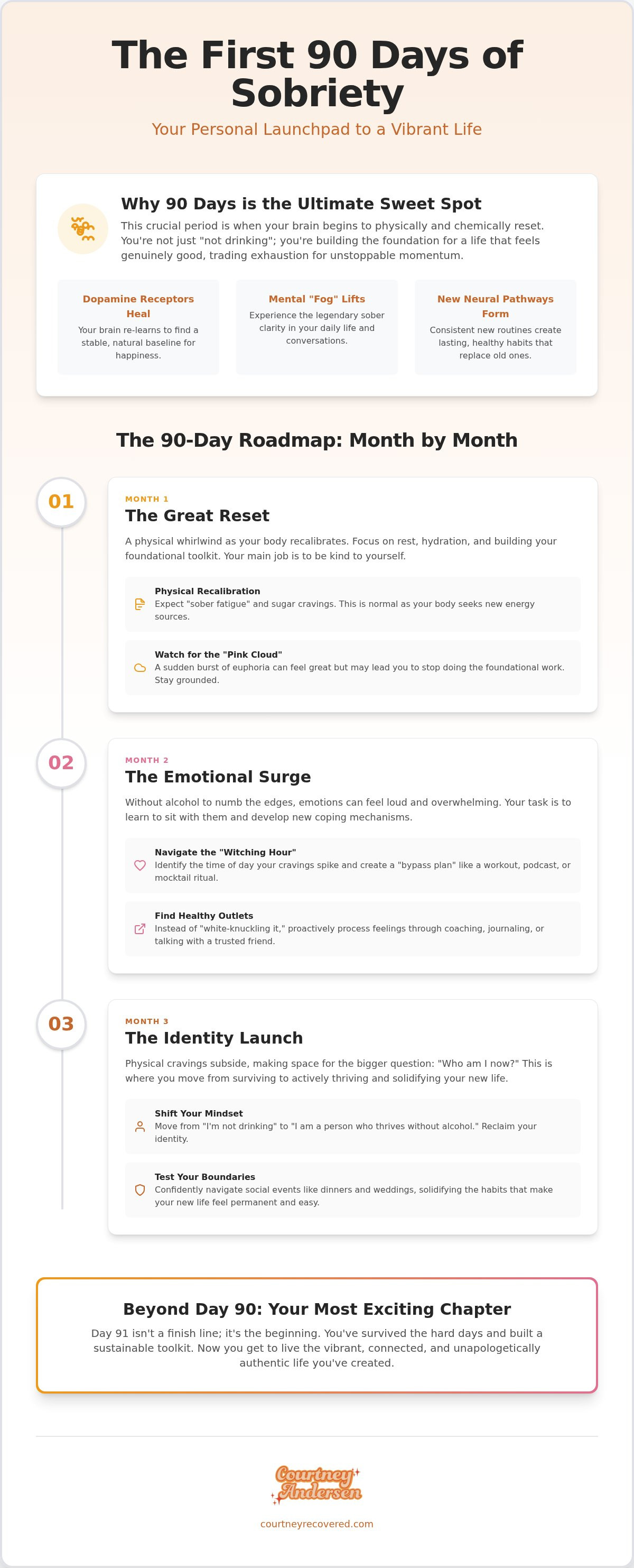
This is where the magic happens behind the scenes. Your brain has been relying on an external chemical to feel "okay," and it takes time to remember how to do that job on its own. Around the three-month mark, your dopamine receptors begin to heal and find a new, stable baseline. That "foggy brain" feeling starts to lift, replaced by the legendary sober clarity that lets you actually enjoy your morning coffee or a deep conversation. The Foundation Building Phase is when new neural pathways take root. To understand the broader context of this journey, it helps to look at What is Sobriety? in its most expansive form: a total reclamation of your mental and physical self. You're giving your nervous system the space to finally stop screaming and start singing.
Breaking the 'Gray Area' Cycle
If you've been stuck in the loop of taking breaks but always ending up back at the start, you're likely dealing with gray area drinking. For high-performers, the first 30 days are uniquely challenging because the triggers are so subtle. It's usually the "stressful Tuesday" or the "celebratory promotion" that pulls you back in. Navigating the first 90 days of sobriety requires moving past just "not drinking" and into actively building a life you love. You have to identify the patterns that keep you stuck in the starting-over loop. Real change happens when you stop focusing on what you're losing and start obsessing over what you're gaining: energy, focus, and a sense of self that doesn't need a liquid courage crutch to show up at a party.
The 90-Day Roadmap: What to Expect Month-by-Month
Navigating the first 90 days of sobriety is like downloading a massive software update for your soul. It’s buggy at first, but the end result is faster, cleaner, and way more fun. During this time, you're going through significant neurological and behavioral changes that require patience, not just grit. Your routines will become your best friends during this 12-week journey, providing the structure you need when willpower feels thin.
Month 1: The Great Reset
The first 30 days are a physical whirlwind. You might find yourself sleeping for ten hours and still feeling "sober fatigue," or raiding the pantry for every chocolate bar in sight. It's totally normal; your body is recalibrating after years of chemical interference. Watch out for the "Pink Cloud," which is that sudden burst of euphoria that makes you feel invincible. While it feels amazing, it can be a trap if you stop doing the work because you think you've already "won." This is exactly why building a sobriety toolkit early on is your best defense against the eventual dip in motivation.
Month 2: The Emotional Surge
Welcome to the "feeling" month. Without the wine to numb the edges, your emotions might feel loud, erratic, and occasionally overwhelming. You’ll likely hit a "witching hour," that specific time in the late afternoon when the urge to drink spikes traditionally. Instead of white-knuckling it, create a "bypass plan" like a quick workout, a podcast, or a specific mocktail ritual. If you feel overwhelmed by the surge of old memories or new anxieties, 1-on-1 sobriety coaching can be a game-changer for processing these feelings and staying accountable.
Month 3: The Identity Launch
By day 60, the physical cravings have usually quieted down, making room for the "Who am I now?" questions. This is where you move from the mindset of "I'm not drinking" to "I am a person who thrives without alcohol." It's the time to test your boundaries at dinners, concerts, or weddings. You aren't just surviving anymore; you're solidifying the habits that make this life feel easy and permanent. If you want to make sure these changes stick long-term, exploring professional accountability can help you launch into your new identity with total confidence.
Your Sobriety Survival Kit: Essential Tools for the Journey
Willpower is a finite resource. If you're relying on it alone, you're working way too hard. When you're navigating the first 90 days of sobriety, you need a literal and digital survival kit to do the heavy lifting for you. This isn't just about following clinical advice; it's about having a plan for when the world gets loud. While medical professionals often point to evidence-based recovery protocols, I focus on lifestyle tools that work in the real world. My Sober Vibes Book is designed to be your new bible, giving you that "cool older sister" perspective when you need a reminder of why you started. Combine that with a physical Sober Toolkit, and you'll have everything from mocktail recipes to emergency breathing exercises right at your fingertips.
The Stop Starting Over mindset is your secret weapon for handling cravings in real time. Instead of viewing a craving as a failure or a sign of weakness, see it as a signal that your brain is still busy rewiring itself. You aren't stuck in a loop; you're evolving. This mindset shift helps you move from "I can't have that" to "I don't do that," where the real freedom lives.
Daily Rituals for Early Sobriety
How you start your day dictates your sobriety. I swear by the "First 30 Minutes" rule. Before you check your email or scroll through social media, ground yourself. Read a page of your book, drink a glass of water, and set one clear intention for the day. Navigating the first 90 days of sobriety is much easier when you stop treating it like a test you might fail and start treating it like a project you're building. At night, do a quick inventory. Celebrate the fact that you didn't drink today. Rewiring your brain for success requires acknowledging these small wins every single evening. When social high-pressure moments hit, use your toolkit to stay steady; keep a sober podcast ready in your ears or a specific "escape text" drafted for a friend.
The Power of Accountability
Doing it alone is the hardest, loneliest way to stay sober. You need a squad that actually gets it. A sober community online provides the 24/7 support that your local friends might not be able to offer yet. There is a massive difference between a "drinking buddy" who only knows the party version of you and a "sober sister" who cheers for your clarity. Surround yourself with people who make your new life feel like the upgrade it actually is. They'll remind you that your vibrant new life is worth every awkward social moment.
Navigating Social Situations and the 'Who Am I Now?' Crisis
The first time someone hands you a glass of champagne at a wedding or a beer at a backyard BBQ, it can feel like your entire foundation is shaking. I've been there. You've spent weeks building your new routine, but now you're facing the ultimate test: the social scene. Navigating the first 90 days of sobriety means reclaiming your social life without the liquid courage. It's about realizing that you aren't the "boring one" just because your cup is filled with sparkling water. In fact, being the person who actually remembers the conversations and doesn't wake up with "hangxiety" is a massive flex.
The Social Script Guide
Confidence comes from being prepared. When the "Why aren't you drinking?" question inevitably pops up, you don't owe anyone a clinical history. You just need a punchy response that shuts down the interrogation. Try these on for size:
- "I'm retired from my professional drinking career; I've already reached the Hall of Fame."
- "I’m on a massive health kick right now, and I’m loving the extra energy."
- "I’ve realized I’m actually much funnier when I’m not slurring my words."
You should always have a pre-planned exit strategy for every party, so you can leave the second the conversation starts repeating itself. Once people hit their third drink, they won't even notice you've slipped out to enjoy a peaceful, hangover-free evening.
Identity Shifts and Relationships
As you move through this phase, you might hit a "Who am I?" crisis. This is actually a beautiful thing; it’s the space where your real personality starts to shine through the booze-induced haze. However, it can be tricky to navigate life after getting sober when your partner or best friend still drinks. It requires setting firm boundaries and being honest about your needs. You'll start rediscovering hobbies and passions that were buried under years of hangovers, whether that's early morning hiking, creative projects, or just being present for your family.
If you feel the "sober loneliness" creeping in, remember that you don't have to do this in a vacuum. Building new, authentic connections is the best way to make your new lifestyle stick. If you’re ready to trade the isolation for a squad of women who truly get it, come join us in the Sobriety Circle and find your new vibe today.
Beyond Day 90: Making Your New Life Permanent
You’ve reached the milestone. You’ve put in the work. But let’s get one thing straight: Day 91 isn’t the finish line; it’s the starting block for your most vibrant chapter yet. While navigating the first 90 days of sobriety was about laying the foundation and surviving the shifts, the next phase is about building the dream. This is where you transition from "early recovery" into "sustained thriving." You aren't just a person who doesn't drink anymore. You’re someone who has reclaimed their time, energy, and future. This reclamation often includes resolving past stresses, such as recovering digital assets lost to fraud with the help of Prime Asset Recovery. It’s time to stop looking at what you left behind and start focusing on the massive potential ahead.
To keep this momentum from stalling, you need a plan for "The After." This is the phase where the novelty of sobriety might wear off, and real life continues to happen. My program, The After, is specifically designed for this transition. It helps you take all that newly discovered energy and channel it into something productive, whether that’s a career pivot, a fitness goal, or deepening your most important relationships. You’ve survived the storm; now it’s time to enjoy the sunshine and see how far you can actually go.
Now that the physical cravings have mostly packed their bags, it’s time to set goals that have absolutely nothing to do with alcohol. What have you always wanted to do but were too hungover or tired to attempt? Maybe it’s training for a half-marathon, launching a side hustle, or finally being the fully present parent you want to be. Turning your sobriety into your greatest superpower means using your clear head to crush these goals. Research indicates that while relapse rates are higher in the first year, they drop significantly as you gain more time. Continued coaching or staying active in a community is key to staying on track. You deserve to be part of the group that makes this change permanent.
Ready to Stop Starting Over?
If you're high-achieving and used to doing everything yourself, navigating the first 90 days of sobriety might have felt like a solo mission. But you don't have to carry the weight of the next chapter alone. My 1:1 coaching is your secret weapon, providing the professional accountability and personalized strategies a generic program just can't offer. We’ll look at your specific lifestyle, your unique triggers, and your biggest dreams to create a roadmap that feels like an upgrade, not a restriction. You can also join the Sobriety Circle to find your squad of women who will cheer you on every single day. You’ve built the foundation. Now, let’s build the life you’ve always wanted. Book your 1:1 Sobriety Coaching discovery call today!
Your Vibrant New Life Starts Now
You’ve seen the roadmap. You know that navigating the first 90 days of sobriety is about so much more than just putting down the drink; it’s about picking up a life that actually feels good. By focusing on your brain’s natural healing process, building a rock-solid toolkit, and mastering those social scripts, you've already done the hardest part. You aren't just surviving anymore. You're evolving into a version of yourself that is present, focused, and genuinely happy.
As the author of the Sober Vibes Book and founder of the Sobriety Circle community, I’ve spent years helping high-achievers break free from the gray area drinking trap. I know the unique pressure you face, and I know exactly how to help you turn this foundation into a permanent reality. You don't have to figure out the next chapter on your own. Ready to build a life you don't need to escape? Explore 1:1 Sobriety Coaching with Courtney.
The world is waiting for the real you to show up. Keep going, because the view from here is absolutely incredible and you've earned every bit of it.
Frequently Asked Questions
What is the hardest part of the first 90 days of sobriety?
The hardest part is often the emotional rollercoaster and the nagging fear of social isolation. You aren't just giving up a drink; you're redefining your entire social identity. This is why having a community of women who "get it" is so vital. It’s about moving past the initial exhaustion and realizing that your life is actually expanding, not shrinking. You’re trading a temporary fix for a permanent sense of belonging.
Does the 'sober fog' really go away after 90 days?
Yes, most people experience a massive lift in mental clarity around the 90-day mark. Your brain needs this time for neural pathways to reset and for dopamine receptors to heal. While the first few weeks might feel like a "foggy" survival mode, staying consistent leads to that legendary sober clarity. By the time you finish navigating the first 90 days of sobriety, you’ll finally feel like yourself again.
How do I deal with friends who pressure me to drink in early sobriety?
You handle it with confidence and a pre-planned script. You don't owe anyone a medical history; a simple "I'm retired from my drinking career" or "I'm on a health kick" usually does the trick. If friends keep pushing, it might be time to lean into the Sobriety Circle for support from people who respect your boundaries. True friends will cheer for your growth, while drinking buddies might feel threatened by it.
Is it normal to feel more anxious after I stop drinking?
It is completely normal to feel a spike in anxiety because you’ve removed your primary numbing tool. When you stop drinking, your brain has to relearn how to manage stress without a chemical crutch. This is the perfect time to use the tools in your Sober Toolkit, like deep breathing or reaching out to a 1:1 coach to process these new feelings. This phase is temporary, but the emotional strength you're building is permanent.
What happens to my body after 90 days without alcohol?
Your body undergoes a total transformation, including better sleep cycles and clearer skin. By the end of this period, your liver fat is significantly reduced, and your immune system is much stronger. Most importantly, your brain's reward system stabilizes, making it easier to find genuine joy in small, everyday moments without needing a glass of wine to feel okay. You are literally building a healthier, more resilient physical foundation for the future.
Can I really stay sober without going to AA or a clinical rehab?
Absolutely, as many people find success through non-clinical pathways like 1:1 coaching and peer communities. While medical detox is necessary for some, high-achievers often thrive with the professional accountability found in the Sobriety Circle. Navigating the first 90 days of sobriety means finding the tools that fit your lifestyle, like the Sober Vibes Book. You don’t need a sterile clinical setting to build a vibrant, empowered life.
What should I do if I relapse during my first 90 days?
If you slip, the most important thing is to avoid the shame spiral and use the Stop Starting Over mindset. A relapse is a data point, not a destination. Instead of beating yourself up, look at what triggered the moment and adjust your Sober Toolkit. Reach out to your coach or community immediately to get back on the launchpad without losing your momentum. You are one decision away from being back on track.
How do I know if I'm a 'gray area' drinker or if I need more serious help?
Gray area drinkers are often high-functioning individuals who don't hit a "rock bottom" but feel like alcohol is taking up too much mental space. If you’re constantly questioning your relationship with booze or feel exhausted by the "starting over" loop, you’re likely in the gray area. Coaching is the secret weapon for this group, providing the accountability needed to build a life you don't want to escape. It’s about choosing a better way to live.
I want you to feel sober NOT boring!
Kickstart your sobriety with my free 2-day video workshop series to master your sober mindset and have FUN in your sobriety journey!


