
Is Moderation Management Effective? What to Know Before You Decide
Nov 02, 2026
What if changing your drinking doesn’t have to begin with a promise to quit forever? If you’re caught between “just cut back” and “you have to stop,” it makes sense to wonder: is moderation management effective, and could it work for you?
Moderation Management (MM) is a peer-support program for people concerned about their drinking who want to reduce harmful habits rather than commit to lifelong abstinence. It includes a 30-day alcohol-free period, self-monitoring, and personal drinking limits, so moderation doesn’t necessarily mean continuing to drink from day one. The approach may help some people, but it isn’t considered suitable for everyone, especially people with severe alcohol problems or physical dependence.
Member survey results are encouraging, but they can’t guarantee what will happen for you or establish that MM is safe for every drinking pattern. This guide explains what the program offers, what the evidence can and can’t show, and how to think about moderation and abstinence without judging or diagnosing yourself. You’ll also find practical ways to consider your next step, including what to do if cutting back doesn’t last.
Key Takeaways
- “Effective” depends on what you hope to change and whether the approach is safe for your circumstances.
- Understand what the evidence can tell you about whether moderation management is effective, and where its limits lie.
- Repeatedly going beyond your own limits is useful information, not a personal failure, and may be a reason to reconsider your plan.
- Use a clear goal, honest tracking, and regular check-ins to decide whether your approach is helping or needs to change.
- Courtney Recovered’s sobriety coaching and community can support you as you explore change; they are not Moderation Management or clinical treatment.
What Is Moderation Management, and What Does 'Effective' Mean?
If you’re asking whether you can change your drinking without choosing lifelong abstinence, that’s a fair question. There isn’t one answer for everyone. Whether Moderation Management works depends on what you want to change, whether its approach fits your circumstances, and whether the change lasts and improves your life.
Moderation Management (MM) is a peer-support approach for people concerned about their drinking who want to reduce or control alcohol use. Unlike abstinence-only approaches, it treats moderation as a possible goal. Program descriptions include an initial alcohol-free period, self-monitoring, personal limits, and peer support. The approach may not be identical for every participant, so joining doesn’t mean everyone follows the same path or gets the same result. The Moderation Management Wikipedia page provides an overview of the program’s history, approach, and intended audience.
What does Moderation Management involve?
At its core, MM encourages participants to examine their drinking and work toward less harmful patterns, rather than treating abstinence as the only possible outcome. Peer support can offer shared experience and encouragement, but it isn’t a medical assessment, detox, or individualized clinical treatment. If you’re unsure whether changing your drinking is safe for you, a peer program can’t determine that on its own. An individualized assessment from a qualified health professional may help clarify your options.
It also helps to distinguish participating in MM from moderation as a broader goal. Someone may use personal strategies to drink less without joining a program. Another person may take part in peer support and later decide abstinence is a better fit. Neither choice alone tells you whether an approach is working for that person.
How should effectiveness be measured?
To answer “is moderation management effective,” first ask: effective for what, and for whom? A useful definition is meaningful, sustained change measured against a person’s stated goals. That keeps the focus on outcomes, not on signing up, attending a meeting, or having one easier week.
Different outcomes matter to different people, and they shouldn’t be treated as interchangeable:
- Drinking reduction: drinking less than before, without assuming any particular amount is safe for everyone.
- Sustained moderation: maintaining a controlled pattern over time, not just for a short stretch.
- Abstinence: choosing not to drink, whether that was the original goal or a change in direction.
- Wellbeing: noticing whether health, relationships, mood, or daily life are improving.
- Reduced alcohol-related harm: seeing whether negative consequences become less frequent or less serious.
A single measure can miss the bigger picture. Drinking less may matter, but it doesn’t automatically mean someone feels better or that harmful consequences have stopped. Choosing abstinence isn’t evidence of failure at moderation. Consider the person’s goals, how long the change lasts, and its impact on their life together.
What Does the Evidence Say About Moderation Management's Effectiveness?
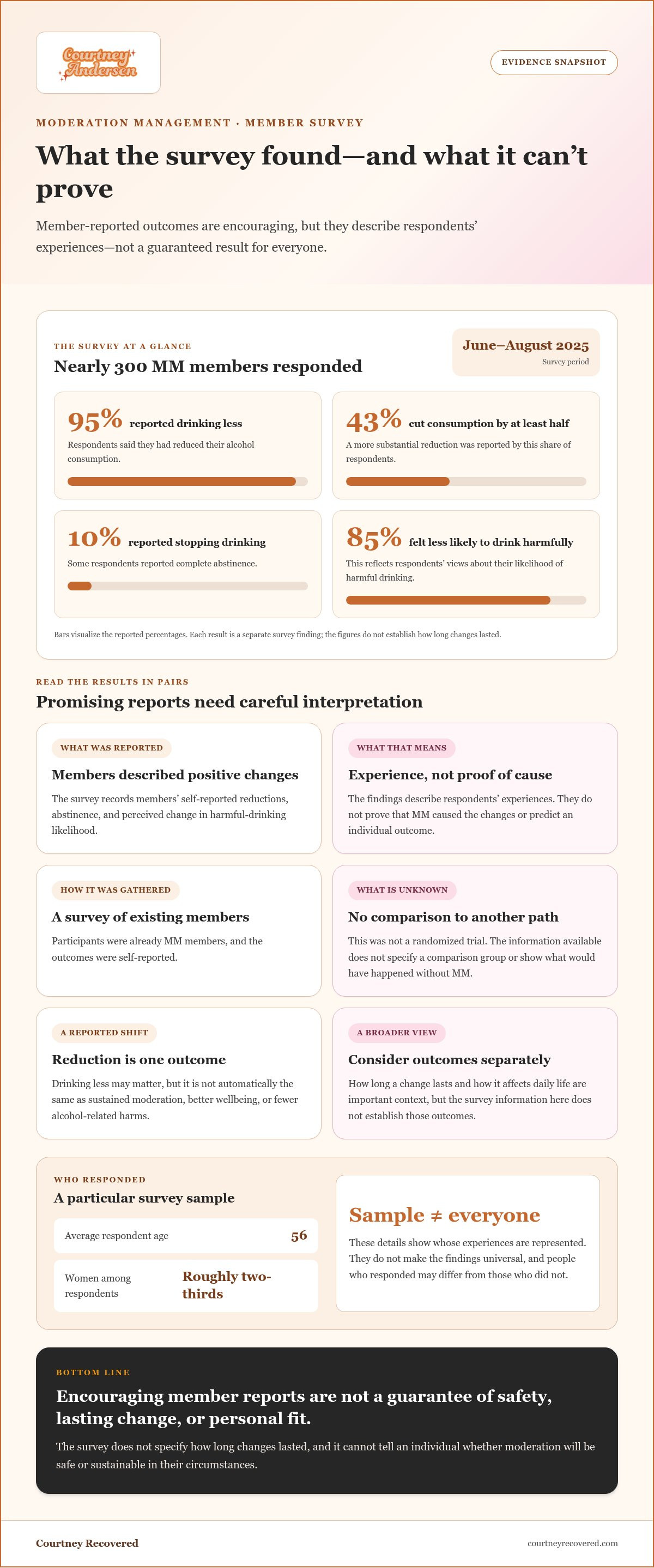
So, is moderation management effective? The clearest program-specific figure in the available evidence comes from a Moderation Management member survey conducted between June and August 2025. Nearly 300 members responded. The survey reported that 95% had reduced their alcohol consumption, 43% had cut it by at least half, and 10% had stopped drinking completely.
Those numbers are worth noting, but context matters. This was a survey of people who were already MM members, not a randomized trial comparing MM with another program or no support. The results were self-reported, and the information available here doesn’t specify a comparison group, follow-up period, or how long changes lasted. People who chose to respond may also differ from those who didn’t. The findings describe respondents’ experiences; they don’t prove MM caused those outcomes or predict what will happen for you.
What research can and cannot show
The survey also found that 85% of respondents said they were less likely to engage in harmful drinking. The respondent group matters: the average respondent was 56, and roughly two-thirds were women. These details help show whose experiences are represented, but they don’t make the results universal. Without a comparison group or fuller information about follow-up and nonrespondents, it’s difficult to separate the program’s influence from other changes in members’ lives.
Keep program-specific evidence separate from research on moderation as a goal more broadly. Evidence that some people reduce drinking through one approach doesn’t establish that they participated in MM or that MM produced the change. Likewise, enrollment and a short-term reduction aren’t the same as sustained moderation, improved wellbeing, or fewer alcohol-related harms. Each outcome needs to be considered on its own terms.
Why results differ from person to person
People bring different drinking histories, health circumstances, goals, and support systems to any change effort. They may also differ in how consistently they follow a plan and whether it remains realistic over time. A group average can describe a survey sample, but it can’t tell you whether moderation will be safe or sustainable for you.
The evidence described here is encouraging for some members, but it isn’t strong enough to establish that MM works for everyone or guarantee lasting results. Treat the survey as one useful piece of information, not a verdict. As you read further, consider what outcome matters to you, how long it lasts, and whether your health and daily life are moving in a better direction.
If you want support thinking through your goals and what sustainable change could look like, sobriety coaching offers a non-clinical space to explore your next step.
Who Might Consider Moderation, and When Is It Not a Safe Assumption?
Wondering whether moderation could work for you doesn’t mean you’re making excuses or ignoring a problem. It means you’re looking for an approach that fits your life. But a goal that feels appealing isn’t automatically safe for everyone. Your drinking history, health, and experience trying to cut back all matter.
Rather than trying to diagnose yourself, look for patterns that can help you decide what support or guidance you may need. For broader reflection on drinking patterns that can be hard to categorize, explore this guide to gray area drinking.
Questions that can clarify personal fit
Consider what happens on ordinary, stressful, or social days, not only your best days. Have the limits you set been achievable consistently? What changes have you noticed in your health, work, relationships, mood, or ability to keep commitments? These questions can help you spot patterns and clarify what matters to you. They aren’t a test and can’t diagnose alcohol use disorder.
- Look at follow-through: Do your plans usually hold up, or do you often drink more or longer than you intended?
- Notice the impact: Are there effects on sleep, emotional wellbeing, responsibilities, or important relationships that concern you?
- Consider the pattern over time: Have attempts to cut back lasted, or does the same cycle keep returning?
If you keep breaking limits you genuinely wanted to follow, that’s information, not a character flaw. It may mean the goal needs adjusting or that you’d benefit from individualized guidance. When you ask, “is moderation management effective for someone like me?” your own patterns matter, but they can’t provide a complete health assessment.
When to prioritize safety and clinical guidance
Alcohol withdrawal can be dangerous. If you’ve had withdrawal symptoms before, are worried about what might happen if you stop or cut down, or have severe symptoms, seek prompt medical advice. Shaking, sweating, nausea, and agitation can be signs of withdrawal; hallucinations or seizures require immediate emergency medical help. Don’t try to manage severe symptoms alone.
It’s especially important to get medical guidance before making a sudden change if you’re concerned you may be physically dependent on alcohol. A qualified health professional can assess your situation and discuss safer options. This isn’t about assuming the worst. It’s about protecting your health.
Peer support and sobriety coaching may offer encouragement as you explore change, but they don’t replace medical evaluation or treatment. If safety is uncertain, start by getting qualified medical guidance. After that, consider what kind of ongoing support feels right. Asking for help is a strong, practical next step.
How Can You Tell Whether a Moderation Goal Is Working?
A moderation plan can sound solid on paper and still feel different in real life. Review what you intended, what actually happened, and how your drinking affected you. Progress depends on whether a plan is sustainable and reducing harm, not just whether you meant to follow it.
Create a useful, nonjudgmental check-in
Keep a simple private record for a period that feels manageable. This isn’t about scoring yourself or proving you’re “good” at moderation. It’s about noticing patterns you might otherwise explain away or forget.
- Set a clear goal: Write down what you’re trying to change, in your own words. Don’t assume any particular drinking limit is universally safe.
- Record the context: Note when you drank, what was happening, and what limit you intended to follow.
- Write down what happened: Record what you actually drank, including occasions when you went beyond your plan.
- Check the impact: Notice changes in sleep, mood, physical wellbeing, relationships, work, and other responsibilities.
- Review the pattern: Look across multiple occasions instead of treating one difficult night as the whole story.
Be honest without turning your notes into a verdict about yourself. For example, if you planned not to drink after work but repeatedly found yourself drinking more than intended, write that down plainly. The pattern helps you decide what to do next; it doesn’t prove anything about your character.
What if moderation is not working?
If you repeatedly miss your limits or consequences keep growing, pause and reassess instead of making a stronger promise and hoping this time feels different. Ask what your notes show: Is the plan realistic? Is it helping you feel healthier and more present? Are the same unwanted outcomes continuing? Your answers can help you decide whether to adjust the goal or seek qualified support.
Abstinence can be one possible next goal. It isn’t a moral verdict, and it doesn’t have to be the right choice for everyone. If reducing or stopping alcohol could involve withdrawal concerns, prioritize medical guidance rather than trying to manage the risk through self-tracking or coaching.
Still sorting out what kind of support fits? Understanding the difference between recovery coaching and rehab can help clarify what each can and can’t provide. If you want a supportive, non-clinical space to explore your drinking goals and next steps, explore sobriety coaching.
So, is moderation management effective for you? Use your goal, tracked patterns, and the impact on your life as information. If the approach isn’t bringing sustainable change, you can choose a different path. That’s not starting over from zero. It’s responding honestly to what you’ve learned.
What Support Can Help You Choose a Next Step?
You don’t have to settle the question “is moderation management effective?” in the abstract. A useful decision brings together the evidence, your experience, safety, and the change you actually want. Ask what you hope will be different, whether your current goal feels realistic, and what your drinking patterns have shown so far. If moderation isn’t working, you’re allowed to consider another path.
Support can help you think it through without pressure to choose a particular label. Courtney Recovered offers non-clinical sobriety coaching and community support. Its services include personalized conversations about goals, accountability, and sustainable lifestyle changes, but they aren’t diagnosis, medical care, detox, or inpatient rehabilitation.
How non-clinical coaching may support change?
One-to-one coaching can offer space to talk honestly about what you want, what’s getting in the way, and what kind of change feels meaningful. Peer community may also help you feel less alone as you explore your options. Neither replaces medical evaluation or treatment, especially if you have safety concerns. For a wider look at the longer-term questions change can bring, explore this reflection on building a life after sobriety.
There’s no need to map out your whole future today. Try this:
- Name your main concern: For example, “I keep drinking more than I intend” or “I’m worried about the effect on my relationships.”
- Write down the change you want to explore: Be specific about what you hope will improve, while staying open to adjusting the goal.
- Choose support that fits the need: Coaching and community can support reflection and accountability; medical concerns call for qualified clinical guidance.
Choose one manageable next step
Keep it small enough to do. You might write down your concern and bring it to a supportive conversation, or review what your recent patterns have been telling you. If you’re worried about withdrawal, have experienced it before, or have severe symptoms, prioritize prompt medical advice. Coaching and peer support can’t assess or manage withdrawal safely.
If personalized, non-clinical support feels like a helpful place to explore your goals, explore 1:1 sobriety coaching. You deserve support that meets you where you are, without promises about your outcome.
Changing the plan is information, not failure. You can use what you’ve learned, get the right support, and choose your next step with care. That counts.
Choose the Support That Moves You Forward
You don’t need to have your whole recovery story figured out before taking a next step. Start with what you want more of: peace of mind, reliable follow-through, better mornings, or a life that feels more like yours. Then choose support that respects your goals and gives you room to adjust them as you learn.
So, is moderation management effective? It may help some people, but no approach can promise the same outcome for everyone. What matters now is choosing a direction that feels honest and noticing whether it supports the life you want. If you’re curious about exploring sobriety, Courtney Andersen’s personalized 1:1 coaching, the Sobriety Circle, and practical recovery resources offer ways to find support without pressure to have all the answers today.
Explore personalized sobriety coaching and take one manageable step toward change. You’re allowed to rethink the plan, ask for support, and build a future that feels brighter, one choice at a time.
Frequently Asked Questions
Is Moderation Management evidence-based?
Some program-specific evidence exists, but it doesn’t show that Moderation Management works for everyone. A survey of nearly 300 MM members conducted from June to August 2025 reported self-described reductions in drinking, but it wasn’t a randomized comparison and doesn’t establish how lasting the changes were. Research on reducing drinking more broadly is a separate question; it can’t automatically show that MM caused an outcome. That’s why “is moderation management effective” needs a qualified answer.
Can Moderation Management work for someone who has tried to cut back before?
Previous attempts matter, but they don’t diagnose you or determine what will happen next. Think about what made those efforts difficult: Was it a particular setting, stress, or finding that limits shifted once you started drinking? Note any effects on work, relationships, or health, then discuss the pattern and your safety with qualified support. If you repeatedly can’t meet goals you set, treat that as a reason to reconsider the plan, not proof that you lack willpower.
Does Moderation Management require complete abstinence?
MM focuses on moderation, not lifelong abstinence as the only acceptable outcome. Available program descriptions include an initial 30-day alcohol-free period, but guidelines and participation details can change, so consult the organization’s current materials for specifics. A program’s approach also doesn’t lock you into one personal goal. You might explore moderation and later choose not to drink at all. Abstinence is a valid choice, not a sign that you failed.
How long does it take to know whether a moderation plan is working?
There isn’t a reliable universal timeline. Give yourself enough time to notice patterns across ordinary routines and challenging situations, rather than judging the plan by one easy weekend. Consider whether you’re meeting your stated goals and whether consequences are changing. If problems are getting worse, or you have health or safety concerns, don’t wait for a review period to end. Reassess sooner and seek qualified guidance about what to do next.
Can you switch from moderation to abstinence if moderation is not working?
Yes. You can change your goal as you learn what does and doesn’t work for you. Choosing abstinence after trying moderation is a practical adjustment, not a personal failure or a reason to feel ashamed. If you’re concerned you may be physically dependent on alcohol, or you’ve experienced withdrawal symptoms, speak with a medical professional before stopping. A change in goal can be supported by honest reflection and the right kind of help.
What is the difference between Moderation Management and sobriety coaching?
Moderation Management is a peer-support approach centered on changing drinking patterns, while sobriety coaching offers personalized, non-clinical support as someone explores recovery goals and lifestyle changes. Courtney Recovered offers sobriety coaching and community support, not Moderation Management. Coaching may help with reflection and accountability, but neither peer support nor coaching provides medical assessment or treatment. If you have health concerns, seek guidance from a qualified medical professional.
Can I stop drinking suddenly if I am worried about withdrawal?
If you’re concerned about dependence or withdrawal, get prompt medical guidance before stopping; a general article can’t assess your personal risk. Alcohol withdrawal can be dangerous, and trying to handle it without medical advice may put your health at risk. If symptoms are severe or feel urgent, seek emergency medical care now. Don’t try to create a home detox plan based on online advice. Getting help to make a safe plan is a strong first move.
I want you to feel sober NOT boring!
Kickstart your sobriety with my free 2-day video workshop series to master your sober mindset and have FUN in your sobriety journey!


