
How to Stop Drinking on Your Own: Your Personalized 2026 Sobriety Plan
Aug 15, 2026
What if the reason you keep starting over every Monday morning isn't a lack of willpower, but a lack of a roadmap that actually sounds like fun? You're likely exhausted from playing the part of the functional failure, terrified that choosing sobriety means trading your vibrant social identity for a sterile, clinical basement. It's a lonely cycle, and quite frankly, you deserve a better exit strategy than just white-knuckling it through the weekend.
The good news is that you don't need a medical facility to find your spark again. I'm going to show you how to build a personalized sobriety plan that prioritizes your joy over restriction. We're ditching the somber recovery vibes and designing a high-energy lifestyle where you feel better on a Tuesday morning than you used to feel after three martinis. This guide will walk you through a manageable daily routine, a social life that feels even better than the drinking version, and the essential tools to make 2026 the year you finally stop starting over and start truly living.
Key Takeaways
- Stop exhausting yourself with willpower and learn how to build a personalized sobriety plan that turns "quitting" into a massive lifestyle upgrade.
- Identify your high-risk triggers using the H.A.L.T. method and start building a custom toolkit that makes alcohol feel totally irrelevant.
- Master your day with a 24-hour blueprint, including morning anchors and social scripts that keep you confident at parties or work events.
- Discover why community is your secret weapon and how to find modern, vibrant spaces that make sobriety feel like a social gain rather than a loss.
- Navigate the first 90 days with a clear strategy for handling both the "pink cloud" highs and the inevitable flat days.
Beyond Willpower: Why You Need a Personalized Sobriety Plan to Stop Drinking on Your Own
Willpower is a limited resource. If you're relying on grit alone to get through the weekend, you're setting yourself up for that exhausting 3 AM "never again" monologue. White-knuckling your way through cravings is like trying to hold your breath underwater; eventually, you have to gasp for air, and that's usually when the Monday reset happens. Learning to build a personalized sobriety plan means moving away from the struggle and toward a strategy. It's a roadmap you design for yourself that treats your life like the celebration it should be, not a series of restrictions.
Most people think they need to hit a dramatic, movie-style rock bottom before they can justify a change. But many of us fall into the category of gray-area drinking, where the consequences aren't always visible to the outside world, but the internal toll is massive. When you look at the clinical definition of What is Sobriety?, it often focuses on the absence of substances. But for us, it's about the presence of everything else. It's about better sleep, authentic connections, and a brain that doesn't feel like it's wrapped in cotton wool every morning.
Shifting your narrative is the first step. Sobriety isn't a "loss" of your social life or your "fun" self. It's a massive gain of time, energy, and genuine health. You aren't giving anything up; you're trading a habit that makes you feel small for a life that makes you feel electric.
The Difference Between 'Not Drinking' and Living Sober
Just "not drinking" can feel like a prison sentence if you don't change your mindset. This is often called being a "dry drunk," where you're technically sober but still miserable, resentful, and bored. Living sober is an active, joyful choice. It’s moving from the restrictive "I can't drink" to the empowering "I don't drink." A plan gives you the "why" behind your "no" when you're at a wedding or a work dinner, making those moments feel like a win instead of a sacrifice. When you understand how to build a personalized sobriety plan, you create a life you don't need to escape from.
Assessing Your 'Recovery Capital'
To make this stick, you need to audit your resources. Recovery capital is the collection of tools that make sobriety sustainable. This includes internal assets like your resilience and your personal goals, as well as external supports like your Sober Toolkit or the community you find in the Sobriety Circle. Look at your environment honestly. Does your home feel like a sanctuary or a trigger? If your social circle is built entirely around the bar, you'll need to intentionally add new, vibrant layers to your support system to ensure your success.
Step 1: Building Your Custom Sober Toolkit
You wouldn't show up to a construction site without a belt full of tools, and you shouldn't try to change your life without a proper setup either. When you're learning how to build a personalized sobriety plan, your toolkit is what stands between you and a "fuck it" moment on a stressful Tuesday. We're moving beyond the idea of just "quitting" and into a phase of active, vibrant addition. It’s about filling your life with things that make you feel so good you don’t want to numb out.
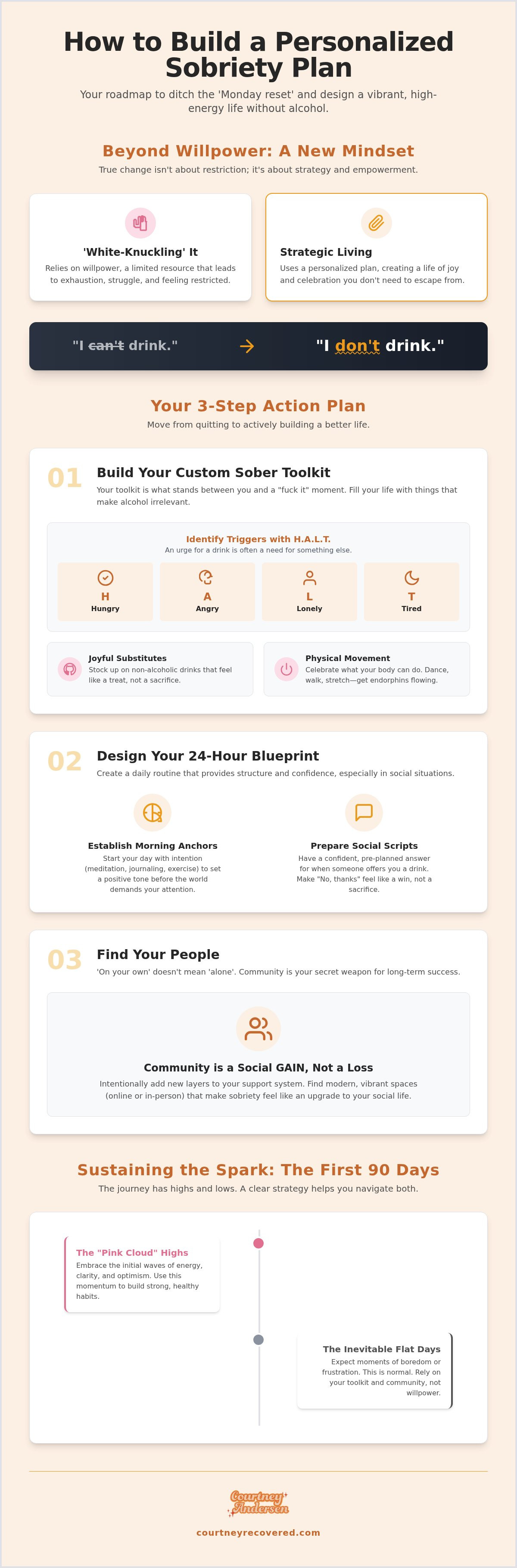
A solid toolkit starts with self-awareness. Use the H.A.L.T. method to check in with yourself whenever an urge hits. Ask yourself: Am I Hungry, Angry, Lonely, or Tired? Usually, the "need" for a drink is actually a need for a sandwich, a vent session, or a nap. Along with this internal check, you need external substitutes. Stock your fridge with non-alcoholic drinks that feel like a treat, not a consolation prize. Think spicy ginger beers, botanical sparkling waters, or a fancy tonic with lime. If you want a head start, my Sober Toolkit is a pre-made resource designed to give you the momentum you need.
Don't forget physical movement. This isn't about punishing yourself at the gym; it's about celebrating what your body can do now that it isn't processing toxins. Whether it’s a living room dance party or a sunset walk, get those endorphins moving. If you're feeling overwhelmed by the options, exploring evidence-based treatment options can provide extra clarity, but your daily toolkit is your front-line defense.
Rewiring Your Brain with Quit-Lit
Isolation thrives in the dark, but reading other people's stories brings everything into the light. "Quit-Lit" is essential because it removes the stigma and proves you aren't a "functional failure." My Sober Vibes Book is a great place to start if you want a practical, relatable manual for the journey. When you learn the science of how alcohol affects your brain, the "desire" to drink begins to evaporate. You stop seeing it as a reward and start seeing it for what it is: a depressant that's been holding you back from your highest energy self.
Managing the Witching Hour
For most of us, the "Witching Hour" hits between 5 and 7 PM. It’s that transition from work mode to home mode when the wine glass used to feel mandatory. To beat it, you need a new ritual. Change your environment as soon as you get home. Put on a podcast, change your clothes, or head straight for a shower. If you usually drink in the kitchen while cooking, move the prep to the dining table or have your fancy NA drink ready before you even touch a knife. If you're finding this transition particularly tough, 1:1 sobriety coaching can help you design a routine that fits your specific lifestyle perfectly.
Step 2: The 24-Hour Blueprint—Designing Your Daily Sober Routine
If your toolkit is your armor, your daily routine is your VIP itinerary for a life you actually enjoy. When you're figuring out how to build a personalized sobriety plan, you have to look at the granular moments of your day. It’s not just about "not drinking"; it’s about how you fill the hours so that alcohol doesn't even make the guest list. A successful blueprint creates a flow that supports your energy rather than draining it. While some people find success through behavioral therapies and medications to help manage the transition, your daily routine is where the lifestyle magic happens.
You also need an emergency plan for those moments when a craving hits like a lightning bolt. This might be a "break glass in case of emergency" text to a sober sister, a 10-minute walk around the block, or a quick breathing exercise. By the time the sun sets, an evening debrief allows you to celebrate that you crushed another day. Use this time to process lingering emotions or stressors before they have a chance to become tomorrow's triggers. Celebrating these small wins is how you turn a "streak" into a permanent lifestyle.
The Power of the Morning Anchor
Waking up without a hangover is a total game-changer. You aren't starting your day in a hole, trying to climb back to "baseline" with three cups of coffee and a side of shame. Instead, you have the clarity to start with a morning anchor. A morning anchor is the non-negotiable first step of your daily plan that grounds you in your "why" before the world starts making demands. Whether it’s five minutes of journaling, a specific "sober vibe" meditation, or just enjoying the silence with a coffee that doesn't taste like regret, this ritual sets a vibrant tone for everything that follows. When you master your morning, you master your mindset.
Navigating Social Situations with Confidence
Socializing was likely the centerpiece of your drinking identity, so it’s natural to feel a bit shaky about work dinners or weddings. Here is a secret: you don't owe anyone a dissertation on your liver health. Practical scripts make saying "no" feel empowering rather than awkward. A simple "I’m not drinking tonight, I’ve got a big morning tomorrow" or "I’m on a health kick and feeling amazing" is usually all it takes. If you’re heading into high-pressure events, check out my guide on how to stay sober at a bachelorette party for specific scripts that keep your confidence high and the vibe fun. Mastering how to build a personalized sobriety plan means you never have to hide at home just to stay sober.
Step 3: Finding Your People—Why 'On Your Own' Doesn't Mean Alone
Choosing to stop drinking "on your own" is an act of total independence, but it shouldn't be an act of isolation. When you're alone with your thoughts, that inner critic loves to whisper that you're a functional failure or that one glass won't hurt. You need a squad that speaks your language and celebrates your wins. Part of learning how to build a personalized sobriety plan is identifying who belongs in your corner when the cravings get loud. You aren't meant to white-knuckle this journey in the dark.
Traditional 12-step programs have their place, but for many high-achieving women, those sterile, somber environments feel totally unrelatable. You don't need a basement meeting to find freedom. Modern, vibrant communities offer a high-energy alternative where sobriety is treated like a massive promotion. You need a space that understands the unique pressure of professional life. That is why the Sobriety Circle is so effective: it connects you with women trading the Monday morning reset for a life that actually feels electric.
The Role of a Sobriety Coach
Think of a coach as your personalized shortcut to long-term success. While therapy often looks backward, 1-on-1 sobriety coaching is aggressively future-focused. You get tough-love realism from someone who has actually walked the path and navigated the same social pressures. A coach helps you refine your roadmap so you stop wasting energy on strategies that don't fit your life. It is the ultimate way to ensure your plan is a lived reality, not just a list of "shoulds" in a journal.
Building Your 'Sober Circle'
Your social life doesn't end when you stop drinking; it gets an upgrade. Find friends who celebrate your growth instead of questioning your choices. If someone is pressuring you to "just have one," they aren't your people for this season. Look for a community that is positive and action-oriented. Shared experience is the fastest way to break the shame cycle. When you see other women thriving, it proves you can too. Finding these connections is a core part of how to build a personalized sobriety plan that actually sticks.
Ready to find your squad and stop the cycle of starting over? Join the Sobriety Circle today and start building the connections that make staying sober feel like a social win.
Sustaining the Spark: Moving Beyond the First 90 Days
Hitting the 90-day no-alcohol milestone is a massive win. By now, the physical fog has lifted, your sleep is likely better than it’s been in years, and you’ve proven to yourself that you can navigate life without a liquid crutch. But this is also where many people hit a plateau. The initial "pink cloud"—that high-energy rush of early sobriety—can start to fade, replaced by what I call the "meh" days. This is exactly why how to build a personalized sobriety plan involves more than just getting through the first month; it requires a strategy for sustaining the spark long-term.
Sustaining your momentum means moving beyond the identity of someone who is "trying to quit." You are shifting into being "recovered and vibrant." This isn't a life sentence of deprivation; it’s an evolution. In my framework, I call this "The After." It’s the stage where sobriety isn't something you do, but who you are. You stop counting days and start making the days count by leaning into a lifestyle that alcohol used to crowd out. Your plan should now focus on maintenance that feels like a reward, not a chore.
Handling Life's 'Hard' Without the Bottle
Life doesn't stop being lifey just because you’re sober. Stress, grief, and boredom will still show up at your door, but now you have the tools to meet them without retreating into a bottle. This is the essence of emotional sobriety. Emotional sobriety is the ability to sit with any feeling, from soul-crushing grief to mind-numbing boredom, without needing to reach for a bottle to dull the edges. Instead of numbing out, you learn to process. You might use a quick workout to burn off stress or a deep conversation with a sober sister to navigate grief. By facing these feelings head-on, you build a level of resilience that a glass of wine could never provide.
Celebrating Your New Identity
When you stop spending your weekends recovering from the night before, you suddenly have a lot of "found time." Use it to rediscover the hobbies and passions you abandoned. Maybe it’s morning hikes, learning a new language, or finally starting that side hustle. Celebrate your milestones with the same energy as your old nights out. Treat yourself to a spa day, a weekend getaway, or a fancy dinner where you actually remember the conversation. You've worked hard to learn how to build a personalized sobriety plan that works, and you deserve to enjoy every vibrant second of it.
Ready to stop starting over and finally step into your "After"? Join the Sobriety Circle and build your plan today!
Design Your Vibrant Future
You have spent enough time stuck in the exhausting cycle of starting over every Monday morning. It is time to trade that "functional failure" feeling for the vibrant, high-energy life you actually deserve. We have covered the essentials of this roadmap, from mastering your morning anchor to navigating social scenes with scripts that keep your confidence high. Understanding how to build a personalized sobriety plan is the ultimate difference between just surviving your weekends and truly loving them.
This journey was designed by professional sober coach Courtney Andersen to bridge the gap between isolation and a connected, alcohol-free reality. You don't need clinical, sterile spaces to find your spark again. With practical resources like the Sober Vibes Book and a non-clinical, high-energy community in your corner, you have everything you need to make this change permanent. It is time to stop mourning a habit that held you back and start celebrating the woman you are becoming. You are ready for what comes next.
Ready to Stop Starting Over? Grab your Sober Toolkit and join the Circle!
Common Questions About Designing Your Alcohol-Free Life
Is it safe to stop drinking on my own without medical supervision?
Stopping on your own is safe for many gray area drinkers, but you must seek medical advice if you experience severe withdrawal symptoms like tremors, seizures, or hallucinations. Safety is the priority. If you have been drinking heavily every single day, consult a healthcare professional before making the leap. For most of us, the challenge is mental and emotional rather than a physical medical emergency.
What should be included in a personalized sobriety plan?
A solid roadmap should include your primary triggers, a 24-hour daily routine, and a list of non-alcoholic substitutes. Building a personalized sobriety plan means tailoring these elements to your unique lifestyle. Don't forget to add an emergency contact and a morning anchor ritual to keep your mindset focused on growth, not restriction.
How do I deal with cravings when I'm trying to quit on my own?
Cravings are temporary, and you can beat them by using the H.A.L.T. method to identify if you are actually hungry, angry, lonely, or tired. Move your body, drink a large glass of sparkling water, or call a sober friend. Most urges pass within 15 to 20 minutes if you distract your brain with a new activity or a quick change of scenery.
Do I have to go to AA to stay sober long-term?
You absolutely do not have to go to AA to stay sober long-term. While it works for some, many women today prefer modern, high-energy communities like the Sobriety Circle or 1:1 coaching. The goal is finding a space where you feel empowered and relatable rather than stuck in a sterile basement. Your recovery should reflect your vibrant identity.
How can I be social and still stop drinking?
You can have an even better social life without alcohol by using prepared scripts and always having a non-alcoholic drink in your hand. Most people don't care what is in your glass as long as you are present and having fun. Focus on the connection, not the cocktail. You will find that you are actually more engaging and high-energy when you aren't numbed out.
What are the best tools for a DIY sobriety toolkit?
The best DIY tools include "Quit-Lit" books like the Sober Vibes Book, sobriety podcasts, and digital trackers to visualize your progress. Having a physical Sober Toolkit helps you stay prepared for the transition from work to home. These resources provide the education and motivation needed to rewire your brain's perception of alcohol as a reward.
How long does it take for the brain to rewire after quitting alcohol?
Your brain begins to make significant repairs within the first few weeks, but substantial rewiring typically takes about 90 days. This is when your dopamine receptors start to reset, and you begin to find genuine joy in everyday activities again. Consistency is key. Over time, the mental obsession with drinking fades as your brain learns to thrive without chemical interference.
What happens if I relapse while following my plan?
If you have a slip, treat it as a data point rather than a reason to give up entirely. Analyze what led to the moment so you can adjust how to build a personalized sobriety plan to cover that gap in the future. Dust yourself off, reach out for support, and start your next day with your morning anchor. One bad night does not erase your progress.
I want you to feel sober NOT boring!
Kickstart your sobriety with my free 2-day video workshop series to master your sober mindset and have FUN in your sobriety journey!


