
Gray Area Drinking: When Your Habit Becomes a Burden
Aug 24, 2026
What if you didn't have to wait for rock bottom to decide your life deserves more than a dull headache and 3 AM hangxiety? Most people think you're either a casual social drinker or you've lost it all, but there's a massive, exhausting middle ground known as gray area drinking. It's that space where your life looks perfect on Instagram, but your internal monologue is a constant negotiation about how many drinks are "allowed" tonight. You feel like a fraud because you're successful and high-functioning; yet, the mental load of managing your habit is becoming a heavy burden you never asked to carry.
I've been exactly where you are, and I know how loud that middle-of-the-night silence feels. You likely believe that because you haven't hit a clinical disaster, you don't have "permission" to want something better. This article invites you to stop waiting for the wheels to fall off. We'll explore why this silent middle is so draining and how you can reclaim your energy. You'll learn how to trade mental obsession for a vibrant, connected reality where you wake up refreshed, proud, and free from the glass.
Key Takeaways
- Understand that gray area drinking isn't a clinical diagnosis; it's a personal signal that your relationship with alcohol is stealing your sparkle.
- Identify the silent signs of a habit turned burden, like the mental gymnastics of setting drinking rules and the crushing weight of 3 AM regret.
- Stop waiting for a crisis to give yourself permission to change; being high-functioning is just a stage you can choose to leave behind.
- Discover how a simple reset can clear the fog and prove you don't need a glass of wine to enjoy a vibrant social life.
- Learn why designing a life you don't want to escape is the ultimate secret to lasting freedom and waking up proud every single morning.
What Exactly is Gray Area Drinking?
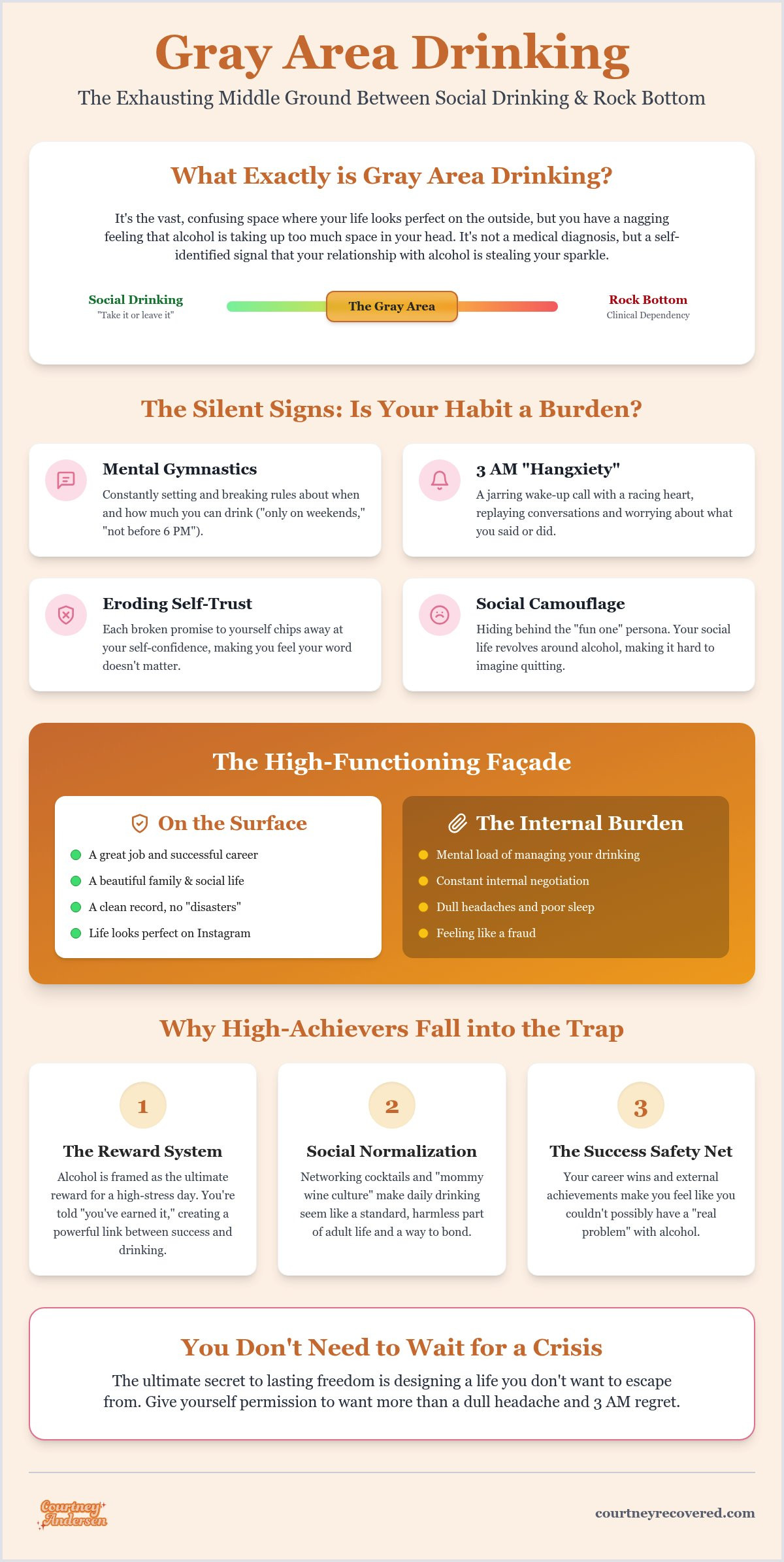
Gray area drinking is the vast, confusing space between "take it or leave it" social drinking and the stereotypical "rock bottom" often associated with a clinical Alcohol Use Disorder. It isn't a formal medical diagnosis you'll find in a textbook. Instead, it's a self-identified misalignment. You might have a great job, a beautiful family, and a clean driving record, but you also have a nagging feeling that alcohol is taking up too much space in your head. It's the silent burden of spending your 10 AM meeting wondering if you have enough wine at home for tonight.
The "Fuzzy Boundaries" of Moderation
For many women, official guidelines feel like they're written for someone else. The NIAAA defines low-risk drinking for women as no more than three drinks on any single day and no more than seven per week. But what if you're hitting those numbers and still feel like garbage? Gray-area drinking often looks like needing that first glass to transition from your professional role to your personal life rather than just wanting a drink for the taste. It's less about physical withdrawal and more about a mental dependency on the ritual to shut your brain off. You aren't physically "addicted" in the way movies portray it, but you're definitely stuck in a loop.
Why High-Performers Fall into the Gray Area
High-achievers are particularly susceptible to this trap. We've been conditioned to view alcohol as the ultimate reward for a high-stress day. Whether it's the "mummy wine culture" in your neighborhood or the professional pressure to network over cocktails, the message is everywhere: you've worked hard, you deserve this. In 2024, nearly 47 percent of people in the U.S. used alcohol in the past month. For many high-performers, that use is a calculated, high-stakes attempt to manage stress.
- The Chemical Off-Switch: Alcohol acts as a temporary escape for a high-energy, high-stress life.
- Social Normalization: Your circle likely views daily drinking as a standard personality trait or a way to bond.
- The Success Safety Net: Your career wins make you feel like you couldn't possibly have a "problem."
The irony is that we use a central nervous system depressant to relax from a life we've worked so hard to build. It's a trade that eventually leaves you more exhausted than when you started.
The Silent Signs: Is Your "Social" Habit Actually a Burden?
Do you have a list of mental "rules" that would make a drill sergeant blush? Maybe you've told yourself you only drink on weekends, or you never open a bottle before the clock strikes 6 PM. If you're constantly negotiating with yourself, you're likely dealing with the weight of gray area drinking. People who have a truly neutral relationship with alcohol don't need to set boundaries to keep things from spiraling. The very act of "managing" your intake is a signal that the habit has become a mental load you weren't meant to carry.
Then there's "Hangxiety." It's that jarring 3 AM wake-up call where your heart is racing, your mouth is dry, and your brain is on a loop of every awkward thing you might have said. You're analyzing The Silent Signs of gray area drinking, wondering if anyone noticed you finished your glass in the kitchen before bringing the bottle back to the table. This "secret drinking" isn't about being a "functional alcoholic"; it's about the shame of knowing you want more than you're willing to admit out loud. You aren't failing; you're just exhausted from the mental gymnastics.
The Physical and Emotional Toll
You might wake up and get the kids to school or lead a board meeting, but are you actually vibrant? Gray area drinking erodes your "morning edge." It shows up in dull skin, disrupted sleep cycles, and a shorter fuse with the people you love most. Worst of all, it kills your self-trust. Every time you break a rule you set for yourself, you're telling your subconscious that your word doesn't matter. It’s a heavy way to live, but you can start rebuilding that trust today with a resource like the Sober Toolkit to help you navigate the shift.
The Social Camouflage
Many women hide behind the "fun one" persona. You're the life of the party, the one who always knows the best vintage, and the first to suggest another round. This social camouflage makes it incredibly hard to stop because your friends might tell you that you don't have a "real" problem. They see your success and your smile, not your 3 AM panic. The fear of being boring is a lie alcohol tells you to keep you stuck. In reality, your personality is sparkling enough without the liquid courage; the booze is actually dampening the very light people love about you.
Gray Area vs. Rock Bottom: Why You Don’t Need a Crisis to Quit
Society tells us we only get to quit drinking if our lives are a smoking crater. We wait for the DUI, the divorce, or the lost job as a "sign" that it's time to stop. But you don't need a catastrophe to deserve a better life. In fact, research from 2024 shows that nearly 90 percent of people who drink excessively don't actually meet the clinical criteria for an alcohol use disorder. This means millions of us are living in the gray area drinking zone, waiting for a permission slip that may never come in the form of a crisis. You are allowed to stop just because you're tired of feeling "meh."
The High-Functioning Trap
People often use "high-functioning" as a badge of honor, but it's really just a stage in the journey, not a permanent status. Your professional success and organized home life make it incredibly easy to ignore the mental burden of your habit. You tell yourself that because you hit your KPIs and get the kids to soccer, you're fine. Let's be real: functioning is the bare minimum for your life, not the ultimate goal. Waiting for a sign that things have gone "too far" is like waiting for your car to explode before you change the oil. You can choose to raise your own bottom today simply because you're ready to feel vibrant again.
Traditional 12-step programs often require you to admit you are "powerless" or "broken." For many women in the gray area, that narrative doesn't fit. You don't feel powerless; you feel over-scheduled, over-stressed, and ready for a change that feels like an upgrade rather than a clinical intervention. A non-clinical approach focuses on your potential, not your past mistakes. It's about recognizing that you've outgrown a substance that no longer serves the woman you are becoming.
Choosing Gaining Over Giving Up
Sobriety isn't a punishment for bad behavior; it's a massive promotion for your entire existence. When you embrace the "Sober Vibes" philosophy, you stop looking at what you're "giving up" and start looking at what you're gaining. This is about a high-energy lifestyle where you actually have the bandwidth to chase your biggest dreams. You don't need to be at your lowest point to want to reach your highest.
- Morning Magic: Trading a foggy head for a 7 AM workout and genuine clarity.
- Emotional Resilience: Learning to handle stress without a liquid crutch.
- Authentic Connection: Building a social life that doesn't require a glass of wine to be interesting.
Reframing this choice as a positive gain changes everything. You aren't "quitting" a hobby; you're starting a new, more connected reality. You don't have to wait for the wheels to fall off to decide you want a smoother ride. You can choose a better life right now, exactly as you are.
How to Break the Cycle of Gray Area Drinking
Breaking the loop of gray area drinking isn't about having more willpower. It's about changing your strategy. If you've been stuck in the cycle of "moderating" only to end up right back where you started, it's time to put down the mental calculator. You don't need to admit you have a disease to want a change. You just need to admit that alcohol has become a burden that’s stealing your energy. The first step is a clean break to clear the fog. Commit to a 30, 60, or 90-day reset. This isn't a "forever" sentence yet; it's a data-gathering mission to see how amazing you can actually feel.
Practical Tools for the First 30 Days
The "Witching Hour" (that 5 PM to 7 PM window) is usually when the craving hits hardest. Instead of white-knuckling it, you need a high-vibe ritual to replace the wine. This is where your Sober Toolkit comes in. Stock up on fancy glassware, sparkling botanicals, and new habits like a quick sunset walk or a 10-minute meditation. You’re not "missing out"; you’re upgrading the experience. Reading the Sober Vibes Book or other "Quit Lit" is essential during this phase. It shifts your mindset from "I can't have a drink" to "I don't want a drink because I love my clarity more."
Navigating the "Stop Starting Over" Phase
High-performers often hit a wall around Day 4 or Day 14. You wake up feeling fantastic, your skin is glowing, and your brain tells you that you're "cured." This is the most dangerous moment in the gray-area drinking cycle. Your brain is trying to trick you back into the "social drinking" trap. To beat this, you must identify your triggers. Are you drinking because of stress, boredom, or just a 20-year-old habit? Understanding the "why" allows you to plan your response before the trigger even hits. Accountability is your secret weapon here. You wouldn't try to master a new business skill without a mentor, so why try to master a new lifestyle alone? Finding a community of women who "get it" ensures you aren't doing this in secret anymore.
If you're tired of the "Day 1" loop and want a personalized path out of the middle ground, let's get to work. You can jump off the hamster wheel and start living your most vibrant life today with 1:1 Sobriety Coaching.
Designing a Life You Don’t Want to Escape
Designing a life you don't want to escape isn't just a catchy phrase; it's the ultimate goal of this work. Most people in the recovery industry focus on the "problem," but we focus on the "solution." If you've been trapped in the loop of gray area drinking, you've likely spent a massive amount of mental energy trying to fix yourself. It's time to stop fixing and start building. This is about creating a reality that feels so vibrant and connected that alcohol becomes an irrelevant footnote in your story.
The Power of Personalized Mentorship
1:1 Sobriety Coaching serves as your personalized fast track to this freedom. Traditional clinical settings can feel sterile, detached, and frankly, a bit depressing. A coach understands your high-functioning world because they have successfully navigated the same pressures. We don't just talk about "not drinking." We tailor a strategy to your high-stress career, your busy parenting schedule, and your active social life. It is the difference between reading a generic map and having a personal guide who knows every shortcut. You'll move past the white-knuckle phase and into a state where you are truly thriving in sobriety.
Your Invitation to the Sobriety Circle
The fear of being "sober and lonely" is the primary reason women stay stuck in the silent middle. The Sobriety Circle answers that fear. It is a dedicated space for social, vibrant women who want a non-clinical, celebratory path to their best selves. You get to find your people, the ones who understand the 3 AM wake-up calls and the "mummy wine culture" pressures. Group support is key to breaking the isolation of gray-area drinking. When you see other successful, fun women living out loud without a glass of wine, your own path becomes much clearer. Join the Sobriety Circle and find your tribe today!
Research shows that as of 2024, approximately 23.5 million people in the U.S. consider themselves to be in recovery. You are part of a massive, growing movement of people choosing more for themselves. You have done enough "Day 1s" by yourself. You have spent enough nights negotiating with your wine glass. Let’s make this the last time you ever have to start over. It is time to step into "The After" and finally experience the freedom you've been chasing.
Your Vibrant New Reality Starts Now
You've spent enough time living in the "silent middle" of the drinking spectrum. Now you know that gray-area drinking isn't about being broken or needing clinical intervention. It's simply a sign that you've outgrown a habit that is stealing your sparkle. You don't need to wait for the wheels to fall off to choose a life that feels as good on the inside as it looks on the outside. You've learned that "high-functioning" is just a temporary stage, and you're ready for the upgrade.
As the author of the Sober Vibes Book and founder of the Sobriety Circle community, I specialize in a non-clinical, lifestyle-first approach to recovery. I've spent years helping women like you move from the mental obsession of "managing" alcohol to the high-energy freedom of a life they love. You don't have to navigate this transition alone or in secret anymore.
Ready to ditch the burden? Book your 1:1 Sobriety Coaching session here.
Your best days aren't behind you in some wine-soaked memory. They are right in front of you, waiting for you to wake up refreshed and proud. Let's make this the last time you ever have to wonder if you're meant for more. You absolutely are.
Frequently Asked Questions
Am I an alcoholic if I only drink gray area amounts?
No, "alcoholic" is a clinical label that often doesn't fit the gray area experience. You might not meet the medical criteria for a severe disorder, but that doesn't mean your drinking isn't a burden. Labels matter less than how you feel. If alcohol is taking up too much mental space or making you feel less than your best, you have every right to change that relationship without needing a clinical diagnosis.
What is the difference between a high-functioning alcoholic and a gray area drinker?
A high-functioning alcoholic is a label for someone who meets the clinical criteria for addiction but maintains their external life. Gray area drinking describes people who aren't physically dependent but are stuck in a cycle of over-drinking and regret. The main difference is the severity of the consequences and physical need. Both groups suffer from the mental load of managing the habit, but gray area drinkers often quit before a major crisis hits.
How can I stop drinking on my own without AA?
You can absolutely build a vibrant life without traditional 12-step programs. Start by building a Sober Toolkit full of non-alcoholic alternatives and new high-energy rituals. Focus on "Quit Lit" like the Sober Vibes Book to shift your mindset. Seeking a community like the Sobriety Circle provides the connection you need without the somber, clinical atmosphere of a basement meeting. It's about finding what empowers you, not what makes you feel powerless.
Will I ever be able to drink moderately again?
Most women find that once they experience the clarity of a sober lifestyle, they lose the desire to moderate. Moderation is actually more exhausting than sobriety because it requires constant mental negotiation and rules. Instead of trying to force a "normal" relationship with a substance that makes you feel "meh," focus on how good you feel without it. You might find that a life without the glass is actually the ultimate upgrade.
How do I tell my friends and family I’m quitting if I don’t have a "problem"?
You don't need to justify your health choices to anyone. Simply tell them you're doing a 90-day reset because you want more energy and better sleep. Most people will be supportive; if they push back, it's usually because of their own relationship with booze. You aren't quitting a hobby; you're gaining a more vibrant version of yourself. Frame it as a positive lifestyle shift rather than a restrictive loss.
What happens to my body after 90 days without alcohol?
After 90 days, your body undergoes a massive transformation. Your liver fat decreases, your sleep cycles stabilize, and your skin looks noticeably more vibrant. Beyond the physical, your brain chemistry begins to reset; this means those 3 AM anxiety spikes finally disappear. You'll likely experience a significant boost in your "morning edge" and find you have way more patience for your career and your family. It's a total system reboot.
Is gray area drinking a real medical term?
No, gray area drinking is not a clinical or medical term. It is a modern, lifestyle-oriented phrase used to describe the space between social drinking and a diagnosable disorder. It focuses on the internal feeling of misalignment rather than external failings. This non-clinical perspective is powerful because it lets you address your habit before it becomes a medical emergency. It’s about self-awareness, not a doctor’s note.
Can a sobriety coach help me if I haven’t hit rock bottom?
Absolutely, a coach is actually the perfect partner for someone who hasn't hit rock bottom. Coaching is about performance and potential, not just stopping a problem. We focus on building your "After" and designing a life that feels too good to escape. You don't need to be broken to want to be better. A coach provides the personalized roadmap and accountability to help you skip the crisis and go straight to thriving.
I want you to feel sober NOT boring!
Kickstart your sobriety with my free 2-day video workshop series to master your sober mindset and have FUN in your sobriety journey!


