
The Early Sobriety Checklist: 20 Tips for an Alcohol-Free Life in 2026
Aug 12, 2026
What if the first month of quitting drinking wasn't a miserable countdown of "no," but the ultimate upgrade to your social status and your sanity? You might feel like you're choosing between your health and your social life, but that's a total myth. It's completely normal to worry that life will be boring without a glass in your hand or that social anxiety will keep you locked in your house. That's why these early sobriety tips focus on adding more to your life rather than just taking things away.
I know the "Day 1" cycle feels like a heavy weight; however, you don't have to white-knuckle your way through the next four weeks. This guide is your non-clinical, high-energy roadmap to surviving the first 30 days without losing your mind. You'll learn how to navigate parties, manage your energy, and find a community that actually feels relatable. We're breaking down 20 essential strategies to help you wake up without a hangover and start living a life that's more vibrant than you ever imagined.
Key Takeaways
- Shift your mindset from "giving up" to "gaining everything" by reclaiming your sleep, confidence, and morning energy.
- Grab the best early sobriety tips for building a "Sober Toolkit" that handles "Wine O'Clock" cravings before they even start.
- Learn the secret art of the exit strategy and mocktail magic to stay social and vibrant without feeling awkward at the party.
- Hack your brain's recovery by understanding the dopamine dip and using the reimagined HALT method to stay balanced.
- Stop white-knuckling your way through the first month and discover why a relatable community is your ultimate secret weapon for success.
Flipping the Script: Why Early Sobriety is a Gain, Not a Loss
Most people treat quitting drinking like they're attending a never-ending funeral for their social life. They focus on the "missing" wine at dinner or the "lost" craft beer at the tailgate. It's time to stop that. Sobriety isn't a life sentence; it's a jailbreak. You aren't losing a best friend; you're firing a toxic intern who was stealing your money, your sleep, and your glow. When you look at the facts, you'll see you're actually gaining a massive competitive advantage in life. You get your mornings back, your skin clears up, and that crushing weight of "hangxiety" finally lifts off your chest.
One of the most vital early sobriety tips is to acknowledge the "Gray Area" reality. You don't need to hit a dramatic, movie-style rock bottom to want a better life. Maybe you still have the job, the house, and the family, but you're just tired of feeling like a shell of yourself every Monday morning. You're allowed to want more than just "getting by." Early sobriety is a vibrant period of neuroplasticity and self-discovery where your brain begins the high-energy process of rewiring itself for genuine connection and authentic joy.
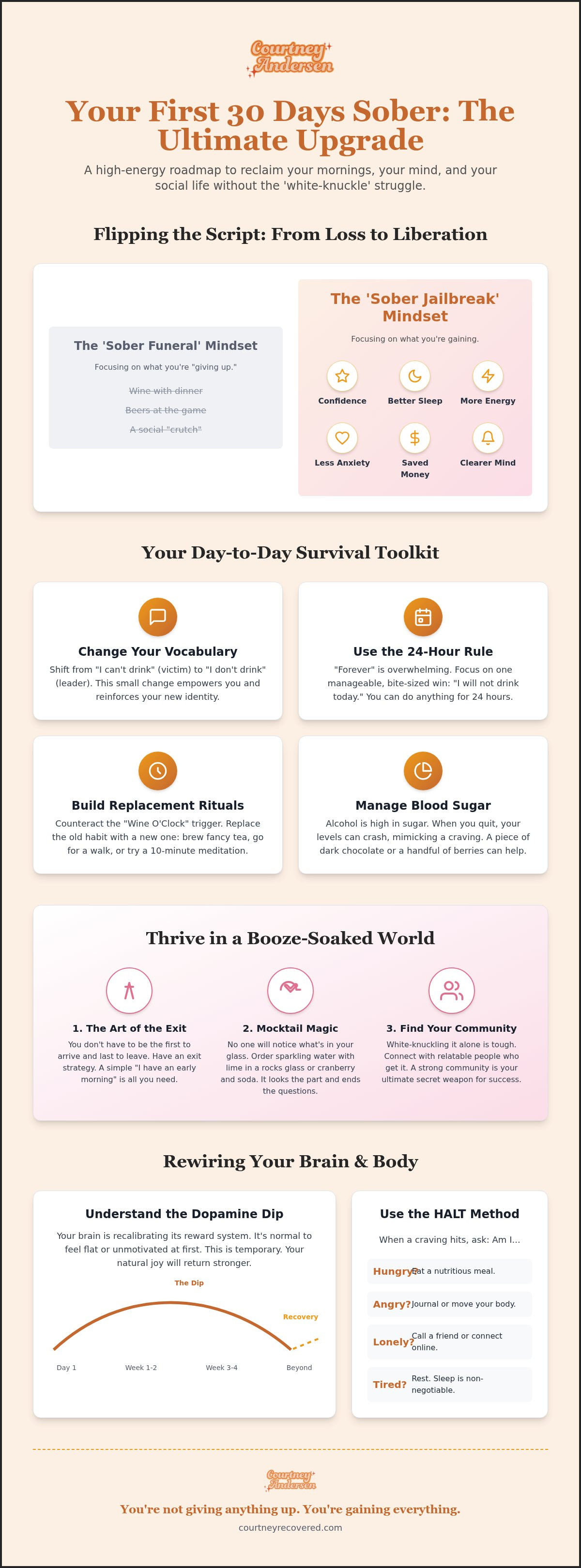
If the thought of "forever" feels like a panic attack, use the 24-hour rule. "Never again" is a heavy, terrifying concept that nobody really knows how to carry. "Not today" is a manageable, bite-sized win. You can do anything for 24 hours. By focusing on the immediate win, you build the confidence muscles needed to sustain a long-term sober lifestyle without the overwhelm.
Ditching the 'Sober Funeral' Mindset
We've been conditioned to romanticize the glass, but we rarely romanticize the 3 a.m. wake-up call with a racing heart. To move forward, you have to stop mourning a substance that was holding you back. You aren't "restricted" from drinking; you're liberated from the need to manage a habit that became a burden. If you're struggling to see the line between a social habit and a problem, understanding the shift in Gray Area Drinking can help you reclaim your power and see your choice as a massive upgrade.
The Power of the 'Sober Mindset Shift'
Changing your vocabulary changes your reality. Moving from "I can't drink" to "I don't drink" shifts you from a victim to a leader. It's totally normal to hit an identity crisis early on. You might wonder who you even are without a drink in your hand at a party. This is where you get to reinvent yourself. Use daily anchors like sobriety quotes to remind yourself why you started. These aren't just pretty words; they're mental armor for when the world tries to tell you that you're "boring" for choosing yourself. You're not boring; you're finally awake.
Your Day-to-Day Survival Guide: The Practical Sober Toolkit
Willpower is like a phone battery; it starts the day full but drains fast by 5:00 PM. Relying on "grit" alone to get through those first few weeks is a recipe for a relapse. Instead, you need a collection of physical and digital assets ready to deploy the second your brain starts whispering about a "quick glass of Pinot." The Sober Toolkit acts as a bridge between craving and calm. Whether it's a physical box in your pantry or a folder on your phone, having these early sobriety tips at your fingertips makes the difference between thriving and just surviving.
Managing the "Wine O'Clock" trigger is all about replacement rituals. If you usually reach for a bottle when you close your laptop, reach for a high-end mocktail or a 10-minute movement session instead. These practical early sobriety tips are about replacing rituals, not just removing them. Don't forget the importance of blood sugar, either. Alcohol is packed with sugar, and when you quit, your levels crash. This often feels like a craving for booze, but a piece of dark chocolate or a handful of berries can actually save your Day 4 by stabilizing your energy and mood.
Managing the Physical 'Ugh' Factor
The first 72 hours can feel like a bit of a swamp. You might deal with night sweats, vivid dreams, or general irritability. It's temporary. This is just your body doing a massive spring cleaning. While I'm not a doctor and you should always check with a professional for medical advice, many women find that magnesium, B-vitamins, and staying well hydrated help soothe the nervous system. Prioritizing high-quality sleep is non-negotiable here because it's the foundation of your emotional regulation. If you're struggling with the transition, resources like the NIAAA's guide on Finding and Getting Help can provide additional authoritative context on what to expect during this phase.
Creating a 'Sober Emergency' Plan
Cravings are like waves; they peak and then they break. Use the "5-Minute Rule." Tell yourself you can't drink for five minutes. During that window, change your environment. Walk into a different room, do ten jumping jacks, or call a friend who actually gets it. Don't reach out to your old drinking buddies; they'll just tell you that "one won't hurt." Instead, lean into the Stop Starting Over framework to break the cycle of Day 1 resets. If you want a curated roadmap for these moments, checking out the Sober Toolkit is a great way to stay prepared for any trigger that comes your way.
The Social Shift: How to Stay Vibrant in a Booze-Soaked World
Most recovery advice tells you to hide under your covers for the first 30 days. That's fine if you want to be bored; however, if you're a high-energy woman with a life to live, it's totally unrealistic. You don't have to choose between your social life and your sobriety. You just need a better game plan. One of the best early sobriety tips is to master the secret art of the exit strategy. Always, always bring your own car or have your ride-share app ready to go. Being "trapped" at a party is the fastest way to trigger a craving. When you have your own keys, you have the freedom to dip out the moment the "drunk talk" starts getting repetitive and the energy in the room shifts.
Then there's the power of mocktail magic. Holding a drink, even a fake one, acts like a social cloaking device. If you have a glass of sparkling water with a lime or a sophisticated non-alcoholic spirit in your hand, people stop asking "What can I get you?" It reduces that awkward social friction and lets you focus on the actual conversation. If a sober saboteur tries to push a drink on you with a "just have one" comment, remember that their discomfort is about them, not you. A perfect 2026-ready script for this is: "I’ve traded the cocktails for better sleep and higher energy lately, and I’m honestly obsessed with how I feel, so I’m sticking with this soda."
Scripts for Saying No (Without Being a Buzzkill)
You don't owe anyone a medical history. If you want to keep it light, use the "Health Reset" excuse. Telling people you're on a wellness kick or a 30-day challenge is a social pass that most people respect without further questioning. If that doesn't fit the vibe, leverage your productivity. Mentioning an early morning workout or a high-stakes meeting at 7:00 AM makes your choice seem like a power move rather than a restriction. For the bold, remember that "No" is a complete sentence. You don't always need an elaborate reason to choose your own clarity over a hangover.
Navigating High-Pressure Events
Weddings and bachelorettes can feel like the final boss of sobriety. The trick is the "Pre-Game" strategy. Call the venue ahead of time to see what non-alcoholic options they have. If they only have lukewarm tap water, bring your own fancy tonics or canned mocktails. You can still be the "fun one" at the party. In fact, you’ll probably be the only one who remembers the best jokes and doesn't end the night crying in the bathroom. Stay vibrant by focusing on the connection, not the consumption. These early sobriety tips are designed to keep you in the mix without the morning-after regret.
Rewiring Your Body and Brain: Sleep, Stress, and Self-Care
You’ve survived the first few social events and stocked your pantry with mocktails. Now, let’s talk about the internal renovation happening in your head. If everything feels a bit "blah" or gray right now, don't panic. Your dopamine receptors are essentially on strike because they’re used to the artificial flood of alcohol. During these first 30 days, neuroplasticity works overtime to repair your reward system and sensitize your brain to natural pleasures like a killer workout or a great meal. These early sobriety tips are about giving your brain the grace and time it needs to heal properly.
When a craving hits, use the reimagined HALT method as a quick diagnostic tool. Ask yourself: Am I Hungry, Angry, Lonely, or Tired? Usually, a high-protein snack or a 20-minute nap will kill the urge faster than any amount of "white-knuckle" willpower. And speaking of naps, get ready for the best sleep of your life. You’re moving from "passing out," which is just chemical sedation that blocks REM, to actual restorative rest. This is the stage where your body repairs cellular damage, and your skin starts to get that famous "Sober Glow."
The First 30 Days Timeline
Week 1 is usually "The Fog," where you're just trying to hydrate and survive the initial slump. Week 2 brings "The Itch," as the novelty wears off and your old habits start barking. By Week 3, you'll likely hit "The Energy" phase where your sleep stabilizes, and you feel a sudden surge of productivity. Finally, Week 4 brings "The Clarity." You might experience the "Pink Cloud," which is a temporary feeling of euphoria and invincibility. It’s a fun ride, but stay grounded; use these early sobriety tips to build a sustainable routine, so you don't crash when the initial "sober high" eventually levels out.
Stress Management Beyond the Bottle
High-achievers often drink to "turn off" their racing thoughts at night. You need a new off-switch that doesn't involve a hangover. Try box breathing or sensory grounding techniques to lower your cortisol without a corkscrew. My "Sober Vibes" approach to evening wind-downs involves dimming the lights, a heavy dose of magnesium, and a hobby that actually engages your hands. Whether it's pickleball, pottery, or learning a new language, you need an activity that isn't just scrolling through your phone with a sparkling water. If you're ready to bypass the struggle and find your flow, my 1:1 Sobriety Coaching offers the personalized support you need to make this lifestyle shift permanent.
The Power of 'We': Why You Can't White-Knuckle Your Way to Freedom
You can only white-knuckle your way through life for so long before your hands start to cramp and your resolve begins to slip. Willpower is a finite resource that drains every time you navigate a stressful meeting or a lonely evening. Community, on the other hand, is an infinite source of fuel that picks you up when your own tank is empty. One of the most overlooked early sobriety tips is to stop trying to be a hero in isolation. Real strength isn't doing it alone; it's knowing when to plug into a network that actually understands your reality. In fact, accountability for sobriety is the missing link in most recovery attempts because it transforms a private struggle into a shared victory.
You'll quickly learn to distinguish between your "Sober Friends" and your "Drinking Buddies." Drinking buddies are the ones who only text when there's a bottle involved and get quiet when you order a soda. Real friends are the ones who celebrate your clear eyes and your new energy. If you're a high-achiever, you don't need a somber circle of people talking about how hard life is. You need a modern, vibrant space like the Sobriety Circle where the focus is on growth and living life out loud. Surrounding yourself with people who are further along the path provides the social proof you need to realize that a dry life is anything but dull.
1:1 Sobriety Coaching vs. Doing It Alone
A coach provides the tough love and the specific roadmap you simply can't give yourself when you're in the thick of a craving. For high-performing professionals, 1-on-1 sobriety coaching is a game changer because it bypasses the shame cycle and gets straight to the solutions. You wouldn't try to master a new business skill without a mentor, so why try to master the most important lifestyle shift of your life without expert guidance? This type of mentorship allows you to identify your specific triggers and build a customized version of these early sobriety tips that actually works for your unique schedule.
Finding Your People in the Sobriety Circle
Inside the Sobriety Circle, the atmosphere is high-energy and inclusive rather than sterile or clinical. It's a judgment-free zone where shared experience becomes your greatest asset. You'll find women who are navigating the same corporate dinners and family holidays you are, all while staying 100% present and vibrant. This community acts as the bridge that takes you from the nervous energy of the first 30 days to the confident reality of "The After." It's time to stop surviving and start thriving with people who see your potential, not just your past. By joining a community that feels relatable and "cool," you remove the stigma and replace it with a sense of belonging that willpower alone can never provide.
Your Vibrant, Alcohol-Free Future Starts Now
You’ve got the toolkit, the social scripts, and the mindset shift to move beyond the "Day 1" loop for good. These early sobriety tips aren't about restriction; they’re about building a life so vibrant that you don't even want to escape it. By focusing on your brain's healing, mastering the art of the mocktail, and ditching the "sober funeral" mindset, you’re already miles ahead of where you were yesterday. Remember that willpower is a limited resource, but a relatable community is an infinite one.
If you're ready to trade the "hangxiety" for high energy, it’s time to plug into a network that actually gets it. Ready to stop starting over? Join the Sobriety Circle and find your vibrant community today. As the Voted #1 Non-Clinical Sobriety Community for Women, we give you instant access to the Stop Starting Over digital program and weekly live coaching calls with Courtney Andersen. You don't have to navigate this transition alone. Your new, connected reality is waiting for you, and it’s going to be better than you ever imagined.
Frequently Asked Questions
What are the first 3 days of sobriety like physically?
The first 72 hours usually involve a physical and mental "fog" as your body starts its initial recalibration process. You might experience night sweats, vivid dreams, or a short fuse with your family. It's just your system clearing out the toxins. Focus on staying well hydrated and going to bed early to get through this temporary hump. While it feels intense, this phase is the foundation for the energy you'll feel in just a few days.
How do I deal with intense alcohol cravings in early sobriety?
Use the "5-Minute Rule" to outlast an intense craving by changing your environment or doing a quick burst of movement. Cravings are like waves that peak and then break; they rarely last longer than twenty minutes if you stay occupied. Reach for your Sober Toolkit or a high-protein snack to stabilize your blood sugar. These early sobriety tips are designed to bridge the gap between that initial urge and a state of calm.
Is it normal to feel bored or lonely when you first stop drinking?
It is completely normal to feel bored at first because your dopamine receptors are used to the artificial high of alcohol. Without that flood, everyday life can feel a bit "gray" for a few weeks. This isn't your new permanent reality; it's just your brain rewiring itself through neuroplasticity. Once your reward system heals, you'll find that genuine connection and new hobbies feel much more vibrant and exciting than a glass of wine ever did.
What should I tell my friends when they ask why I'm not drinking?
You can use a simple "Health Reset" script to decline drinks without making the situation awkward or heavy. Tell them you're on a wellness kick, training for an early morning workout, or just obsessed with how good your sleep has been lately. You don't owe anyone a deep medical history. Most people are actually more interested in their own drink than why you don't have one in your hand at the party.
How long does it take for your brain to feel 'normal' after quitting alcohol?
Most women start to feel a sense of mental clarity and emotional stability around the 30-day mark. Your brain uses this time to repair its reward system, which helps you feel natural joy again. While the first week is often foggy, the "Pink Cloud" of energy usually arrives by week three. Consistency is key to letting your nervous system fully settle into its new, vibrant baseline where everything feels colorful again.
Can I stay sober without going to AA or 12-step meetings?
You absolutely can stay sober without the 12-step model by using modern, non-clinical resources like 1:1 coaching or the Sobriety Circle. Many high-achieving women prefer a high-energy, growth-oriented community over a somber meeting room. Finding a relatable mentor and a group of "cool older sisters" who have been where you are provides the accountability you need. You get to choose the roadmap that actually fits your social lifestyle and personality.
What are the best drinks to have at a party instead of alcohol?
The best party drinks are sophisticated mocktails like sparkling water with fresh lime, ginger beer with mint, or high-end non-alcoholic spirits. Holding a glass reduces social friction and keeps "sober saboteurs" from asking what you're drinking. These early sobriety tips help you stay in the mix without feeling like the "odd one out." You get the ritual of a fancy glass without the 3:00 AM heart racing and next-day regret.
When does the 'Sober Glow' actually start to show on my skin?
The famous "Sober Glow" typically starts to show on your skin and in your eyes between week three and week four. This happens because your body is finally getting restorative REM sleep and consistent hydration instead of being chemically sedated. Your skin repairs itself faster, puffiness fades, and your eyes lose that tired, glassy look. It's a visible, celebratory reward for the hard work you're putting into your new, alcohol-free life.
I want you to feel sober NOT boring!
Kickstart your sobriety with my free 2-day video workshop series to master your sober mindset and have FUN in your sobriety journey!


