
Accountability for Sobriety: Why You Can’t White-Knuckle Your Way to Freedom
Jul 14, 2026
How many times have you told yourself that this Monday will be different, only to find yourself hiding a glass of wine by Thursday evening? You're likely exhausted from playing the secret drinker game while trying to maintain a perfect professional facade. It feels like you're constantly white-knuckling your way through life, but here is the truth: your willpower isn't broken; it's just lonely. Real accountability for sobriety isn't about having a babysitter or a clinical lecture; it's about finally being seen so you can stop the cycle of starting over.
You probably think you should be able to handle this on your own because you're successful and capable in every other area. It's frustrating to feel like you're failing at something that seems so simple for everyone else at happy hour. I promise that when you shift your perspective, accountability becomes the most powerful tool in your kit for a vibrant, long-term lifestyle. It turns sobriety from a restrictive chore into a total life upgrade that feels like a gain, not a loss. We are diving into practical tools to handle social pressure and how to build connections that actually stick without the sterile, clinical stigma.
Key Takeaways
- Stop relying on willpower alone and learn how external systems override the old habits that keep you stuck in the "starting over" cycle.
- Transform accountability for sobriety from a restrictive chore into a supportive framework that actually makes your life feel bigger and better.
- Find your ideal support style by comparing the personalized energy of 1:1 Sobriety Coaching with the 24/7 connection of the Sobriety Circle.
- Master practical daily habits using the Sober Toolkit to handle social pressure and internal triggers without breaking a sweat.
- Audit your social circle to identify "safe" spaces and build a lifestyle where you no longer have to maintain a professional facade.
Why Willpower Fails: The Truth About Accountability for Sobriety
You have probably spent years believing that if you were just "stronger" or "more disciplined," you could finally get a handle on your drinking. You treat your sobriety like a high-stakes project at work, applying the same grit that earned you your promotion. But white-knuckling your way through cravings is a recipe for total burnout. It turns your life into a constant battle against yourself, and eventually, the version of you that just wants to relax wins out. This cycle isn't a character flaw; it is a physiological dead end.
This happens because of the "willpower gap." Your brain is a master of automation, and those old habits are stored in a part of the mind that doesn't care about your goals for 2026. To override these deep-seated patterns, you need external systems that act as a safety net when your internal resolve feels thin. Real accountability for sobriety isn't about surveillance or being "caught" doing something wrong. It's a supportive partnership that shifts the focus from avoiding failure to ensuring your success. This shift toward external accountability for sobriety is what finally stops the exhausting Monday morning reset.
Sobriety accountability is the bridge between "wanting to quit" and "staying quit."
The Myth of the Lone Wolf in Recovery
As a professional woman, you're used to being the one everyone else leans on. You might feel like you "should" be able to handle this alone, leading to the dangerous game of secret sobriety. You maintain a perfect facade while internally struggling with the cycle of "starting over" every Monday. Isolation is the greatest fuel for relapse, especially for gray area drinkers who don't feel like they fit into traditional, clinical boxes. Coming out of the shadows and being seen by people who "get it" is where the vibrant transformation begins.
Accountability vs. Responsibility
You are always responsible for your own choices, but you don't have to carry the weight of those choices in a vacuum. Being accountable to a community or a mentor is the secret sauce that changes your psychology. While various Twelve-Step Programs have historically emphasized this peer-to-peer connection, modern sobriety coaching takes it a step further. Having a "sober coach" is different from just having a supportive spouse. Your partner loves you, but they might not understand the specific triggers of a high-pressure career or social scene. When you have someone else "in it" with you, you stop being a "lone wolf" and start becoming part of a winning team.
The Three Layers of Professional-Grade Accountability
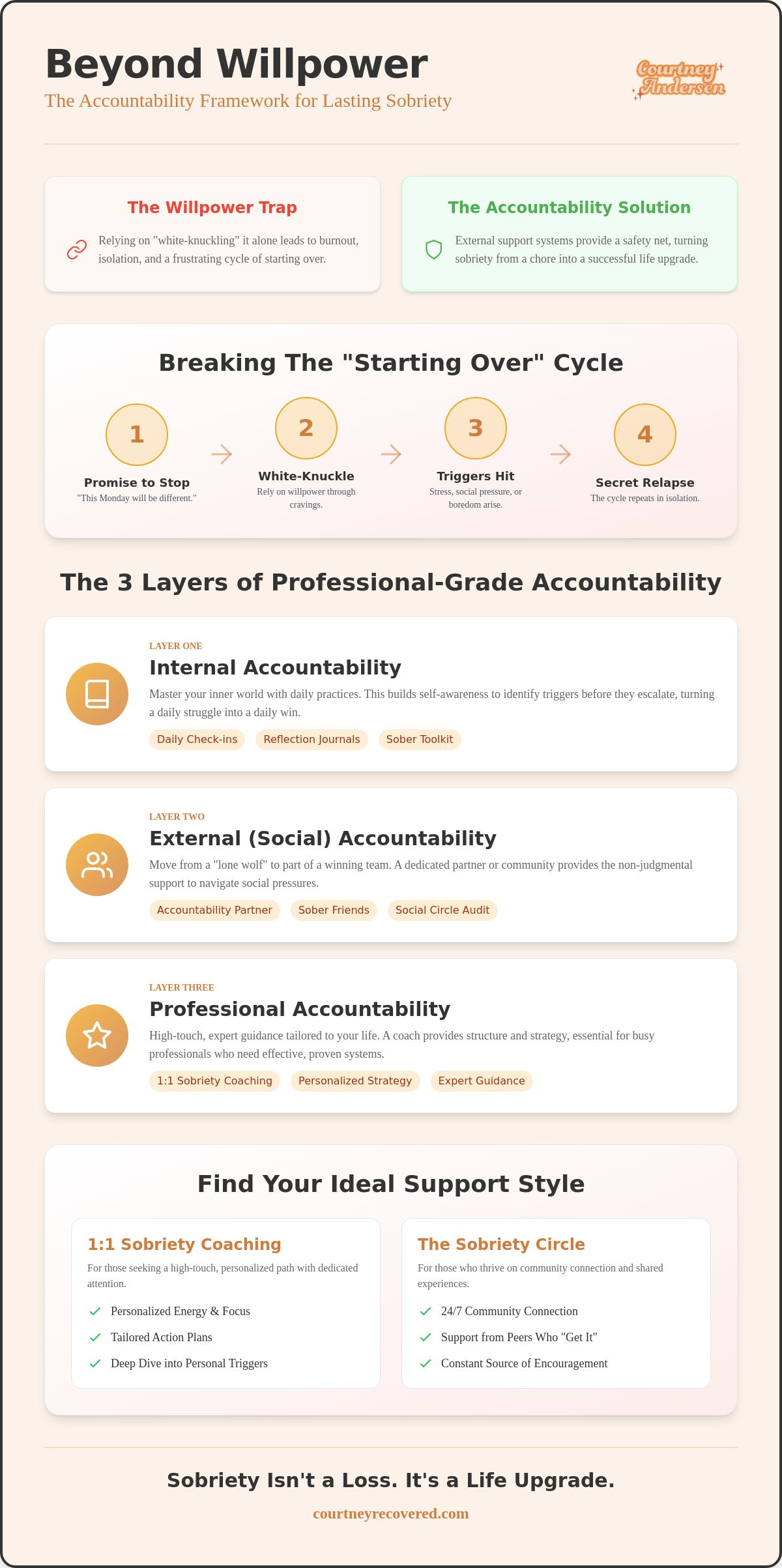
Relying on willpower is like trying to power your entire house with a single AA battery. It might work for a few minutes, but eventually the lights will flicker and fade. To build a life that stays vibrant, you need a multi-layered safety net. True accountability for sobriety isn't just a single person checking in on you; it is a comprehensive system that surrounds you at every level. When you have internal, social, and professional layers working together, you stop worrying about "slipping" and start focusing on your evolution.
Effective recovery requires more than just a desire to change. According to the Principles of Drug Addiction Treatment, successful outcomes depend on addressing the whole person, which includes their social and psychological environment. This is why a high-tech breathalyzer or a tracking app isn't enough. You need a strategy that feels like a lifestyle upgrade rather than a digital leash.
Internal: Mastering the Daily Check-In
The first layer starts with you. Using the Sober Toolkit as a daily practice helps you anchor your morning and evening before the world starts making demands. When you use the Sober Vibes Book for reflection, you aren't just "journaling"; you're auditing your internal state. This helps you identify "yellow light" triggers, those subtle moments of stress or boredom, before they escalate into "red light" cravings. If you are tired of the DIY approach, exploring 1:1 Sobriety Coaching can provide the high-touch support that turns a daily struggle into a daily win.
External: Choosing Your Accountability Partner Wisely
There is a massive difference between a "friend who knows you're quitting" and a dedicated sober accountability partner. Your drinking buddies, even the well-meaning ones, cannot be your primary support system because they don't speak the language of your new reality. You need people who can call you out with love and empathy when they see you slipping back into old mindsets. This is the magic of the Sobriety Circle. It provides a space where you are seen and understood by people who have navigated the exact same path.
The final, most robust layer is professional accountability. Think of a 1:1 coach as the personal trainer for your sober life. While peers offer shared experience, a coach provides a proactive roadmap to ensure you don't just "get sober," but actually stay that way. These three layers create a structure where your success is no longer a question of "if," but a matter of "when."
Comparing Support Systems: Which Accountability Style Fits You?
Choosing the right support system is like picking a workout routine. If you hate running, a marathon training plan will fail you by Tuesday. The same applies to your recovery. Finding the right accountability for sobriety isn't about finding the "strictest" program; it is about finding the one that actually fits your life as a high-achiever. You don't need a clinical lecture. You need a system that respects your professional drive while giving you the tools to thrive without a glass of Chardonnay in your hand.
Traditional support groups often focus on the weight of the past, which can feel heavy and somber. Modern, non-clinical coaching flips the script. We focus on the life you're building, not just the one you're leaving behind. Whether you need a massive reset to Stop Starting Over or you're ready for the long-term vibrancy of The After, your accountability style should feel like a gain, not a loss.
When to Hire a 1:1 Sobriety Coach
If you've spent years maintaining a "secret" drinking habit while crushing it in the boardroom, you likely need a personalized roadmap. A 1:1 Sobriety Coach acts as a high-energy mentor who provides the "tough love" realism you're used to in business. This isn't a one-size-fits-all checklist. It is a proactive partnership designed to identify your specific triggers and social pressures. High-achievers often ask if coaching is worth the investment. Think of it this way: what is the cost of another year spent in the exhausting cycle of "starting over" every Monday? Investing in a coach is investing in the version of you that finally feels free.
The Magic of the Sobriety Circle
Loneliness is the silent killer of many sober streaks. When your entire social life revolves around happy hours and wine nights, quitting can feel like social suicide. This is where the Sobriety Circle becomes your greatest asset. It is a tribe of women who understand the specific "gray area" struggle. You aren't just a number in a room; you're part of a community that provides 24/7 access to shared wisdom. Group accountability for sobriety reduces that "sober and lonely" feeling by connecting you with people who actually "get it" without the clinical stigma. Within this community, specialized programs like Stop Starting Over provide the structure you need to bridge the gap between wanting to quit and actually staying quit.
Deciding between these paths depends on where you are right now. If you're currently in the "white-knuckle" phase, a 1:1 coach provides the immediate, high-touch safety net you need. If you're looking for a sustainable lifestyle that feels like a constant upgrade, the community energy of the Sobriety Circle will keep you moving forward. Either way, you are no longer doing this alone.
Building Your Accountability Toolkit for 2026
Moving from the "white-knuckle" phase to true freedom requires more than just a change in perspective. It requires a physical and digital toolkit that works for you when your energy is low. Building a customized system of accountability for sobriety ensures you aren't just surviving the weekend; you're actually enjoying it. By 2026, the rise of sobriety apps and integrated behavioral health has made it easier than ever to stay connected, but you still need a personal strategy to filter out the noise.
- Step 1: Social Audit. Look at your calendar for the next month. Identify "safe" spaces where you feel supported and "high-risk" events where the pressure to drink is baked into the culture.
- Step 2: The Daily Anchor. Implement a morning and evening practice using the Sober Vibes Book. This isn't about being perfect; it's about checking in with yourself before the world starts making demands.
- Step 3: The Early Warning System. Set up a "red flag" protocol with your 1:1 coach or a partner in the Sobriety Circle. If you start feeling restless or bored, they should be your first call, not your last resort.
- Step 4: The After Framework. Plan your social interactions using a "gain-first" mindset. Instead of thinking about what you're missing, focus on the vibrant morning and clear head you're gaining.
This proactive approach makes accountability for sobriety feel like a seamless part of your high-performance lifestyle rather than a restrictive set of rules.
Social Scripts for High-Pressure Situations
One of the biggest hurdles for professional women is the social fallout of not drinking. You don't owe anyone a clinical explanation of your life choices. When you're at a wedding or a high-stakes work dinner, keep your script short and confident. Try saying, "I'm on a 90-day health reset and the energy boost is too good to stop," or simply, "I've realized I sleep ten times better without the wine." The key is to avoid making it a "big deal." If the environment feels too heavy, use your "exit strategy." Whether it's a pre-booked ride or a "early morning meeting" excuse, having a way out is your most important tool for social success.
Digital Tools and the Power of Habit Tracking
While counting days is a great way to see progress, it's only one piece of the puzzle. In 2026, we use habit tracking to monitor things like sleep quality, mood, and stress levels. Seeing the data prove that your life is improving makes the choice to stay sober much easier. Leveraging online recovery communities provides real-time support whether you're standing in the grocery store aisle or sitting alone after a long day. The Sober Toolkit replaces the frantic "wine o’clock" habit with a curated set of rituals that actually lower your cortisol levels without the morning-after regret. If you're ready to stop the guessing game, grab the Sober Toolkit and start building your foundation today.
Stop Starting Over: Taking the Next Step Toward Freedom
The "Day 1" cycle is one of the most draining experiences a high-achieving woman can face. You are successful in your career and your relationships, so why does this one thing keep tripping you up? If you find yourself stuck in a loop of starting over every Monday morning, it is almost always a symptom of missing accountability for sobriety. You aren't broken, and you don't need more willpower. You simply need a system that was actually built for the life you live, not a sterile, clinical model that feels like a punishment.
The Courtney Recovered approach bridges that massive gap between trying to do it all yourself and the clinical atmosphere of traditional recovery. We focus on creating a life you don't feel the need to escape from. This is about moving from "trying to quit" to "living a vibrant, sober reality" in which wine no longer holds power. When you have the right layers of support, the transition feels like a massive life upgrade rather than a restrictive sacrifice. You stop looking at what you're "losing" and start celebrating everything you're finally gaining back.
Your Invitation to the Sobriety Circle
If you're tired of being the only one at the party without a glass in your hand, the Sobriety Circle is your new home. In your first 30 days, you'll dive into community-led accountability for sobriety, focusing on a total mindset reset. Our "Stop Starting Over" program is designed to break the relapse cycle once and for all by connecting you with women who are also choosing a vibrant, connected reality. You get the tools, the tribe, and the 24/7 access to people who actually "get it" without any of the clinical stigma. It is the antidote to the loneliness that often comes with early recovery.
Personalized Support: Is 1:1 Coaching Your Missing Link?
Sometimes, the "functioning alcoholic" trap requires a more intensive, personalized approach. Working with Courtney Andersen is the fast-track to the freedom you've been chasing. 1:1 Sobriety Coaching provides the high-level mentorship and "tough love" realism you need to navigate high-pressure social and professional situations. You don't have to figure this out by trial and error anymore. It's time to stop the exhausting "secret drinker" game and start living with total transparency and joy. Whether you need a massive reset or long-term maintenance through "The After" framework, having a personal trainer for your sober life changes everything. Book your 1:1 Sobriety Coaching discovery call here and let's build the roadmap to your new life together.
Your Vibrant, Sober Future Starts Here
You have already proven that you can do hard things in your career and your life. Now it's time to stop treating your recovery like a solo endurance test. Real accountability for sobriety is the difference between a temporary dry spell and a permanent lifestyle upgrade. By moving away from the "lone wolf" mentality and embracing a multi-layered support system, you bridge the gap between "trying to quit" and "staying quit" for good.
Courtney Andersen, author of the Sober Vibes Book, has designed specialized programs like Stop Starting Over and The After to help professional women and gray area drinkers escape the exhausting cycle of starting over every Monday. You don't have to navigate bachelorette parties, high-stakes work events, or internal triggers in isolation anymore. It is time to step into a community that celebrates your growth and sees your potential. Join the Sobriety Circle and find your tribe today! You aren't broken; you just need a better roadmap. Your new, connected reality is waiting for you.
Common Questions About Staying Accountable
What is the most effective form of accountability for sobriety?
The most effective form of accountability for sobriety is a multi-layered system that covers your internal habits, your social circle, and professional guidance. Relying on just one person or a single app creates a single point of failure. When you combine daily check-ins using the Sober Toolkit with the community energy of the Sobriety Circle, you build a safety net that catches you before you even think about a drink.
How do I find a sober accountability partner who actually understands me?
Finding a partner who "gets it" starts with hanging out in the right rooms. If you are a high-achieving professional, you likely won't find your tribe in a clinical basement meeting. Look for communities like the Sobriety Circle where women are focused on building a vibrant life rather than just talking about the struggle. You need someone who understands the specific pressures of your career and social life.
Is a sobriety coach different from a sponsor in AA?
A sobriety coach is a professional, proactive mentor, while a sponsor is a volunteer peer focused on specific traditions. Think of a coach as a personal trainer for your sober life who helps you build practical strategies for the future. While sponsors are helpful for navigating 12-step programs, coaching offers a non-clinical, high-energy partnership that focuses on your specific lifestyle goals and mindset shifts.
What should I do if my accountability partner relapses?
If your partner relapses, your first priority is protecting your own peace and progress. It's helpful to have a wider support network so you aren't leaning on just one person. Reach out to your 1:1 coach or the Sobriety Circle to process your feelings. You can offer them empathy from a distance, but you must maintain your boundaries to ensure you don't get pulled back into the cycle yourself.
How can I stay accountable for my sobriety without telling everyone I have a drinking problem?
You can maintain accountability for sobriety privately by using high-touch professional support. Working with a 1:1 coach or using the Sober Toolkit allows you to stay on track without making a public announcement at the office. You get to decide who hears your story and when you feel comfortable sharing your "health reset" with the world. Privacy doesn't have to mean isolation.
Does the Sobriety Circle offer tools for women who are still in the gray area?
Yes, the Sobriety Circle is specifically designed for women navigating the gray area struggle. We don't use clinical labels or focus on rock bottoms. Instead, we use programs like Stop Starting Over to help you reset your mindset and build a life that feels like an upgrade. It is a space for women who know drinking isn't working for them anymore and want a better way to live.
How long do I need professional accountability before I can do it on my own?
Professional accountability is most critical during your first year, but many women keep some level of support as they move into long-term maintenance. Think of it like a fitness routine. You might need a trainer to learn the moves, but you keep the community to stay inspired. Programs like The After are perfect for when you've mastered the basics and want to keep your sober life vibrant.
What happens if I "mess up" while in an accountability program?
If you "mess up," we treat it as data rather than a disaster. In a non-clinical accountability program, a slip is a sign that there's a gap in your toolkit or a trigger we haven't addressed yet. We don't do shame or lectures. We look at what happened, adjust your strategy, and get you back into action immediately so you can stop the cycle of starting over.
I want you to feel sober NOT boring!
Kickstart your sobriety with my free 2-day video workshop series to master your sober mindset and have FUN in your sobriety journey!


