
The Sober Curious Movement: Why Re-evaluating Your Relationship with Alcohol is the Ultimate Lifestyle Upgrade in 2026
Jul 15, 2026
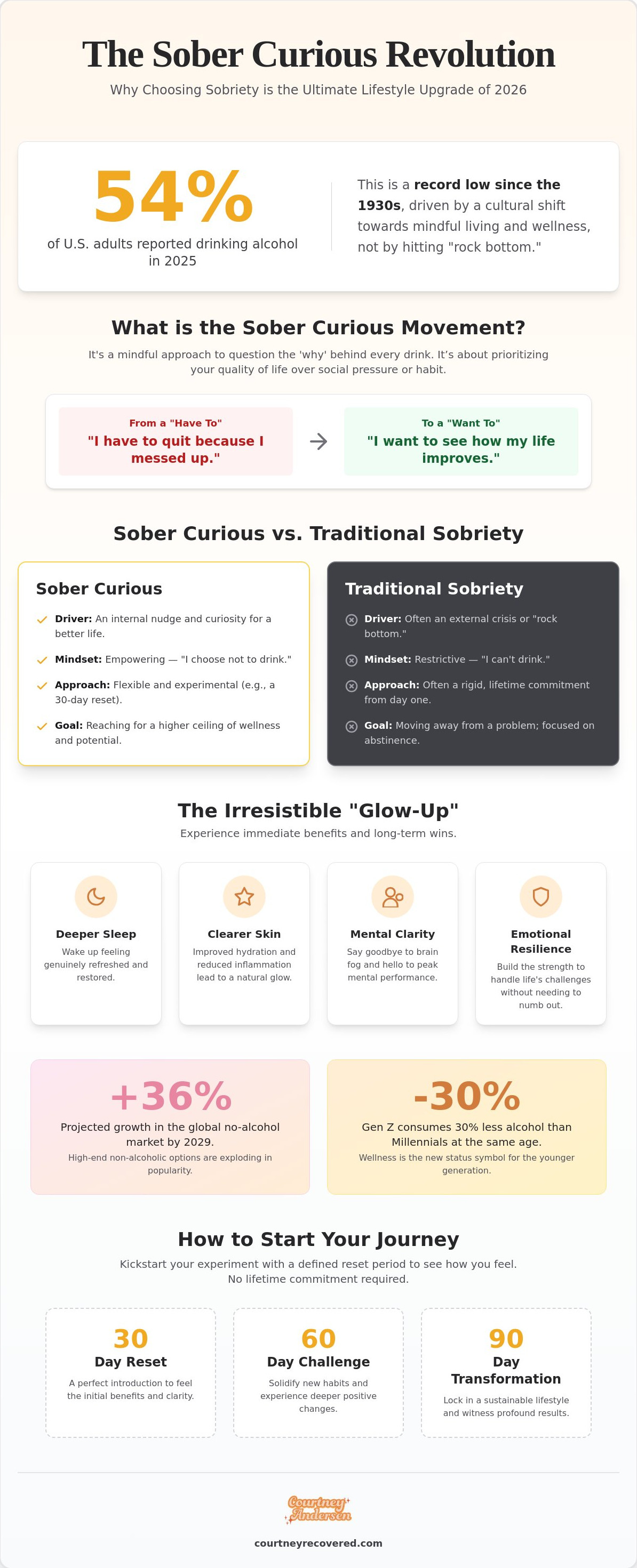
In 2025, only 54 percent of U.S. adults reported drinking alcohol. That is a record low since the 1930s, and it is not because everyone suddenly joined a somber support group. It is because the sober curious movement is officially the ultimate lifestyle upgrade of 2026. You know that specific feeling of waking up on a Saturday morning with a fuzzy head and a phone full of texts you barely remember sending. You do not have a "rock bottom" story, but you are definitely tired of the morning-after regret and the "boring" stigma that usually follows the idea of sobriety.
I get it. It often feels like alcohol is the only way to decompress after a long week, but you are also craving something more authentic. This article will show you how to redefine your social life and personal identity without the clinical labels or the soul-crushing fear of missing out. You will learn how choosing to stay sober is actually the most empowering move you can make for your mental clarity and your Sunday mornings. Get ready to discover why the most vibrant version of your life does not require a drink in your hand.
Key Takeaways
- Learn why the sober-curious movement is about choosing a higher quality of life through mindfulness rather than waiting for rock bottom or adopting a clinical label.
- Discover the freedom of following an "internal nudge" and how a curiosity-led approach differs from traditional, high-pressure recovery commitments.
- Get the lowdown on the immediate "glow-up" benefits like deeper sleep and clearer skin, alongside the long-term win of building unshakable emotional resilience.
- Find out how to kickstart your own experiment with a 30, 60, or 90-day reset and the best ways to restock your space with satisfying sober swaps.
- Understand how to transition from a temporary experiment to a sustainable, vibrant lifestyle by plugging into a supportive community.
What is the Sober Curious Movement? Redefining Our 'Standard' Social Life
So, what exactly are we talking about here? The sober-curious movement isn't about sitting in a basement with bad coffee and talking about your "problem." It's a mindful, high-energy approach to questioning every single "why" behind your drink. Instead of focusing on clinical labels like "alcoholic," this movement is obsessed with one thing: your quality of life. It is the shift from "I have to quit because I messed up" to "I want to see how much better my life gets without the booze." In 2026, we've moved past the idea that sobriety is a punishment. It's now the ultimate flex. With the global market for no-alcohol products projected to grow by 36 percent by 2029, your local bar probably has a better NA menu than their actual cocktail list.
The landscape of 2026 has completely transformed how we view a night out. We're seeing an explosion of high-end non-alcoholic options, from functional botanicals to sophisticated "near beers" that actually taste like the real thing. Sober social clubs are popping up in every major city, offering spaces where the connection is the main event rather than the liquid in your glass. This isn't a restrictive diet for your social life; it's an invitation to show up as your most authentic, energized self.
The Origins: From Niche Trend to Global Revolution
We can't talk about this shift without giving a massive shout-out to Ruby Warrington. She gave a name to that itchy, uncomfortable feeling many of us had: "gray area drinking." She realized that you don't need to lose everything to decide that alcohol isn't serving you. Since her work began, social media has normalized the "alcohol-free" aesthetic, turning it into something aspirational rather than isolating. This movement has resonated deeply with high achievers and professional women who have realized they don't need a martini to network. They need mental clarity to win. It's about reclaiming your power from a habit that was never serving your goals.
Why 2026 is the Year of the Vibrant Non-Drinker
In 2026, wellness is the new status symbol. We track our sleep, our macros, and our recovery scores; pouring a neurotoxin into the mix just doesn't fit the mold anymore. Gen Z is leading this charge, consuming 30 percent less alcohol than Millennials did at the same age. They've redefined nightlife to center on genuine experiences rather than blurry memories. The sober-curious movement is a proactive choice for optimal mental health.
Sober Curious vs. Traditional Sobriety: What’s the Real Difference?
Traditional sobriety usually sounds like a heavy, permanent sentence you only serve after a major disaster. But the sober curious movement is different. It is driven by an internal nudge rather than an external catastrophe. It is that quiet, persistent voice asking if you are actually happy or just comfortably numb. You do not need to lose your job, your house, or your dignity to decide that alcohol is getting in the way of your glow-up. This movement is for the women who are ready to trade "fine" for "phenomenal."
This shift is about moving away from the restrictive "I can't drink" mindset and leaning into the empowering "I choose not to." It is inclusive and flexible. While traditional recovery often demands a lifetime commitment from day one, being sober curious allows you to explore sobriety one day, one event, or one month at a time. It is about being mostly sober and entirely present for your own life. You are not waiting for a rock bottom; you are reaching for a higher ceiling.
Breaking the 'Alcoholic' Binary
The old-school binary of "alcoholic" vs "normal" is a trap that keeps millions of people stuck in a cycle of mediocrity. If you do not fit the extreme stereotype of someone who has lost everything, you might feel like you do not have permission to change your relationship with booze. This is the "functional" trap. You are paying your bills and hitting your deadlines, so you tell yourself you are okay. But gray area drinking is where most of the struggle happens. It is the low-grade anxiety, the midnight wake-ups, and the feeling that you are just going through the motions. If you have ever felt like you are doing "fine" but want so much more, you should read So You’re a Functional Alcoholic? Here’s the Truth.
Curiosity as a Superpower
Approaching your habits with curiosity instead of judgment changes your brain's reward system. Instead of focusing on what you are "giving up," you focus on what you are gaining. Asking yourself "Why am I reaching for this glass?" or "What am I actually trying to feel right now?" shifts you from a place of restriction to a place of discovery. You are not losing your social life; you are gaining the ability to actually connect with people. You are not losing your way to decompress; you are gaining real, restorative sleep. If you are tired of the cycle of regret, my Stop Starting Over program is the roadmap you need to make this lifestyle stick.
The Irresistible Benefits of Being Sober Curious
Choosing to join the sober curious movement is like giving your entire life a high-definition upgrade. We often focus so much on what we think we are giving up that we completely miss the massive list of gains waiting on the other side. The "glow-up" is real, and it starts the very first morning you wake up without that familiar sense of dread. You start seeing immediate wins in your physical appearance and energy levels, but the deep wins, like unshakable confidence and emotional resilience, are what truly change the game.
Let's talk about the "Sober Raise." Have you actually looked at your banking app lately? Between the overpriced cocktails, the late-night Uber rides, and the "I'm hungover so I'm ordering takeout" expenses, drinking is a black hole for your finances. When you cut the booze, you suddenly find yourself with a surplus of cash and, more importantly, a surplus of time. Saturday mornings are no longer lost to a dark room and a headache. Instead, you gain "Time Wealth," the ability to actually enjoy your weekend from the moment the sun comes up.
- Better Sleep: You finally get into that deep, restorative REM sleep that alcohol systematically destroys.
- Clearer Skin: Alcohol is a massive dehydrator; without it, your skin regains its natural glow and elasticity.
- Emotional Resilience: You learn to process your feelings in real-time instead of numbing them, which makes you feel invincible.
The End of Hangxiety and the Rise of Mental Clarity
If you have ever spent a Sunday morning spiraling about a conversation you barely remember, you have experienced hangxiety. It feels like a moral failing, but it is actually just biology. When you drink, your brain suppresses glutamate (the "go" chemical) and ramps up GABA (the "relax" chemical). The next day, your brain overcompensates by flooding your system with cortisol and glutamate. Hangxiety is a chemical reaction, not a character flaw. By stepping away from the bottle, you allow your dopamine levels to reset, leading to a level of mental clarity you probably haven't felt since you were a teenager.
Authentic Social Connection: The 'Sober Social' Secret
We have been sold a lie that alcohol makes us "more fun" or more social. In reality, booze often acts as a barrier to genuine connection. When you are sober curious, your conversations are actually better because you are fully present and you actually remember the details the next day. You stop relying on a liquid crutch to feel confident and start building authentic "sober social" skills. If you are worried about how to navigate your next party, check out my podcast, Sober Vibes, for all things alcohol-free socializing.
How to Start Your Sober Curious Journey in 2026
Ready to dive in? Joining the sober curious movement doesn't require a dramatic announcement or a lifetime vow. It starts with a simple choice to pause and observe. First, you need to commit to an experiment. Whether it is 30, 60, or 90 days, give yourself a window to clear the fog. Next, clean out your environment. If your fridge is full of wine, you are playing on hard mode. Replace the booze with high-end "Sober Swaps" like functional adaptogen drinks or the premium NA spirits that have flooded the market in 2026.
Identify your triggers early. Is it the 5 PM stress? Is it the social pressure of a Friday night? Once you know your "witching hour," you can plan for it rather than reacting to it. This is where your "Why" comes in. Keep it visible. Maybe you want better skin, more energy, or just to stop those 3 AM wake-up calls. Finally, do not try to do this alone. Lone wolves usually end up back at the bar. Get some accountability through a community or a mentor to keep your momentum high. If you want the fast track to mastering this lifestyle, my 1:1 Sobriety Coaching is the ultimate way to level up your progress.
The 90-Day Experiment: Why Duration Matters
While a 30-day challenge like Dry January is a great start, it usually only scratches the surface of what your body can do. To see the real magic, you need a longer runway. Check out 90 Days No Alcohol: What Really Happens to Your Body to see why the three-month mark is the sweet spot for a total brain chemistry reset. Treat this time as a data-collection phase rather than a period of deprivation. You are not "giving up" alcohol; you are testing a new version of yourself.
Navigating the 'Firsts': Social Scripts and Survival
The first time you go out without drinking can feel like you are walking into a party naked. It is not that deep, I promise. Most people are too worried about themselves to care what is in your glass. Use a simple script: "No thanks, I'm not drinking tonight; I have a big morning tomorrow." Another pro tip is to always have a drink in your hand. If you have a sparkling water with lime, nobody asks questions. My Sober Toolkit is packed with more scripts and survival strategies to help you navigate every social situation with total confidence.
Beyond the Trend: Building a Sustainable Sober Lifestyle
You have done the experiment. You have felt the mental clarity and seen the "glow-up" in the mirror. Now comes the part where the sober curious movement stops being a 30-day challenge and starts being your permanent lifestyle upgrade. Transitioning from "curious" to "committed" is where the real magic happens, but it is also where most people get stuck. It is easy to stay sober when you are in the middle of a challenge, but building a sustainable life without alcohol requires a shift in your environment and your squad.
Let's be real about "Sober Loneliness." In the early stages, you might feel like the odd one out. Your old friends might still be at the bar, and you might feel like you are losing your social identity. This is a temporary phase, not a permanent state. To bridge the gap, you need to stop white-knuckling your way through Friday nights and start building a life you don't want to escape from. This is about more than just not drinking; it is about reclaiming your energy and finding new ways to connect that don't involve a hangover.
The Power of the Sobriety Circle
Finding "your people" is the absolute difference between surviving and thriving. When you are the only person in your friend group who isn't drinking, it feels like a chore. When you are part of a vibrant, non-clinical community, it feels like a party you are actually invited to. Shared experience removes the heavy stigma of "quitting" and replaces it with a sense of belonging. My Sobriety Circle is designed to be that bridge. It is a space where you can be honest about the struggle while celebrating the wins with women who totally get it. This is how you prevent the "Stop Starting Over" cycle and finally make your new habits stick.
Why 1:1 Coaching is Your Secret Weapon
If you want the "cheat code" for success, personalized support is it. While community provides the foundation, 1:1 coaching provides the fast track. Having a mentor who has "been there" gives you a level of accountability you just can't get from a book or a podcast. We don't just talk about not drinking; we heal the root causes of the urge to drink in the first place. You deserve to move past the "struggle" phase and into a life that feels effortless and expansive. Ready to upgrade your life? Book a 1:1 discovery call with Courtney Andersen today.
Your Vibrant New Reality Starts Right Now
You have spent enough time wondering "what if." You have seen how the sober curious movement is redefining what it means to be social, successful, and truly awake in 2026. It is not about deprivation or hiding from your life; it is about finally having the energy and clarity to actually live it. You have learned that you don't need a rock bottom to deserve a better version of yourself. You deserve to wake up with energy and genuine connection every single day.
I have seen this transformation happen for a vibrant community of 1,000+ women. As the author of the Sober Vibes Book, I know that an empowerment-based, non-clinical approach is the secret to making this lifestyle stick for the long haul. You don't have to navigate the social pressure or the internal nudges alone. You have the tools, and now you have the roadmap to a life that feels expansive rather than restricted.
Ready to turn your curiosity into a vibrant new reality? Join the Sobriety Circle today!
You are so much closer to that energized, authentic version of yourself than you think. This is your time to stop starting over and start thriving. I can't wait to see you shine on the other side.
Frequently Asked Questions
What does 'sober curious' actually mean?
Being sober curious means you are choosing to look at your relationship with alcohol through a lens of mindfulness rather than one of necessity. It is not a label you wear; it is a lifestyle practice where you question the cultural default of drinking. You are essentially auditing how alcohol affects your mood, sleep, and energy. This approach allows you to explore the sober curious movement without the pressure of a lifelong commitment.
Can I be sober curious and still drink occasionally?
Yes, you can still drink occasionally while identifying with this mindset. The goal is to move away from mindless consumption and toward intentional choices. Many people find that as they get more curious, their desire to drink naturally fades because they prefer the clarity of being sober. It is about the curiosity more than the sobriety at first. You are simply testing the waters to see which version of you feels better.
How do I deal with friends who pressure me to drink?
Dealing with social pressure requires a mix of confidence and a solid plan. I always recommend having a non-alcoholic drink in your hand before anyone can ask what you want. If someone pushes, a simple script like "I am not drinking tonight because I want to feel great tomorrow" usually shuts it down. Most of the time, their pressure is about their own relationship with alcohol, not yours. Stay firm and prioritize your energy.
Is being sober curious the same as being in recovery?
Being sober curious is not the same as traditional recovery, though they can overlap. Recovery often stems from a place of necessity or a rock bottom moment where abstinence is the only path forward. In contrast, the sober curious movement is a proactive lifestyle choice driven by a desire for optimization and wellness. It is less about fixing a problem and more about upgrading your life quality to a level alcohol can't reach.
What are the best books to read if I'm sober curious?
You should start with my Sober Vibes Book for a high-energy, relatable roadmap to this lifestyle. Other essential reads include Ruby Warrington’s Sober Curious, which essentially coined the term, and Quit Like a Woman by Holly Whitaker for a deep dive into the cultural structures around drinking. These books provide the intellectual and emotional foundation you need to stop feeling like you are missing out and start feeling like you are moving up.
Will my social anxiety get worse if I stop drinking?
It is common for social anxiety to feel louder at first because you are no longer numbing it with liquid courage. However, drinking actually creates more anxiety the next day due to cortisol spikes. As you practice being social while sober, you build genuine confidence that doesn't disappear when the booze wears off. You learn that you are actually interesting and capable without a drink. Over time, your baseline anxiety levels will likely drop.
What are some good non-alcoholic drinks for beginners?
Beginners should start with high-quality non-alcoholic malt beverages or botanicals that mimic the complexity of a cocktail. In 2026, the options are endless, from near beers that taste exactly like a craft IPA to adaptogen-infused spirits that help you relax without the buzz. If you are at a bar, a simple sparkling water with lime and a splash of cranberry is a classic "invisible" sober drink. These swaps make the transition feel like a gain.
How long does it take for the 'sober glow' to appear?
You will likely notice the physical sober glow within two to four weeks of consistent abstinence. This happens because your body is finally hydrated and your sleep quality has improved, allowing your skin to repair itself. The mental glow, characterized by sharp focus and emotional stability, usually kicks in around the 60 to 90 day mark. This is when your brain chemistry has fully recalibrated and you start feeling like the most vibrant version of yourself.
I want you to feel sober NOT boring!
Kickstart your sobriety with my free 2-day video workshop series to master your sober mindset and have FUN in your sobriety journey!


