
Recovery Coaching Not Rehab: Why Your Path to Sobriety Doesn’t Have to Be Clinical
Jul 19, 2026
What if the biggest barrier to your sobriety isn't your drinking, but the clinical, sterile box you think you have to fit into to fix it? You've likely spent hours Googling solutions, only to feel a pit in your stomach at the thought of fluorescent lights and thirty days away from the career you've worked so hard to build. You know you want to change your relationship with alcohol, but you also feel like traditional programs are just too extreme for your situation. That's exactly why more high-functioning women are choosing recovery coaching, not rehab, to reclaim their lives without hitting a pause button on their daily reality.
I get it because I've been there, and I promise you that a vibrant, alcohol-free life doesn't require a medical diagnosis or a somber atmosphere. In this article, you'll discover why a lifestyle-focused approach is the ultimate alternative for women who want to keep their privacy and their paycheck. We're going to look at how coaching offers a path that feels like a life redesign rather than a clinical treatment, helping you find a community of women who truly understand your world and your ambitions.
Key Takeaways
- Learn why you don't need to hit a "rock bottom" to deserve support and how a future-focused partnership prioritizes your growth over your past.
- Understand how choosing recovery coaching not rehab allows you to keep your career and family life intact while you build a sustainable, alcohol-free lifestyle.
- Identify if you are a "gray area" drinker who is ready for high-energy, non-clinical support instead of a traditional hospital setting.
- Discover how to trade sterile group rooms for the Sobriety Circle community, where connection feels like a social win rather than a chore.
- See how 1:1 Sobriety Coaching provides the tailored strategy you need to navigate your specific triggers and finally stop starting over.
Beyond the Hospital Gown: Why You’re Looking for Recovery Coaching, Not Rehab
You're likely sitting in your office, closing a deal or managing a busy household, while secretly wondering if that third glass of wine last night is becoming a permanent fixture. You don't feel like a "patient," and the idea of checking into a sterile facility feels like an overreaction that would blow up your professional reputation. This is exactly where the shift happens. Recovery coaching is a strengths-based, future-focused partnership designed for women who are still "winning" on paper but losing on the inside. It's about looking forward, not dwelling on a medical diagnosis or a hospital gown.
The biggest hurdle for most high-functioning women is the "Rock Bottom" myth. Society tells us we have to lose our job, our house, or our kids before we're allowed to ask for help. That's a total lie. You don't need a catastrophic crisis to deserve a better life. Choosing recovery coaching, not rehab, means you're deciding to change before the wheels fall off. It's an empowering move. By stepping away from the clinical "patient" label, you reclaim your agency. You aren't someone who needs to be "fixed" by a detached authority figure; you're a woman ready to design a life she won't want to escape. This approach replaces the cold authority of a doctor with the relatable guidance of a mentor who has actually walked the path and understands the unique pressures you face—much like how a leader of a mid-size company might partner with Carter Strategies for high-level business strategy and fractional leadership to navigate their professional growth.
The Core Philosophy: Discovery over Recovery
Traditional recovery often feels like a long, somber apology for your past. Coaching flips the script. We focus on "Discovery" rather than just "Recovery." Instead of spending months dissecting every mistake you made while drinking, we spend our time building the woman you want to be. It's about designing a vibrant life where sobriety feels like a massive upgrade, not a restrictive sentence. We use shared experience and deep empathy to create a safe space. Because I've been in your shoes, I'm not looking down from a pedestal. I'm walking right beside you, helping you see the possibilities that alcohol was blurring out.
Is Coaching a 'Light' Version of Rehab?
Don't mistake "non-clinical" for "easy." For a motivated woman, the intensity of 1:1 sessions often surpasses the group-think of large facilities where it's easy to hide in the back of the room. We dive deep into your specific triggers, your social calendar, and your daily routines. The mentor-peer dynamic acts as a powerful catalyst for change by combining professional strategy with the raw honesty of lived experience. You stay in your life while you change it, integrating new habits in real-time rather than trying to survive in a vacuum. It's about building a sustainable toolkit that works in the boardroom, at brunch, and everywhere in between.
Recovery Coaching vs. Rehab: Comparing the Experience
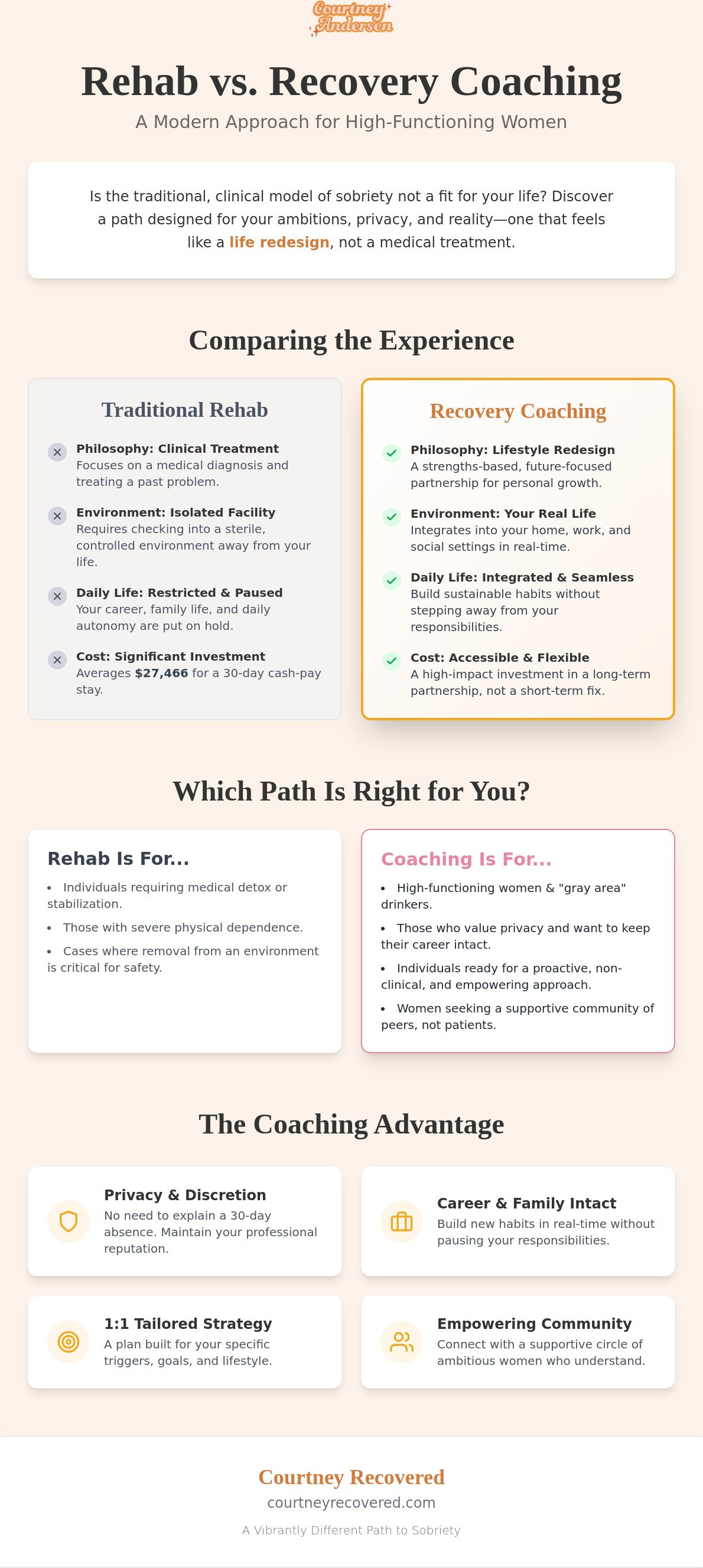
Imagine waking up in your own bed, brewing your favorite coffee, and starting your day without a hospital wristband or a scheduled wake-up call from a nurse. When you choose recovery coaching not rehab, your "treatment center" is your actual life. Traditional rehab requires you to step into a clinical ward, often stripping away your autonomy in exchange for a sterile environment. Coaching happens in your living room, your office, or on a walk in your neighborhood. It's about changing your relationship with alcohol while you're actually living your life, not while you're hiding from it in a 30-day vacuum.
The practical commitment is also a game-changer. While residential rehab can cost an average of $27,466 for a 30-day cash-pay stay (based on 2026 data), coaching offers a high-impact alternative that doesn't require you to drain your savings or disappear from your career. It's an investment in a long-term partnership rather than a short-term crisis fix. This path provides a unique level of accountability. I'm not a detached clinician; I'm a mentor who offers "tough love" realism. I've been in the trenches, so I can spot an excuse from a mile away. This peer-based connection is a powerful tool for sustainable change. In fact, the SAMHSA guide on peer recovery support notes that this type of non-clinical support is vital for long-term success and quality of life.
Structure and Daily Life
Rehab is built on isolation. You have scheduled meals, mandatory group sessions, and restricted freedom. For a high-functioning woman, this often feels like being grounded as an adult. Coaching is built on integration. We tackle real-world triggers as they happen. You might have a 1:1 session on a Tuesday and then use your Sober Toolkit to navigate a high-stakes networking event on Thursday. You keep your career, you stay present for your family, and you learn to be sober in the world you actually live in. If you want to see how this looks in practice, the resources at Courtney Recovered show you how to build that foundation without the hospital gown.
Methodology: Clinical vs. Vibrant
Most clinical programs rely heavily on the 12-step model, which can feel somber or even disempowering to some. Many women are now seeking non-12-step sobriety programs that focus on personal agency and "Emotional Sobriety." We reclaim the vocabulary of recovery. Sobriety isn't a somber "loss" of alcohol; it's a vibrant gain of clarity, energy, and self-respect. We focus on healing the root causes of your drinking through an empowering lens, turning your path into a celebratory life redesign rather than a medical chore.
Is Coaching Enough? Identifying if You’re a Fit for Non-Clinical Support
You’re checking every box on your to-do list, yet you’re trapped in a mental loop about when you can have your first drink. It’s a lonely place to be. You feel like you’re doing "too well" for a clinical program, but you’re definitely not doing well enough to keep going like this. This is where the choice of recovery coaching, not rehab, becomes clear. If you aren't in a medical crisis but you are tired of the secret cycle of drinking, coaching offers the high-level accountability you need without the hospital gown. It’s for the woman who is done with the "Day 1" regret and is ready for a "Stop Starting Over" philosophy that actually sticks.
Before we dive deeper, let’s talk safety. If your body has a physical dependency that leads to dangerous withdrawal symptoms like seizures or extreme tremors, medical stabilization is your first step. I don’t offer detox or clinical treatment. My work begins when you are medically safe and ready to build a life you love. For many high-functioning women, the struggle isn't about medical survival; it's about emotional sobriety and lifestyle design. You need someone who understands the pressure of a high-stakes career and the "Gray Area" of drinking where you’re functional but miserable.
Signs You’re Ready for a Recovery Coach
If you've tried to "only drink on weekends" or "limit it to two glasses" and failed every single time, you don't need more willpower. You need a new system. You might be a functioning alcoholic who is simply exhausted from wearing the mask of perfection while nursing a secret hangover. Coaching is the right fit if you want a personalized roadmap that honors your ambition rather than a one-size-fits-all program that treats you like a number. You’re ready to trade the clinical "patient" label for the role of a woman taking charge of her future.
When Rehab is the Right Choice
Safety is non-negotiable. If you are at risk for severe withdrawal, a residential facility with 24/7 medical monitoring is the only responsible choice. These programs focus on the critical first step of stabilization. Once that foundation is set, coaching becomes the essential bridge back to your real life. Think of rehab as the emergency room and coaching as the personal trainer for your new, vibrant existence. Whether you’re starting fresh or looking for "The After" support, knowing the difference ensures you get the specific level of care your body and mind deserve; for guidance on finding clinical treatment or mental health support, Addiction Center is a valuable referral resource for individuals and families.
Building Your 'Sober Toolkit': How Coaching Replaces the Rehab Routine
You’ve realized that a hospital gown isn't your style. Now comes the practical part: how do you actually stay sober when the 5 PM "witching hour" hits and you’re in your own kitchen, not a locked facility? This is where the magic of a bespoke toolkit comes in. While traditional programs offer a generic schedule for everyone, 1:1 Sobriety Coaching provides a tailored strategy for your specific life. We don't just talk about "staying away from a drink." We build a roadmap that accounts for your high-stakes meetings, your social calendar, and your unique stressors. Choosing recovery coaching, not rehab, lets you test these tools in the real world immediately, ensuring they work when it matters most.
Daily maintenance is the heartbeat of this lifestyle. Instead of mandatory group sessions in a basement, you use the Sober Vibes Book to anchor your morning and night routines. It’s about setting a vibrantly optimistic tone for your day before the world starts demanding things from you. You’re not just avoiding a liquid; you’re curating a new vibe. When you’re out in the "social jungle," you aren't hiding behind a facility wall. You're learning to be sober and social in real-time. We develop scripts for those awkward bachelorette parties and networking events so you can hold a mocktail with total confidence. Ready to build your bespoke plan? Check out 1:1 Sobriety Coaching to get started.
The Power of the Online Sober Community
Isolation is the high-performing drinker’s greatest enemy. You think you’re the only one struggling because everyone else at the gala seems to be "handling it" just fine. The Sobriety Circle breaks that illusion. It’s a digital squad of women who prioritize vibrancy over shame. Having real-time access to a community through your phone provides a layer of relapse prevention that a weekly clinical meeting can't touch. You can text the group when you’re tempted at a wedding and get immediate, empathetic feedback from women who truly get it. This isn't about sitting in a circle and sharing your "sins"; it's about connecting with a tribe that celebrates every sober win.
Practical Tools for the Real World
The Sober Toolkit is your secret weapon for the moments when willpower feels thin. It provides immediate, tangible alternatives to that 5 PM glass of Chardonnay. Whether it's a specific breathing technique, a go-to mocktail recipe, or a quick mindset shift, these tools are designed for your actual life. We also focus on the "Stop Starting Over" philosophy, which is a total game-changer for your brain. This approach creates lasting neural shifts by replacing the exhausting cycle of Day 1 regrets with consistent, positive reinforcement. You stop viewing sobriety as a restrictive "diet" and start seeing it as the ultimate competitive advantage for your career and your relationships; for B2C business owners, this clarity is the perfect foundation for scaling with Founder Freedom.
Courtney Andersen: A Vibrantly Different Path to Sobriety
Courtney Andersen isn't a doctor in a white coat or a detached counselor reading from an outdated manual. She’s the "cool older sister" who has already navigated the messy, confusing path you're on right now. By blending her lived experience with high-level professional mentorship, she offers a way out that feels empowering rather than embarrassing. For women trapped in the "High-Functioning Trap," the struggle is often invisible to the outside world. You're still hitting your targets and showing up for your family, but the internal cost is becoming too high to pay. Choosing recovery coaching, not rehab, with Courtney means you finally get to drop the mask and start building a life that feels as good on the inside as it looks on the outside.
The core of this work is the Stop Starting Over philosophy. We move beyond the exhausting cycle of relapse and regret by focusing on what you're gaining, not what you're giving up. This isn't just about "The After" of clinical treatment; it's about creating a reality where you don't feel the need to escape through a bottle in the first place. It’s a total life redesign. You learn to navigate the world with a clear head and a full heart, turning your sobriety into your greatest competitive advantage.
Once you've reclaimed your energy and focus, you might find that your professional ambitions reach new heights; to further elevate your leadership and business growth, check out Jani Havunen for expert coaching and advisory.
The 1:1 Coaching Experience with Courtney
When you step into your first session, you can leave the shame at the door. There is no judgment here, only a concrete plan. We look at your schedule, your triggers, and your goals to build a strategy that actually fits into your busy professional life. You don't have to quit your job or leave your family to get better. In fact, many women find that accessing couples counseling near me helps to heal relationships strained by past drinking. You just need personalized sobriety support that respects your time and your ambition. This is high-impact accountability designed for the woman who is ready to take her power back and stop the "start-stop" cycle for good.
Join the Sobriety Circle
If you’re tired of feeling like the only one who can’t "handle" their wine, the Sobriety Circle is your new home. This community is built on the collective energy of women who are choosing more for themselves. It’s a space where vibrancy replaces shame and where connection feels like a social win rather than a chore. This can be the last "Day 1" you ever have to face. Stop waiting for a crisis to give yourself permission to change. Join the membership today and start living the loud, colorful, and alcohol-free life you deserve. Your future self is waiting for you to make this move.
Design a Life You Don’t Want to Escape From
You’ve spent enough time wondering if your drinking is "bad enough" to deserve support. The truth is that you don't need to hit a clinical rock bottom to choose a better version of yourself. We’ve explored how choosing recovery coaching not rehab gives you the freedom to stay in your life while you change it. You get to keep your career, your privacy, and your autonomy while building a personalized toolkit that actually works at a boardroom table or a neighborhood BBQ. It’s about integration, not isolation.
As the author of Sober Vibes and a specialist in Gray Area Drinking, I’ve helped countless women break the "functioning but miserable" cycle. Through the Sobriety Circle and my coaching programs, I provide the "cool older sister" guidance you need to stop the exhausting "start-stop" loop for good. You deserve a life that feels electric and authentic, not one managed by clinical labels and hospital routines. It’s time to trade the secret hangovers for a vibrant, alcohol-free reality.
Ready to stop starting over? Book your 1:1 Sobriety Coaching session now.
Your new chapter is waiting, and it’s going to be the best thing you’ve ever done for yourself. You’ve got the power to change, and I’m here to help you lead the way.
Frequently Asked Questions
What is the difference between a recovery coach and a therapist?
A recovery coach is a future-focused partner who helps you build a vibrant, alcohol-free lifestyle through action and accountability. While a therapist often focuses on healing past trauma and diagnosing clinical conditions, a coach focuses on your "how" rather than your "why." We work on practical tools, daily routines, and real-time strategy to keep you moving toward the woman you want to be.
While coaching provides the roadmap for your future, some women find that sobriety opens the door to a deeper existential rupture. If you are looking for a non-clinical, depth-oriented approach to these transitions, you can visit Dialogs with Life, Inc. to learn about psychotherapy focused on spiritual and major life changes.
For therapists and counselors interested in professional development or building their own specialized service, you can learn more about Martin Hogg (Private Practice Success) to explore accredited CPD training and business coaching.
Is recovery coaching as effective as inpatient rehab for high-functioning drinkers?
For women who are medically stable, recovery coaching, not rehab, is often more effective because it happens in your actual life. You aren't learning to stay sober in a clinical bubble; you're doing the work while navigating your career and family. Specialized programs like sobercoach.com.au provide high-intensity accountability and personal strategy without the massive disruption and isolation of a 30-day facility stay.
How do I know if I need medical detox before starting with a sober coach?
You must seek medical detox if you experience physical withdrawal symptoms like severe tremors, hallucinations, or seizures when you stop drinking. Safety is non-negotiable. If you are physically dependent, you need clinical stabilization first. Once you are medically safe and out of the danger zone, coaching acts as the essential bridge to help you maintain your sobriety in the real world.
Can I work with a sobriety coach if I don't want to do AA or the 12 steps?
Yes, my approach is a non-12-step alternative that focuses on personal agency and lifestyle design. You don't have to adopt traditional labels or follow a specific 12-step program to find success here. We focus on "Emotional Sobriety" and building a toolkit that aligns with your modern, professional life, allowing you to reclaim your power without the somber atmosphere.
How much does recovery coaching cost compared to a 30-day rehab stay?
Recovery coaching is significantly more accessible than traditional residential programs. While a 30-day cash-pay rehab stay can cost an average of $27,466 based on 2026 data, coaching packages provide long-term, personalized support at a fraction of that investment. You get high-level mentorship and a community of women who "get it" without the massive financial burden or taking weeks off work.
What happens during a 1:1 sobriety coaching session?
Every session is a no-judgment zone where we map out your specific triggers and refine your sobriety strategy. We might develop scripts for an upcoming networking event or dive into your morning routine using the Sober Vibes Book. It's a high-energy conversation focused on practical solutions, ensuring you have the exact tools needed to handle your week with total confidence and clarity.
Can a recovery coach help me if I have already relapsed multiple times?
Absolutely, because coaching is specifically designed to break the "Stop Starting Over" cycle. We look at exactly where your previous attempts hit a wall and build a more resilient system that accounts for your high-pressure lifestyle. Relapse often happens due to a lack of real-world integration; coaching fixes that by providing real-time support as you navigate your daily stresses.
Is recovery coaching confidential for professional women?
Privacy is a top priority for the high-performing women I work with. Your work with a coach is a private, professional partnership that doesn't involve insurance records or medical files. You can reclaim your life and build a sustainable, alcohol-free future without ever having to worry about your reputation or career standing being compromised. It's about getting the support you need with total discretion.
I want you to feel sober NOT boring!
Kickstart your sobriety with my free 2-day video workshop series to master your sober mindset and have FUN in your sobriety journey!


