
Professional Woman Drinking Too Much? The High-Functioning Guide to Sobriety in 2026
Aug 06, 2026
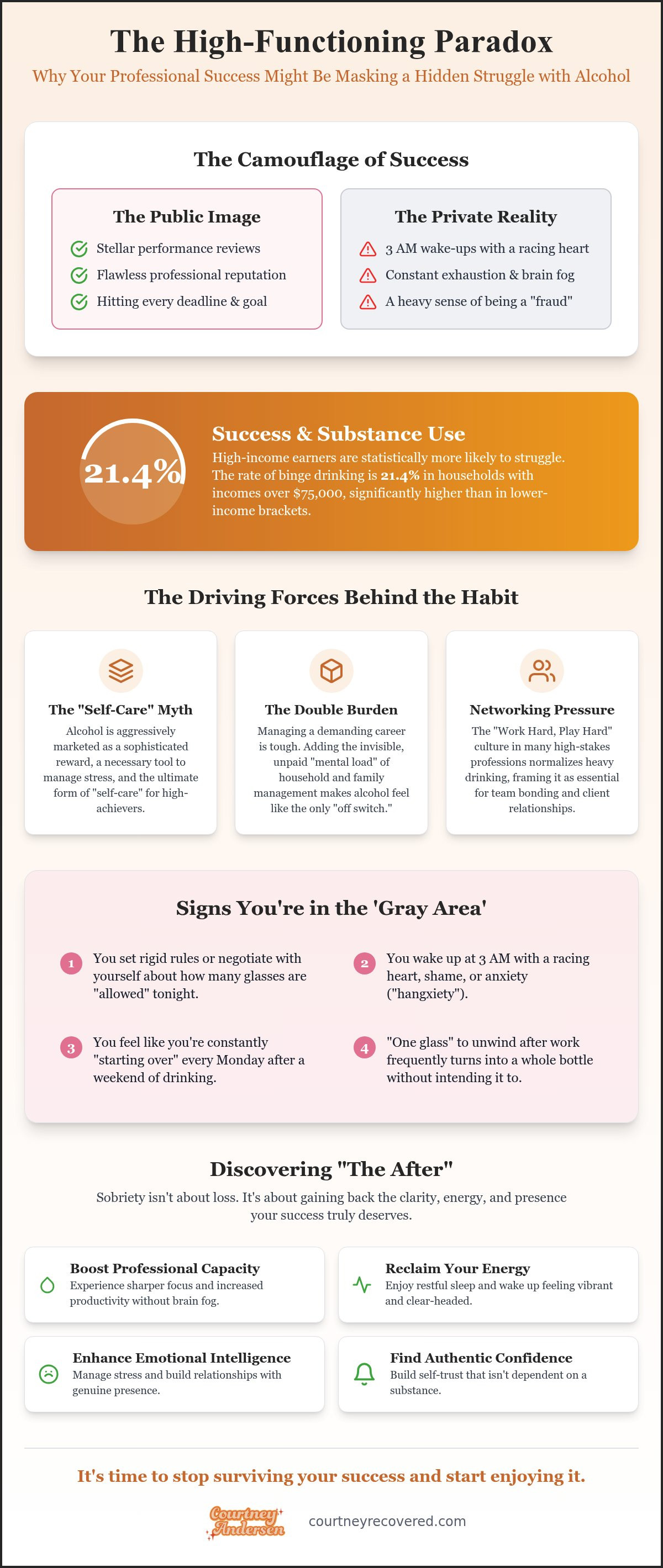
What if your professional success isn't proof that you're "fine," but is actually the very thing keeping you stuck in a cycle of hidden hangovers? You're hitting every deadline and maintaining a flawless reputation, yet you're waking up at 3 AM with a racing heart and a heavy sense of "fraud" hanging over your head. It's the ultimate paradox. Being a professional woman drinking too much often means your high performance acts as a camouflage, making it easy to ignore the brain fog and the exhaustion of the "Wine Mom" social pressure.
I know you're tired of "starting over" every Monday morning while pretending everything is perfect. You're ready to feel vibrant and clear-headed again, but you don't want the sterile, clinical atmosphere of traditional programs. This guide is your roadmap to reclaiming your energy in 2026. We'll look at why high-income earners are statistically more likely to struggle with binge drinking and show you the practical, celebratory steps to find your "after" without the stigma. It's time to stop surviving your success and start actually enjoying it.
Key Takeaways
- Understand why professional success often acts as a camouflage for a drinking problem, letting you maintain a perfect image while your internal peace erodes.
- Recognize the "Mommy Juice" marketing traps that convince a professional woman drinking too much that alcohol is the only way to manage a high-pressure career and home life.
- Identify the subtle red flags of gray area drinking, such as setting rigid rules or negotiating with yourself about how many glasses are "allowed" tonight.
- Discover how to use non-clinical resources like the Sober Toolkit to stop the exhausting cycle of starting over every Monday.
- Learn how to build a life in "The After" where sobriety isn't a loss, but a gain that boosts your professional capacity and emotional intelligence.
The High-Functioning Paradox: Why Success Masks the Struggle
High-functioning is a trap. It is the ability to keep all the plates spinning while the kitchen is quietly on fire. For the professional woman drinking too much, success is the ultimate disguise. It's a state where your LinkedIn profile is glowing and your quarterly reviews are stellar, but your internal peace is being eroded by every "just one more" glass. You aren't hitting a stereotypical "rock bottom," but you're definitely living in gray area drinking; that murky middle ground where the fun has started to fade, yet the consequences haven't quite destroyed your life. Not yet.
The higher the title, the harder the fall. This shame-success gap is incredibly real. When you have resources and privacy, it's easy to hide the habit from the world. You aren't drinking in a dive bar; you're drinking expensive Cabernet in a beautiful kitchen. While the clinical definition of Alcohol Use Disorder doesn't care about your tax bracket or your career achievements, our culture certainly does. We've normalized the "Work Hard, Play Hard" mentality so much that heavy drinking is often seen as a badge of honor, but for a professional woman drinking too much, it's actually a heavy weight to carry in secret.
Camouflage in the Corner Office
Your promotions and awards are more than just career milestones; they are "proof" that everything is fine. High-stakes environments, like law firms or corporate headquarters, often use alcohol as the primary social glue for networking. This makes it almost impossible to see the line between professional socializing and a problematic habit. Your impressive title acts as a success shield, convincing both you and your peers that your evening habit couldn't possibly be a problem because "look at everything you're achieving." You use your productivity to silence your intuition, telling yourself that as long as you're winning at work, the wine doesn't matter.
The 3 AM Wake-Up Call
The physical toll is where the mask finally starts to slip. Alcohol triggers a massive cortisol spike a few hours after your last drink, leading to that dreaded 3 AM wake-up call filled with heart palpitations and "hangxiety." You spend your morning battling a hangover with expensive skincare and green juice, trying to maintain the facade of a "perfect" routine. It's the moment when "unwinding" after a long day of meetings quietly shifts into "unraveling" your mental health. You're exhausted from the effort of maintaining the image, and that exhaustion only makes the next drink feel more necessary.
The 'Mother's Little Helper' of 2026: Why Professional Women Drink Too Much
Alcohol has undergone a massive rebranding. It isn't just a beverage anymore; it is being marketed as the ultimate tool for "self-care" and survival. For the professional woman drinking too much, "Wine O'Clock" isn't just a cute meme on a kitchen towel. It is a cultural permission slip to use a depressant to manage the high-voltage demands of a modern career. In 2026, the lines between a relaxing reward and a necessary coping mechanism have blurred into a dangerous haze.
The "double burden" is a major driver of this trend. You aren't just managing a team and hitting quarterly targets. You're also likely carrying the majority of the household "mental load," which refers to the invisible labor of planning, organizing, and remembering everything for everyone else. By the time you close your laptop, your brain is still running a thousand open tabs. Alcohol feels like the only "off switch" fast enough to quiet the noise, but it's a temporary fix that comes with a heavy price. Research shows that health risks for women are significantly higher because our bodies process alcohol differently, making that "off switch" more toxic than we realize.
Networking in 2026 has also become a minefield. Binge drinking is often higher in households with incomes over $75,000, sitting at 21.4% compared to lower-income brackets. In high-pressure professional circles, heavy drinking is frequently framed as "socially acceptable" bonding. It's the new golf, but with higher stakes for your health and clarity.
The Marketing of 'Self-Care' in a Bottle
The alcohol industry has perfected the art of lifestyle branding. They've linked "sophistication" with a glass of rosé and "strength" with a stiff cocktail after a board meeting. This marketing convinces you that wine is a necessary reward for your hard work. It creates a false connection between high-status living and alcohol consumption, making it feel like you're losing part of your identity if you put down the glass. Breaking this link is the first step toward realizing that true sophistication is having the clarity to lead without a chemical crutch.
The Mental Load and the Pour
Using a depressant to manage high-stress career demands is like trying to put out a fire with gasoline. While it feels like you're relaxing in the moment, alcohol actually increases your baseline anxiety the next day. This creates a cycle where you drink to escape the stress that the previous night's drink helped create. If you're tired of using "Mommy Juice" to survive your own life, exploring 1:1 Sobriety Coaching can provide the high-performance mentorship you need to manage your load without the bottle.
Signs Your 'Social Habit' is Actually Gray Area Drinking
If you're a professional woman drinking too much, your checklist for a "problem" probably doesn't match the clinical lists you find online. You aren't losing your job or showing up to meetings visibly intoxicated. Instead, the signs are much quieter and more internal. It is the subtle shift from wanting a drink to needing one just to feel "normal" after a high-stakes day. You might still be hitting your KPIs, but you're losing your spark, your patience, and your presence. Gray area drinking is that space where the external world sees a success, but you feel like a fraud.
The "Rule-Setting" trap is one of the biggest red flags. We tell ourselves that as long as we have boundaries, we're in control. Common rules include "no drinking before 6 PM," "only two glasses a night," or "only on weekends." However, if you find yourself constantly thinking about, negotiating, or counting down the minutes until those rules allow you to have a pour, the alcohol is already running the show. For a high-achiever, having to manage a "social habit" with rigid rules is a clear sign that the habit has become a burden.
The Negotiation Phase
Think about the mental energy you spend on alcohol. It's the internal monologue that starts around 4 PM: "I had a rough meeting, so I deserve one extra," or "I'll skip the gym so I can start earlier." This mental gymnastics is exhausting. It's why many women find that "taking a break" during Dry January feels like a relief at first, but then they slide right back into the same patterns. Without a real change in your relationship with alcohol, you stay stuck in the "start-over" cycle, waking up every Monday morning promising that this week will be different.
The Impact on Professional Performance
You might not be missing meetings, but are you truly leading? Alcohol disrupts your sleep cycles, even if you "pass out" easily. This leads to a lack of "deep work" capabilities the next morning. You're operating on a deficit, using caffeine and willpower to bridge the gap left by last night's Chardonnay. When we look at the sex-based risks involved, we see that the female brain is uniquely sensitive to these disruptions, making that professional "edge" even harder to maintain.
Micro-withdrawals often manifest as "hangxiety," that low-grade dread that makes you second-guess your emails or your tone in a presentation. For a high-achiever, "functional" is a dangerously low bar to set for yourself. You weren't meant to just function; you were meant to thrive. If your drinking is making your leadership feel like a performance rather than a natural expression of your talent, it's time to look closer at the habit.
Reclaiming Your Edge: Practical Resources for the Professional Woman
Reclaiming your edge isn't about restriction; it's about optimization. If you are a professional woman drinking too much, you might worry that sobriety will make you boring or less effective in the boardroom. The reality is the exact opposite. Sobriety is the ultimate performance enhancer. When you remove the depressant that has been taxing your brain and body, you unlock a level of focus and vibrancy that a morning double-espresso could never touch. You aren't losing a social life; you're gaining a competitive advantage.
Transitioning away from alcohol requires more than just willpower. It requires a strategy. High-performers don't just "wing it" during a major merger, and you shouldn't wing your sobriety either. By shifting your perspective to see alcohol-free living as a gain rather than a loss, you start to build a life in "The After" that you actually enjoy living. This is where you move from surviving your career to truly leading it.
Building Your Sober Toolkit
The Sober Toolkit is your secret weapon for daily maintenance. It is a collection of non-clinical, practical resources designed to replace the 5 PM glass of wine with high-vibe rituals that actually lower your cortisol. Your toolkit should include:
- High-Level Accountability: Utilizing 1-on-1 sobriety coaching provides the same kind of mentorship and structure you expect in your professional development.
- Quit-Lit: Reading books like the Sober Vibes Book helps reframe your mindset by sharing the stories of other successful women who have walked this path.
- Networking Strategies: Learning to navigate professional events with a mocktail in hand allows you to network effectively without the next-day "hangxiety."
The Power of Community
Doing this alone is the hardest way to quit. In a professional world that celebrates "Work Hard, Play Hard," you need a tribe that values clarity over cocktails. The Sobriety Circle offers a space to find professional peers who understand the unique pressures you face. It acts as a networking and support hybrid, removing the clinical stigma often found in traditional recovery groups. When you're surrounded by other high-achievers who are choosing vibrancy, the social pressure from colleagues starts to lose its power. You aren't the woman who "can't drink"; you're the woman who chooses to be at the top of her game every single morning.
If you're ready to stop the cycle of starting over and finally reclaim your energy, it's time to invest in your most important asset: yourself. Take the first step toward your new reality and explore our high-performance sobriety mentorship today.
The After: Rediscovering Your Identity Beyond the Bottle
Sobriety isn't just the absence of alcohol; it's the presence of everything else. For a professional woman drinking too much, the biggest fear often isn't the health risks. It's the identity crisis. You worry that without the wine, you'll lose your social edge, your "cool girl" status at networking events, or your ability to handle high-stakes pressure. The reality is that alcohol was never your edge. It was the weight holding you back from your true potential. Moving into "The After" means building a life that is so vibrant and fulfilling that you no longer feel the need to escape.
When you stop numbing your emotions, your emotional intelligence (EQ) skyrockets. You start to lead with more empathy, patience, and clarity. Instead of reacting to workplace stress from a place of "hangxiety" and depletion, you respond with a calm, focused mind. This shift allows you to actually solve the root causes of your stress rather than just masking them for a few hours every night. This is the essence of emotional sobriety; a sustainable lifestyle shift that values long-term peace over short-term relief.
Your New Professional Edge
Think of sobriety as the ultimate return on investment (ROI). While the world focuses on what you're "giving up," you'll be too busy celebrating what you've gained. The professional benefits of an alcohol-free life are immediate and undeniable. You'll notice:
- Unmatched Focus: No more "brain fog" during morning meetings or relying on caffeine to survive the 2 PM slump.
- The Sleep Luxury: Real, restorative sleep that allows you to wake up feeling genuinely refreshed rather than just "functional."
- Physical Vibrancy: Clearer skin, brighter eyes, and a natural energy that skincare products can't replicate.
- Deep Work Capabilities: The ability to stay in the zone and tackle complex projects without the distraction of a racing, anxious heart.
Building a Sustainable Future
Transitioning from those first few weeks of "not drinking" to a lifetime of "The After" requires a change in your internal narrative. You aren't "recovering" in the somber, clinical sense. You are evolving. You are choosing a version of yourself that is bold, unapologetic, and fiercely present. This maintenance phase is where the real magic happens, as you rediscover hobbies, passions, and connections that the bottle previously overshadowed.
Sustainable change doesn't happen in a vacuum. High-achievers know that the fastest way to reach a goal is through expert mentorship. Whether you're navigating your first sober business trip or re-evaluating your social circle, coaching provides the high-level accountability you need to stay on track. Ready to reclaim your edge and start living your version of "The After"? Book a 1:1 discovery call with Courtney Andersen today and discover how vibrant life can be when you stop starting over.
Your New Chapter Starts Now
Success shouldn't feel like a secret you're trying to protect while your health and peace of mind slowly erode. We've explored how high performance often masks the struggle and why the "Wine Mom" culture is a trap designed to keep you stuck. If you're a professional woman drinking too much, you already know that "functional" is a dangerously low bar. You deserve to feel as good as your resume looks. By reclaiming your identity and building a life you don't want to escape, you unlock a level of focus and joy that alcohol simply can't provide.
As the author of the Sober Vibes Book and creator of the Stop Starting Over program, Courtney Andersen serves as an expert mentor for high-performing women ready to trade 3 AM anxiety for genuine vibrancy. You've done the hard work of building your career; now it's time to do the rewarding work of rediscovering yourself. Start your journey to a vibrant, alcohol-free life with 1:1 coaching and step into the clarity you've been missing. The world needs your full, unfiltered light, and it's waiting for you in "The After."
Frequently Asked Questions
Is it possible to be a high-functioning alcoholic if I never miss work?
Yes, it is absolutely possible to be high-functioning while struggling. Many high-performers use their career success as a shield to ignore the reality of their habits. If you're a professional woman drinking too much, you might never miss a deadline, but you're likely missing out on your own peace of mind. High-functioning is simply a stage, not a permanent pass to keep drinking without consequences.
How do I tell my professional network that I’m not drinking anymore?
You have total control over this narrative. You don't need to make a grand announcement or use heavy labels. Try saying, "I'm prioritizing my sleep right now," or "I've realized I have way more energy without it." Most people are too worried about their own glass to care about yours. When you lead with confidence, your network will respect your new level of clarity.
What is gray area drinking and how is it different from alcoholism?
Gray area drinking is the murky middle ground where the fun has faded but the "rock bottom" hasn't hit. It differs from clinical alcoholism because you might still have your life together on paper. It is more about your relationship with alcohol and the mental energy it drains. If you're constantly negotiating your next drink or setting rigid rules, you're likely in the gray area.
Can I still be successful and social without alcohol in my industry?
You will actually be more successful. Sobriety gives you a massive competitive advantage because you're always present and sharp. While others are getting sloppy at the after-hours event, you're making genuine connections and remembering every detail. You'll find that your "social edge" was never in the bottle; it was always in your own confidence and emotional intelligence.
How long does it take for my brain fog to clear after I stop drinking?
Most women notice a significant lift in brain fog within the first 10 to 14 days. Your sleep architecture begins to repair itself almost immediately, which is the biggest factor in mental clarity. By the end of your first month, your "deep work" capabilities usually return. The long-term cognitive gains continue to stack up as your nervous system finds its new, healthy baseline.
What should I do if my husband still drinks but I want to stop?
Your sobriety belongs to you, not your marriage. It's helpful to have an honest conversation about your needs, but you can't wait for him to be ready before you choose yourself. Find a community like the Sobriety Circle to get the support you might be missing at home. Focusing on your own vibrant "after" often inspires those around you more than any lecture could.
Is sobriety coaching more effective than AA for professional women?
Effectiveness depends on what you need. AA is a peer-led support group focused on recovery, while 1:1 sobriety coaching is high-level mentorship for high-performers. Many professional women prefer coaching because it feels like professional development rather than a clinical treatment. It is about moving toward a bigger life and reclaiming your energy, not just moving away from a bottle.
What are the first signs that my drinking is affecting my professional performance?
Watch out for "hangxiety" and the loss of your creative edge. If you're a professional woman drinking too much, you might start second-guessing every email or feeling a sense of dread before morning meetings. Another sign is the inability to focus on "deep work" because your brain is stuck in a loop of counting down to the evening. Your performance might look fine, but your potential is being capped.
I want you to feel sober NOT boring!
Kickstart your sobriety with my free 2-day video workshop series to master your sober mindset and have FUN in your sobriety journey!


