
What to Ask a Potential Sobriety Coach: Your Essential 2026 Interview Checklist
Jul 21, 2026
You aren't a "failure" because your last attempt at sobriety didn't stick. You just haven't found the right strategic partner to help you redesign your life. It's exhausting to keep up that "everything is fine" mask in your professional circle while feeling totally isolated by gray area drinking at home. You're likely done with the clinical, somber approach to recovery. You want a life that feels like a celebration, not a restriction. Finding that vibe starts with knowing exactly what to ask a potential sobriety coach before you invest your time and heart.
I understand the anxiety of wondering if a coach will actually "get" you or if it's just another expense that leads back to day one. You need a mentor who balances deep empathy with the kind of tough love that keeps you moving forward. This guide provides your essential 2026 interview checklist to ensure your coach is a perfect match for your lifestyle evolution. We'll dive into how to vet their lived experience, their approach to social confidence, and the practical tools they use to help you stop starting over for good.
Key Takeaways
- Learn why the discovery call is your secret weapon for finding a coach who acts as a strategic partner rather than a detached authority.
- Master exactly what to ask a potential sobriety coach to uncover their personal history with alcohol and their specific training in the recovery space.
- Discover the difference between traditional recovery models and modern, non-clinical methodologies that utilize practical resources like a Sober Toolkit.
- Get clear on the logistics of premium 1:1 coaching, including how to navigate session frequency and total financial investment with confidence.
- Use our two-step "gut check" process to determine if a mentor makes you feel truly seen and supported or just judged by a sterile system.
Why You Need to Interview Your Coach (Not Just Hire the First One)
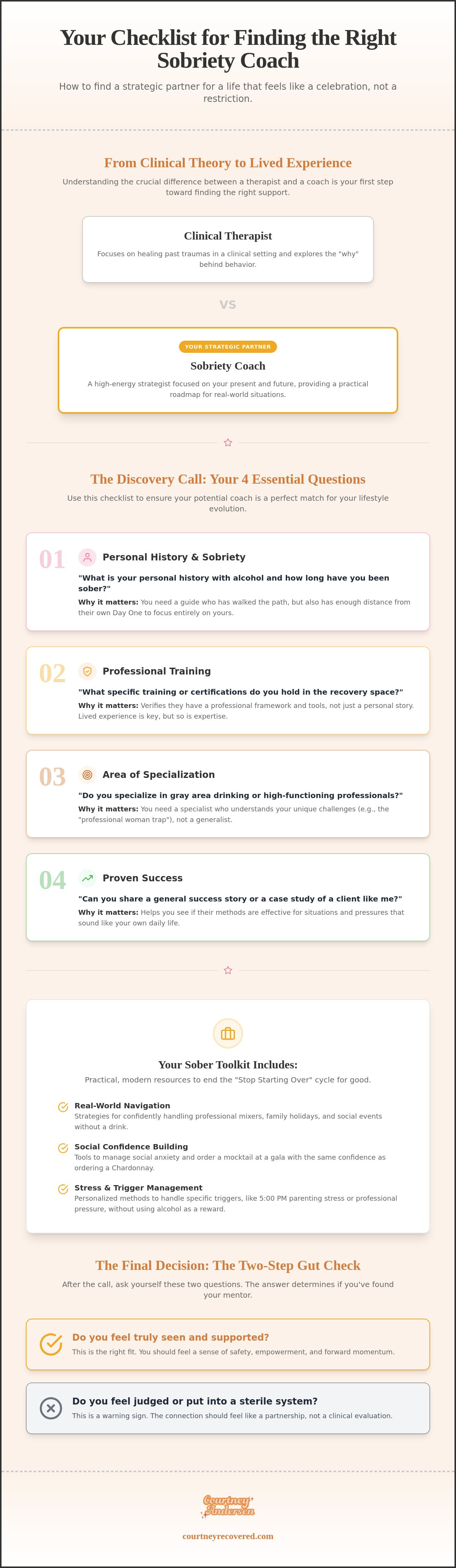
Hiring a sobriety coach is a massive step toward the life you actually want to live. It is not just about picking a name from a list or hiring the first person who pops up on your feed. This person is going to be your mentor, your strategic partner, and the person who helps you redesign your entire lifestyle. Before you dive in, you need to understand what is a recovery coach and how their role differs from a clinical therapist. While a therapist often focuses on healing past traumas in a clinical setting; a sobriety coach is a high-energy strategist focused on your present and your future. They provide the practical roadmap you need to navigate real-world situations like professional mixers or family holidays without a drink in your hand.
The discovery call is the ultimate vibe check. It is your chance to see if the coach’s energy matches your own. You are looking for a connection that feels both safe and empowering. This initial conversation is where you decide if this person can handle your need for "tough love" realism or if they are the empathetic cheerleader you require. Knowing exactly what to ask a potential sobriety coach during this call ensures you aren't just wasting more money on another attempt that doesn't stick. The right match creates a sense of immediate momentum, helping you break the "Stop Starting Over" cycle before it even begins.
The Power of Lived Experience vs. Clinical Theory
High-functioning professionals often feel alienated by sterile, clinical environments. You don't need a textbook definition of alcohol use; you need someone who knows exactly how it feels to white-knuckle a cocktail hour while your brain screams for a glass of Chardonnay. Lived experience creates an immediate safety zone. It removes the stigma of gray area drinking because your coach has been in your shoes. They’ve navigated the same professional pressures and social anxieties you face every day. This shared history is what makes their mentorship so effective. It is not about academic theory; it is about the real-life tools that actually work when the pressure is on.
Setting the Intent: What Do You Want Your Sobriety to Look Like?
Before you get on that call, get honest about your desired outcomes. Do you want to be the person who confidently orders a sophisticated mocktail at a gala? Are you trying to survive the 5:00 PM stress of parenting without using wine as a reward? Your coach should feel like the "cool older sister" who has already successfully navigated the path you're on. Identifying your specific triggers, whether they are professional stress or social anxiety, allows you to see if the coach has the right tools for your specific life. You want a mentor who balances deep empathy with the practical strategies found in a Sober Toolkit, ensuring your sobriety feels like a celebratory gain rather than a restrictive loss.
The Experience Checklist: Beyond the Bio
You’ve decided you’re done with the "Stop Starting Over" cycle. Now, you need to make sure the person you’re hiring is actually equipped to lead you to the finish line. It isn't enough to just like someone's Instagram aesthetic or feel inspired by their morning routine. When you are narrowing down what to ask a potential sobriety coach, you have to dig deeper than their bio. You are looking for a blend of lived experience and professional skill. This isn't just about how long they’ve been sober; it’s about their ability to translate that success into a roadmap for your specific life.
During your discovery call, keep these four questions front and center:
- Question 1: What is your personal history with alcohol and how long have you been sober? You want to know they’ve walked the path, but also that they have enough distance from their own Day One to focus entirely on yours.
- Question 2: What specific training or certifications do you hold in the recovery space? By 2026, the industry has shifted toward a heavy emphasis on professional development. Ensure they have more than just a story; they need a framework.
- Question 3: Do you specialize in gray area drinking or high-functioning professionals? If you’re managing a career and a family, you don't need a generalist. You need someone who understands the "professional woman trap."
- Question 4: Can you share a general success story or a case study of a client like me? Listen for how they handled social anxiety or professional stress. If their examples sound like your daily life, you’ve likely found a winner.
Vetting Their Professional Background
There is a massive difference between a "certified coach" and a "sober influencer." An influencer might inspire you, but a coach has the tools to hold you accountable when the initial excitement fades. Continuous education in the recovery field matters because the science of habit change is always evolving. While a decade of sobriety is impressive, it doesn't automatically mean a person has the professional framework to guide you through your own unique triggers. You deserve a mentor who stays current on the best ways to support your long-term evolution.
Niche Expertise: Do They "Get" Your Life?
If you’re a high-functioning woman, your struggle often involves a "mask" of perfection. You need a coach who understands why you feel like a failure despite your external success. When considering what to ask a potential sobriety coach, ask specifically about social sobriety. How do they help you navigate a bachelorette party or a high-stakes networking event without feeling like the "boring" one? You aren't looking to hide in your house for a year. You want to learn how to be vibrantly social without the liquid courage. If you're ready to find that balance, exploring 1:1 mentorship can provide the tailored strategy you need to thrive in every social setting.
The Methodology: Tools for Ending the Relapse Cycle
You’ve vetted their history and checked their vibe. Now it is time to look under the hood. Sobriety is not just about willpower; it is about having a repeatable system that works when life gets messy. Willpower is a finite resource that runs out by 5:00 PM on a stressful Tuesday. When you are deciding what to ask a potential sobriety coach, you need to understand their "how." You aren't just paying for a weekly chat. You are investing in a strategic framework designed to move you out of the exhausting cycle of day ones and into a life that feels vibrant and sustainable.
During your interview, ensure you cover these four methodological pillars:
- Question 5: Is your approach based on the 12 steps, or do you offer an alternative? You need to know if their philosophy aligns with your personal beliefs and needs.
- Question 6: What practical tools, like a Sober Toolkit, do you provide for daily maintenance? Ask for specifics on what you will actually do when a craving hits.
- Question 7: How do you help clients move past "Day 1" and into "The After"? Look for a coach who has a clear plan for long-term growth, not just short-term abstinence.
- Question 8: Do you focus on the root causes of drinking or just the behavior? True evolution requires looking at why you reach for the glass in the first place.
Non-12-Step Alternatives and Modern Recovery
Many high-achieving women find that traditional recovery models don't quite fit their lifestyle. They don't want to identify as "powerless" or spend the rest of their lives in church basements. A modern coach helps you build a "sober identity" where you are the empowered hero of your own story. This is about a lifestyle gain, not a restrictive loss. By using a Stop Starting Over philosophy, a coach helps you identify the specific patterns that lead to relapse. They provide the roadmap to help you transition from someone who is "trying not to drink" to someone who simply doesn't drink because their life is too good to dull down.
The Daily Toolkit: What Happens Between Sessions?
The real work of sobriety happens in the 167 hours a week when you aren't on a coaching call. Ask your potential mentor if they provide literature, such as the Sober Vibes Book, to keep your mindset focused between sessions. You should also inquire about "emergency" support. Do they have a plan for when you are at a high-pressure networking event and feel the urge to blend in with a glass of wine? A great coach helps you build a Sober Toolkit filled with rituals that replace your old habits. Whether it’s a morning routine that sets your intention or a nightly wind-down that doesn't involve a bottle, these practical tools are what make sobriety stick for the long haul.
The Logistics: Commitment, Cost, and Accountability
You’ve checked the vibe and vetted the tools. Now it's time for the brass tacks. Many people feel awkward asking about money or boundaries, but these details are exactly what keep you from falling off the wagon. When you're finalizing what to ask a potential sobriety coach, you need to be direct about the logistics. This is a professional relationship designed to change your life; so treat it with the respect it deserves. Clear expectations prevent resentment and ensure you're actually getting the support you pay for. You are hiring a partner, not just a cheerleader.
During your discovery call, don't be afraid to pull out your notepad and get specific with these four questions:
- Question 9: What is the frequency and duration of our 1:1 sessions? You need to know if you're meeting weekly or bi-weekly and how long those deep dives last. Consistency is what builds the new neural pathways of a sober life.
- Question 10: What is the total financial investment, and are there payment plans? This is an investment in your future, but it needs to fit your current reality. A professional coach will be transparent and unapologetic about their rates.
- Question 11: How do you handle accountability between our scheduled calls? This is crucial because the real work happens when you aren't on a call. Ask about text support or check-in protocols.
- Question 12: What is your policy on "slips" or relapses during our time together? You need to know if they offer "tough love" resets or if a slip means the end of the program. Transparency here builds immediate trust.
Defining the Boundaries of the Relationship
A sobriety coach is your strategist, not a 24/7 crisis counselor. Understanding this boundary is actually healthy for your recovery. It forces you to build your own resilience rather than relying on a "sobriety 911" line every time you see a wine commercial. You should expect "sober work" or homework between calls to keep your momentum high. These assignments are designed to help you practice the tools we discussed in the previous section.
Community vs. Individual Support
While 1:1 coaching is the premium, tailored solution for ending the relapse cycle, you might eventually want more connection. Ask your potential coach if they offer group components like a Sobriety Circle. This allows you to transition from intensive individual work to long-term community maintenance. Surrounding yourself with other high-functioning women who "get it" provides an extra layer of safety. It removes the loneliness of gray area drinking and replaces it with a vibrant, connected reality. If you're ready to see how a structured plan can change your life; check out our coaching options to find the right fit for your schedule and your goals.
The Gut Check: Deciding Who Walks This Path With You
You’ve finished the calls and your notes are scattered across your desk. Now comes the most important part of the process: the gut check. While knowing what to ask a potential sobriety coach is the foundation, your intuition is what builds the house. You are looking for a mentor who doesn't just have the right answers, but whose energy makes you feel like a vibrant, alcohol-free life is actually possible for you. This isn't a sterile business transaction. It is a partnership that will shape your entire future. If you don't feel a spark of excitement mixed with that "good" kind of nervousness, they might not be the one.
Take a breath and walk through these four steps to make your final choice:
- Step 1: Review your notes immediately. Don't wait until tomorrow when the details get fuzzy. Write down your first impression while it is still fresh.
- Step 2: Ask yourself: "Did I feel judged, or did I feel seen?" A great coach makes you feel safe enough to drop the mask. If you felt the need to "perform" during the call; that is a sign to move on.
- Step 3: Evaluate their energy. Does this person radiate the kind of life you want to build? You want a mentor who represents the "vibrant" reality of sobriety, not someone who makes it feel like a somber chore.
- Step 4: Trust the "Hell Yes" rule. Sobriety is a big commitment. If your reaction to the coach isn't a "Hell Yes," it is a "No."
Red Flags to Watch Out For
In your search for the right partner, stay alert for a few specific red flags. Beware of any coach who promises "guaranteed" results or claims to have a "cure" for your struggle. Recovery is a personal evolution, not a quick fix you can buy. You should also avoid coaches who are overly rigid or dogmatic about one single path. If they insist their way is the only way, they aren't leaving room for your unique life. Most importantly, sobriety should feel like a celebration. If a coach makes "The After" sound like a life sentence of restriction and boredom, run the other way. You are looking for more life; not less.
Ready to Stop Starting Over?
The transition from gray area drinking to a life of total clarity is the most rewarding move you will ever make. Courtney Andersen’s 1:1 coaching is designed specifically to help high-functioning women break out of the "professional woman trap." We don't do boring, and we definitely don't do clinical. We focus on the practical strategies you need to navigate your social and professional world with total confidence. If you’re tired of the relapse loop and ready to see what your life looks like on the other side, it’s time to take action. Book Your 1:1 Sobriety Coaching Discovery Call today and let's see if we're the perfect match for your evolution.
Design Your Vibrant Alcohol-Free Future
You now have the full roadmap for vetting your next strategic partner. By mastering what to ask a potential sobriety coach, you've moved from the isolation of gray area drinking into a space of intentional action. You aren't looking for someone to fix you; you are looking for a mentor with the lived experience and professional methodology to help you redesign your entire lifestyle. Whether you need the "tough love" of a 1:1 session or the inclusive energy of the Sobriety Circle, the right match is out there waiting to help you shine.
Courtney Andersen has already walked this path and built the Stop Starting Over program to ensure you don't have to do it alone. As the author of the Sober Vibes Book, she knows that "The After" is where the real celebration begins. It's time to stop white-knuckling your social life and start living it with total clarity and confidence. You deserve a life that feels like a gain, not a restriction.
Ready to break the cycle? Apply for 1:1 Sobriety Coaching with Courtney today.
Your best days aren't behind you. They're waiting for you on the other side of this decision. Let's make 2026 the year you finally stop starting over.
Frequently Asked Questions
What is the difference between a sobriety coach and a therapist?
A therapist is a licensed clinical professional who diagnoses and treats mental health disorders, while a sobriety coach is a non-clinical mentor focused on goal-setting and practical life skills. Think of a therapist as someone who helps you heal the past and a coach as the strategist who helps you build your future. We focus on the "how-to" of daily sober living rather than medical diagnosis or clinical treatment.
How much does a sobriety coach typically cost in 2026?
In 2026, hourly rates for a sobriety coach typically range from $75 to $300, with most standard sessions falling between $100 and $175 per hour. If you're looking for more intensive support, monthly retainer packages can range from $800 to over $3,000. These costs reflect the high level of personalized accountability and between-session support provided by professional mentors who lead through lived experience.
Do I have to be "hitting rock bottom" to hire a sobriety coach?
You absolutely don't need to hit a "rock bottom" to seek support and start redesigning your relationship with alcohol. Many women hire a coach because they're tired of the "gray area" drinking cycle and want to reclaim their energy before things get worse. If you feel like alcohol is dimming your light or making your life feel smaller, you're in the right place to start your evolution.
Will a sobriety coach tell me I have to go to AA?
A modern sobriety coach won't force you into any specific program like AA, as the goal is to find a path that actually works for your unique lifestyle. While 12-step programs are a great tool for some, many coaches specialize in non-clinical alternatives that focus on building a sober identity through empowerment rather than powerlessness. It's one of the most important things to ask a potential sobriety coach during your initial interview.
How long should I expect to work with a sobriety coach?
Most clients find the greatest success by committing to a three- to six-month coaching container to truly solidify new habits. This duration allows enough time to navigate various social triggers, professional stressors, and holiday seasons with guided, 1:1 support. Long-term maintenance can then transition into community-based support like the Sobriety Circle to keep your vibrant momentum going for years to come.
Can a sobriety coach help me if I have already relapsed multiple times?
Yes, a coach is specifically trained to help you identify the patterns that keep leading back to "Day One" so you can finally break the cycle. We don't view relapse as a failure but as a data point that shows us exactly where your current toolkit needs strengthening. This is why a tailored, non-clinical approach is often more effective for high-functioning individuals who have struggled with traditional recovery models.
Is sobriety coaching confidential?
Sobriety coaching is a private, confidential relationship designed to give you a safe space to be completely honest about your struggle. While coaches aren't clinical providers, professional mentors uphold strict privacy standards to protect your personal and professional reputation. This safety zone is essential for high-achieving women who may have anxiety about being "found out" in their professional or social circles.
What happens during a discovery call with a sobriety coach?
A discovery call is a low-pressure conversation where you and the coach determine if you're a "Hell Yes" match for each other. You'll discuss your current challenges, your vision for an alcohol-free life, and get a feel for the coach's energy and personality. It's the perfect time to ask a potential sobriety coach about their specific experience and how they handle accountability between scheduled calls.
I want you to feel sober NOT boring!
Kickstart your sobriety with my free 2-day video workshop series to master your sober mindset and have FUN in your sobriety journey!


