
What Does a Sobriety Coach Do? Your Alcohol-Free Guide
Aug 31, 2026
What if the reason you keep "starting over" isn't a lack of willpower, but a lack of a tactical roadmap? You might be asking yourself: What does a sobriety coach do that a standard support group or a "dry January" challenge doesn't? It's a valid question, especially when you feel isolated in that frustrating gray area. You aren't "bad enough" for rehab, but you're exhausted by the cycle of promising yourself last night was the final time.
I get it because I've been there, and I know that the fear of losing your professional edge or your social life is incredibly real. This guide is your deep dive into how a coach acts as a lifestyle architect. We'll explore how they provide real-time accountability and tactical tools to help you navigate high-stakes happy hours and emotional triggers without a drink. You're about to learn how to design a vibrant, alcohol-free life that feels like a massive upgrade, not a boring sacrifice. We'll cover the roadmap for social success, emotional resilience, and the lifestyle design needed to finally stop the relapse cycle for good.
Key Takeaways
- Learn exactly what a sobriety coach does to help you break the relapse cycle by focusing on the tactical "how" of daily alcohol-free living rather than just the "why" of the past.
- Understand the crucial differences between coaching, therapy, and AA, and why a personalized, forward-looking roadmap is often the missing piece for professional women.
- Discover how to use a practical Sober Toolkit to navigate high-stakes social situations like weddings and corporate events with total confidence and zero deprivation.
- Shift your focus from what you're "giving up" to what you're gaining by designing a vibrant new identity and a life that feels bigger and more connected than your drinking days.
- Get clear on how to find a coaching match that resonates with your specific background so you can finally feel safe, seen, and appropriately challenged to grow.
Beyond the Bottle: Defining the Role of a Sobriety Coach in 2026
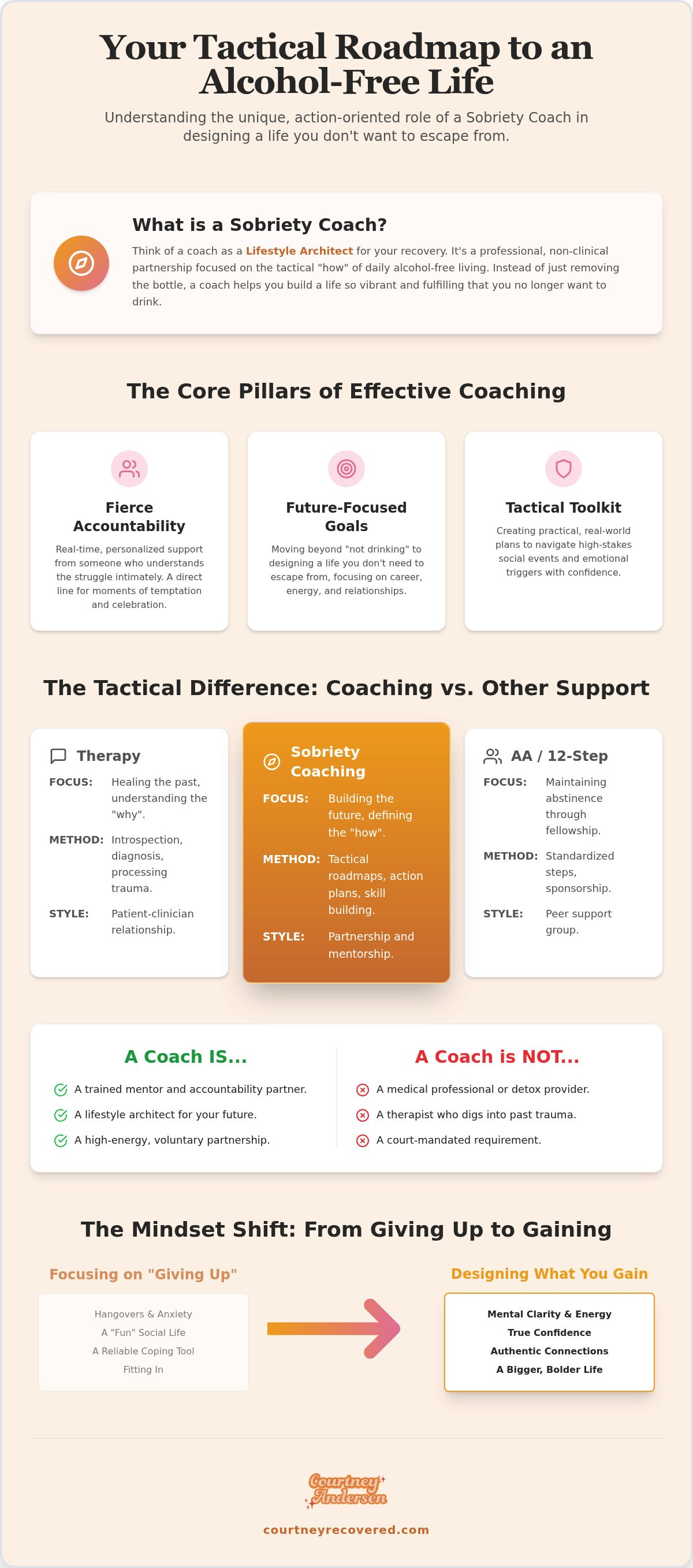
Let's talk about what actually happens after you decide you're done with the wine-induced brain fog. If you've been scrolling for answers, you've likely wondered: what does a sobriety coach do that you can't just do with a self-help book and a lot of grit? A sobriety coach is a trained mentor who provides personalized, non-clinical support for those finally ready to exit the exhausting alcohol cycle. Think of a coach as a lifestyle architect for your recovery. We aren't just focused on removing the bottle; we're focused on building a life that's so vibrant you don't actually want to drink anymore.
Unlike medical professionals who focus on the clinical aspects of addiction, a coach lives in the tactical "how" of your daily existence. It's a partnership rooted in shared experience and fierce accountability. While Recovery coaching has deep roots in peer support, the modern version is a professional mentorship designed to bridge the gap between "I'm quitting" and "I'm thriving." We don't just tell you to stop; we give you the blueprints for a new way of being.
The Core Pillars of Sobriety Coaching
Effective coaching isn't about vague encouragement. It's about structure. We focus on three specific areas to ensure you don't just stop drinking, but stay stopped. It's about momentum.
- Accountability: This is about having a direct line to someone who knows the "Day 1" struggle intimately. When you're tempted at 5:00 PM on a Tuesday, you have a person to text who understands exactly what's happening in your head.
- Goal Setting: We move beyond the goal of "not drinking." We look at your career, your energy levels, and your relationships. We're designing a life you don't feel the need to escape from.
- Trigger Management: We identify the specific professional and social pressures that often lead to gray area drinking. Whether it's a high-stakes board meeting or a neighborhood BBQ, we build a plan before you even arrive.
What a Sobriety Coach is NOT
To fully grasp what a sobriety coach does, you need to know the boundaries. This isn't a medical or clinical service. Here is what we are not:
- We don't provide medical detox: If you're physically dependent, you need a doctor. Coaches do not provide inpatient rehabilitation or clinical medical advice.
- We aren't therapists: We don't spend years digging into childhood "whys." We focus on the "what now?" and the specific actions you'll take today to change your tomorrow.
- We aren't court-mandated: This isn't a box to check for a legal requirement. This is a voluntary, high-energy partnership for women who are ready for a total lifestyle upgrade.
The Tactical Difference: Sobriety Coaching vs. Therapy and AA
If you've ever sat in a sterile waiting room or a basement circle feeling like a "patient" rather than a person, you know the disconnect. When people ask what a sobriety coach does, they're often trying to figure out where the clinical world ends, and real life begins. Therapy is an incredible tool for healing trauma and digging into the "why" of your past. Coaching, however, is about the "what now?" and the "how" of your future. While therapy heals the wounds of your yesterday, coaching builds the wonders of your tomorrow.
Traditional 12-step programs offer a standardized path that has helped millions, but for many professional women, it can feel like a one-size-fits-all suit that just doesn't fit. This is where 1-on-1 sobriety coaching changes the game. Instead of a generic list of steps, you get a roadmap tailored to your specific career, your social calendar, and your unique triggers. It fills the massive gap between knowing you should stop and actually knowing how to stay stopped when your boss sends a stressful email at 4:45 PM.
Why Traditional Methods Sometimes Fall Short
Clinical environments often inadvertently foster a sense of shame or "otherness" that makes you want to hide rather than heal. For the woman who is high-functioning but struggling in silence, a sterile rehab setting doesn't feel like the right answer; it feels like a step backward. Real-time support is another issue. A therapist might see you for an hour on Tuesday, but what happens when a craving hits during a Friday night bachelorette party? Coaching provides that immediate, direct-line connection that traditional methods simply aren't built to handle. It's about being in the trenches with you, not just analyzing you from a distance.
The Synergy of Coaching and Community
You don't have to choose just one tool. In fact, the most successful journeys often use a multi-tool approach. Combining 1:1 mentorship with a community like the Sobriety Circle provides the peer support that acts as an antidote to recovery loneliness. When you pair my Sober Vibes Book and the Sober Toolkit with the direct guidance of a coach, you aren't just trying to quit; you're launching a lifestyle upgrade. This layered strategy ensures you have a plan for the quiet moments and the loud ones alike. If you want to see how this personalized approach can work for you, start your journey here and stop the cycle for good.
Inside the Sober Toolkit: How a Coach Helps You Navigate Real-World Triggers
Most people think sobriety is just about white-knuckling your way through a craving. It isn't. If you've been stuck in the cycle of "quitting" every Monday morning, you've probably wondered: what does a sobriety coach do to make the change actually stick? The answer lies in the gear you carry. A coach provides you with a physical and digital Sober Toolkit designed for high-stakes moments. This isn't just a collection of vague advice; it's a tactical survival kit for the real world. We create specific, written plans for the events that usually make you crumble, like weddings, bachelorette parties, and those corporate happy hours where the pressure to "just have one" is relentless.
We also overhaul your daily rhythm to eliminate the "wine o'clock" habit. If your current night routine centers on a bottle of Chardonnay, we replace it with morning and evening rituals that actually nourish your nervous system. And if a slip happens? We don't spiral into shame. We use Stop Starting Over strategies to look at the data, adjust the toolkit, and get you back on track immediately. It's about progress, not a perfect streak that shatters at the first sign of a struggle.
The Power of the Pre-Game Plan
You wouldn't walk into a high-level board meeting without a script, so why would you walk into a party without one? We work together to script your "no" so you feel like the most powerful person in the room, not an outcast. We also establish a clear exit strategy. If the energy of an event shifts and the alcohol becomes the centerpiece, you already know exactly how and when you're leaving. Using the Sober Vibes Book as a daily anchor helps keep your mindset focused on what you're gaining, making the "no" feel like a total win.
Emotional Sobriety and Stress Management
What does a sobriety coach do when "The Witching Hour" hits? Between 5 PM and 7 PM, your brain is wired to crave a reward. We work to dismantle that old alcohol-reward system and replace it with genuine, dopamine-boosting activities that actually relieve stress. We also address the "functional alcoholic" trap. Many professional women believe that because they're hitting their KPIs, the drinking isn't a problem. We build the emotional resilience you need to see that alcohol is actually the ceiling on your potential, not the fuel for your success. We move you toward a life where you don't need a liquid crutch to handle a heavy workload.
Building 'The After': Life Design and Identity Beyond the Quit
If you've spent years as "the fun one" with a wine glass permanently attached to your hand, the idea of stopping can feel like a total identity crisis. You might wonder: what does a sobriety coach do to help you find yourself again? Coaching isn't just about the "quit" or getting through the first week of cravings. It's about life after getting sober and designing a reality you actually enjoy. We work on shifting your internal monologue from the restrictive "I can't drink" to the empowered "I don't drink." This isn't just semantics; it's the ultimate mindset shift that turns a perceived loss into a massive lifestyle upgrade.
We focus on the vibrant life you gain, not what you're leaving behind. When you stop using alcohol to numb your boredom or stress, you suddenly have a surplus of time, energy, and mental clarity. A coach helps you channel those new resources into what actually matters. We look at your career goals, your hobbies, and how you want to show up in the world. It is about redefining who you are when you're not the one looking for the nearest bottle of Prosecco at every event.
Healing Relationships and Connection
Navigating your marriage and friendships as a newly sober person can feel like walking through a social minefield. I take a "cool older sister" approach, helping you script conversations so you can explain your change to your inner circle without sounding like a lecture. You don't have to lose your social life; you just have to evolve it. We also focus on finding a new tribe within a sober community online. Having a group of women who "get it" is the antidote to the isolation that often leads back to the bottle. Real connection is what makes the lifestyle stick.
The 90-Day Transformation
The first 90 days are where the magic happens, but they also require the most intensive accountability. This is what a sobriety coach does best: keeping you on track when the initial excitement fades. During this window, your brain begins to rewire, your skin clears up, and your energy levels skyrocket. We celebrate the milestones that clinical programs often ignore, like your first sober vacation or your first high-stakes presentation without a hangover. These 90 days are the foundation for "The After," and having a mentor ensures you don't let a single slip-up turn into a full relapse. If you're ready to stop the cycle and start designing your new life, book your 1:1 coaching session today and let's get to work.
Ready to Stop Starting Over? Finding Your Perfect Coaching Match
When you're standing at the edge of change, the most important thing you can do is find a guide who actually understands the terrain. You aren't looking for a clinical authority or a detached observer; you're looking for a mentor whose story resonates with your own professional hurdles and personal goals. A true coach provides a "vibe check" that makes you feel safe, seen, and appropriately challenged to grow. When you ask what a sobriety coach does to ensure your success, it comes down to that specific, 1:1 connection. It’s about having someone who can see your blind spots and call you out with love when you’re leaning back into old patterns.
Now is the time to invest in your personalized sobriety toolkit. Whether you thrive in a high-intensity 1:1 environment or prefer the collective energy of a group membership, there is a path designed for your specific needs. We offer structured programs like 1:1 Sobriety Coaching, the Sobriety Circle, and self-paced resources to ensure you have the support your lifestyle requires. You don't have to guess your way through this anymore.
The Sober Vibes Approach
My approach is vibrantly optimistic and intentionally high-energy because I believe sobriety is a promotion, not a punishment. We don't do "somber" or "sterile" here. We focus on celebrating what you're becoming. By integrating the Sober Vibes Book into your daily life and using the Stop Starting Over framework, we effectively end the exhausting cycle of Day 1s. This isn't about just getting through the day; it's about thriving in it. We use modern, lifestyle-oriented tools to make sure your new alcohol-free identity feels like the best version of you.
Taking the First Step Today
A discovery call helps you see whether 1:1 coaching is your missing link. It’s a low-pressure way to see if our vibes align and if you're ready for the "tough love" realism that leads to real results. If you need immediate community support to combat that "gray area" isolation, the Sobriety Circle is waiting for you with open arms. Here is the final push: stop waiting for the "perfect time" to quit. That Monday when you finally feel "ready" isn't coming on its own. You have to create it. You have the roadmap, the tools, and the support. The only thing left is to decide you're worth the investment.
Your Vibrant Life is Waiting for You
Choosing to live alcohol-free isn't about restriction; it's about giving yourself a massive promotion. We've explored how a sobriety coach acts as your lifestyle architect, providing the tactical tools and fierce accountability you need to navigate real-world triggers. By now, you have a clear answer to the question: what does a sobriety coach do, and how this partnership can finally break the exhausting cycle of starting over every Monday morning.
As a relatable mentor with years of lived experience, the author of the Sober Vibes Book, and the creator of the Sobriety Circle Community, I'm here to show you that "The After" is much better than the "Before." You don't have to navigate the gray area alone. You deserve a life that feels bigger, brighter, and more connected. It's time to stop white-knuckling and start designing a reality you don't want to escape from.
Ready to end the cycle? Apply for 1:1 Sobriety Coaching with Courtney today. You've got this, and I've got you. Let's make this your last "Day 1."
Frequently Asked Questions
Is a sobriety coach the same as a sponsor in AA?
No, they're different roles. A sponsor is a volunteer peer who guides you through the 12 steps of a specific program. A sobriety coach is a paid professional who acts as a lifestyle architect. While a sponsor focuses on program traditions, a coach focuses on your unique social life, career, and daily routines. It's a tactical, personalized partnership designed for women who want a roadmap that fits their high-energy life.
How much does sobriety coaching typically cost in 2026?
Industry rates vary based on experience and the level of support provided. In 2026, standard hourly rates for sobriety coaching typically range from $100 to $175, though some specialists charge up to $300. Many clients prefer monthly retainers, which often range from $800 to $3,000. These packages usually include regular sessions and direct contact for real-time accountability between meetings, ensuring you never have to face a trigger alone.
Can a sobriety coach help me if I'm a high-functioning drinker?
Absolutely, this is exactly who coaching is for. High-functioning drinkers often feel stuck in a "gray area" where they're successful at work but exhausted by their relationship with alcohol. If you're asking what a sobriety coach does for professionals, the answer is that we help you remove the invisible ceiling on your potential. We build a plan that protects your edge while removing the wine-induced brain fog.
What happens during a typical 1:1 sobriety coaching session?
Every session is action-oriented and forward-looking. We start by reviewing your recent wins and any close calls, then we dive into tactical planning for your upcoming week. If you have a wedding or a high-stakes board meeting, we script your responses and set an exit strategy. We focus on the "what now" rather than just the "why," ensuring you leave with concrete steps to maintain your momentum.
Do I need to be 'completely done' with drinking before I hire a coach?
No, you don't need to have it all figured out to start. Many women hire a coach specifically because they can't seem to make the "quit" stick on their own. We work together to bridge the gap between wanting to stop and having the tools to actually do it. Starting while you're still in the cycle allows us to identify your real-time triggers and build your toolkit immediately.
How long do people usually work with a sobriety coach?
Most people commit to a coaching relationship for three to six months. This timeframe matters because it lets you navigate a full cycle of seasonal triggers, such as holidays, vacations, or high-stress work quarters. Rewiring your reward system and building a new identity takes time. Some clients choose to continue with less frequent "maintenance" check-ins once they feel solid in their new lifestyle.
Is sobriety coaching confidential and private for professionals?
Yes, privacy is a cornerstone of the coaching relationship. Because coaching is a private professional service rather than a clinical medical record, it offers a level of discretion that many high-profile women find essential. Your sessions and progress stay between us. This makes it a safe space to be honest about your struggles without worrying about your professional reputation or medical history being impacted.
Can a coach help me if I've relapsed multiple times before?
Yes, and your past slips are actually valuable data. Instead of seeing a relapse as a failure, we treat it as a roadmap for where your current toolkit needs an upgrade. We analyze what happened right before the slip to build better defenses for the next time. A coach helps you stop the shame spiral so you can get back to living your vibrant life right away.
I want you to feel sober NOT boring!
Kickstart your sobriety with my free 2-day video workshop series to master your sober mindset and have FUN in your sobriety journey!


