
The Limitations of Sobriety Apps: Why Your Digital Counter Isn't a Recovery Plan
Sep 02, 2026
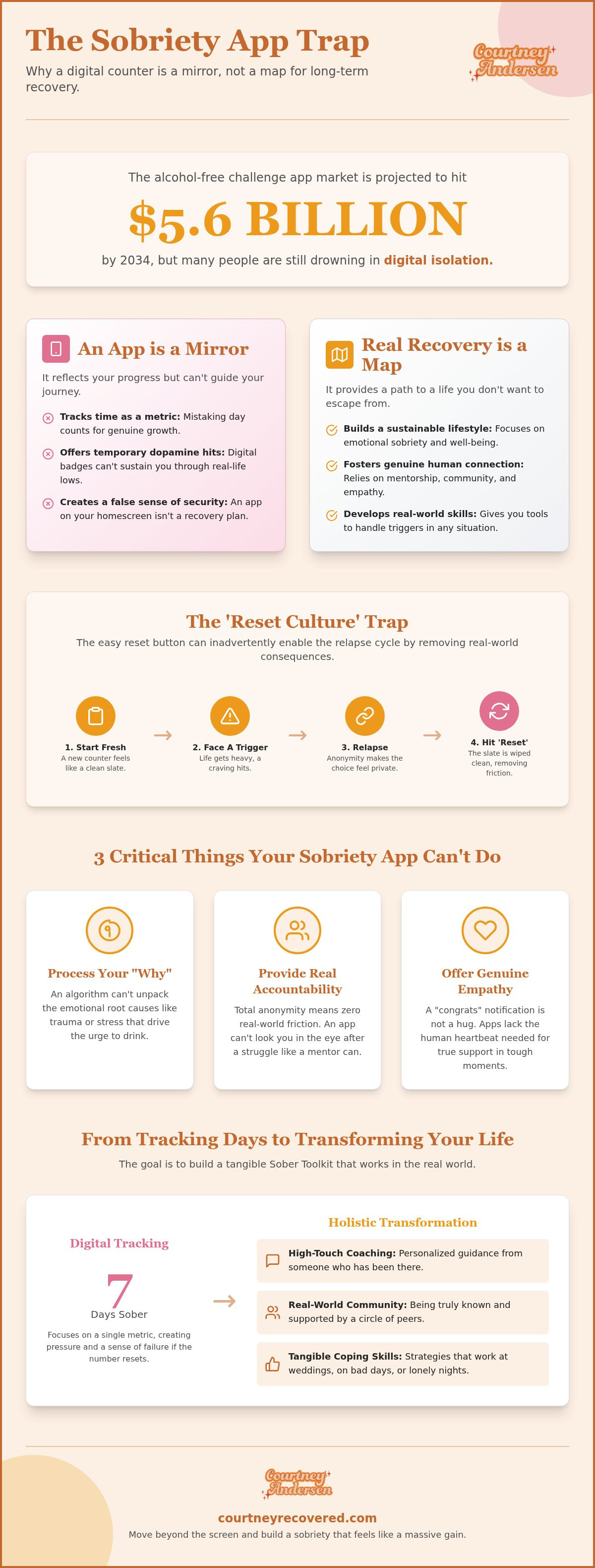
Your sobriety app is a great mirror, but it's a terrible mentor. While the alcohol-free challenge app market is projected to hit $5.6 billion by 2034, many people are still drowning in digital isolation. You've probably felt that quick hit of dopamine when your counter hits a milestone, only to feel totally alone when you're staring at a reset button after a rough night. It's exhausting to feel like you're just a data point in an algorithm. The limitations of sobriety apps often show up right when you need support the most, leaving you with tracking tools but no real human heartbeat to lean on.
You deserve a recovery that doesn't feel like a chore or a secret. In this article, you'll discover why digital counters often fail to create lasting change and how to move past the screen to find a sobriety that feels like a massive gain. We're going to explore how to bridge the gap between simply counting days and actually building a life you don't want to escape from.
Key Takeaways
- Understand why a digital counter is just a reflection of your progress, not the actual roadmap you need to stay sober long-term.
- Recognize the limitations of sobriety apps when it comes to "reset culture" and how an easy restart button can inadvertently keep you stuck in a cycle of starting over.
- Learn about the three critical things an algorithm can't do, including processing the emotional root causes like trauma or stress that drive the urge to drink.
- Discover how to build a tangible Sober Toolkit that works in real-world scenarios, from high-stakes weddings to lonely nights on the couch.
- Find out why the "high-touch" human connection of coaching and community is the missing piece for transforming your life beyond a simple day count.
The Sobriety App Trap: Why a Digital Counter Isn't a Recovery Plan
You know that rush. You download a sleek new app, tap a button, and suddenly seeing "Day 1" in a bold, neon font feels like you’ve already crossed the finish line. It’s a digital pink cloud. It’s exciting, it’s fresh, and it feels like this time is different because you have a progress bar to prove your commitment. But here is the tough love: an app is a mirror, not a map. It can show you exactly where you are, but it can’t tell you how to get where you’re going. One of the primary limitations of sobriety apps is that they often mistake tracking a habit for transforming a lifestyle.
Many of these tools are categorized as Digital therapeutics, which are evidence-based software interventions designed to help manage health conditions. They are fantastic for gathering data and providing a baseline of your habits. However, they aren't a replacement for the messy, beautiful work of human evolution. A dopamine hit from a digital badge is a temporary band-aid for a deep-rooted habit. You need more than a "congrats" notification to stay the course when life gets heavy.
The 'Mirror' Effect: What Apps Actually Do
Sobriety counters are powerful because they make time visible. Seeing those numbers climb can feel like a game you’re finally winning. However, time is just a metric; it isn’t the same thing as growth. You can stay sober for 100 days and still feel miserable if you haven't addressed why you wanted to escape in the first place. Community forums within these apps can also be a double-edged sword. Shouting into a digital void of strangers might give you a quick "keep going" comment, but it doesn’t offer the depth of being truly known by a mentor or a circle. Eventually, notification fatigue sets in. Your recovery tool becomes just another "ping" you ignore while scrolling, losing its impact right when you need it most.
The False Sense of Security
Having an app on your home screen can trick your brain into thinking the hard work is done. You feel protected by the algorithm. The reality is that an algorithm can’t monitor your emotional sobriety or tell you when you’re leaning into old, toxic patterns. Digital recovery is using software to monitor a habit, while integrated recovery is a holistic approach that weaves sobriety into your physical, emotional, and social well-being. Relying solely on a screen creates a gap where real-world accountability should be. It makes the limitations of sobriety apps painfully obvious when you're facing a real-life trigger that a progress bar can't solve. To truly break the cycle, you need to move beyond the screen and build a Sober Toolkit that supports your whole life, not just your phone usage.
The 'Reset' Culture: How Apps Can Actually Enable the Relapse Cycle
The reset button is the ultimate "undo" for your recovery, but it’s a dangerous psychological safety net. When you drink and hit that button, the app wipes the slate clean, making your choice feel consequence-free. It turns a relapse into a simple UI update. This is one of the most hidden limitations of sobriety apps; they can inadvertently keep you stuck in the Stop Starting Over cycle. In an app, "Day 0" feels light and easy. It lacks the weight of looking another human in the eye and admitting you struggled. Without that friction, the incentive to stay the course disappears when the first craving hits. You aren't failing the app; the app is failing to provide the stakes you need to grow. Many apps now focus on moderation or "mindful drinking" to appeal to a broader audience, but for those of us who need real change, these "soft resets" can just prolong the struggle.
The Anonymity Double-Edged Sword
Privacy feels safe, but total anonymity often equals zero real-world accountability. It’s easy to be honest with an algorithm because an algorithm can’t feel disappointed or offer a hug. This creates a "ghosting" phenomenon that many of us know all too well. When things get hard, we just stop opening the app. We delete the notification and pretend the struggle isn't happening. Recent research on digital health tools shows that while many professionals recommend these apps, very few have been proven to deliver long-term clinical outcomes. If you use your app just to hide your struggle from real people, it’s not a recovery plan. It’s a digital shield that keeps you isolated. You can't heal in the dark, and an anonymous counter keeps the lights off.
Breaking the 'Day 1' Addiction
Sometimes, we actually get addicted to the "fresh start" rather than the long-term journey. The excitement of a new plan on Monday morning distracts from the hard work of Tuesday night. You need to shift your focus from the number on your screen to how your body actually feels. How does your head feel? How is your energy? This is where the limitations of sobriety apps become clear. A screen can't help you navigate the nuance of a bad day or a celebratory moment. Transitioning to 1-on-1 sobriety coaching creates a "no-reset" mindset. It moves you from being a number in a database to being a person with a plan. If you're tired of the reset loop, it's time to find a partner who sees you as more than a data point.
The 3 Critical Things Your Sobriety App Can't Do for You
You can’t automate empathy. It’s just not possible. Your phone is great at tracking the "what," but it is completely blind to the "why." This is where the limitations of sobriety apps become a real barrier, especially if you identify as a gray area drinker. You might not need a hospital bed, but you definitely need a mentor who understands that a Tuesday night craving isn't just a random glitch. It’s a signal. Apps can monitor symptoms, but they can't treat the person behind the screen. They lack the physical presence and "felt" support that only comes from a real human connection.
Think about your worst days. An app doesn't know you just had a blowout fight with your partner or that your boss is breathing down your neck. It just sees a "yes/no" check-in. It can’t offer a perspective shift or a word of encouragement when your world feels like it’s crashing. This lack of context is a major gap. When you're silent, a push notification is just another "ping" to swipe away. A human coach, however, knows your patterns. They can ask, "What’s really going on?" when they notice your energy shift. That dynamic accountability is something an algorithm simply cannot replicate.
Processing the 'Why' Behind the Wine
Apps are designed for "how many" drinks you didn't have. They celebrate the quantity of days, but they ignore the quality of your internal life. If you don't address the trauma or boredom driving the urge, you're just white-knuckling it. This is why emotional sobriety coaching is so vital. It moves you beyond the "urge" and helps you find the "origin" of the craving. You stop just tracking symptoms and start healing the root cause. Identifying your triggers takes a conversation, not just data entry. When you understand the "why," the "how" becomes much easier to manage.
The Power of Human Discernment
A coach sees the blind spots that an algorithm will never detect. We all tell ourselves stories to justify a "slip," and an app is too polite to call you out. Human discernment provides the tough love and celebratory energy that a digital tool lacks. It’s the difference between a static record of your past and a dynamic partnership for your future. The limitations of sobriety apps are most obvious when you need someone to hold space for your messiness while pointing you toward your potential. You deserve more than a digital badge; you deserve to be heard, challenged, and truly seen.
Building a Toolkit That Survives the 'Low' Moments
If your recovery plan is stuck behind a glass screen, it’s time to bring it into the real world. Moving from a basic digital counter to a robust Sober Toolkit is the only way to build a lifestyle that actually sticks. While an app can tell you how many days you’ve logged, it can’t tell you how to navigate a high-stress wedding or a lonely Friday night. This is where the limitations of sobriety apps become a liability. You need a plan that addresses your human needs, not just your data usage. A toolkit means having tangible, physical resources you can grab when the "ping" of a notification isn't enough to stop a craving.
Building this toolkit starts with four essential steps. First, identify your high-risk "human" scenarios. Don't wait for a craving to hit; map out the weddings, work deadlines, and quiet nights that usually lead you to a drink. Second, replace those pixels with real life. Instead of a digital badge, celebrate a milestone with a tangible reward like a spa day or a high-end coffee. Third, integrate peer support through a community like the Sobriety Circle. Fourth, engage your brain with physical resources. Use "Quit-Lit" to rewire your thinking away from your phone's blue light. These steps ensure that when the limitations of sobriety apps fail you, your real-life foundation holds strong.
The Physicality of Recovery
Holding a physical copy of the "Sober Vibes Book" creates a sensory connection that scrolling a feed simply can’t match. It’s about creating a morning and night routine that doesn't start with checking your phone. Sensory-based sobriety means having things you can touch, taste, and feel that ground you in your new life. When you engage your senses, you aren't just tracking time; you're experiencing it. This physical approach helps you stay present in your body instead of getting distracted by an algorithm.
Finding Your 'Sober Circle'
A massive difference exists between a "follower" and a "community member." You need to vet your circles for authentic, high-vibe support. Life after getting sober requires a completely new social blueprint. You aren't just deleting an old habit; you're designing a connected, vibrant reality. If you’re ready to stop being a data point and start being part of a movement, check out the Sober Toolkit to see how to build a life that feels like a gain, not a loss.
From Tracking Days to Transforming Your Life: The Case for Human Support
We’ve reached peak digital saturation. 2026 is officially the year of "High-Touch" recovery in a "High-Tech" world. While we’ve spent years trying to optimize our lives through screens, we are finally realizing that you can’t download a new personality or sync your soul with a server. The limitations of sobriety apps are most glaring when you realize that a progress bar can't give you a hug or tell you that it’s proud of you. You deserve a recovery that feels like a massive upgrade, not just a data entry project. It’s time to use apps as the minor support they are while making human connection your actual foundation.
Think about the return on investment. A free app subscription costs you nothing, but it often yields exactly that: nothing in terms of big, lasting change. Investing in yourself through coaching is a completely different ballgame. You aren't just paying for advice; you're paying to collapse time. Instead of spending another three years stuck in a loop of starting over, you get a blueprint that works right now. You are more than a number on a counter. You are a person with big dreams and a lot of life left to live, and you deserve a reality that feels like a celebration, not a set of restrictions.
Why Coaching is the Ultimate Upgrade
An app gives you a generic template; a coach gives you a personalized roadmap. No algorithm can account for your specific history, your unique triggers, or your personal goals for the future. The speed of progress accelerates when you have a mentor who has already navigated the path you’re on. You get to skip the trial and error and move straight into the "High-Vibe" life you’ve been imagining. I encourage you to book a discovery call to experience the massive difference that one-on-one support makes compared to a cold, digital interface.
Your Invitation to the Sobriety Circle
Moving from an anonymous app to a vibrant, living community is like turning the lights on for the first time. In the Sobriety Circle, you aren't just a username. You are part of a group that understands the nuances of your journey. This is where the "Stop Starting Over" promise comes to life. We don't just track your days; we help you transform your lifestyle so that you never want to go back to Day 1 again. It’s about finding your people and building a social blueprint that supports your growth. Join the Sobriety Circle today and find the community that finally gets it. You’ve done the digital tracking; now it’s time for the human transformation.
Step Away from the Screen and Into Your Life
You've spent enough time staring at a digital counter, waiting for a number to change how you feel inside. While tracking is a solid start, the limitations of sobriety apps become obvious the moment life gets messy, and you're left with a "ping" instead of a partner. Real growth happens when you trade the reset button for real-world roots and human support that actually sees you. It is about moving from surviving your days to actually thriving in them.
As a professional coach, I've seen how the right foundation transforms everything. I built my platform to provide that missing human element through our specialized 'Stop Starting Over' roadmap and the vibrant Sobriety Circle community. You don't have to navigate this alone or settle for being just another data point in an algorithm. You are a person with a story, and you deserve a roadmap as unique as you are.
Ready for real accountability? Book your 1:1 Sobriety Coaching discovery call today. You deserve a life that feels like a massive gain, not a restrictive loss. Let's make this your last Day 1 and start building a reality that you actually want to celebrate every single day.
Common Questions About Digital Recovery Tools
Are sobriety apps helpful for beginners?
Sobriety apps are fantastic for beginners who need to visualize their progress in those first shaky weeks. Seeing a "Day 3" on your screen provides a quick hit of dopamine that can keep you motivated through an early craving. However, this is where the limitations of sobriety apps start to show. While they help you track the start, they don't teach you how to handle the heavy emotions that arrive once the initial excitement fades.
Why do I keep deleting and re-downloading my sobriety app?
You’re likely stuck in a cycle of "digital ghosting." When you have a slip, the shame of seeing that counter makes you want to delete the app and pretend it never happened. Re-downloading it feels like a fresh start, but without real-world accountability, you’re just repeating the same pattern. It’s a sign that you need more than a screen to keep you grounded when life gets messy or stressful.
Can a sobriety app replace a recovery coach?
An app cannot replace a coach because an algorithm doesn't have a heartbeat. A sobriety app is a data tracker, while a coach is a mentor who provides personalized strategy and emotional root work. While an app might give you a generic badge, a coach provides the "tough love" and deep discernment needed to navigate your unique life stressors and gray-area drinking patterns that a screen just can't see.
What is the best way to use a sobriety app without getting obsessed with the counter?
Shift your focus from the counter to the journaling or community features. Treat the app as a secondary support tool, not the sole judge of your success. If the number on the screen starts to feel like a weight rather than a win, close the app and focus on how your body feels. Your sobriety is about your quality of life, not just a digit on a dashboard.
How do I find a sober community that isn't just a digital forum?
Look for communities that offer live interaction and shared resources, like the Sobriety Circle. Digital forums are often filled with anonymous noise, but a dedicated community provides authentic, high-vibe connections. You want a group where people actually know your name and your story. Moving from a "follower" to an active member changes the entire energy of your journey and provides the human connection that apps lack.
What should I do if my sobriety app makes me feel more anxious?
If your app causes anxiety, it is a clear sign that you’ve hit the limitations of sobriety apps for your specific needs. The pressure of maintaining a "streak" can sometimes do more harm than good. Step away from the screen and lean into physical resources like the Sober Toolkit. Focus on sensory-based grounding techniques and real-life connections that don't depend on a digital daily check-in to feel valid or successful.
Is it possible to stay sober without any apps at all?
Absolutely. People have been staying sober long before smartphones existed. While apps are modern tools, your foundation should be built on human connection, mindset shifts, and a solid plan like the Stop Starting Over roadmap. If you find that digital tracking doesn't serve you, don't be afraid to go "old school." Your recovery is about your personal transformation and lifestyle changes, not your technology or your data points.
I want you to feel sober NOT boring!
Kickstart your sobriety with my free 2-day video workshop series to master your sober mindset and have FUN in your sobriety journey!


