
Sobriety Toolkit: 2026 Guide for the Modern Woman
Oct 02, 2026
What if your 5 PM "witching hour" wasn't a crisis to survive, but the most luxurious part of your day? For most high-achieving women, the transition from work mode to home life feels like a high-stakes wrestling match with a wine glass. You've probably told yourself that if you just had more willpower, you could finally kick the habit. But here is the truth: willpower is a finite resource, and it's exhausting to rely on it every single night. You don't need more grit; you need a better system that makes sobriety feel like a massive lifestyle upgrade, not a clinical chore.
I am going to show you how to build a high-vibe life you don't feel the need to escape. You will learn exactly what to put in a sobriety toolkit to replace that old "mommy juice" culture with practical, empowering resources that actually work. We are diving into the best 2026 digital tools, including apps like I Am Sober and Reframe, alongside physical essentials that turn your recovery into a competitive advantage. From navigating social isolation to crushing anxiety, this guide provides the roadmap to a vibrant, connected reality where you finally feel like you belong.
Key Takeaways
- Move beyond willpower by building a proactive system that anticipates the "witching hour" before it even starts.
- Discover exactly what to put in a sobriety toolkit to handle sensory triggers and reset your nervous system when cravings hit hard.
- Turn your smartphone into a sobriety sidekick by leveraging the latest 2026 digital apps and high-vibe online communities.
- Master social situations with pre-planned scripts and exit strategies that make saying "no" feel like a superpower.
- Understand why a community like the Sobriety Circle is the essential foundation for long-term maintenance and a life you don't want to escape.
Sobriety Toolkits: Why Willpower is Your Weakest Link
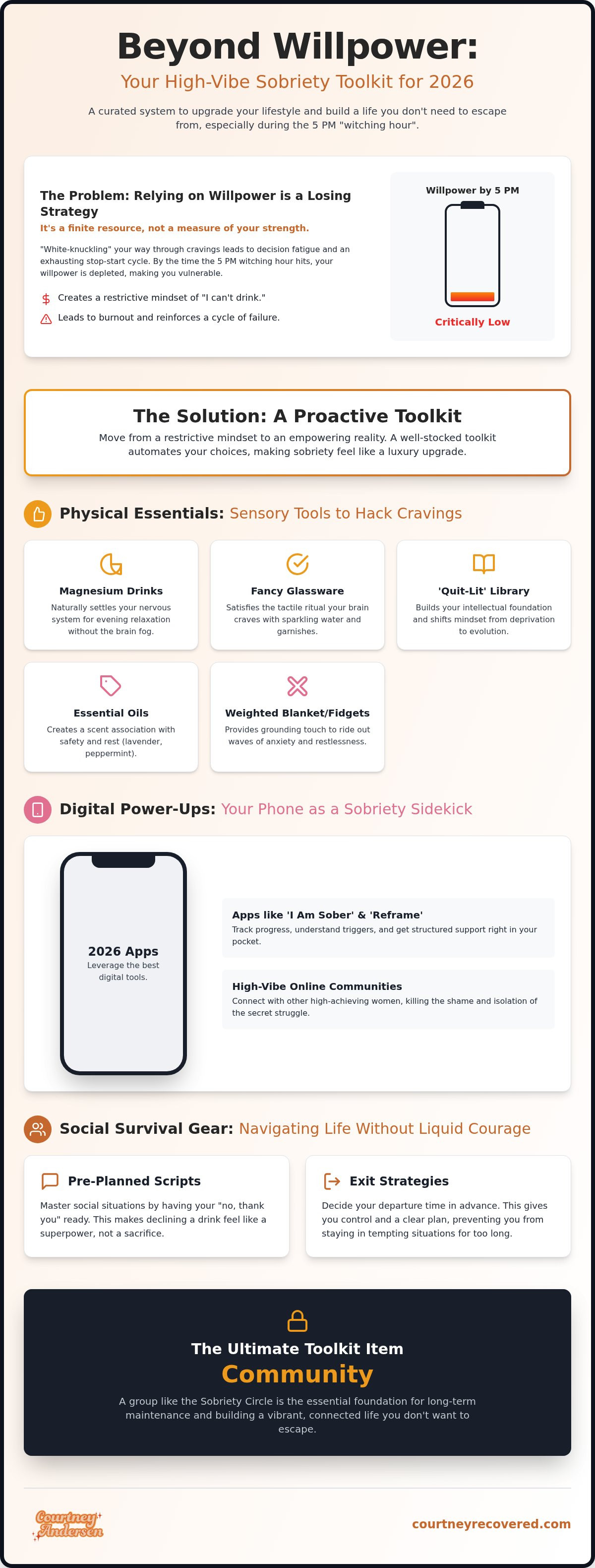
Stop treating your sobriety like a fire drill. For years, the recovery world told us that if we just wanted it bad enough, we could stay dry. But when you are a high-achieving woman balancing a career, a social life, and a household, "wanting it" isn't the problem. The problem is that willpower is like a phone battery; it drains throughout the day. By the time the 5 PM witching hour hits, your battery is at 1%. You are dealing with a spike in cortisol, the stress hormone, and your brain is screaming for a dopamine hit. If your only plan is to "try harder," you've already lost.
That is why knowing what to put in a sobriety toolkit is the difference between a miserable struggle and a vibrant lifestyle upgrade. We aren't just talking about a list of phone numbers for when things get dark. We are talking about a curated system of physical, digital, and social assets that make your life feel richer without the booze. In 2026, What is Sobriety? is no longer defined by what you are giving up. It is about what you are gaining: clarity, energy, and a massive competitive advantage in your professional and personal life.
The Myth of 'White-Knuckling' It
White-knuckling is the fastest way to find yourself back at the bottom of a bottle. It relies on pure grit, which leads to an exhausting stop-start cycle. Every time you say "no" to a craving using only your mind, you suffer from decision fatigue. A well-stocked toolkit automates those choices. Instead of debating whether or not to pour a glass, you reach for a predetermined tool. You move from the restrictive mindset of "I can't drink" to the empowering reality of "I have much better things to do with my time."
Customizing for the Gray Area Drinker
If you've ever felt like traditional recovery meetings were too clinical, you are likely navigating gray area drinking. This isn't about severe physical dependency; it's about a habit that no longer serves your high-functioning lifestyle. Your triggers might be boredom or social pressure. Your toolkit needs to reflect that. It should feel like a luxury upgrade, not a medical prescription. Identifying these triggers helps you decide what to put in a sobriety toolkit that actually resonates with your specific lifestyle and goals.
The Physical Essentials: Sensory Tools to Hack Your Cravings
Cravings aren't just a mental game; they are a physical experience that demands a physical response. If you only focus on the "why" of quitting without addressing the "how" of your nervous system, you are making it harder than it needs to be. Your brain is used to the ritual of the pour, the chill of the glass, and the immediate relaxation response of that first sip. To successfully transition, you need tangible items that hack your senses and provide immediate physiological relief.
When deciding what to put in a sobriety toolkit, start with your immediate environment. You want to replace the bar cart energy with a "Sober Sanctuary" that feels like a reward, not a waiting room. This means stocking up on high-vibe alternatives and sensory tools that signal to your brain that it is time to decompress. Whether you are at home or building an on-the-go sober toolkit for your bag, these physical essentials are your first line of defense against the 5 PM itch.
Sensory Soothers for the Witching Hour
The 2026 approach to sobriety is all about biohacking your way to calm. Magnesium drinks have become the gold standard for evening relaxation, offering a natural way to settle your nervous system without the morning fog. Pair this with essential oils like lavender or peppermint to create a scent association with safety and rest. Don't underestimate the power of "hand-held" habits. Holding a fancy glass filled with sparkling water and fresh garnishes satisfies the tactile ritual your brain craves. If evening anxiety feels heavy, a weighted blanket or simple fidget tool can provide the grounding touch you need to ride out a wave of restlessness.
The Essential 'Quit-Lit' Library
Knowledge is the intellectual foundation of your recovery. Filling your nightstand with the right sobriety tools and resources turns your bedroom into a classroom for your new life. "Quit-Lit" is essential because it kills the shame of the secret struggle by showing you that your experience is actually quite universal. My Sober Vibes Book acts as a daily mentor, helping you shift from a mindset of deprivation to one of massive personal evolution. Reading the stories of other high-achieving women reminds you that you aren't "broken"; you are just upgrading your operating system. If you want to start building that intellectual foundation today, you can grab your copy of the Sober Vibes Book to begin your journey.
Digital Power-Ups: Your Phone as a Sobriety Sidekick
Your phone used to be the thing that delivered booze ads and late-night texts from your drinking buddies. In 2026, we are flipping the script. Your smartphone is now the most powerful item in your sober toolkit because it provides something willpower never could: 24/7, instantaneous support. When you are deciding what to put in a sobriety toolkit, digital assets are your secret weapon for those moments when you are standing in the grocery store aisle or sitting at a high-pressure work dinner. You need tools that move as fast as your life does, and your phone is the only thing that is always in your hand.
Modern recovery tech lets you visualize your wins in real time. Apps like Nomo offer completely free tracking, while I Am Sober Plus provides premium features for $9.99 per month to help you see exactly how much money you've saved and how your health is rebounding. Seeing those numbers climb is a massive dopamine hit that replaces the temporary buzz of a cocktail. This data-driven approach appeals to the high-achiever in you, turning your recovery into a measurable success story. It is much harder to reach for a glass when your phone shows you you've already saved hundreds of dollars and gained hours of deep sleep this week.
Online Sobriety Communities vs. Traditional Meetings
For the modern, high-achieving woman, sitting in a somber basement meeting often feels clinical and outdated. You want a vibe that matches your professional drive and celebratory outlook on life. Joining a sober community online offers high-energy engagement and professional anonymity that traditional groups simply can't provide. You can connect with other women who understand the "gray area" without the stigma. It is about vibe-matching with people who are building lives they love, rather than just "not drinking."
Apps and Tech for the Modern Sober Woman
The tech landscape in 2026 is deeply personal. Reframe Access, for instance, costs $13.99 per month and uses neuroscience-based tools to help you rewire your brain. Loosid offers a premium "Sobriety and Addiction Mentor" for those who need a bit more guidance, with subscriptions starting around $14.99 per month. Beyond just trackers, your digital toolkit should include passive resources like curated recovery podcasts that you can listen to while driving or folding laundry. When you are figuring out what to put in a sobriety toolkit, don't forget "stealth accountability" notifications. These private alerts pop up during your most stressful work hours, reminding you of your "why" before cravings even have a chance to start. This ensures you always have a "tribe in your pocket" whenever you need a quick mindset shift.
Social Survival Gear: Navigating Life Without the Liquid Courage
Some recovery experts tell you to stay home and avoid triggers for the first ninety days. That is terrible advice for a woman with a career to build or a life to live. You don't need to hide; you need a plan. When you are considering what to put in a sobriety toolkit, your social survival gear is the most critical component. It is the difference between feeling like a sober outcast and being the most vibrant, interesting person in the room. You are not "missing out" on the party; you are finally present enough to actually enjoy it.
The "Exit Strategy" is your ultimate superpower in any social setting. Always have your own transportation and park where you won't get blocked in. Tell the host early that you can only stay for an hour because of a "busy morning." Having a pre-planned escape route lowers your cortisol levels immediately because you are no longer trapped by social expectations. You are in total control of your time, your energy, and your exit. This mental safety net allows you to relax and engage without the underlying panic of how you will get through the night.
Scripts for Every Occasion
Awkward silences are the enemy of social confidence. You need a library of "Social Scripts" ready to go so you aren't caught off guard when someone asks why you aren't drinking. For corporate happy hours, try the "Professional Pivot": "I've got a massive project launch tomorrow, so I'm staying sharp with sparkling water." In the "Mom-Circle," keep it light and celebratory: "I'm doing a 30-day health reset, and I feel way too good to stop now." Remember, you do not owe anyone a deep dive into your medical history. "I'm not drinking tonight" is a complete sentence that requires no further explanation.
The Psychology of the Mocktail
Holding a sophisticated glass is a brilliant bio-hack for your brain. By 2026, the non-alcoholic market has expanded to include high-end botanical spirits that satisfy a complex palate without the poison. This "Hand-Held" habit is essential for reducing social anxiety. If your hands are busy with a garnish-heavy mocktail, you won't feel exposed or "different." It tricks your brain into "reward mode," giving you that sense of celebration and ritual without the next-day regret or brain fog. Mastering these high-stakes social nuances is easier when you have a mentor who's been there. If you are ready to build your own personalized social script library and nail your next event, explore my 1:1 sobriety coaching to lead with total confidence.
The Ultimate Toolkit Item: The Sobriety Circle
You can have the best apps, the fanciest mocktail recipes, and a library full of quit-lit, but without a central nervous system to connect them, your recovery can still feel like a lonely DIY project. When you are deciding what to put in a sobriety toolkit, the most powerful asset is a curated community that matches your energy and ambition. The Sobriety Circle isn't just another group; it is the hub that makes every other tool in your kit more effective. It is where theory meets reality, and where your "new normal" becomes a celebrated lifestyle.
Sometimes, even with a great kit, you need a professional eye to help you refine your strategy. Integrating 1-on-1 sobriety coaching allows for a personalized toolkit audit. We look at your specific professional triggers, your social calendar, and your internal monologue to ensure your system is airtight. This moves you beyond just "not drinking" and into the realm of The After, where sobriety is no longer the main event but the foundation for a life that is actually fun to live.
Why a Curated Community Beats a Random Forum
Random internet forums and clinical data points often miss the emotional lifeline aspect of recovery. You don't need a lecture; you need "cool older sister" energy from mentors who have navigated the same high-stakes professional and social world you do. Within the Sobriety Circle, you get access to exclusive frameworks like the Stop Starting Over program, which helps you break the relapse cycle for good. It is a judgment-free, high-vibe space where shared wins are the currency. When you see another woman crush a corporate presentation or a wedding weekend sober, it reinforces your own belief that you can do it too.
Building Your Roadmap Today
The shift from using tools to survive to using tools to thrive is where the magic happens. You stop "white-knuckling" your way through the 5 PM hour and start looking forward to the clarity and connection of your new life. Your future self is waiting for you to stop playing small and start investing in a system that actually works for the woman you are becoming. It is time to trade the isolation of the struggle for the vibrancy of the tribe. Ready to build your toolkit? Join the Sobriety Circle today!
Ready to Own Your Vibrant New Reality?
You've spent long enough white-knuckling your way through the 5 PM witching hour. Now you know that willpower is a battery that eventually drains; but a curated system is a generator that keeps you moving forward. From sensory hacks that settle your nervous system to digital sidekicks that track your health wins, you finally have a roadmap for what to put in a sobriety toolkit that actually matches your ambition. Sobriety isn't about sitting in a somber basement meeting. It's about reclaiming your energy and building a life you don't feel the need to escape.
You don't have to navigate this path alone. By choosing a vibrantly optimistic, non-clinical approach, you can turn your recovery into a total lifestyle upgrade. You deserve direct access to expert coaching and a 24/7 tribe that truly understands your professional drive. Stop starting over and build your ultimate toolkit in the Sobriety Circle! Your future self is already waiting for you on the other side of this choice. Let's make it happen.
Frequently Asked Questions
What is the single most important thing to put in a sobriety toolkit?
The single most important element is a curated community like the Sobriety Circle. While physical items are great, a "tribe in your pocket" provides the emotional resonance and accountability that objects cannot. Having a group of high-achieving women who understand your specific professional and social pressures turns recovery from a solo struggle into a shared victory. It is the central nervous system that makes every other tool in your kit actually work.
Do I have to spend a lot of money to build a sober toolkit?
Building a powerful system doesn't require a massive budget. Many digital resources, like the Nomo app, are completely free. You can start with podcasts, library books, and simple sensory items from your pantry. However, investing in premium resources like the Sober Vibes Book or specialized coaching can significantly accelerate your progress. Think of it as a lifestyle investment rather than a cost; you are redirecting "wine money" into your own personal evolution.
How can a sobriety toolkit help with 'gray area drinking'?
A toolkit is actually perfect for gray area drinkers because it focuses on lifestyle enhancement rather than clinical intervention. When deciding what to put in a sobriety toolkit, you can select items that address your specific "high-functioning" triggers like work stress or social networking. It helps you break the habit of using alcohol as a transition tool between your professional and personal life, offering healthier, more effective sensory resets.
What should I put in my bag for a social event where alcohol is served?
Your on-the-go kit should include a printed or digital list of "Social Scripts" and a clear exit strategy. Pack sensory grounding tools like a specific essential oil roller or strong mints to help snap you out of a craving. Knowing what to put in a sobriety toolkit for social settings ensures you never feel exposed. Always have your own transportation plan so you can leave the moment the vibe shifts or your energy dips.
Can an online community really replace in-person support groups like AA?
For many modern women, an online community like the Sobriety Circle is actually more effective than traditional in-person groups. Digital spaces allow for professional anonymity and vibe-matching with people who share your specific drive and outlook. You get 24/7 access to support without the somber atmosphere often found in basement meetings. It is about finding a tribe that celebrates your growth rather than just focusing on the struggle of the past.
Is it 'cringey' to use a sobriety toolkit if I'm high-functioning?
There is nothing "cringey" about using a system to optimize your life and performance. In the world of high-achieving professionals, we use toolkits for everything from productivity to fitness. Why shouldn't your sobriety be any different? Framing your recovery as a "lifestyle upgrade" or a form of biohacking removes the stigma. It is a bold, unapologetic choice to live with more clarity, energy, and presence than everyone else in the room.
How often should I update the items in my recovery toolkit?
Audit your toolkit every few months as your needs evolve. At first, you might need more "emergency" tools for survival and craving management. As you move into "The After," your toolkit will likely shift toward maintenance and personal growth resources. Regularly refreshing your sensory items, quit-lit, and digital apps keeps your system relevant to the woman you are becoming, not the person you used to be.
What happens if I have a toolkit but still feel like I'm going to relapse?
If your current tools aren't enough to quiet the noise, it is time to level up your support. This is the moment to lean into the Sobriety Circle or book a 1:1 Sobriety Coaching session for a personalized audit. Sometimes, you need a mentor to help you identify a hidden trigger or refine your "Stop Starting Over" framework. Feeling a pull toward old habits isn't a failure; it is just a signal that your toolkit needs a professional upgrade.
I want you to feel sober NOT boring!
Kickstart your sobriety with my free 2-day video workshop series to master your sober mindset and have FUN in your sobriety journey!


