
7 Signs You Need a Sobriety Coach (And Why It’s the Ultimate Lifestyle Upgrade)
Jul 16, 2026
What if the "gray area" you're living in isn't just a phase, but the very thing standing between you and the vibrant life you actually want? You know the feeling. It's that 3 AM internal monologue where you're pleading with yourself to make last night the final time, only to find that "Day 1" feels like a mountain you've climbed a hundred times before. You're functional, sure. You're getting the work done, but you're also searching for the signs you need a sobriety coach because the "will I or won't I" cycle is finally wearing you thin.
It's completely normal to feel like a fraud when you're "high-functioning" but struggling behind the scenes. We've all been there, wondering if we're "bad enough" to ask for help or if we should just keep white-knuckling it alone. This article will show you how a sobriety coach acts as a high-performance mentor, turning the "loss" of alcohol into your greatest gain. We'll break down the seven subtle indicators that it's time for a lifestyle upgrade and preview exactly how a personalized roadmap can replace your social anxiety with genuine, unshakeable confidence.
Key Takeaways
- Stop waiting for a "rock bottom" and learn why proactive change is the ultimate power move for high-achieving women.
- Identify the subtle signs you need a sobriety coach, from the nightly internal negotiation loop to the frustration of the "day one" relapse cycle.
- Understand the difference between clinical therapy and forward-looking coaching that focuses on your future lifestyle and daily habits.
- Get a clear guide on how to vet a mentor based on their lived experience and whether their methodology feels like a restrictive loss or a vibrant gain.
- Find out how personalized support through programs like Stop Starting Over can fast-track your journey from "functional but tired" to a high-energy life.
Beyond the 'Rock Bottom' Myth: Why You’re Questioning Your Drinking Now
The old-school recovery narrative tells us we have to lose everything before we're "allowed" to want something different. But it's 2026; the world has shifted. According to recent Gallup data, alcohol consumption is at a record low, with only 54% of adults reporting they drink. More people than ever are realizing that even "moderate" drinking is a total vibrancy thief. You don't need to be in a crisis to decide you're done being exhausted. If you're successful on paper but feel like you're constantly managing a secret struggle, you're likely looking for signs you need a sobriety coach to help you step into a version of yourself that doesn't need a liquid off-switch.
Waiting for a "rock bottom" is a dangerous and outdated strategy that keeps you stuck in the gray area for years. In this space, you aren't "bad enough" for rehab, but you're definitely not thriving. You're functional, but you're also depleted. Choosing sobriety today isn't a punishment for being "weak"; it's a high-performance wellness choice for women who want their energy, clarity, and time back. It's about trading a nightly habit for a life that actually feels good to wake up to.
The 'Functional' Trap: Why Success Masks the Struggle
You're killing it at work, your home is organized, and your social life looks great. This is the functional trap. Because you're meeting your obligations, you use your achievements as an excuse to ignore the heavy mental load of "managing" your wine intake. You spend your afternoons negotiating how many glasses you'll have and your mornings regretting that you didn't stick to the plan. Recovery coaching provides a way out of this loop by focusing on future goals rather than just past mistakes. A sobriety coach is a lifestyle mentor who helps high-achievers trade the drain of alcohol for a high-performance, vibrant life.
Sober Curious vs. Ready for Change
Maybe you've experimented with Dry January or ordered a few craft mocktails, but there's a specific moment when "curiosity" isn't enough anymore. You've reached the point where you don't just want to drink less; you need a completely new system. The internal shift occurs when "I have to quit" becomes "I want to see who I am without it." This isn't about restriction. It's about an upgrade. If you're tired of the "sober curious" phase and want a roadmap that actually sticks, recognizing the signs you need a sobriety coach is the first step toward a life that feels like a gain. You're ready to stop starting over and finally start living.
Sobriety Coach vs. Therapy: Finding the Right Support for Your Vibe
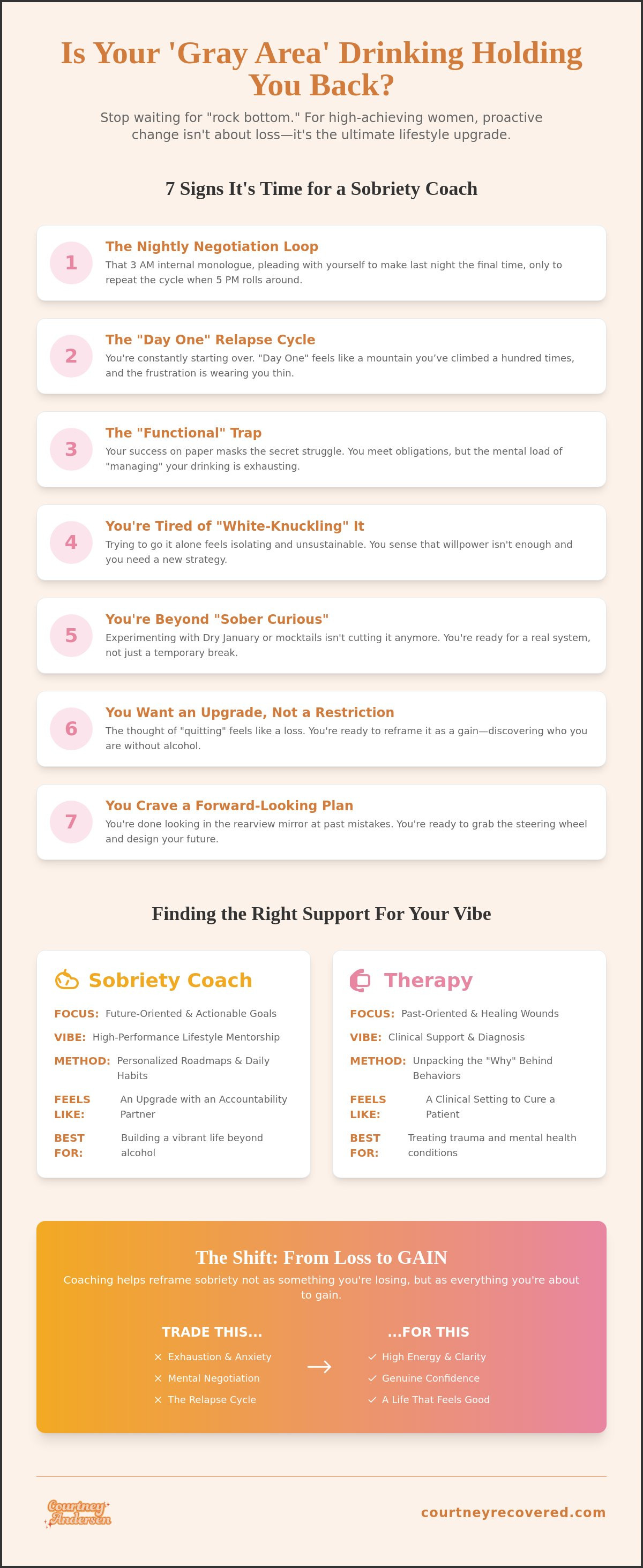
Let’s be real: therapy is incredible for digging into the "why" of your life. It’s where you heal old wounds and unpack the heavy backpack of trauma you’ve been carrying. But sometimes, knowing exactly why you drink doesn't actually help you stop. One of the clearest signs you need a sobriety coach is when you’re done looking in the rearview mirror, and you’re ready to grab the steering wheel. Coaching is the forward-looking, action-oriented sister to therapy. It’s not about clinical diagnoses; it’s about lifestyle design and celebratory growth.
A coach brings the "cool older sister" energy that the recovery industry has been missing for way too long. I’ve been where you are. I know the 3 AM panic and the 5 PM itch. That lived experience creates a sense of immediate safety that a clinical setting just can’t replicate. You aren’t a patient to be cured; you’re a high-achiever looking for an upgrade. Coaching provides the high-level accountability that therapy often skips. While a therapist might ask how you felt about your last drink, a coach helps you plan exactly how you’ll navigate your next high-stakes social event without one.
When to Choose a Coach Over Traditional AA
For many professional women, the traditional 12-step model feels heavy and outdated. You don't want to sit in a basement identifying with your lowest moment for the rest of your life. You want to identify with your future. A one-size-fits-all approach often fails because it doesn't account for your specific career, social life, or ambitions. A sobriety coach helps you build a non-12-step sobriety program that feels like a gain, not a loss. It’s private, personalized, and designed to fit into your actual life, not the other way around.
The Power of Proactive Mentorship
Instead of focusing on "the problem," we focus on "The After." A coach acts as a sober accountability partner who keeps you moving toward your goals. We develop practical tools for the real world. This isn't about abstract theories; it's about what you say when a client orders a bottle of wine for the table. It’s about waking up with high energy and zero hangxiety. If you’re tired of the relapse cycle and ready for a system that works, these are the signs you need a sobriety coach who treats your sobriety as the ultimate lifestyle upgrade.
The 7 Signs You Need a Sobriety Coach to Break the Cycle
Identifying the signs you need a sobriety coach usually starts with a quiet realization rather than a loud explosion. It’s that feeling that you’re working way too hard to manage a habit that’s clearly not working for you anymore. You’re functional, but you’re also flat-out exhausted. If you resonate with these indicators, it’s time to stop white-knuckling and start winning.
- The Internal Negotiation Loop: You spend your entire afternoon commute bargaining with yourself. You promise to have just one glass, but by 10 PM, the bottle is empty, and your self-trust is shattered again.
- Failed Solo Missions: You’ve read every "quit lit" book and listened to all the podcasts. If willpower were the only requirement, you’d be sober by now. Coaching provides the external structure that internal resolve often lacks.
- Social Fear: You’re terrified that an alcohol-free life means a boring life. You don't know how to be "you" at a wedding or a work dinner without a drink in your hand.
- The Hangxiety Tax: You might not have a physical hangover, but the mental fog and morning-after dread are real. It’s affecting your focus at the office and your patience with your kids.
- The Gray Area Gap: You don't fit the clinical definition of an "alcoholic," so you feel like rehab isn't for you. You’re stuck in the middle; too "good" for a hospital, but too unhappy to keep going like this.
Sign 6: The 'Day 1' Relapse Cycle is Your Norm
Stop telling yourself that you lack willpower. Willpower is a battery that runs out; a system is a generator that keeps going. The constant cycle of promising yourself a fresh start on Monday only to feel the crushing weight of failure by Tuesday morning is an emotional tax you no longer have to pay. Our Stop Starting Over approach focuses on building a framework that removes the need for constant struggle. When you identify the signs you need a sobriety coach, you’re admitting that your current system is broken, not your character.
Sign 7: You Feel Lonely in Your Sobriety
There’s a massive difference between being dry and being truly fulfilled. Doing this alone is the hardest, most isolating path you can take. You need a sober online community that matches your energy, ambition, and vibe. When you join the Sobriety Circle, you realize that your new life isn't about what you’re giving up. It’s about the incredible, connected reality you’re finally gaining. Stop trying to be a lone wolf; the pack makes the journey a lot more fun.
How to Vet a Sobriety Coach: Finding Your Perfect Match
Once you’ve identified the signs you need a sobriety coach, the next step is finding the person who actually gets it. This isn't about scrolling through a directory of clinical bios or looking for someone with a PhD in a sterile office. For high-performers living in the Gray Area, the "secret sauce" is a mentor who has walked the path and come out the other side with more energy, not less. You’re looking for a lifestyle architect, not a clinical technician.
The global coaching industry has exploded to over $5 billion for a reason: people want personalized, high-momentum results. When you’re vetting a coach, your first priority should be their lived experience. Do they understand the pressure of being the "functional" one who everyone else relies on? If their story doesn't resonate with your current struggle, their tools probably won't either. You need a coach who specializes in your specific life stage, whether that’s the corporate grind or the unique chaos of motherhood.
Methodology matters just as much as experience. Some coaches lean into "tough love" and rigid rules, while others offer a vibrantly optimistic, celebratory outlook. Since you’re likely already your own harshest critic, you probably don't need more shame. You need someone who frames sobriety as a massive upgrade. Look for a structure that fits your pace, whether that’s high-touch 1:1 sessions or the collective energy of a group. If you're ready to see if our vibe matches your goals, you can explore 1:1 sobriety coaching to start your personalized roadmap.
Questions to Ask During a Discovery Call
- How do you handle the emotional roots of drinking? You want to make sure they have tools for the "why" without getting stuck in the past.
- What does a typical session look like for someone in the Gray Area? The answer should focus on practical lifestyle design and future goals.
- Do you provide a toolkit for the moments between calls? Real life happens on Tuesday nights, not just during your scheduled session.
Red Flags to Watch Out For
In an unregulated industry, you have to be your own advocate. Watch out for coaches who promise "moderation" as a guaranteed outcome; for most of us in the Gray Area, the goal is to get free from the mental load of managing alcohol entirely. A "one-size-fits-all" approach is another warning sign. Your triggers are unique, and your plan should be too. Finally, ensure a professional structure is in place. High-energy doesn't mean disorganized. A great coach should have clear boundaries and a proven methodology that moves you forward, not just someone who is "good at listening." If you see the signs you need a sobriety coach, don't settle for a subpar match. Hold out for the mentor who makes your "After" life look irresistible.
Stop Starting Over: How Courtney Recovered Turns Sobriety into a Gain
You’ve spent enough time looking for signs you need a sobriety coach; now it’s time to focus on what happens when you actually hire one. At Courtney Recovered, we don't do somber meetings in cold basements. We do vibrantly alcohol-free upgrades. Our philosophy is simple: sobriety shouldn't feel like a life sentence. It should feel like the ultimate promotion. Whether you’re diving into 1:1 Sobriety Coaching for a personalized fast-track or joining the Sobriety Circle to find your high-energy tribe, the goal is to stop managing a struggle and start designing a life.
We provide the Sober Toolkit to help you navigate everything from awkward networking events to high-stakes family dinners with total confidence. This isn't just about "not drinking." It's about having a system that makes alcohol irrelevant. When you stop starting over every Monday, you finally have the bandwidth to pursue the big, bold goals you’ve been putting on hold. Our programs like Stop Starting Over are specifically designed to break the momentum of the relapse cycle by replacing shaky willpower with a sustainable, celebratory framework.
The 'After' Program: Building a Life You Don't Want to Escape
The real magic happens when you move beyond just "quitting" and start focusing on life after getting sober. Thriving in the "After" means reclaiming your identity. You aren't just "the girl who doesn't drink." You’re the woman who is more social, more present, and more alive because she’s not numbed out. You can be sober and social without feeling like an outcast; in fact, you’ll likely find that your connections become deeper and more authentic when you’re fully there for them. Reclaiming your identity is about discovering who you are when you aren't reaching for a glass of wine to cope with the stress of the day.
Your Next Step: From Curiosity to Action
The best time to hire a coach is before you hit a "rock bottom" you can't recover from. It’s about being proactive. The ROI of sobriety is massive. We're talking better sleep, glowing skin, and the kind of mental clarity that often leads to a higher income and better career performance. If you’ve seen the signs you need a sobriety coach in your own life, don't wait for a crisis to make a change. You deserve to wake up every morning feeling energized and unapologetically yourself. Ready to upgrade? Book your 1:1 Sobriety Coaching discovery call here!
Your Vibrant 'After' Life Starts Today
You’ve spent enough time living in the gray area; wondering if you’re "bad enough" to change or if you can keep white-knuckling it on your own. We’ve explored how proactive mentorship bridges the gap between where you are and where you want to be. By choosing a forward-looking approach over traditional clinical models, you’re not just quitting alcohol; you’re upgrading your entire lifestyle. Recognizing the signs you need a sobriety coach is the first step toward reclaiming the energy, confidence, and time that alcohol has been stealing from you.
As a mentor at Courtney Recovered, I’ve served high-performing women who are done with the struggle with function. You don't have to navigate this journey in isolation. Whether you’re looking for a supportive tribe or the practical tools to handle social settings with ease, the roadmap is ready for you. Ready to break the cycle? Get the Sober Toolkit and start your journey!
The version of you who wakes up with zero hangxiety and total clarity is waiting. It’s time to stop starting over and finally start thriving. You’ve got this; it’s time to choose your vibrancy.
Frequently Asked Questions
What exactly does a sobriety coach do?
A sobriety coach acts as your personal lifestyle mentor and high-level accountability partner. Instead of focusing on clinical labels, they help you design a daily routine that makes alcohol irrelevant. They provide the practical tools you need to handle social pressure, manage stress without a glass of wine, and navigate the moments between sessions where life actually happens. It’s about moving from "not drinking" to building a life you’re genuinely obsessed with.
Is a sobriety coach the same as a sponsor in AA?
No, the roles are very different. A sponsor is a volunteer who guides you through the specific 12-step program of Alcoholics Anonymous. A sobriety coach is a professional mentor who offers a personalized, non-clinical approach tailored to your unique goals and high-performer lifestyle. While sponsors focus on the Big Book, a coach uses a variety of modern tools and systems to help you fast-track your results and upgrade your entire life experience.
How much does sobriety coaching typically cost?
The cost of coaching varies significantly depending on the level of support and the structure of the program. You’ll find options ranging from accessible community memberships like the Sobriety Circle to more intensive, personalized 1:1 coaching packages. Many women view this as a strategic investment in their future. When you calculate the money saved on alcohol and the increased productivity at work, the ROI often pays for itself quickly.
Do I have to be an 'alcoholic' to hire a coach?
Absolutely not. Many women searching for the signs you need a sobriety coach don't resonate with that label at all. Coaching is for anyone who feels their relationship with alcohol is holding them back from their full potential. Whether you drink every night or just can't seem to stop once you start on the weekends, coaching is about where you’re going, not how you’re labeled.
Can a sobriety coach help me with gray area drinking?
Yes, gray area drinkers are exactly who coaching is designed for. If you’re high-functioning and successful but feel exhausted by the mental load of managing your drinking, a coach is your best asset. They specialize in helping you bridge the gap between "functional" and "vibrant" without requiring you to hit a traditional rock bottom. It's about recognizing that "fine" isn't good enough when "extraordinary" is an option.
How long do I need to work with a sobriety coach to see results?
Most clients start feeling a massive shift in their energy and mental clarity within the first 30 days of consistent work. However, creating a permanent lifestyle upgrade usually takes longer. Structured programs like Stop Starting Over are often designed to support you through the first 90 days and beyond. This timeframe allows you to navigate various social seasons and stressful triggers while building a rock-solid foundation for your new life.
What is the difference between a recovery coach and a therapist?
Therapy typically looks backward to heal past trauma and address clinical mental health issues. Coaching is an action-oriented partnership that looks forward. While a therapist might help you understand the "why" behind your habits, a coach focuses on the "how" of your daily life. They provide the direct feedback, accountability, and real-world strategies you need to stay moving toward your goals in real-time.
How do I know if I'm ready for a sobriety coach?
You’re ready for a coach when you’re done making excuses and ready to take radical responsibility for your happiness. If you’ve noticed the signs you need a sobriety coach, like the constant internal negotiation or the frustration of the Day 1 cycle, you’ve already done the hard part. You’re ready when you want a professional roadmap and a supportive mentor to help you stop starting over and finally start thriving.
I want you to feel sober NOT boring!
Kickstart your sobriety with my free 2-day video workshop series to master your sober mindset and have FUN in your sobriety journey!


