
How to Be Sober and Social Without Losing Your Mind (or Your Friends)
Jul 17, 2026
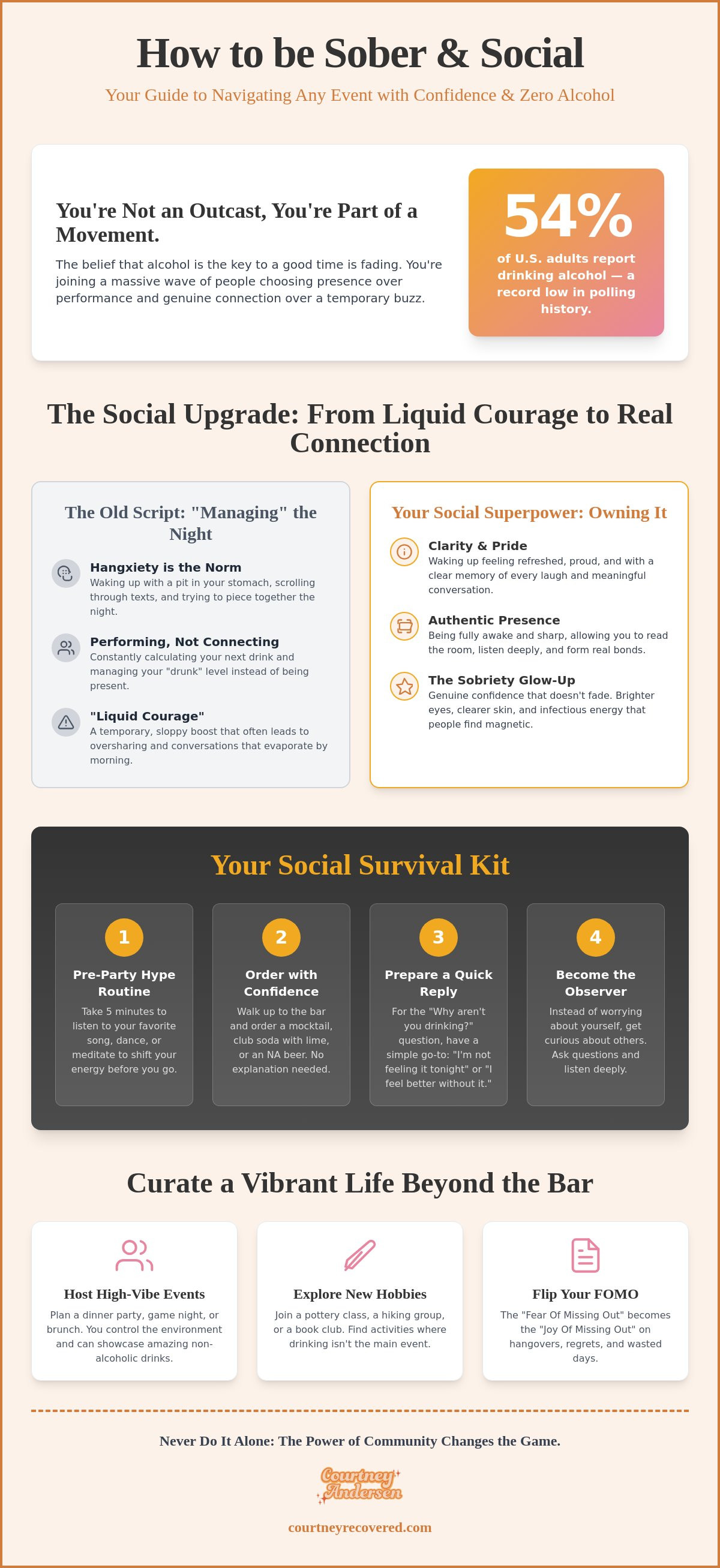
What if the most magnetic version of you isn't the one holding a glass of wine, but the one who actually remembers every laugh the next morning? For a long time, we've been told that alcohol is the "magic key" to relaxation, but the reality is that only 54 percent of U.S. adults still report drinking alcohol, a record low in polling history. You aren't becoming an outcast; you're joining a massive movement of people learning how to be sober and social. Still, I get the anxiety. It's hard to imagine a wedding or a first date without a liquid shield to hide behind.
If you're worried about feeling like the "boring" friend or sweating over the "why aren't you drinking?" question, take a breath. Sobriety isn't a loss; it's a massive upgrade. I promise that you can navigate any crowd with total confidence and zero alcohol while having more genuine fun than you ever did while buzzed. This guide covers how to ditch the hangxiety for good, handle awkward social pressure like a boss, and build the kind of authentic connections that only happen when you're fully present.
Key Takeaways
- Bust the myth that alcohol is your personality and learn why being the "sober one" actually makes you more magnetic and memorable.
- Master the practical tools for how to be sober and social, from a 5-minute pre-party hype routine to ordering mocktails with total confidence.
- Discover how to flip the script on FOMO and turn your sobriety into a social superpower that boosts your energy and presence.
- Get tips for curating a "vibrant life" calendar that goes beyond the bar, including how to host high-vibe dinner parties your friends will love.
- Find out why trying to navigate events in a vacuum usually fails and how finding a community like the Sobriety Circle changes the game.
The 'Boring' Myth: Why We Fear a Sober Social Life
Let's get one thing straight right now: you aren't boring. You've just been conditioned to believe that your personality is a product of a bottle. For years, we've been sold a lie that alcohol is the essential ingredient for a good time. We worry that without it, we'll turn into a wallflower who has nothing to say. This fear of being the "sober outcast" is what keeps so many women stuck in a cycle of gray area drinking. Our brains have been wired to associate booze with social survival, making us feel like we're naked in a crowd without a glass in our hand.
The truth is that you've been "managing" your social life instead of actually living it. When you're constantly calculating your next drink or wondering if you're acting too drunk, you aren't present. You're just performing. Learning how to be sober and social isn't about surviving the night until you can run home to your pajamas. It's about realizing that the most interesting version of you is the one who is fully awake, sharp, and genuinely connected to the people around her. You're moving from a state of social anxiety to one of social authority.
Identifying the 'Outcast' Anxiety
We've all had that internal monologue. It's the one that screams, "Everyone is looking at my sparkling water and judging me!" Here's a reality check: they aren't. Most people at the party are too busy worrying about their own awkwardness, their own outfits, or their own drink levels to notice yours. That feeling of being an "outcast" isn't a sign that you're failing at being social. It's actually a sign of massive personal growth. You're opting out of a cultural script that no longer serves you. That takes serious guts. Instead of feeling left out, start seeing yourself as the leader of a new, higher-vibe way of living.
Embracing this new identity often requires a boost in mental resilience, much like the empowering guidance provided by motivational speaker Jeff Yalden, who specializes in helping people build the confidence to lead lives of purpose and clarity.
The Truth About Social Lubricant
People call alcohol a "social lubricant," but it's more like a social barrier. It numbs your ability to read the room, listen deeply, and form real bonds. While it might give you a burst of "false confidence," it usually ends in a messy night and a morning full of hangxiety. This shift toward intentionality is a huge part of the sober curious movement, where people are choosing to prioritize mental clarity over a temporary buzz. You don't need a liquid crutch to be magnetic. When you ditch the booze, you trade that sloppy "party girl" energy for a genuine sober glow that people actually find attractive and inspiring. You'll find that how to be sober and social becomes second nature once you realize you were the life of the party all along; the alcohol was just getting in your way.
Flipping the Script: How Sobriety Becomes Your Social Superpower
Forget everything you’ve been told about alcohol giving you an "edge" in a crowd. The truth is that sobriety is the ultimate social upgrade. When you learn how to be sober and social, you stop being a passenger in your own life and start being the driver. You become the person who actually remembers the deep conversation you had at 11 PM. You’re the one who notices the subtle shift in the room’s energy. You aren't just surviving the party; you're owning it.
If you want to navigate social gatherings with ease, you have to lean into your emotional intelligence. Without the fog of booze, you can read social cues with laser precision. You’ll know exactly when a conversation has run its course or when a friend actually needs a ride home. Plus, the best part happens the next day. While everyone else is nursing a headache and scrolling through their sent texts with a pit in their stomach, you’re waking up feeling refreshed and proud. Zero hangxiety is the greatest gift you can give yourself.
Real Connection vs. Liquid Courage
Drunk talk is usually just a loop of the same three stories told with increasing volume. It feels deep in the moment, but it evaporates by morning. Sober talk is where the magic happens. I define a social superpower as the rare and magnetic ability to be fully present, genuinely curious, and completely yourself without needing a chemical buffer to feel brave. You’ll find yourself building authentic relationships that don't rely on a shared bottle of wine. These are the connections that actually last because they’re built on shared values and real laughter.
The Sobriety Glow-Up: Confidence That Doesn't Fade
Let’s talk about the physical side of this transformation because people will notice. Your skin will look clearer, your eyes will be brighter, and your energy will be infectious. It’s a fact that quitting alcohol is the ultimate beauty hack for anyone wanting to look and feel their best. This newfound confidence doesn't just stay on the dance floor. It follows you into the boardroom and your personal life. When you prove to yourself that you can handle a high-stakes event without a drink, you realize you can handle anything. You’re no longer the "party girl" who might say something she regrets; you’re a vibrant woman who knows exactly who she is. If you're ready to find your own confidence, my Sober Vibes Book offers the perfect roadmap for this new chapter.
Your Social Survival Kit: Practical Tools for Every Event
Socializing without a drink isn't a test of your willpower; it's a test of your strategy. You wouldn't go into a high-stakes meeting without notes, so why go to a party without a plan? The secret to how to be sober and social is preparation. Before you even step out the door, give yourself a 5-minute pre-party "hype" routine. Blast your favorite high-energy track, look in the mirror, and remind yourself that you are the vibe. When you walk in with that energy, people react to your confidence, not your beverage choice. Having a solid sober toolkit is your non-negotiable safety net for when things feel heavy.
Scripts for the 'Why Aren't You Drinking?' Interrogation
The "why" question is the one everyone fears, but you can handle it with grace. For casual acquaintances, keep it short and sweet: "I'm on a health kick and feeling amazing," or "I've got a big morning tomorrow." For your inner circle, try being deep and honest: "I realized alcohol was just getting in the way of my goals, so I'm trying life without it." If you encounter a "Drink Pusher" who won't take no for an answer, stay firm. A simple, "I said I'm good, thanks," with a smile usually does the trick. Remember, their discomfort with your sobriety is about them, not you.
The Power of the Mocktail and the Exit Plan
Holding a glass is the ultimate social camouflage. It reduces friction because it stops people from asking if you need a drink. Master the art of the sophisticated mocktail; order a soda water with lime and a splash of cranberry, or tonic with bitters. It looks like a cocktail, and it keeps your hands busy. While you're enjoying your drink, keep an eye out for the "tipping point." This is the moment when the music gets too loud and the conversations start looping. This Jefferson Health guide offers great tips for sober socializing that remind us we don't have to stay until the lights come on.
When the vibe shifts, use the "Ghost Exit." You don't need to give a long-winded goodbye or explain why you're leaving at 10 PM. Just slip out quietly. You've already made your connections and had your fun. Giving yourself permission to leave early without apologizing is a total boss move. You'll wake up tomorrow with a clear head while everyone else is still in bed, proving once again that how to be sober and social is actually the ultimate life hack.
Curating Your New Social Calendar: Beyond the Bar Scene
If your entire social life was built around happy hours and late-night dives, it’s time for a renovation. Moving from a "nightlife" mindset to a "vibrant life" perspective is the secret to making this lifestyle stick. It’s not just about removing alcohol; it’s about filling that space with things that actually light you up. Recognizing your gray-area drinking triggers is the first step toward clearing out the clutter in your schedule. Maybe it’s that 5 PM Friday "debrief" or the Sunday Funday that always turns into a Monday migraine. When you identify these patterns, you can replace them with activities that don't leave you feeling depleted.
Hosting a sober-friendly dinner party is a fantastic way to show your circle that a good time doesn't require a corkscrew. Focus on high-end glassware, a killer playlist, and a menu that actually requires your taste buds to be awake. When the focus is on the connection and the food, nobody misses the booze. You’ll find that rediscovering hobbies you used to love, or finding new ones like pottery, tennis, or even a book club, provides a much deeper sense of fulfillment than a bar stool ever could. This is the heart of how to be sober and social; you're creating a life you don't need to escape from.
Finding 'Your People' in the Gray Area
Let's be real: some of your current friends might just be "drinking buddies." These are the people who are fun when the rounds are flowing but disappear when things get real. Navigating the shift in your existing friend group can be tricky, but it’s a necessary part of your evolution. You need to identify the friends who support your growth and are willing to meet you for a coffee or a morning walk. If you’re struggling to find women who are on the same high-vibe path, don't panic. They are out there, and they are usually at the places you’ve been ignoring while you were at the bar.
Activities That Don't Require a Hangover
The world looks very different at 8 AM than at 2 AM. Morning-focused social events are the new gold standard for the sober-and-social woman. Think about it: brunch where you actually taste the avocado toast, Saturday morning hikes that clear your head for the weekend, or creative workshops where you actually learn a skill instead of just "getting through" the night. There is a massive amount of joy in being the "reliable" friend. You’re the one who shows up on time, remembers what was said, and drives everyone home safely. That reliability is a magnet for high-quality relationships. If you want a personalized roadmap to building this kind of social confidence, my 1:1 Sobriety Coaching is designed to help you navigate these social shifts with total ease.
Never Do It Alone: The Power of a Sober Community
Trying to master how to be sober and social while isolated is like trying to learn a new language without anyone to talk to. It’s exhausting, and eventually, you’ll probably give up. Most women fail because they try to navigate the "gray area" in a vacuum. They white-knuckle their way through weddings and work parties, feeling like the only person on the planet who isn't buzzed. But when you have a squad that actually gets it, the entire experience shifts from a test of endurance to a shared adventure. You aren't just "not drinking"; you're joining a movement of women who are choosing more for themselves.
This is where the Sobriety Circle comes in. It provides the psychological safety you need to take risks in your social life. Instead of feeling like an outsider, you’re part of a collective that celebrates every sober win. If you want a personalized roadmap to handle your specific social triggers, 1-on-1 sobriety coaching is the ultimate way to build your resilience. We work together to ensure you aren't just surviving these events, but actually thriving in them. You deserve a life that feels like a constant celebration rather than a daily sacrifice. This isn't about restriction. It's about expansion.
Why a Circle is Your Secret Weapon
Imagine being at a high-pressure event and having an "emergency" text thread full of women cheering you on in real time. That’s the power of community. You get access to shared resources, like the best sober-friendly spots in town or the newest alcohol-free products that actually taste good. The best part? It’s the relief of being in a room where no one asks why you aren't drinking. In our circle, your empty glass isn't a question mark; it’s a badge of honor. This environment of true acceptance reflects the values of Culture Of Belonging Global INC., where being noticed and known is the foundation of a healthy culture. You aren't the "sober friend" here. You’re just you, fully present and totally supported by people who speak your language.
Taking the Next Step Toward Your Vibrant Life
Sobriety isn't a waiting room; it’s the main event. You’ve likely spent enough time in the "Stop Starting Over" phase, and now it’s time to move into "The After." This is the phase where you stop worrying about the booze and start focusing on the vibrant, connected life you’re building. Signing up for personalized support is the fastest way to bridge that gap and find your footing in this new reality. I want you to know that your best social years are ahead of you, and they’re going to be more colorful and meaningful than anything you experienced while drinking. You've got the tools, the scripts, and the mindset. Now, it's time to go out there and live it.
Your Vibrant Social Life Starts Now
You don't have to choose between your sobriety and your social life. By flipping the script on the boring myth and arming yourself with a practical survival kit, you turn every event into an opportunity for real connection. You've learned that how to be sober and social is about more than just surviving the night. It's about owning the room with a clear head, a magnetic presence, and zero hangxiety the next morning. Whether you're mastering the "Ghost Exit" or hosting a high-vibe dinner party, you are proving that life without alcohol is a massive upgrade.
If you're ready to stop white-knuckling your way through parties and start thriving, you don't have to do it alone. Led by professional coach Courtney Andersen, our community provides access to the Stop Starting Over framework and the practical wisdom in the Sober Vibes Book. It’s time to trade the isolation for a squad that truly gets it. Join the Sobriety Circle and find your vibrant, alcohol-free community today! Your most confident, connected, and fun years are officially waiting for you. Let's make them count.
Frequently Asked Questions
Will my friends think I'm boring if I stop drinking?
Your real friends will actually find you more engaging, reliable, and present than ever before. Alcohol often acts as a mask that makes conversations repetitive and sloppy; sobriety allows your actual personality to shine through. While "drinking buddies" might drift away, your true connections will deepen because you'll actually remember the laughs and heart-to-hearts you share.
How do I handle a bachelorette party or wedding while sober?
Success at high-pressure events depends on having a clear exit strategy and a non-alcoholic drink in your hand at all times. Book your own transportation so you aren't trapped when the vibe gets messy, and use the "Ghost Exit" when the "drunk loop" starts. Weddings are the perfect place to practice being sober and social by focusing on dancing and food rather than the open bar.
What should I drink at a bar if I'm not having alcohol?
Order sophisticated options like club soda with bitters and lime, ginger beer with fresh mint, or a non-alcoholic botanical spirit. These drinks look exactly like cocktails, which helps you blend in and prevents people from constantly asking if you need a refill. Most modern bars now offer creative mocktails that use high-end ingredients, so you never have to settle for a lukewarm Diet Coke.
Do I have to tell everyone I'm 'sober' or can I just say I'm not drinking tonight?
You have total control over your narrative and are under no obligation to use specific labels if they don't feel right yet. Saying "I'm not drinking tonight" or "I'm on a health kick" is a perfectly valid way to set a boundary without opening a deep life discussion. Over time, you might feel empowered to share more, but for now, your only job is to protect your peace and your glass.
How do I deal with social anxiety without liquid courage?
Managing social anxiety is much easier when you realize that most people are far too worried about their own awkwardness to judge yours. Try arriving early to get comfortable with the space before it gets crowded, and have a few "go-to" questions ready to keep others talking. You'll find that your "sober glow" and genuine presence are far more magnetic than the false confidence alcohol provides.
Is it okay to still go to bars if I'm not drinking?
It is absolutely okay to visit bars as long as you have a clear purpose and a plan for when the energy shifts. If you're there for the live music, the great food, or a specific friend's birthday, you can still have a blast. Success in how to be sober and social means knowing when the "tipping point" has been reached and giving yourself full permission to head home when it stops being fun.
What if my partner still drinks and our social life revolves around it?
Open communication with your partner is essential for maintaining your boundaries while they continue their own habits. Suggest new, activity-based dates like morning hikes, pottery classes, or checking out a new coffee shop to break the "happy hour" routine. It's about evolving your shared life to include "vibrant life" activities that don't require a hangover to be enjoyable.
How long does it take to feel comfortable being social without alcohol?
Most women start feeling a significant shift in their social confidence after three to six months of consistent practice. Think of social skills like a muscle that has been dormant; it takes a few "reps" at parties and dinners to feel strong again. Each time you navigate an event successfully, you're building the resilience and evidence you need to prove that life is better in high definition.
I want you to feel sober NOT boring!
Kickstart your sobriety with my free 2-day video workshop series to master your sober mindset and have FUN in your sobriety journey!


