
Best Sobriety Workbook for Women: Path to Freedom 2026
Aug 18, 2026
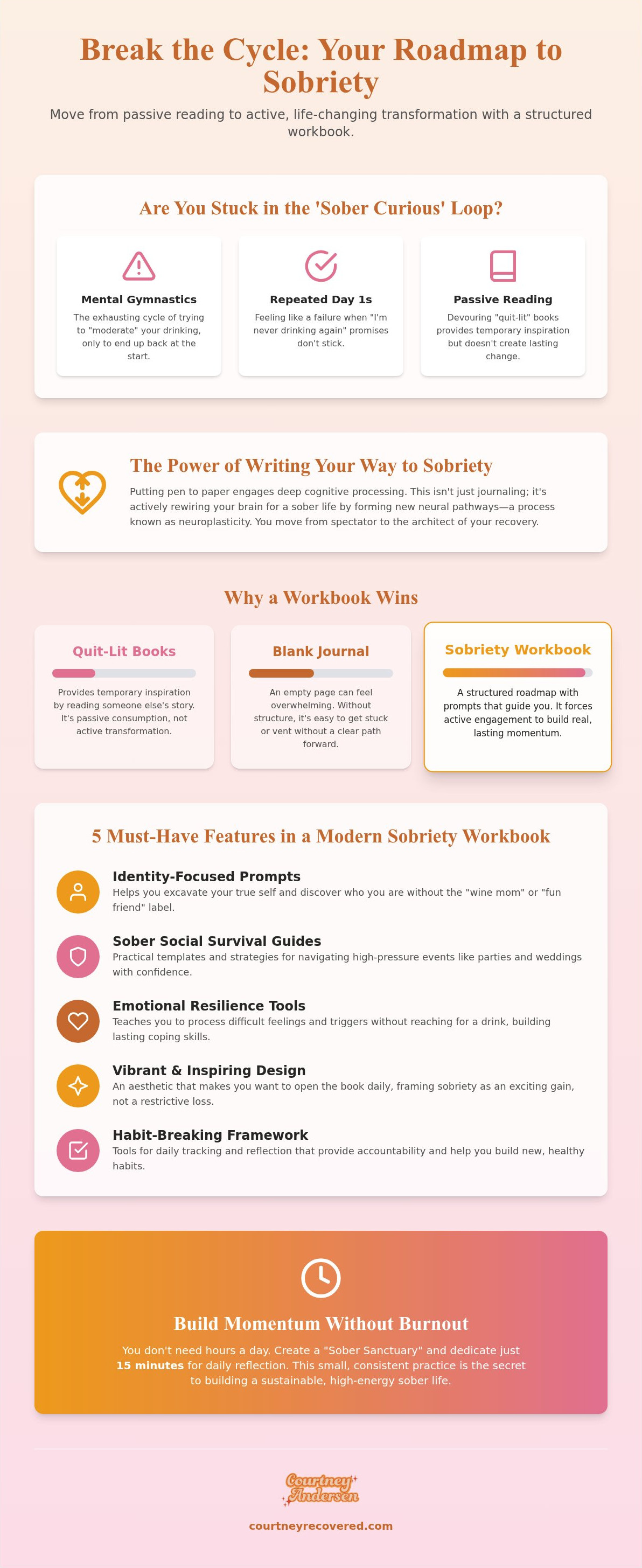
What if the mental gymnastics of trying to "moderate" your drinking is actually more exhausting than the alcohol itself? If you are stuck in a loop of repeated Day 1s and feel like a total failure, take a deep breath. You are likely searching for the best sobriety workbook for women because you know that passive reading isn't cutting it anymore. You need more than just another quit-lit book; you need a structured roadmap that turns your "sober curious" thoughts into a vibrant, permanent reality.
I totally get the fear that sobriety means losing your social spark or being the "boring" one at the next bachelorette party. It's a lie we tell ourselves to stay stuck in the gray area. In this article, you will learn how to use a sobriety workbook for women to break the cycle of drinking for good and finally reclaim your energy. We are diving into how the right tools can move you from exhaustion to a sense of joy and freedom that you never thought was possible. Get ready to stop starting over and start living your most authentic, high-momentum life.
Key Takeaways
- Shift from passive quit-lit reading to active habit-breaking by understanding the brain-changing power of putting pen to paper.
- Identify the five essential features of an effective sobriety workbook for women, including identity-focused prompts and social survival guides.
- Learn why choosing a lifestyle-oriented resource over a clinical manual is the secret to staying motivated as a gray area drinker.
- Create a sustainable "Sober Sanctuary" and discover how 15-minute daily sessions prevent recovery burnout while building momentum.
- See how to bridge the gap between individual reflection in the Sober Vibes Book and the high-energy accountability of a coaching community.
Beyond the Quit-Lit: Why a Sobriety Workbook is Your Secret Weapon
You probably have a shelf full of "quit-lit" books that you devoured during those 3 a.m. "I am never drinking again" spirals. Reading those stories is a fantastic start, but let's be real: consumption doesn't equal transformation. To actually break the cycle of gray area drinking, you have to move from being a spectator to being the lead architect of your recovery. A sobriety workbook for women is your secret weapon because it forces you to engage with your own story, not just nod along to someone else's. It's a structured, high-energy tool designed to take you beyond the "why" of your drinking and straight into the "how" of your new, vibrant life.
The "Aha!" moment usually happens when you're halfway through a prompt and realize that your "wine o'clock" habit isn't about the taste of the Chardonnay at all. It's about a specific trigger you've been ignoring for years. Workbooks uncover these root causes by asking the tough, identity-focused questions you might avoid in a passive read. Instead of just understanding that alcohol is a toxin, you start to see exactly how it's been stealing your joy, your sleep, and your social confidence. This shift from theoretical knowledge to personal insight is what finally stops the "moderation" mental gymnastics and moves you toward real momentum.
The Science of Writing Your Way to Sobriety
Writing is literal magic for your brain. When you put pen to paper, you're engaging in deep cognitive processing that actually reduces the intensity of your cravings. This practice is a cornerstone of many modern addiction treatment therapies because it bridges the gap between your emotional urges and your logical goals. Neuroplasticity is the brain's incredible ability to reorganize itself by forming new neural connections, and using a workbook helps physically "carve out" these sober pathways through repetitive, intentional focus. Daily tracking and reflection through a sobriety workbook for women create a layer of accountability that keeps you grounded when life gets loud.
Workbook vs. Journal: Understanding the Difference
A blank journal can feel like a total trap when you're in early sobriety. Looking at a vast, empty page while your head is spinning with anxiety is a recipe for a shutdown. You don't need more space to vent; you need a roadmap to follow. While free-writing has its place, structured prompts win every time in those first 90 days because they provide the guardrails you need to stay on track. This is the exact philosophy behind the Stop Starting Over framework. It provides the "Sober Social" survival guides and habit-breaking tools that a regular notebook simply can't offer, helping you move from the isolation of a struggle into the vibrancy of a connected reality without the burnout of trying to figure it out alone.
5 Must-Have Features in a Sobriety Workbook for Modern Women
If your recovery resource looks like a clinical manual from 1985, you'll probably leave it gathering dust on your nightstand. A modern sobriety workbook for women needs to feel like a high-energy lifestyle guide, not a medical chore. It should be a space where you can be messy, honest, and ultimately, inspired. To truly move the needle, your workbook must go beyond basic "don't drink" advice and tackle the actual life you live. Focus on four core pillars: identity, social strategy, emotional resilience, and aesthetic appeal.
The first must-have feature is identity-focused prompts. You've spent years identifying as the "fun friend" or the "wine mom," so who are you without that glass in your hand? A great workbook helps you excavate your true self. It should also feature a vibrant, optimistic design. When a book is beautiful, you actually want to open it every day. This isn't just about "pretty" pages; it's about creating a celebratory atmosphere that frames sobriety as a massive gain rather than a restrictive loss. If you are looking for this exact vibe, check out the Sober Vibes Book to see how lifestyle-led recovery feels.
Navigating the Social Minefield
Let's talk about the elephant in the room: your social life. A workbook is useless if it doesn't prepare you for the real world. You need practical templates for saying "no" to a drink without making the whole room feel awkward. It should include specific guides for high-pressure events, like learning how to stay sober at a bachelorette party without losing your mind. The goal is to move from feeling "restricted" to feeling completely empowered. You aren't "missing out" on the party; you are finally present enough to actually enjoy it. Your sobriety workbook for women should provide the scripts that turn you into a sober social pro.
The Emotional Sobriety Component
Many of us fall into the "High-Functioning Trap." On the outside, your life looks perfect, but inside, you're drowning in the mental gymnastics of moderation. This is why emotional sobriety tools are non-negotiable. While many behavioral therapies for AUD focus on the clinical side of cravings, a lifestyle workbook helps you handle the "witching hour" after work. You need tools to process stress, boredom, and anxiety without using liquid courage to numb out. By building a comprehensive sober toolkit through your daily work, you learn to navigate life's highs and lows with your eyes wide open and your heart intact.
Clinical vs. Lifestyle Workbooks: Which One Actually Works for Gray Area Drinkers?
If you have ever picked up a recovery manual and felt like you were reading a medical textbook, you know exactly why so many women quit before they even start. Traditional clinical workbooks are often designed with a "deficit model" in mind. They focus heavily on fixing a "broken" person, which can feel incredibly alienating if you are a high-achieving professional who is simply tired of the wine-soaked weekends. For the woman who is still hitting her KPIs but struggling with the mental gymnastics of moderation, a lifestyle-based sobriety workbook for women is the game changer. It shifts the focus from what you are losing to the massive, vibrant life you are gaining.
While 12-step approaches and clinical literature have helped millions, they often lean into a somber, sterile atmosphere. Modern, holistic tools recognize that gray-area drinking is a spectrum. You don't necessarily need a hospital bed; you need a mindset shift and a new set of social tools. A "tough love" but celebratory tone works better for professional women because it mirrors the way we already tackle our careers and fitness goals. It’s about leveling up, not just surviving. You want a resource that feels like a mentor, not a doctor.
Identifying Your Drinking Pattern
Are you caught in the "High-Functioning Trap"? You might be if you are making the school run and crushing your presentations, but your internal monologue is a constant debate about whether you have had too much. Clinical labels can sometimes hinder progress for women in this category because they carry a heavy stigma that doesn't match their reality. According to the 2024 National Survey on Drug Use and Health, 10.7 million women in the U.S. have Alcohol Use Disorder, yet many in the gray area don't seek help because they don't feel "sick enough." Choosing a workbook that matches your current knowledge level and lifestyle goals lets you bypass the identity crisis and get straight to healing.
The Power of Non-Clinical Language
Words are the foundation of your new reality. When you move away from the sterile language of traditional recovery, you lower your defenses. A sobriety workbook for women that adopts a "cool older sister" vibe makes the process feel accessible and even exciting. By reclaiming words like "vibrant," "connected," and "empowered," you frame your sobriety as a positive choice rather than a restrictive punishment. This shift in vocabulary is essential for removing the shame that often keeps women stuck in the cycle of repeated Day 1s. You aren't just "quitting alcohol"; you are choosing a more high-energy, authentic version of yourself.
How to Successfully Work Through Your Recovery Guide Without Burning Out
Most of us are natural overachievers. When we decide to change our lives, we want it done by yesterday. You might be tempted to sit down and power through your entire sobriety workbook for women in one wine-free weekend, but I am here to tell you: resist that urge. This isn't a college cram session; it's a slow-burn transformation of your entire identity. The "Bite-Sized" approach is your best friend here. Committing to just 15 minutes a day is far more powerful than a three-hour binge because it keeps your goals front of mind without causing emotional fatigue. You are building a lifestyle, not just finishing a book.
To make this stick, you need a "Sober Sanctuary." This is a specific physical space where you feel safe, inspired, and completely honest. It could be a sun-drenched corner of your living room or a quiet spot in bed before the house wakes up. In this space, you are the boss. Sometimes, the prompts will get "too real," and you might hit an emotional breakthrough that feels a bit heavy. That is okay. If it feels like too much, close the book, take a walk, and come back when you have caught your breath. Integration takes time, and you are allowed to move at your own pace.
Establishing Your Morning and Night Routine
Consistency lives in your daily habits. Integrating your workbook into a daily sobriety routine allows you to "bookend" your day with intention. In the morning, use your workbook to set a high-energy intention for the day ahead. Who do you want to be at that 5 p.m. meeting or that social mixer? In the evening, use the reflection prompts. What went well? Where did you feel a wobble? This practice creates an accountability loop that keeps you grounded. Pair these sessions with the Sober Toolkit to ensure you have practical, real-world strategies ready to go the moment you step out of your sanctuary and into your busy life.
Staying Consistent When the "Pink Cloud" Fades
The first 30 days often come with a "pink cloud" of excitement and newfound energy. But eventually, the novelty wears off, and the reality of long-term change sets in. This is the danger zone where many women drift back toward the gray area. This is exactly when the Stop Starting Over mentality becomes crucial. When motivation dips, rely on your workbook to track your progress visually. Seeing those checked-off days and completed chapters creates momentum that logic alone can't. Celebrate every single win, no matter how small. If you want to keep that vibrancy alive, check out our daily sobriety tools to supercharge your consistency and keep moving forward.
Elevating Your Journey: From the Sober Vibes Book to 1:1 Coaching
Finishing your first sobriety workbook for women is a massive milestone that deserves a serious celebration. It means you have stopped just "thinking" about your drinking and started doing the actual, messy work of self-discovery. But let's be honest: the workbook is the launchpad, not the final destination. You have cleared the fog, and now it is time to design what your life after getting sober really looks like when the training wheels come off. This is where the Sober Vibes Book becomes your new bible. It is a high-energy guide that reminds you every single day that you aren't giving anything up. You are finally gaining the clarity, the sleep, and the vibrant energy you have been chasing for years.
The transition from the pages of a book to real-world application can feel a bit daunting, but you don't have to do it in a vacuum. A workbook gives you the "how-to," but community gives you the "want-to." When you move beyond solo reflection and start engaging with others who are on the same high-momentum path, your sobriety shifts from a project into a lifestyle. It’s about taking those insights you’ve scribbled down and turning them into social confidence that works in the boardroom, at brunch, and everywhere in between.
The Sobriety Circle: Your Online Support System
The "Sober and Lonely" narrative is a total lie designed to keep you stuck in the gray area loop. Transitioning from solo reflection to group accountability is how you make this change stick for the long haul. When you join the Sobriety Circle, you are not just finding a support group; you are finding your tribe of like-minded, high-achieving women. These are the friends who understand that you still want to go to the concert, the bachelorette party, and the five-star dinner. You just want to do it without the next-day hangxiety. Group energy keeps your momentum up when your personal motivation dips, providing a sense of immediate safety and shared experience you simply cannot find in a clinical setting.
Personalized Support with 1:1 Coaching
Sometimes, the prompts in a sobriety workbook for women hit a nerve that needs more than a journal entry. If you feel like you are doing the work but still hitting a wall with specific triggers, it is time for a personalized sobriety roadmap. Leveling up to 1:1 sobriety coaching is about breaking through the specific obstacles of the "High-Functioning Trap" that are unique to your life. A coach acts as your strategist and your "cool older sister" mentor, helping you navigate high-stress career moves or complex family dynamics without reaching for a drink. It accelerates the work you have already started, turning those workbook insights into permanent, joyful lifestyle changes. You have already proven you can do the hard things. Now, let’s make the best things last.
Your Most Vibrant Life is Waiting
You have spent enough time trapped in the exhausting mental gymnastics of trying to moderate your drinking. It's time to stop starting over and finally embrace the freedom you deserve. By using a sobriety workbook for women that focuses on your identity and social lifestyle, you're doing more than just quitting alcohol; you're reclaiming your joy and your energy. We've explored how the right tools move you from the isolation of the struggle into the high-momentum reality of a connected, sober life.
Courtney Andersen, a professional sober coach, has built this vibrant, non-clinical approach specifically for modern women who want to level up. You don't have to navigate this path alone when you have the Sobriety Circle community and a structured roadmap to guide you. It's time to trade the hangxiety for a life that feels authentic and celebratory every single day. Grab your copy of the Sober Vibes Book and start your vibrant sober journey today! You've got this, and I'm so excited to see you shine.
Your Sobriety Workbook Questions Answered
What is the best sobriety workbook for women starting their journey?
The best sobriety workbook for women balances practical habit-breaking with identity-focused prompts, like the Sober Vibes Book. It should move beyond clinical theory and offer real-world social scripts that actually work in your busy life. Look for a resource that feels celebratory rather than restrictive, helping you see sobriety as a massive gain rather than a loss of your social spark.
Can a sobriety workbook really help me stop drinking without AA?
Yes, a workbook is a powerful alternative or supplement to traditional programs like AA. Many women find success using a structured sobriety workbook for women because it focuses on personal evolution and lifestyle integration. It provides the "Stop Starting Over" framework you need to address your specific triggers and rewrite your social life on your own terms without feeling like a broken person.
How long does it take to work through a sobriety workbook?
Most workbooks are designed to be completed over 30 to 90 days, but the pace is entirely up to you. Committing to just 15 minutes a day is much more effective than rushing through chapters in a single sitting. This "bite-sized" approach ensures the lessons actually stick and become part of your daily routine without causing the emotional burnout that often leads to a relapse.
What should I look for in a workbook for gray area drinking?
Look for a workbook that avoids sterile, clinical language and uses relatable, high-energy prompts instead. It should specifically address the "High-Functioning Trap" and offer tools for navigating high-pressure social situations like work happy hours or bachelorette parties. A lifestyle-focused guide resonates better with gray-area patterns than a medical manual because it frames change as a positive lifestyle upgrade.
Is a digital or physical sobriety workbook better for recovery?
Physical workbooks are generally better because the act of putting pen to paper creates a stronger cognitive connection in your brain. This "hand-to-brain" processing helps you internalize your breakthroughs and physically carves out new sober pathways. However, digital versions can work well if you need a discreet option you can access on your phone during a busy workday or while traveling for events.
How do I stay motivated to use my sobriety workbook every day?
Tie your workbook time to an existing habit, like your morning coffee or your evening wind-down routine. Creating a "Sober Sanctuary" in your home makes the practice feel like a luxury treat rather than a medical chore. Tracking your progress visually and celebrating small wins helps maintain your momentum when the initial "pink cloud" excitement starts to fade, and the real work of transformation begins.
Can I use a sobriety workbook alongside 1:1 coaching?
Absolutely, and this is often the fastest way to see permanent results. While a sobriety workbook for women provides the foundational roadmap, 1:1 coaching offers personalized breakthroughs for your specific life obstacles. Using the two together lets you take insights from your daily writing and apply them directly to career moves or complex family dynamics, with the support of a mentor who's been there.
What is the difference between a sobriety workbook and a regular journal?
A workbook provides structured guidance and evidence-based prompts, whereas a regular journal is just a blank space for free-writing. For early recovery, a workbook is superior because it gives you the guardrails and habit-breaking tools you need to stay on track. It moves you from just venting your feelings on a page to actively building a new, vibrant, and alcohol-free identity that you actually love living.
I want you to feel sober NOT boring!
Kickstart your sobriety with my free 2-day video workshop series to master your sober mindset and have FUN in your sobriety journey!


