
Alternatives to AA: Your Modern Guide to Sobriety
Oct 14, 2026
What if quitting drinking wasn't about surrendering your personal power, but finally claiming it? If the idea of declaring yourself powerless or adopting rigid labels makes you want to bolt, take a deep breath. You aren't broken, and you aren't failing at recovery. Wanting to step away from alcohol without church basements, spiritual dogma, or dwelling on past war stories makes complete sense. Exploring modern alternatives to AA for sobriety isn't a cop-out; it's a clear sign you're ready for a practical approach built on self-trust and genuine growth.
You deserve a shame-free path that treats an alcohol-free life as an exciting lifestyle upgrade rather than a lifelong punishment. In this guide, you'll discover proven secular communities, evidence-based frameworks, and fresh coaching models that help you build an empowering, sustainable routine. We're breaking down the most effective modern recovery options so you can choose tools that fit your lifestyle, leave the rest behind, and thrive on your own terms.
Key Takeaways
- Explore proven, evidence-based alternatives to AA for sobriety that prioritize self-empowerment and practical mindset shifts over rigid lifelong labels.
- Compare leading secular mutual aid networks like SMART Recovery, LifeRing, and Recovery Dharma to see how their formats and philosophies differ.
- Evaluate clinical therapies, modern peer sanghas, and private coaching to choose the recovery path that matches your personality and goals.
- Learn how to build a customized alcohol-free toolkit that combines emotional regulation, practical habit loops, and positive community.
- Discover how stepping away from alcohol can feel like an energetic, vibrant lifestyle upgrade rather than a restrictive daily sacrifice.
Why Seek Alternatives to AA for Sobriety?
For decades, Alcoholics Anonymous was treated as the only game in town. Walking into a dimly lit church basement, drinking stale coffee, and admitting you were powerless over your life was simply "what you did" if alcohol became a problem. But today, alternatives to AA for sobriety are recognized as legitimate, evidence-based recovery pathways that help millions build vibrant, alcohol-free routines without rigid dogma.
Traditional 12-step programs undoubtedly offer deep fellowship, yet they often alienate people who crave scientific backing, autonomy, and practical lifestyle tools. This disconnect is especially loud if you find yourself dealing with gray-area drinking. You might not identify with hitting a catastrophic "rock bottom," yet you know alcohol is draining your energy, clouding your weekends, and shrinking your potential. Conventional meetings demand a strict, black-and-white framework: you are either an alcoholic or a normal drinker. Modern approaches reject that false binary, treating habit change as a spectrum of personal growth.
The Problem with Powerlessness and Lifelong Labels
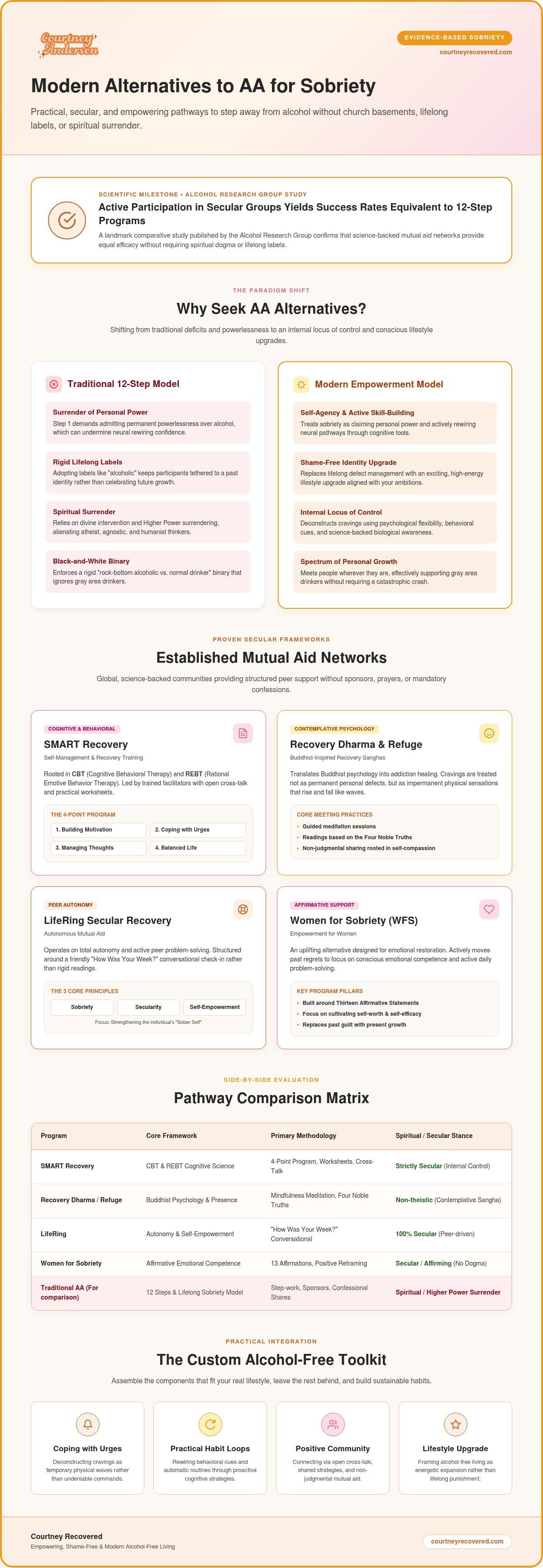
In traditional recovery, Step 1 demands that you admit you are permanently powerless over alcohol. For many people, starting habit change by stripping away agency feels counterproductive. Believing you have zero control can actually undermine the confidence you need to rewire your neural pathways.
Adopting lifelong labels like "alcoholic" can also keep you tethered to a past identity rather than celebrating who you are becoming. Modern empowerment models frame sobriety as active skill-building. You aren't managing a defect; you are consciously choosing an upgraded lifestyle that matches your ambitions.
Secular Sobriety vs. Spiritual Surrender
Surrendering your will to a Higher Power can create intense friction for atheist, agnostic, or humanist thinkers. When recovery insists on spiritual surrender, many capable people simply walk away because they think sobriety isn't for them. That is a massive loss.
Secular recovery frameworks shift the focus from external divine intervention to your internal locus of control. Instead of praying away an urge, you learn how to deconstruct it using cognitive tools. Groundbreaking organizations like the SMART Recovery program demonstrate that building psychological flexibility and understanding behavioral cues can keep you grounded. When you align your recovery with your personal values and actual biology, staying alcohol-free stops feeling like a grueling chore and starts feeling like freedom.
Established Non-12-Step Mutual Aid Programs
You don't have to navigate an alcohol-free life alone just because traditional rooms aren't your vibe. Several global, science-backed organizations offer community support without prayers, sponsors, or mandatory confessions. In fact, a landmark comparative study of mutual help alternatives published by the Alcohol Research Group confirmed that active participation in secular groups yields success rates equivalent to 12-step programs. If you are exploring alternatives to AA for sobriety, these established mutual aid networks provide structured, empowering spaces to connect.
SMART Recovery and Cognitive Tools
SMART Recovery (Self-Management and Recovery Training) relies on cognitive behavioral therapy and Rational Emotive Behavior Therapy. Instead of working through steps, participants focus on a practical 4-Point Program: building motivation, coping with urges, managing thoughts and behaviors, and living a balanced life. Trained facilitators run meetings that welcome open cross-talk, letting members exchange real-time problem-solving strategies and interactive worksheets.
Mindfulness and Buddhist-Inspired Groups
Recovery Dharma and Refuge Recovery take a contemplative approach, translating Buddhist psychology into practical addiction recovery. Rather than viewing urges as evidence of a permanent defect, these sanghas teach you to observe cravings as impermanent physical sensations that rise and fall like waves. Weekly gatherings incorporate guided meditations, readings on the Four Noble Truths, and small-group shares rooted in non-judgmental presence and self-compassion.
LifeRing and Women for Sobriety
If you prefer complete autonomy, LifeRing Secular Recovery operates on three core principles: Sobriety, Secularity, and Self-Empowerment. Their meetings use a conversational "How Was Your Week?" format in which you share recent wins and plan strategies to strengthen your personal "Sober Self."
For women seeking emotional restoration, Women for Sobriety (WFS) offers an uplifting alternative centered on thirteen affirmative statements. The program shifts the focus away from past regrets toward self-worth, emotional competence, and active problem-solving.
Every one of these networks proves there are diverse, viable alternatives to AA for sobriety. Finding the right room is simply about discovering the language that resonates with your personal goals. If you want a more intimate, lifestyle-first approach alongside these groups, exploring private mentorship through Courtney Recovered can give you the personalized cheerleading you need to thrive.
Comparing Recovery Pathways: Which Method Fits Your Life?
Recovery is deeply personal, and a strategy that transforms one person's life might leave you feeling completely untouched. Mainstream directories often reduce your options to clinical hospital stays or 12-step church basements. In reality, modern alternatives to AA for sobriety span a rich spectrum of secular peer groups, digital memberships, and private mentorship tailored to real life.
A helpful perspective from Harvard Health comparing AA and SMART Recovery highlights how philosophical differences affect engagement. The best fit depends on whether you prefer open group discussions, self-directed study, or personalized accountability. Joining an interactive sober community online gives you real-time connection from your phone without the pressure of rigid meeting scripts.
| Recovery Pathway | Core Methodology | Spiritual Focus | Primary Format |
|---|---|---|---|
| Traditional 12-Step | Surrender, amends, peer sponsorship | High (Higher Power reliance) | In-person and online group meetings |
| Secular Mutual Aid | CBT, REBT, mindfulness techniques | None (Secular or psychological) | Structured volunteer-led peer circles |
| 1:1 Sobriety Coaching | Behavioral design, lifestyle integration | Personalized to client values | Private calls, direct access, custom roadmaps |
Core Differences Between Traditional and Alternative Paths
Traditional frameworks emphasize lifelong attendance to stay in remission. Secular and modern models take an educational stance: you build coping skills, rewire triggers, and eventually graduate into independent living. Relapse handling differs radically, too. Rather than resetting your sobriety clock to day zero and carrying heavy shame, alternative frameworks treat slip-ups as practical data points to learn from.
The Role of Professional Sobriety Coaching
Mutual aid meetings offer broad encouragement, but listening to group shares cannot replace a customized plan for your actual daily life. Working through 1-on-1 sobriety coaching shifts the dynamic from passive attendance to proactive transformation. Instead of recounting old drinking stories, you collaborate with an experienced mentor to build rock-solid boundaries, craft smooth social scripts for dinner parties, and establish realistic evening routines. Private mentorship turns alternatives to AA for sobriety into a clear, momentum-fueled blueprint for lasting freedom.
How to Build Your Custom Alcohol-Free Toolkit
Quitting drinking isn't just about removing a bottle from your fridge; it's about what you put in its place. White-knuckling through Friday nights with sheer willpower will drain your battery fast. Sustainable long-term momentum requires building a multi-layered support routine that supports your mind, body, and social life every single day. When considering alternatives to AA for sobriety, success comes from stacking proactive habits rather than hoping a craving disappears on its own. Start by building a sobriety toolkit tailored to your schedule, triggers, and values.
Quit-Lit and Neurological Education
Reading behavioral science books completely dismantles the illusion that alcohol helps you relax. Learning how ethanol triggers cortisol spikes and destabilizes your nervous system turns quitting into an obvious health upgrade. Practical literature like the Sober Vibes Book breaks down early physical transitions and offers straightforward behavioral shifts to navigate your first ninety days without feeling deprived.
Somatic Practices and Craving Management
Cravings are bodily sensations, not commands. You can regulate physical urges before they hijack your thoughts by using somatic grounding techniques:
- Urge Surfing: Imagine a craving as an ocean wave, and ride its physical peak for ten minutes until the adrenaline subsides.
- Physiological Sighs: Take two quick, deep inhales through your nose, followed by a long, slow exhale through your mouth to lower your heart rate.
- Targeted Processing: Work through structured reflection prompts in the Sober Toolkit to untangle what you actually need, whether that is rest, food, or emotional relief.
Rewriting Your Social Life Without Alcohol
Staying alcohol-free doesn't mean hiding at home on weekends. Keep your hands busy by ordering sparkling water with bitters or refreshing non-alcoholic craft brews. Having a signature alcohol-free drink protects your sensory habit without the morning regret.
Prepare simple, confident boundary scripts for questions like "Why aren't you drinking?" A short response like "I feel so much better without it" ends debates quickly. As you lean into functional alternatives to AA for sobriety, you'll naturally build genuine friendships centered on mutual passions instead of late-night drinking buddies. Ready to build your personalized game plan? Explore coaching and community resources at Sober Vibes to jumpstart your progress today.
Creating an Empowered, Alcohol-Free Life with Courtney Andersen
Sobriety isn't a boring sentence of perpetual sacrifice; it's an incredible lifestyle upgrade. When you leave alcohol behind, you unlock vibrant mental clarity, deep emotional resilience, and authentic confidence that no cocktail could ever replicate. Yet so many people stay stuck because they feel caught between cold, clinical rehabs and dogmatic, smoke-filled meeting basements. Courtney Recovered bridges that exact gap. By blending empathetic, lived-experience mentorship with actionable habit design, you learn how to truly celebrate life after getting sober without living in the shadow of your past.
Instead of constantly looking in the rearview mirror, Courtney's structured programs focus entirely on forward-looking growth. Whether you are tired of the exhaustion cycle and ready to jump into Stop Starting Over, or stepping into long-term personal evolution inside The After, you'll discover that alternatives to AA for sobriety can be uplifting, energized, and deeply social.
The Power of the Sobriety Circle Community
Isolation fuels repetitive drinking cycles. Finding your people makes lasting change possible. The Sobriety Circle is an active, shame-free membership community where individuals ditch alcohol together without rigid labels or performative guilt. Inside this global space, members tap into:
- Live Group Coaching: Real-time strategy sessions to troubleshoot upcoming vacations, work events, and tricky emotional cravings.
- Focused Challenges: Practical milestones designed to build positive momentum and celebrate habit wins without judgment.
- Dynamic Camaraderie: A warm, vibrant network proving daily that a sober life is anything but dull.
Personalized 1:1 Mentorship for Sustainable Freedom
Sometimes you need more than a group chat; you need an experienced guide in your corner. Through 1:1 Sobriety Coaching, Courtney Andersen provides high-touch, non-clinical mentorship tailored strictly to your schedule, career, and family dynamics. This personalized partnership digs into your specific subconscious habit loops, pinpointing emotional triggers so you can break the quit-and-restart cycle for good.
You don't have to navigate rigid doctrines or surrender your personal power to stay free from alcohol. When looking for genuine alternatives to AA for sobriety, working with an empathetic mentor helps you build an unshakeable, custom lifestyle that lasts. Take your next confident step with Courtney Recovered and build a vibrant life you never want to escape.
Step Into Your Vibrant, Alcohol-Free Future
You never have to force yourself into a recovery box that doesn't fit your life. Embracing modern alternatives to AA for sobriety allows you to leave behind heavy labels, dogmatic rules, and the fear of missing out. By combining practical nervous system regulation, empowering literature, and supportive peer connections, you turn quitting drinking into a massive personal upgrade rather than an endless struggle.
Real freedom happens when your recovery aligns with your values and goals. Through a proven non-clinical coaching methodology tailored to modern routines, Courtney Andersen, author of the acclaimed Sober Vibes Book and creator of the Sober Toolkit, provides the relatable mentorship you need to make this lifestyle stick. You don't have to navigate the social scene or manage stress on your own.
Your alcohol-free life is waiting, and it gets to be energizing, joyful, and deeply connected. Join the Sobriety Circle and discover a modern, shame-free path to lasting freedom today.
Frequently Asked Questions
Can I successfully stay sober without attending AA meetings?
Yes, absolutely. Millions of people build fulfilling, long-term alcohol-free lives without ever stepping inside a 12-step meeting room. By exploring modern alternatives to AA for sobriety, you can rely on behavioral science, personalized coaching, and secular communities that match your lifestyle. Success depends on building consistent self-awareness, emotional coping skills, and a solid support network, not on following a specific 12-step doctrine.
How does SMART Recovery differ from traditional 12-step programs?
SMART Recovery relies on cognitive behavioral therapy and Rational Emotive Behavior Therapy rather than spiritual surrender. While traditional 12-step programs focus on admitting powerlessness and seeking help from a Higher Power, SMART emphasizes self-empowerment and practical tools to overcome urges. Facilitators also encourage open dialogue and cross-talk during meetings, whereas 12-step groups strictly prohibit cross-talk, keeping shares purely one-directional.
Is it possible to quit drinking without adopting a religious or spiritual belief?
Yes, you don't need any spiritual or religious beliefs to stop drinking. Secular recovery approaches view alcohol misuse through psychological, emotional, and neurobiological lenses rather than as a spiritual defect. Programs like LifeRing and SMART Recovery, as well as private coaching frameworks, rely entirely on internal agency, behavioral modification, and cognitive reframing to help you stay grounded and alcohol-free on your own rational terms.
What is the role of a sobriety coach compared to a sponsor?
A 12-step sponsor guides you through the 12 Steps based on their personal recovery in that specific program, usually without professional training. A non-clinical sobriety coach provides structured, individualized mentorship focused on forward-looking lifestyle design. Working with a coach through private 1:1 sessions means getting tailored habit architecture, personalized social boundary strategies, and goal-oriented accountability that fits your specific career, family, and daily routines.
Are non-12-step recovery programs recognized as evidence-based?
Yes, several secular programs are rooted directly in clinically validated behavioral science. Organizations like SMART Recovery build their curriculum on Cognitive Behavioral Therapy and Rational Emotive Behavior Therapy, both proven to treat addictive behaviors. When researching alternatives to AA for sobriety, peer-reviewed studies confirm that active participation in science-based mutual aid groups produces recovery outcomes comparable to traditional 12-step models.
How do I handle social events when I choose not to follow AA?
You handle social events by having a practical game plan before you walk through the door. Decide on your alcohol-free beverage in advance, practice a concise one-liner like "I'm feeling so much better not drinking," and set a clear exit strategy if the vibe shifts. Bringing your own sparkling water or craft mocktail keeps your hands busy and your confidence high without awkwardness.
What should I do if secular peer support meetings are unavailable locally?
Use virtual spaces and digital communities. Most major non-12-step organizations host multiple daily online meetings that you can join from anywhere. You can also join vibrant private communities like the Sobriety Circle, participate in digital habit programs, or read focused recovery literature. Online connectivity lets you build an empowering, judgment-free support circle without relying on local options.
I want you to feel sober NOT boring!
Kickstart your sobriety with my free 2-day video workshop series to master your sober mindset and have FUN in your sobriety journey!


