
Beyond the Basement: 7 Modern Alternatives to Alcoholics Anonymous in 2026
Oct 12, 2026
What if the reason you haven't quit drinking yet isn't because you lack willpower, but because you're trying to force a 1930s solution onto a 2026 life? For decades, the church basement was the only game in town, but if admitting powerlessness makes your skin crawl, you aren't alone. You aren't failing recovery; you're just looking for alternatives to Alcoholics Anonymous that actually feel like a gain rather than a life sentence of punishment.
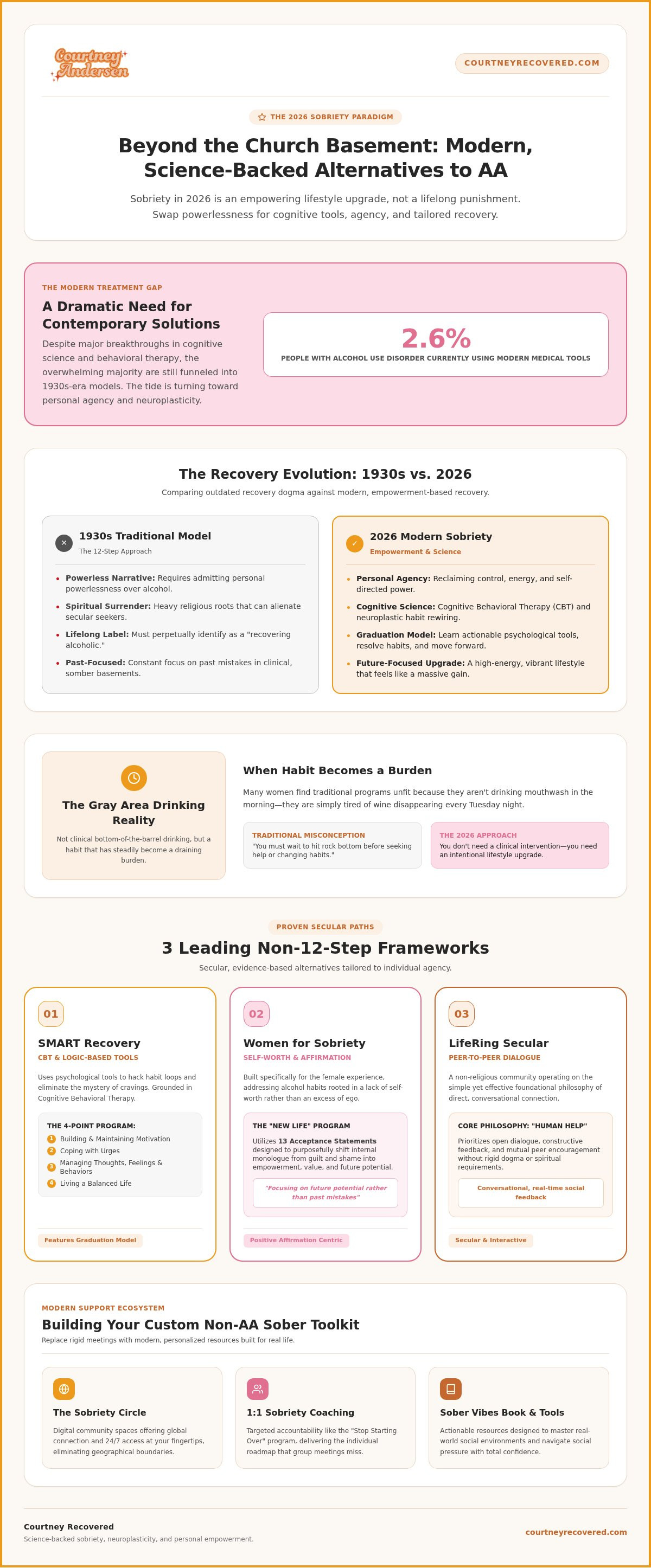
I get it because I've been there, feeling like an outcast in traditional spaces. You want a community that feels like "your people" and tools that work in actual social situations. While data shows only 2.6 percent of people with alcohol use disorder currently use modern medical tools, the landscape is shifting toward personal agency. Today, we're diving into seven vibrant, science-backed paths to help you reclaim your life. We'll explore everything from cognitive behavioral tools to digital habit trackers that make sobriety feel like a massive upgrade to your lifestyle. It's time to stop starting over and find the path that finally clicks.
Key Takeaways
- Stop waiting for rock bottom and learn why gray-area drinking requires a fresh, non-clinical approach to a vibrant life.
- Discover modern alternatives to Alcoholics Anonymous that prioritize science, neuroplasticity, and your own personal power.
- Swap the somber church basement for digital spaces like the Sobriety Circle, where global connections and 24/7 access are just a tap away.
- Understand how 1:1 Sobriety Coaching and the Stop Starting Over program provide the personalized roadmap that group meetings often miss.
- Master real-world social situations by building a custom Sober Toolkit filled with practical resources like the Sober Vibes Book.
Why AA Isn't the Only Path to a Vibrant, Sober Life
If you've ever walked into a traditional recovery meeting and felt like you suddenly aged forty years, you aren't alone. For way too long, the only way to get "sober" involved fluorescent lights, stale coffee, and a heavy dose of shame. It felt clinical, sterile, and let's be honest, a little bit depressing. But here is the truth: sobriety in 2026 is a vibrant, high-energy lifestyle choice. It's not a life sentence of sitting in a basement talking about your past mistakes. It's about building a future you don't want to escape from.
Many women today find themselves in the "gray area." You aren't drinking mouthwash in the morning, but you're also not happy about how much wine disappears every Tuesday night. This concept of Gray Area Drinking: When Your Habit Becomes a Burden is exactly why traditional models often feel like a bad fit. You don't need a clinical intervention; you need a lifestyle upgrade. Modern alternatives to Alcoholics Anonymous aren't just "Plan B" options. For most of us, they're the primary path to a life that actually feels like fun again.
The 'Powerless' Narrative vs. Personal Empowerment
The core of the 12-step philosophy is admitting you're powerless over alcohol. While that might work for some, it feels completely backward for a professional woman who's used to making things happen. Why would you want to adopt a "lowly" label when you're trying to level up? Empowerment-based coaching flips the script. Instead of focusing on what you can't do, we focus on your agency, your neuroplasticity, and your ability to rewire your habits. Sobriety is about taking back your control and your energy. It's the most powerful move you can make.
Secular Sobriety: When You Need Science, Not Spirituality
The 12 steps have deep religious roots that can feel alienating if you're looking for logic-based tools. In 2026, the demand for secular recovery is exploding. We want to know how our brains work and how to hack our habit loops. Programs like SMART Recovery have paved the way by using Cognitive Behavioral Therapy (CBT) instead of spiritual surrender. When you understand the "why" behind your cravings through a scientific lens, the mystery disappears. You stop being a "recovering alcoholic" and start being someone who simply chose a better, clearer way to live.
The Top Science-Based and Secular Alternatives for 2026
Finding the right fit for your sobriety is like finding the right pair of jeans. If it pinches, makes you uncomfortable, or just doesn't suit your style, you won't wear it. For years, we were told there was only one "brand" of recovery available. But in 2026, the market for alternatives to Alcoholics Anonymous is booming with options that prioritize your brain, your agency, and your actual lifestyle. These aren't just backups; they're high-performance models designed for the modern world.
SMART Recovery: Tools for Your Brain
If you're the type of person who needs to know the "how" and "why" behind your habits, SMART Recovery is your new best friend. Instead of spiritual steps, it uses a 4-Point Program focused on building motivation, coping with urges, managing thoughts, and living a balanced life. It's grounded in Cognitive Behavioral Therapy (CBT), which means you're learning actual psychological hacks to rewire your brain. This Harvard Health comparison of AA and SMART Recovery highlights how these logic-based tools offer a completely different experience from traditional meetings. One of the best parts? It's a graduation model. You don't have to identify as "in recovery" forever if you don't want to. You learn the tools, you change the habit, and you move on with your life.
Women for Sobriety: The Power of Affirmation
Something magical happens when women gather without the "anonymous" label hanging over their heads. Women for Sobriety (WFS) was built specifically for the female experience, recognizing that our relationship with alcohol often stems from a lack of self-worth rather than an excess of ego. Their "New Life" Program uses 13 Acceptance Statements to shift your internal monologue from guilt and shame to empowerment and value. It's one of the most effective alternatives to Alcoholics Anonymous for women who want to focus on their future potential rather than their past mistakes. By removing the somber atmosphere, you make room for a celebratory, high-energy community that actually feels like "your people."
LifeRing and Digital Communities
LifeRing Secular Recovery operates on a simple but powerful philosophy: "Human Help." It's a non-religious, peer-to-peer network that encourages open dialogue and conversational feedback, which is a huge relief if you're tired of the "no-crosstalk" rules in other rooms. Beyond these established programs, digital-first communities like The Luckiest Club have revolutionized how we connect. These spaces feel more like a social club or a high-vibe mastermind than a clinical support group. They offer 24/7 access to women who are navigating the same professional and social pressures as you. If you're ready to trade the church basement for a space that matches your energy, joining a community like the Sobriety Circle can give you an immediate sense of belonging without the dogma.
The Digital Revolution: Online Sober Communities
The church basement was a lifeline for generations, but let’s be real: it doesn’t exactly fit into a Google Calendar between back-to-back Zoom calls. For the modern professional woman, the digital revolution has turned the recovery world upside down in the best way possible. These online spaces have become the premier alternatives to Alcoholics Anonymous because they meet you where you actually are, in your living room, on your lunch break, or at 2 AM when you’re scrolling through your phone feeling alone. You get all the connection without the commute or the fluorescent lighting.
The biggest perk of a digital community is the global connection. You aren't limited to the people who happen to live in your zip code. Instead, you tap into a collective of women who understand the specific pressure of being a high-achiever who also struggles with a wine habit. It’s about finding a Sober Community Online: Finding Your Vibe and Your People in 2026 that doesn't feel like a chore, but like a social upgrade. Craving a drink at 6 PM on a Tuesday? Your digital community is right there in your pocket, ready to talk you through it in real-time.
The Sobriety Circle: Relatable, High-Energy Support
In our own curated space, the Sobriety Circle, we’ve ditched the clinical labels for a high-energy, relatable vibe. This isn't just another support group; it’s an inclusive membership where shared experience meets tough love realism. We focus on the fact that you can be sober and still be the life of the party. By surrounding yourself with women who are also choosing a vibrant lifestyle, you avoid the "sober and lonely" trap that causes so many people to slide back into old habits. It’s about building a life you love, not just surviving one without a bottle.
Why a 'Vibe' Check Matters in Recovery
Not all digital spaces are created equal. Some are just as somber as the old-school meetings, filled with "war stories" and a constant focus on the struggle. If you want a life that feels like a gain, you need a community that celebrates your wins, not just your sobriety date. Look for a lifestyle community, not just a support group. If the vibe feels too clinical, sterile, or restrictive, it’s okay to keep looking. You deserve a space that matches your energy and makes you feel empowered, not just "compliant." Finding your people is the secret sauce to making sobriety stick long term.
Personalized Sobriety: Why 1:1 Coaching is the Fast Track
If you're a high-achiever, you probably don't have time to wait until next Tuesday at 7 PM to figure out how to handle a high-stakes client dinner. Group meetings offer community, but they often lack the surgical precision needed to dismantle your specific habit loops. This is where 1:1 mentorship becomes one of the most effective alternatives to Alcoholics Anonymous. It’s the difference between taking a general fitness class and hiring a personal trainer who knows exactly which muscles you need to strengthen. Coaching is built for efficiency, focusing on your unique triggers and your specific lifestyle.
In this space, we move away from the "anonymous" label and toward a 1-on-1 Sobriety Coaching: Your Personalized Roadmap to a Vibrant, Alcohol-Free Life. We don't just talk about the problem; we build a customized Sober Toolkit you can use when life gets loud. Whether it’s navigating a holiday party or surviving a stressful Tuesday without the bottle, coaching provides the immediate, tailored support that a crowded room simply can’t match.
Accountability Without the Judgment
The traditional "sponsor" relationship is often built on a power dynamic and rigid rules. Professional coaching flips this on its head. Think of a coach as a "cool older sister" who has already navigated the messy middle and is here to hand you the roadmap. We don't spend our sessions dissecting your past mistakes or making you feel "lowly." Instead, we focus on future-oriented goals. We look at who you want to become and what energy you want to bring into your life. It’s about professional accountability that respects your agency and your intelligence.
Building Your Custom Recovery Roadmap
One size never fits all in sobriety. Your life includes bachelorette parties, work travel, and family stressors that require a specific strategy. Coaching helps you navigate these events with confidence rather than just "white-knuckling" through them. If you’ve been stuck in a cycle of dry months followed by heavy binges, programs like Stop Starting Over are designed to break that specific relapse loop. We transition the conversation from "quitting drinking" to "building a life you don't need to escape." When your daily reality feels vibrant and connected, alcohol naturally loses its appeal. Ready to stop the guessing game and start your personalized journey? Book a 1:1 coaching session today and let's build your roadmap together.
Building Your Non-AA Sober Toolkit for 2026
Sobriety isn't just about what you subtract from your life. It’s about the high-vibe tools you add. If you try to quit drinking without replacing that 5 PM ritual, you’re going to feel like something is missing. You need gear. Think of your Sober Toolkit as lifestyle insurance. It’s a collection of physical and mental resources designed to help you navigate the "witching hour" and beyond without ever feeling deprived. Whether it’s a specific brand of sparkling water that feels fancy in a stemless glass or a go-to playlist that shifts your energy, these small shifts make a massive difference.
In 2026, we have more resources at our fingertips than ever before. You don’t have to guess what works. Explore The Best Sobriety Tools and Resources to Kickstart Your Alcohol-Free Life in 2026 to see what’s helping other women thrive. By curating a personalized mix of alternatives to Alcoholics Anonymous, you create a safety net that actually feels like a lifestyle upgrade rather than a chore.
Essential Resources for Women
Your emergency kit should be as unique as your social calendar. While traditional recovery relies on one specific text, modern sobriety embraces "Quit-Lit" that speaks to our actual lives. The Sober Vibes Book has become a staple for women who want a relatable, high-energy alternative to the Big Book. It’s written for the woman who still wants to be ambitious, social, and vibrant. Pair your reading with digital trackers and apps that gamify your progress. Seeing those "days alcohol-free" numbers climb can provide a hit of dopamine that rivals any cocktail, especially when you’re sharing those milestones with a community that actually gets it.
Actionable Next Steps: Starting Your Journey Today
The beauty of the modern recovery landscape is that you aren't stuck with a "one-size-fits-all" solution. You have the permission to shop around. If a specific meeting or app doesn't click, move on to the next one without a shred of guilt. Your only job right now is to find the path that makes you feel empowered. Pick one of these alternatives to Alcoholics Anonymous and commit to trying it out for just 30 days to see how your energy shifts. Sobriety isn't about what you lose; it's about the clarity, the sleep, and the authentic connections you're finally ready to gain. You've got this, and you don't have to do it in a basement.
Your Vibrant, Alcohol-Free Life Starts Now
You've seen that the church basement isn't the only way to find freedom. Whether you choose science-backed models or high-energy digital spaces, your path is entirely up to you. Sobriety in 2026 is about reclaiming your power and building a lifestyle that feels like a massive gain. By using practical tools from the Sober Vibes Book and leaning into a community of women who get it in the Sobriety Circle, you're not just quitting a habit; you're leveling up your entire existence.
There are so many effective alternatives to Alcoholics Anonymous that prioritize your agency and your future. You don't have to settle for a one-size-fits-all solution that makes you feel small. You deserve a roadmap that matches your ambition. Expert guidance from a professional sober coach can turn white-knuckling into a confident, celebratory journey.
Ready to stop starting over? Book your 1:1 Sobriety Coaching session with Courtney today and let's get to work. Your most vibrant self is waiting for you to finally make the move. You've got this.
Frequently Asked Questions
Is it possible to stay sober without Alcoholics Anonymous?
Yes, millions of people find long-term sobriety using modern alternatives to Alcoholics Anonymous that prioritize personal agency and science. You aren't limited to one specific path or a single set of rules. Many women thrive by building a custom toolkit that includes digital communities like the Sobriety Circle and professional mentorship. Sobriety is a lifestyle choice, and you can absolutely create a vibrant, alcohol-free life without ever stepping into a traditional 12-step meeting.
What is the most successful alternative to AA?
Success is deeply personal and depends on what clicks with your personality and lifestyle. While SMART Recovery is widely recognized for its CBT-based tools, many find that 1:1 coaching or programs like Stop Starting Over provide the specific accountability they need to stop the start-over loop. The "most successful" path is the one you actually enjoy. When recovery feels like a gain rather than a punishment, you're much more likely to stick with it.
Can I do SMART Recovery and AA at the same time?
Absolutely, you can mix and match different recovery models to see what works best for your unique needs. Some people enjoy the community aspect of traditional groups while using SMART Recovery's logic-based tools to handle daily triggers. No rules require you to pick just one team. You're the boss of your own sobriety, so feel free to explore your options and keep the parts of each program that actually help you stay empowered.
What is a secular sobriety program?
A secular program is a recovery path that doesn't rely on a "Higher Power" or religious spirituality to achieve sobriety. These programs, such as LifeRing or SMART Recovery, focus on human connection, cognitive behavioral tools, and personal empowerment. They're perfect if the religious roots of traditional 12-step programs make you feel uncomfortable. Secular options treat sobriety as a practical habit change and a lifestyle shift rather than a spiritual requirement or a moral failing.
How do I know if I need a sober coach or a therapist?
Therapists typically focus on processing past trauma and diagnosing clinical mental health issues, while a sober coach is your forward-looking strategist. If you're looking for practical tools, real-time accountability, and a "cool older sister" vibe to help you navigate bachelorette parties or work dinners, 1:1 coaching is the way to go. Coaching focuses on where you want to be tomorrow, not dissecting every mistake you made yesterday. It's about high-energy, goal-oriented action.
What happens if I relapse while using an AA alternative?
In a modern recovery framework, a slip is seen as a data point rather than a total failure. Instead of starting back at "day zero" with a heavy dose of shame, we look at the triggers and adjust your Sober Toolkit. Programs like Stop Starting Over are specifically designed to help you analyze the "why" behind the slip so you can move forward with better strategies. The goal is progress and personal evolution, not perfect compliance to a rigid set of rules.
Are there sobriety groups specifically for women?
Yes, gender-specific spaces like the Sobriety Circle or Women for Sobriety offer a unique dynamic that focuses on empowerment and self-worth. Many women find that traditional mixed-gender groups can feel intimidating or fail to address the specific social pressures we face. In a women-only community, you can speak openly about things like "mom wine culture" or professional burnout. It creates a sense of immediate safety and shared experience that makes the journey feel much less lonely.
Is there a non-religious version of the 12 steps?
While the original 12 steps are inherently spiritual, many people use secular alternatives to Alcoholics Anonymous that offer similar structure without the religious language. Programs like LifeRing or various digital memberships provide the peer support and framework you might be looking for, but they swap "powerlessness" for personal agency. You can find the same sense of routine and community in modern spaces that prioritize science and self-empowerment over traditional dogma or spiritual surrender.
I want you to feel sober NOT boring!
Kickstart your sobriety with my free 2-day video workshop series to master your sober mindset and have FUN in your sobriety journey!


